by niamh on September 26, 2013
A new report  from the British think-tank Demos (for the group of the Socialists and Democrats in the European Parliament) on the quality of democracy in European countries makes some interesting claims. It states that Hungary and Greece are ‘the most significant democratic backsliders, with Hungary in the bottom quartile for all measures of democracy’.
But while democratic values may be at risk in both countries, it seems to me that this is happening in different ways. In particular, the way government control is exercised in the presence of parties of the far right is quite different. In Hungary, the government has consolidated political control by moving further toward the positions adopted by the far right. In Greece, the state faces a crisis of authority that is worsened by the activities of the far right.
[click to continue…]
by niamh on September 5, 2013
For months now, the prospect of federal elections in Germany at the end of September have put a halt to making hard choices about the continuing Eurozone crisis. But now that the elections are near, domestic debate about policy choices is oddly muted. There seems to be a resigned acceptance in Germany that Merkel will lead the next government, and that her policies are not really open to serious challenge.
Maybe domestic contentment makes voters oblivious to the wider world – after all, unemployment in Germany is actually lower now than before the crisis. But Germany’s political choices at home can’t be separated from its role as the largest and strongest European economy. It has a massive European current account surplus that closely mirrors the deficits of the European ‘periphery’ – most of the EU’s trade takes place within the EU itself. But in the Eurozone, relative cost adjustment is heavily one-sided, requiring that all the adjustment must take place in the ‘periphery’, while Germany’s real effective exchange rate is held down.Â
Then again, it isn’t as if all is rosy in Germany either. Low unemployment is made possible by a tough-minded strategy of cost containment, which has give rise to new form of ‘precarious’ jobs, rising inequality, and static real living standards. Tight spending controls have resulted in an ongoing decline in investment in skills and education which threatens the sustainability of the export-led model itself. Yet the European dimension of German politics seems to have fallen entirely from sight. Since decision-making in the Eurozone now hinges almost entirely on the German government’s preferences, this matters a great deal.
So it’s quite entertaining to see the ad by the largest trade union, IG Metall (here with subtitles, courtesy of The Guardian), encouraging people to turn out and vote. It’s clearly meant as a last-ditch effort to remind people that they don’t have to sleep-walk to an inevitable electoral outcome. Whether that’s enough to energize a change of mood is probably doubtful.
Who will bring about political reform, and what are the political incentives for doing it? The question comes from an earlier post. Is there a road-map for exiting from a sub-optimal equilibrium in the way political institutions function? I don’t know the answer.
In Ireland, parties in opposition seem to agree that the lack of accountability of the executive to parliament is a problem. But why would they voluntarily cede the advantages of executive autonomy when in power themselves?
In Greece, the question as to who will introduce real reform is more serious because the problems are so much more pervasive. Behind the massive improvement that has been achieved in the primary fiscal balance, many would still hold that the political system often works badly (inefficiently, ineffectively) and that corruption is a pervasive feature of everyday life. People don’t have much confidence that the institutions of state will act impartially (the keystone of good governance, as Rothstein and Teorell tell us), or even that the rule of law will prevail in the justice system. But individuals can’t change the perverse institutional incentives by themselves. They are stuck with their decidedly dysfunctional political culture, trying to work through it as best they can.
[click to continue…]
There’s a nice summary of EU plans to address the ‘slow train-wreck’ of youth unemployment here.
But as the author says, ‘where are the jobs going to come from?’
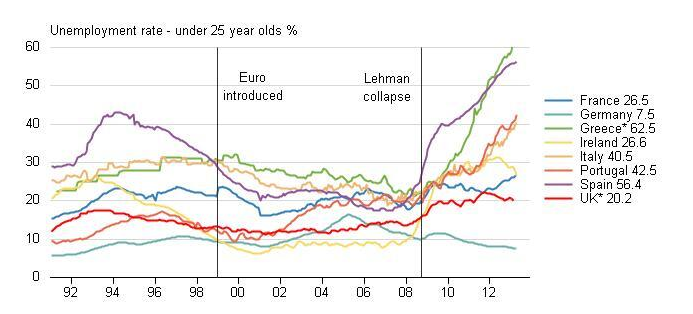
Amidst the litany of country-by-country disasters noted here is this:
‘The chart shows a downturn in Ireland’s youth unemployment, from over 30% in early 2012 to 26% now. This is why:Â “In the past four years, over 300,000 people have emigrated from Ireland; 40% were aged between 15 and 24”.-Â RTE News, 9 May2013′. My own recently-graduated daughter and most of her friends among them.
What happens if you get a collection of your fellow-citizens together for a sustained structured discussion over time about how to change the Constitution? That’s what the Convention on the Constitution is doing in Ireland at the moment. It’s an initiative by David Farrell and others, and their remit is set by a resolution of the Houses of the Oireachtas (the Irish Parliament), modelled on earlier such conventions in Canada and elsewhere. I was involved in a recent weekend’s deliberations about electoral reform. (My presentation is here and the Q&A is here).
So what can and can’t it do, and what might it amount to?
[click to continue…]
by niamh on April 29, 2013
I was reminded the other day how good a book Strumpet City is: it’s being serialized on RTE radio. It seems everyone in Dublin is reading it at the moment. John posted about centenaries and the need to remember, ‘lest we forget’, and there are several important dates coming up in Ireland soon.
 The Irish government has set up an advisory group of historians to consider appropriate ways of marking a decade of centenaries from 2012 to 2022. 1916 will be a particularly sensitive one, if they’re to do justice to the Somme as well as the Easter Rising. But it’s 1913, the year of the Great Lock-Out, Ireland’s most dramatic labour dispute, about unions’ right to organize, that’s very much on people’s minds at the moment. The impact of the Lock-Out on the lives of the working people living in Dublin’s appalling tenements forms a central strand of Strumpet City. (I read it not long after it came out and was particularly enthralled by labour organizer Jim Larkin, a real historical figure, pictured left).

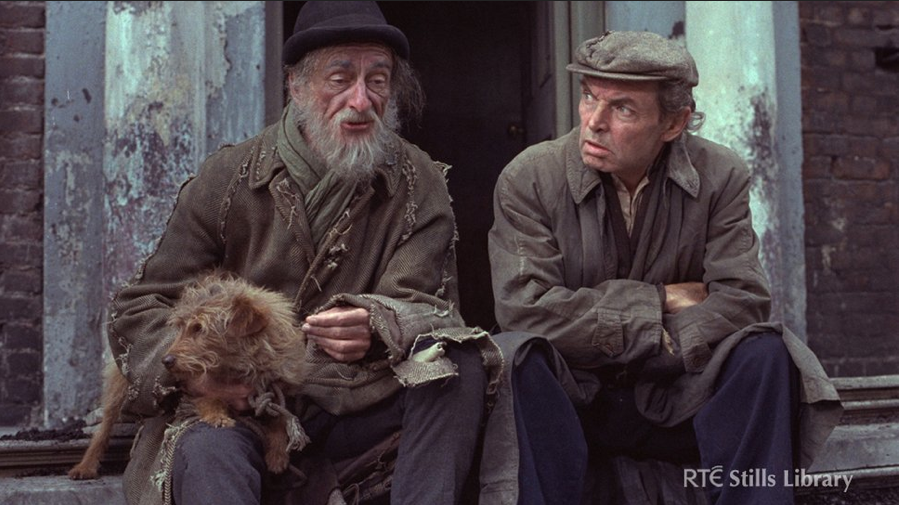
It’s a novel that ranges right across the social spectrum, bringing characters from widely different backgrounds to life most vividly. Dublin had the most appalling tenements in Europe at that time – 30% of the population lived in the slums – with very little industry to speak of, and a lot of casual employment in transportation industries.There’s terrific anger behind the novel, and you’re never in doubt over the culpability of the slum landlords, the hard-heartedness of the key employers, or the smugness of some of the clergy. But the book is considerably more subtle than this might suggest, and there are counterbalancing characters in every context, with differences in interests and outlook as well as in temperament and character. The 1980 TV adaptation is slower-paced than we’re used to now, but it had a whole cast of excellent actors and was marvellously realized. And yet it was the written word – or in this case, the spoken word, beautifully read by Irish actor Barry McGovern – that proved most evocative for me that night, as I dropped what I was doing to follow once again the fate of the most destitute of all the characters, a man of spirit and dignity named Rashers Tierney (pictured here as played by David Kelly, holding his dog Rusty, with Brendan Cauldwell as ‘Toucher’ Hennessy).
The world has been transformed in 100 years and Ireland is now of course a far wealthier country. But the stories about the struggle to make a living and the hardships of life on the edge still have resonance. And although the role and function of trade unions has changed hugely, the importance of being able to organize to defend basic rights is something no-one should ever forget.Â
by niamh on April 24, 2013
Greece is at the hard end of another European policy problem, related to austerity, but this time to do with immigration, and it’s turning into a serious human rights and humanitarian crisis. According to Europe’s border control agency Frontex, 93% of migrants to Europe came through eastern and central Mediterranean routes in 2011.With the tightening of the patrolling of Spanish and Italian access routes, most of these arrived first in Greece, with legal rights under the European Convention of Human Rights to seek asylum status there. Greece doesn’t have the resources to provide adequate social services, and the justice system is grossly inadequate to deal with the demands put on it. This means that large numbers of people are cast adrift in Greece in a legal limbo and with no resources. They are then at the mercy not only of highly repressive policing but of the fascist organization Golden Dawn, whose growing influence is now also starting to contaminate the political discourse of other political parties. A new internet crowd-released film, Into the Fire, documents the human face on what’s going on.
This is not just a story about Greece, but about European policy more generally. Under what is known as the Dublin regulation, people can only claim asylum in the EU country in which they first arrive. It means that if anyone manages to move on to another country, their claim to asylum need not be heard in that country, but they can be summarily deported back to the country in which they first arrived. This was supposed to be a burden-sharing measure to cut out parallel asylum claims in multiple jurisdictions. But in effect, because of the way people arrive in Europe, it corrals the EU’s asylum-seekers into the southern European countries, and increasingly concentrates it in Greece. A 2011 decision by the European Court of Human Rights found that, unlike other EU member states, Greece was not able to vindicate people’s rights under the European Convention on Human Rights, and that deportations back there are not defensible. But as shown in the documentary Dublin’s Trap: another side of the Greek crisis, these rights are hard to access and the implications extend to very few people. And securing ‘Fortress Europe’ is taking an even greater toll on human lives:
…at least 18,567 people have died since 1988 along the european borders. Among them 8,695 were reported to be missing in the sea. The majority of them, 13,733 people, lost their life trying to cross the Mediterranean sea and the Atlantic Ocean towards Europe. And 2011 was the worst year ever, considering that during the year at least 2,352 people have died at the gates of Europe.
There are lots of questions about other European countries’ ways of dealing with asylum seekers and refugees. Ireland’s citizenship laws were changed in 2004 to deter possible claimants; people are left for unconscionably long periods living in ‘direct provision’ accommodation; and the rate of successful application is very low indeed. But the scale of the humanitarian and human rights issues building up in Greece is something else again. And while many northern European policy-makers may well be silently grateful that the issue of rising refugee pressures (most recently from Syria) is kept out of their country, the fillip it gives to Golden Dawn, the third-largest political grouping in Greece in recent polls, should be a cause for deep alarm right across Europe.
by niamh on February 26, 2013
In yesterday’s elections in Italy, ‘voters defied a failing policy and a clapped-out political establishment‘, resulting in an indecisive outcome. Here is more evidence in the Eurozone of what the late Peter Mair called the conflict between ‘responsible’ and ‘responsive’ politics. The centre-left ‘responsible’ party of Pier Luigi Bersani won most votes, just about. But the über-‘responsible’ Mario Monti, the technocratic prime minister and Bersani’s most likely coalition partner, gained only half the support he had hoped for. Quelle surprise, one may be forgiven for thinking, since the mix of ‘austerity’-driven tax increases with no real structural reform, and with none of the stimulus that would enable reform to work, has proven highly unpopular with voters.
Once again, it seems to me, we see that it really is a mistake to leave the politics out of politics. I have some thoughts about why this is a bad idea in a recent talk (audio and slides here).
[click to continue…]
by niamh on January 31, 2013
The current issue of the online journal Intereconomics features stories about the politics of adjustment in Greece, Ireland, Spain, Italy, and Portugal. Aidan Regan and I contributed the article about Ireland. Each paper outlines the measures that have been taken in recent years, and the major challenges each country now faces. All five countries share many common features of course, including the difficulty of keeping on track with deficit reduction targets in the context of no growth and truly awful unemployment figures. But the challenges discussed by authors are quite varied too: in Greece, for example, it’s governance problems that are highlighted; in Portugal and Italy, productive capacity and export performance; in Spain, problems over sustaining the revenue base of the state.
In Ireland’s case, we outline the ongoing problems involved in trying to reduce the large government deficit. We also note that the legacy of the financial crisis complicates Ireland’s recovery strategy. The government has staked a great deal on getting some relief on a portion of the deficit and debt issues that arise from recapitalizing the banks. What the government is looking for at the moment is not a debt restructuring or a default by this or any other name, but a rescheduling of a portion of the costs of unwinding the full liabilities of the now-defunct Anglo Irish Bank. From the Irish point of view, the ECB has given mixed signals on this: positive indications about the design of the ESM in June 2012, but in September, a statement that was construed by UCD Professor of Economics Karl Whelan as ‘Germany to Spain and Ireland: Drop Dead’.
Yet the backroom diplomacy continued, and the government certainly seemed to that that an agreement would be possible before the next critical deadline for Ireland of 31 March. Right now though, things are not looking so good. There are fears that, as in other areas of crisis management, there is a tendency for EU decision-makers to pull back from new commitments unless crisis is staring them straight in the face. ‘They are under-performing again’, a senior EU official said in December. Even as Germany reported a downturn in economic activity earlier this month, José Manuel Barroso said that ‘the existential threat against the euro has essentially been overcome’. Well, that’s alright then.
For all that, the game is not over yet in Ireland’s negotiations with the ECB. The Irish Congress of Trade Unions has taken up the case too. With the call to ‘Lift the Burden: Jobs not Debt‘, it’s calling for protests on 9 February. We’ll wait and see.
by niamh on January 11, 2013
Jean-Claude Juncker said some remarkably candid things to the European parliament yesterday. His role as the chair of the Eurozone group of countries has given him limited scope to speak freely to date. Indeed he’s someone who is quoted as saying ‘I’m for secret, dark debates‘.
Now that he’s about to step down, he’s made some extremely critical comments about the entire approach the EU has adopted in response to the crisis. Eurointelligence summarizes his ‘furious attack on Berlin’ as follows, noting:
- that he disagreed with the rhythm of adjustments “imposed on certain countries”, and that the Eurogroup has not made political valuations of the adjustments which too often were just rubber-stamping recommendations by the Commission, ECB and IMF “whose democratic legitimacy is not clear”.that “the choice was made to make the adjustment fall on the weakest”;
- that certain countries who benefitted from capital flight out of Greece were not doing anything about it;
- that the mistake has been made to “underestimate the drama of unemployment” and to “give the impression that Europe is only there to punish” and by not rewarding the “program countries” for following through with their adjustment plans;
- that his successor would be well advised to “listen to all Eurozone members on an equal footing” even if it takes a long time to go through a meeting, or else “we’ll see the results in 6 months if my successor doesn’t”;
- that the ESM should have “some degree of retroactivity” and be able to “recapitalise banks” and not just address “new problems that may apply in the future”;
- that the results of the latest European Council were “disappointing”, because “the original idea was to present a road map for the following decades”;
- in respect of economic policy coordination, that “we can’t carry on with a system where the Frankfurt monetary arm is strong and the economic policy arm is feeble” and “those who refused [in 1997] are now the largest voices calling for this idea”. And “we have to make sure that every time a government recommends a structural reform it is explained to the Eurogroup and that the ministers in charge explain the consequences and others say what the consequences of such reforms will be on policy in their countries”;
- “there’s a need for all member states to agree on a ‘minimum social wage'”, a need for “a basis of minimum social rights for workers”, as “otherwise we’re going to lose the support of the working classes”. There’s a need to “agree on the elements of solidarity”, “principle and ways and means of bank resolution”, and “a deposit guarantee scheme”;
- that the Green party in Luxembourg will vote against the Fiscal Treaty because “they are fed up with what they see as a German diktat”.
I’m especially struck by his recognition that poor coordination and procrastination has resulted in unacceptable costs in the form of unemployment, inequality, and social hardship, because this is where the real human cost of unremitting austerity is felt. Unemployment in the Euro area is now 11.8% – worst of all in Spain and Portugal, where it is over 26%; very serious too in Portugal, Ireland , Latvia and Slovakia. And even these official data conceal a lot: the standardized unemployment rate in Ireland, for example is 14.6%, but there are also a great many under-employed people and discouraged workers who don’t appear in the official statistics.
The end of the Christmas holidays has been a particularly poignant time in Ireland this year. It’s the start of Ireland’s seventh phase of holding the rotating Presidency of the EU, so Dublin is full of Euro-bureaucrats; all the commissioners arrived yesterday. It’s also the start of a year-long government initiative to boost tourism called ‘The Gathering’, which is meant to promote an influx of visitors analogous to Scotland’s ‘Homecoming’ a few years ago. But we’re also seeing large numbers of people leaving, especially young people, and lots of sad friends and families have been saying goodbye. The gathering up and out of a new generation of emigrants, sadly.
by niamh on October 17, 2012
The US presidential debates are on TV at very unsocial hours for Europeans, but I gather the general view is that Obama ‘won’ last night’s.
Reading the coverage this morning, Romney seems to have hit a nerve with his ‘binders full of women’ – I can’t help laughing at Tumblr responses such as this:

by niamh on October 7, 2012
Fans of Red Plenty, of whom there clearly are many in view of the online seminar we had here recently, will be interested to know that Francis Spufford has a new book out: entitled Unapologetic, this time it’s about Christianity.(1) The style as well as the content is different from his previous writings. There is some subtle and often quite beautiful writing in parts, but the tone is mostly conversational, unbuttoned, colloquial. It is also witty, funny even, and the book is in my view a highly engaging read.
There’s a lot of new interest in what religion can bring to public discourse, whether in the context of the human costs of rising inequality, the fundamental questions about economic organization raised by the current crisis, or our catastrophic despoliation of the natural world itself. For example, INET (the Institute for New Economic Thinking) is initiating a series of conversations between economists and theologians ‘designed to provoke creative thinking about money and markets in light of the world’s pressing economic challenges’. Keynes himself thought that we’d sooner or later have to face the question of what growth was actually for and what the purpose of a good life should be, and although not religious himself, he thought religious values would be important as a guide.
But Spufford’s book starts a few steps prior to these kinds of debates: he wants us to see what it means to take religion seriously on its own terms. It is in part a counter-blast at what he sees as over-simplification by atheists such as Dawkins and Hitchens. This doesn’t take the form of a point-by-point argument, nor is it a combative riposte such as, for example, Terry Eagleton’s. But mostly it’s an extended personal account of what it feels like to commit to a view of the world that is religious. If you’d like a flavour of how he goes about this, you can read the first chapter here.
[click to continue…]
by niamh on September 20, 2012
Would you be surprised to hear that Italian Prime Minister Mario Monti recently said this:
political scientists need to re-think the type of democratic structures that are required to govern in a post-Eurozone crisis world. The EU needs institutional renewal.
Monti also provides tips on how best to influence Angela Merkel’s thinking (go silent on a topic. It spooks her). This and more, from a fascinating blog by Aidan Regan, a Max Weber Fellow at the EUI in Florence. But don’t get too excited about democratizing Europe just yet. What Monti actually meant was this:
The European parliament, he argued, needs to be empowered to take collectively sanctioned decisions for Europe as a whole. Furthermore, the technical decisions required to solve the crisis (in his opinion) have to be somewhat removed from the immediate interest of national electorates. In fact he went as far as saying that citizens (and their respective governments) need to be faced with the threat of an exit from the European Union so as to empower European policymakers to take new and bold decisions.
In other words, democratic accountability as normally understood is expendable in the interests of administrative efficiency. Well, he would say that, wouldn’t he; and understandably, perhaps, in the Italian context, since Monti is certainly a contrast gainer relative to Berlusconi. But it’s an unusually candid and ‘realist’ statement of the default trend in European integration. It is precisely this that makes many people wary of deeper integration, that drives up Euroscepticism in defence of national prerogatives, and indeed that tends to fuel right-wing populism. It is equally a world removed from, for example, Habermas‘s vision of the EU as a radically democratized, market-restraining constitutional order, trans-national and cosmopolitan in character, and governed by humane values.
by niamh on June 27, 2012

At last Sinn Féin have done it. They missed out on all the big symbolic moments of Queen Elizabeth’s official visit to Ireland last year. Then realized that they were way out of step with public opinion. Handshakes for slow learners. But better late than never.
by niamh on June 18, 2012
It’s getting pretty exhausting living inside the Eurozone. We screw up our nerves for the next moment of crisis, which is narrowly averted, only to find that the same old problems lie in wait just around the corner; but worse this time, because they were’t properly sorted out the first time.
Last week’s worries were put to rest for a short while: Greece is still in the Eurozone, the Euro hasn’t imploded, the banks are still open. Spanish banks teetered; a fix was found for the time being. But it doesn’t mean anything has been solved, and the moments of respite get shorter and shorter.
It seems to me that we’re strung out on Dani Rodrik’s trilemma of global politics in an increasingly dangerous way. His contention is that you can only have two of these three things:
‘hyper-globalization’ (in the EU context, the free market in goods and services and mobility of capital and labour);
‘national sovereignty’ (in which national governments have realistic choices to make between options that may be ideologically quite distinct);
and ‘democratic politics’ (in which there is meaningful involvement by actors and electoral accountability for decisions made).
Kevin O’Rourke (whose work I’ve mentioned here before) pointed out that the odd design of the Eurozone was meant to avoid it getting definitively boxed into any two options in this triangle. Trans-national oversight of the currency was delegated to the ECB. Nation states were charged with making fiscal and financial policy within a loose-ish trans-national framework of rules. Democratic debate was expected to internalize the requirements of pooled sovereignty.
But the sharp ends of the trilemma are becoming more and more difficult to span. The fuzzy compromises are under growing strain, and the Eurozone is being pushed into classic trilemma trade-offs. It’s at growing risk of ripping apart entirely.
[click to continue…]