Having alighted from the bus in an industrial area I’d never been before, I found the right building and descended the stairs. As instructed by email, I rang the doorbell. I was immediately met by the two cutest dachshunds you’ve ever seen. My first words to the Westpac archivist:
“This is already the best archive ever!”

Pic: incredibly cute research assistant with literal puppy dog eyes
This is not an open archive so I’m incredibly grateful to the archivist for having me, even though it is not a requirement of her job.
The archivist has laid out on trolleys the sample of ledgers from the Wiradjuri (Western) goldfields, which is where I am generally concentrating my research.
Ledgers are a funny historical source, consisting mainly of lists of numbers. But they are absolutely crucial to taking what Perry Merhling calls the ‘money view’ of the history of capitalism. I’ll come back to that in a bit.
Ledgers are the outcome of work performed by my favourite kind of banker: ledgerkeepers. This is work now done by massive computers. But before the computers there were huge leather bound books with details of all bank transactions, kept by humans.
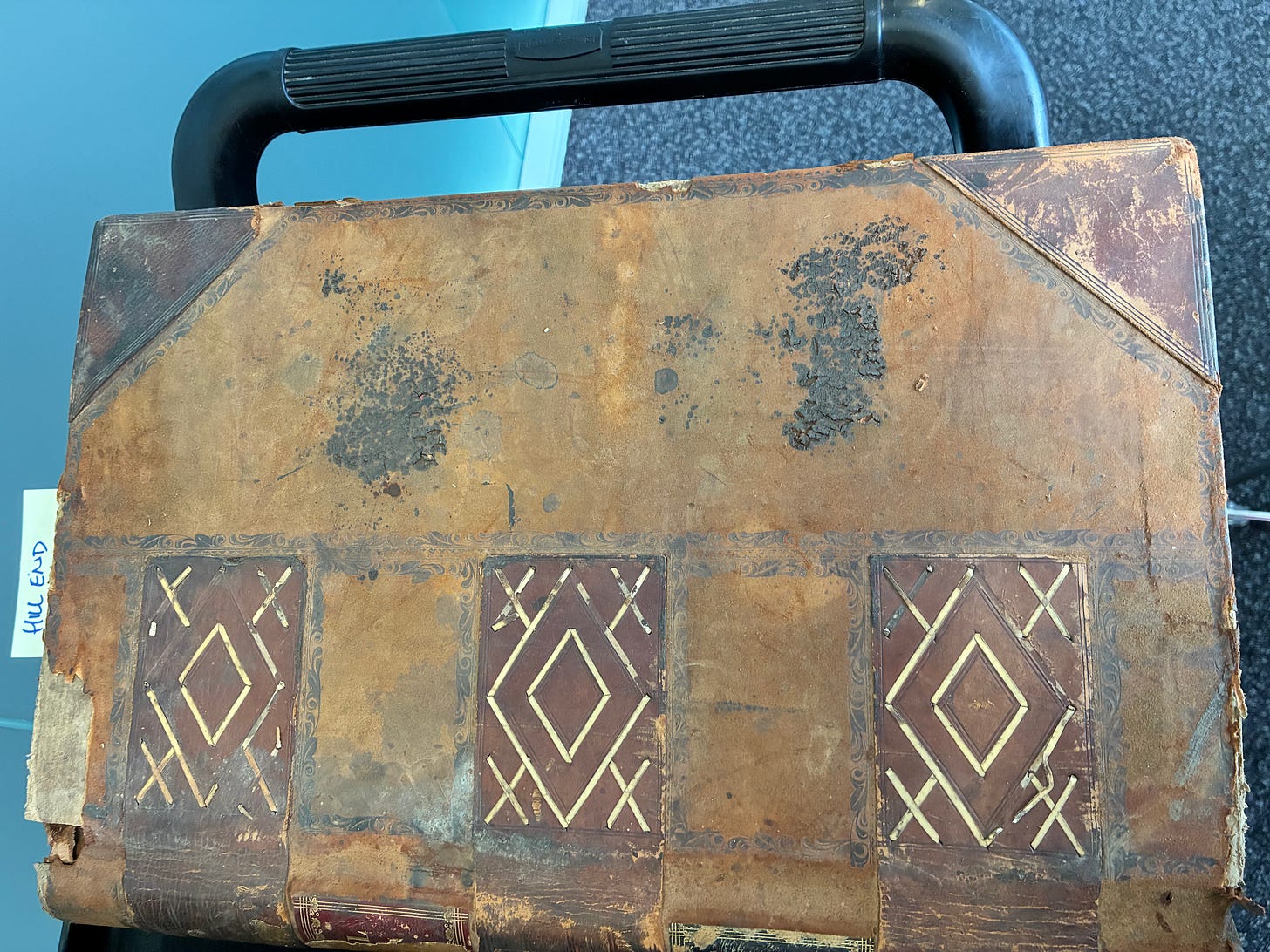
Pic: Hill End Ledger on Trolley. I couldn’t rotate it without losing half the ledger, sorry it is sideways.
This was crazy important work, absolutely as foundational to the bank’s money as Wiradjuri gold. More, in many ways. Banks cannot function without the ledger. They can, as they discovered in more recent decades, operate pretty well without (much) gold.
Money doesn’t work – it loses its money-ness – without trust. Wiradjuri gold (and gold from other First Nations land in Australia, Aotearoa, Canada and the USA) was sitting in the vaults of the growing financial centres in Sydney and Melbourne, the Bank of England underpinning currency and smoothing global trade-enabling finance.
But those piles of gold, all now of a standardised composition (I’ll write about that later), embodied trust in money in the aggregate.
Trust in money specifically needed the ledger. It was a very responsible job. Most ledgerkeepers were very experienced bankers. They knew their ledger so intimately that they watched out for death notices of the people whose accounts they kept. In cases of flood or fire or emergency evacuation of a war zone (with ledgers too heavy to carry out), ledgerkeepers were known to accurately reconstruct their ledger from memory.
Seeing Wiradjuri Gold in the ledger
The ledgers also indicate how extensively local people held deposit accounts; how much gold was purchased directly by the bank; how much diggers were ‘advanced’ money pending their own sale of Wiradjuri gold to someone else; what sorts of surpluses were found in the gold after assaying (I think they estimated higher levels of dirt and other non-gold stuff in Wiradjuri gold when it was initially sold and refunded any surplus value found after the assay).
Human Relationships Mediated by Money
Diggers and miners and most other people typically deposit some cash in one go – often around £30 – then they withdraw it, often £10 at a time. Occasionally there is a name against a withdrawal (‘self’ if themselves), indicating payment by cheque or note to someone.1 The ledger does not cover that long a period, so often a line or two is the only activity associated with that person’s account. This suggests, I think, that the hope by the banks that having branches on the goldfields would increase their deposits didn’t really work. Money went in and was withdrawn, almost certainly in place and within a few days or weeks.
There were plenty of things to do with your money on the Wiradjuri gold fields. These were informed by the global sensibility enabled by the the increased velocity of global trade and people increasingly attached their currency to gold, creating more certainty about the value of contracts or bills of exchange helping encourage and speed up trade. In the process financial institutions across the world grew, and became more entangled with one another – also connecting them to the gold fields.
So in this picture you can purchase a ‘Paris’ haircut. In others there is ‘American tobacco/whisky/shoes’. Chinese products, including silk, were widely available.
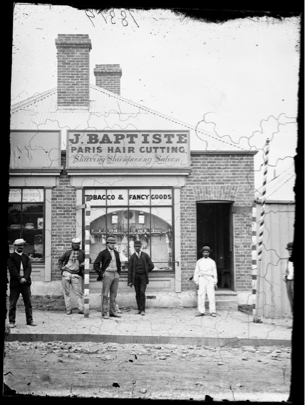
Fancy goods was the catchword. There were watches, jewellery. Studio photographs. Bowling and shooting galleries. A theatre. Pubs and purveyors of spirits.
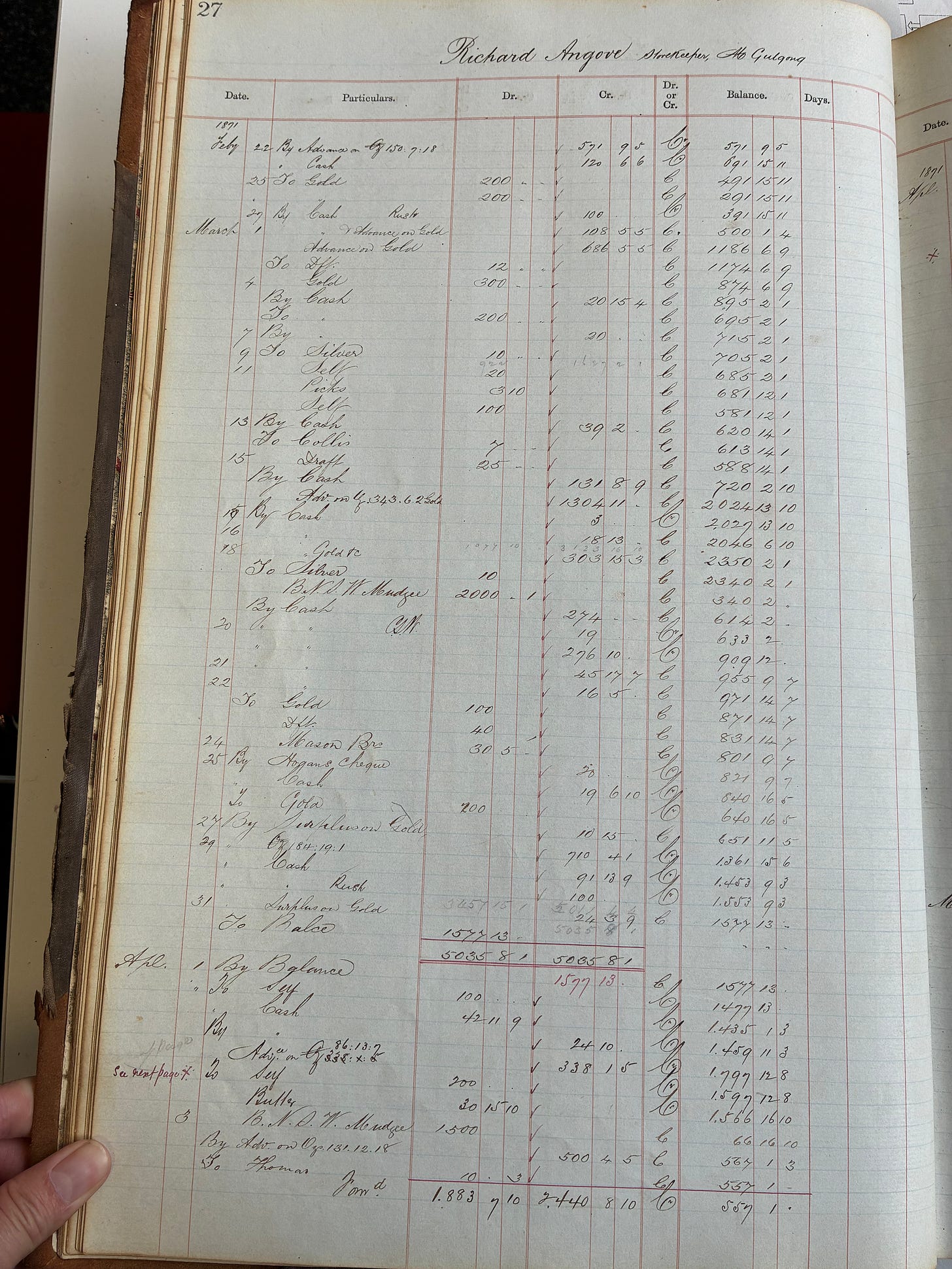
For gold to go out, money had to come in. We can see from Richard Angove’s store that he bought gold in quite large quantities. £200 pounds twice on 25 Feb 1871, £300 on 4 March. He deposits more than £300 from gold sales a bit later.
Richard Angove buys stuff for the store – butter and mining equipment (picks), often. Pays an account at the Post Office, pays for freight. Deposits cash regularly, presumably from sales in the store. Sometimes he takes cash for himself.
And then a whole lot of interactions with people and businesses. Deposits of cheques from people and payments to others: the publican pays a lot out to the local butcher.
As global finance shaped gold towns on Wiradjuri land, human relationships were transformed, redefined by their relationships to commodities sold in town, by cheques and cash that changed hands.
This is how money matters – is turned into matter, that is. On one hand, money is imbued with the idea of value, the ur-commodity, an abstraction. But when it is in action, changing hands because people find they need to pay for stuff, it is material stuff and has material effects. The relationship between money-as-fetish and money in action will be important in a future post (almost certainly). But first:
If money is the bond binding me to human life, binding society to me, connecting me with nature and man [sic, or eye roll], is not money the bond of all bonds? Can it not dissolve and bind all ties?
…If I long for a particular dish or want to take the mail-coach because I am not strong enough to go by foot, money fetches me the dish and the mail-coach: that is, it converts my wishes from something in the realm of imagination, translates them from their meditated, imagined or desired existence into their sensuous, actual existence – from imagination to life, from imagined being into real being. In effecting this mediation, [money] is the truly creative power.
I think we can all agree that Marx is not a fan of capitalism and the money it creates, but he’s surely capturing here something of how money, which seems an abstraction of value, comes to matter – is brought into material existence, in embodied practice.
More-than-human Relationships also mediated by money
All through the ledgers are diggers, miners (I don’t know what the difference was between diggers and miners – certainly they don’t seem to deposit more money than one another), who appear selling (or getting advances on) Wiradjuri gold that they spent the day or week extracting from Wiradjuri country.
Gold rush histories give a lot of detail about mining techniques. Very few gold rush historians care about gold as/and money, but gosh they seem enamoured with the ways of getting it out of the ground. I have to admit that, although I am the daughter of a mining engineer, I don’t really care much about mining practices.
But on Wiradjuri land, mining changes the relations humans have with the environment. In this sense money not only commodified human to human relationships and their connection to society, but it also changed human relationships to Country.
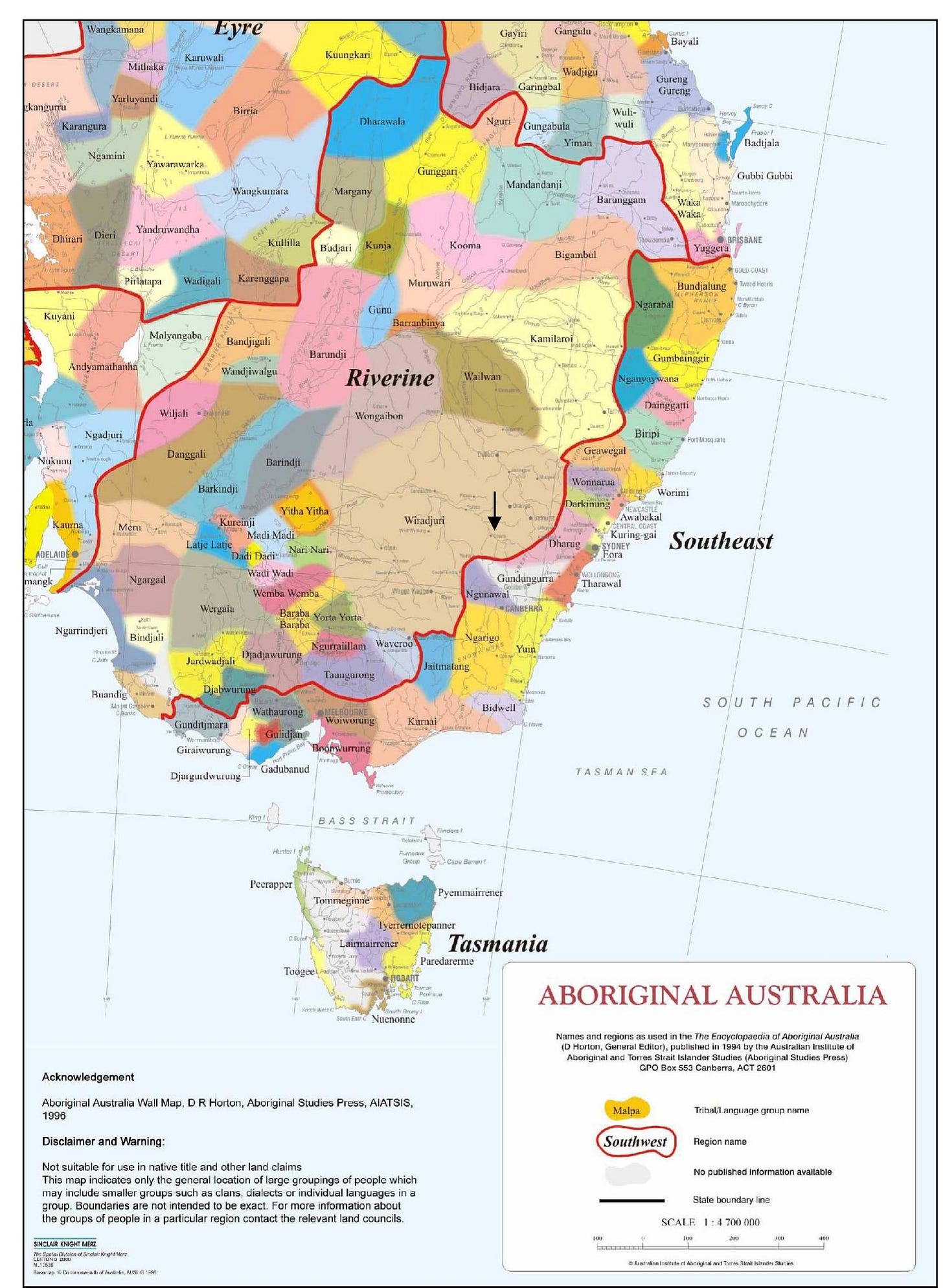
Image: section of the Aboriginal Map of Australia, showing Wiradjuri land
Many started out hand-dredging the bottom of rivers, disrupting freshwater aquatic life. By the time of the ledgers I’m using, huge rock crushers are needed to crumble the granite and extract the gold. For some reason that I don’t care much about, this released mercury into the river, poisoning fish – and probably was not great for the health of anyone else drinking the water, whether human or non-human.
Humans and other life were part of the same Country. Commodifying the relationships between humans also commodifies the relationship to Wiradjuri land and water. This was made ‘cheap’ (or even ‘worthless’, or perhaps better reimagined as an ‘externality’ to the stuff of economic value) in the pursuit of the substance needed to make money make the world go around. That is, Country, landscape, water and everyone who lives in it or needs to drink it are not in the ledgers. But they also really are. Invisible, sure. But their value is making money nevertheless.
In fact, this is a kind of environmental arbitrage. Gold is ‘bought’ cheaply because the environment is not monetised. It is ‘sold’ dear on the other side of the world where everyone behaves as if Wiradjuri country is invisible – or faces the same ‘inevitable’ decline as white people often considered to be the fate of Wiradjuri people themselves.
Country, as Aboriginal and Torres Strait Islander people continually teach us, has agency, but not immeasurably so. Wiradjuri people have more agency, arguably, and by seeing themselves as inalienable from Country enacted customs, practices, protests and forms of love and protection that nourish all of us still, who live on Aboriginal land.
Consistent with the diversity of Aboriginal and Torres Strait Islanders politics, some Wiradjuri people joined the mining of gold. Some went and found gold in their own way and turned up to exchange it for money while keeping its location secret. Others lived on the edge of gold towns, seeking tea and flour in place of the resources settlers stole and disrupted. Still others refused to participate, fought back when they could – keeping in mind that in the past decade, a major pan-Aboriginal uprising was (with difficulty) quelled by the colonial government.
But for all, the gold rush was a major disruption, not only environmentally and by the massive influx of settlers into Wiradjuri country, but also by disrupting the inalienability of humans and environment that kept Wiradjuri Country safe and productive for thousands of years. The only thing that could enable the gold rush was to see the land, the rivers and the gold as alienated, separate to the humans. And then, the money obtained in exchange for Wiradjuri gold became the only way to survive.
The ‘Money View’ meets ‘Follow the Thing’
I recently watched one of those shows where the gambling addict can’t repay his debts to the organised criminals from whom he stupidly borrowed. I can’t pay today he says, every time, in every one of these show. Give me a week/day/month whatever, I’m good for it. But like everyone who needs to pay a bill on time, having the money at the moment you need it is what keeps the economy in motion. Not having it, on telly and sometimes in real life, kills you/loses you a finger/forces the business or bank (think of what happens after a run on a bank) to close.
This is the ‘survival constraint’ that is the basis of what Perry Mehrling calls ‘the money view’. This is one of the key approaches I am taking to this whole gold/money history thing.
In some ways the gold rush helped overcome a huge survival constraint. It was, after all, the middle of the industrial revolution. The global economy was growing fast. Not having enough cash would constrain (or nearly as bad, slow down) the whole thing. And cash, at this time, depended on gold. It was the thing that backed British money and it was being adopted everywhere because having something that everyone agreed was worth something fairly stable helped smooth global trade, enabling things and money to circulate at a velocity that could keep up with the new pace of production (and consumption).
This is all fine, but I want to also understand the historical connection between this ‘big money’ (of trade and global finance) to the ‘small money’ of buying bread, milk and fancy goods. For this reason I’m combining this money view bizzo with what material culture studies calls ‘follow the thing’.
By following Wiradjuri gold from the stars that collided to make gold to wherever it is now (spoiler alert, most of it is probably in the vaults of the Bank of England), the historical moment of the Age of Gold (from the gold rush to the Great Depression, which I will get to) shows us something of the way money – the same money, connected and inescapable – comes to matter.
{ 6 comments }
Scott P. 10.07.26 at 3:28 pm
By following Wiradjuri gold from the stars that collided to make gold to wherever it is now (spoiler alert, most of it is probably in the vaults of the Bank of England),
It didn’t all get transferred to the US in payment for war materiél in 1939-41?
Hannah Forsyth 10.07.26 at 9:25 pm
Hey Scott P. Not from here anyway – maybe the BoE sent it on, then? On top of the squillions of pounds of sovereigns minted in Australia and sent to the BoE. What it looks like from the testimony of the Royal Commission into banking 1936/7 is that c.1933 the Commonwealth Bank bought up all the gold that the banks were holding and shipped it to the BoE to back/buy sterling. The new Australian pound was backed by what they liked to call ‘London funds’, which was held in sterling now. The position was that if GBP were backed by gold and Aussie pounds backed by sterling, everyone was still, technically, backed by gold.
D. S. Battistoli 10.07.26 at 11:27 pm
Fascinating!
I think you might be missing the end of a sentence here:
I bring it up only because I would be interested to know how that sentence continues after “because one time.”
¤
In Suriname, Japan and other countries with high rates of artisinal gold-mining, the incidence of birth defects among populations that eat a lot of mercury-exposed fish have been fairly well-established in the literature. (see, eg, here for Maroons and Amerindians in Suriname, and here, searching “Minimata,” for Japan). I could go on a rather long tangent on the potential but uncertain connection of polydactyly between the two cases, but the evidence is rather thin, in part because the literature itself is (polydactyly specifically may be an unpromising piste). I bring this up at all only because I know you often draw on photos from the period, and, should it be of interest and once you know what to look for, you may be able to find photographic evidence of mercury poisoning, either through direct exposure or through consumption of exposed fish.
¤
I can’t wait until you do. Australia, in part due to its high settler population, was able to move up the value chain for products like gold and bauxite in ways that other colonies making the transition to autonomy and independence around roughly the same time were not. I can’t wait to follow what all your research brings up.
Gareth Wilson 10.08.26 at 3:42 am
” Wiradjuri gold (and gold from other First Nations land in Australia, Aotearoa, Canada and the USA) was sitting in the vaults of the growing financial centres in Sydney and Melbourne, the Bank of England underpinning currency and smoothing global trade-enabling finance.”
What’s the Wiradjuri word for “gold”?
Karin Prinsloo 10.11.26 at 7:44 am
The contrast between what the ledgers record and what they leave out is striking. Every deposit, cheque and gold purchase is carefully accounted for, yet the damage to rivers, land and communities sits outside the books entirely. It makes the idea of “environmental arbitrage” especially powerful, because the apparent value of the gold depended partly on treating those real costs as if they did not exist.
Hannah Forsyth 10.13.26 at 6:50 am
Ugh, I replied to comments but it got lost, possibly bc of the gmail.
Anyway, I’ll try again:
@D. S. Battistoli sorry, pasting failure! “I discovered this because one time the Mudgee coach was held up by bushrangers and the occupant of the vehicle explained that the notes they were stealing were no longer valid. The robbers said no worries, they would have a bonfire.”
Yes, I’d be interested to hear more about the physical effects of drinking water with mercury in it. Feel free to email me hforsyt4@une.edu.au
Standardisation – Kindelberger reckons the gold standard is only possible when there are steam presses for uniform coins, but its also about the composition/purity of the outputs. I’ve just been in the archival weeds of the Melb Mint. The handwritten notebooks of the fellas making gold bars, sovereigns but also other currency including for lots of other bits of the world is a proper nerdy treat.
@Gareth Wilson – Wiradjuri word for gold is ‘walang’. https://wcclp.com.au/wiradjuri-dictionary/ – for a variety of reasons I am sticking to Wiradjuri gold, including the inalienability of Wiradjuri personhood and Country but the necessary alienation of personhood and capitalist-money, so pushing them both together creates a truth and a tension that I think by itself offers historical insight. I expect some people will hate it, but that’s ok.
@Karin Prinsloo thank you, I am drawing a bit on Jason Moore and others to think about environmental arbitrage, I think it is a helpful concept. I’m delighted you agree.
Comments on this entry are closed.