“Spiders don’t socialise. Spiders don’t work together. Spiders don’t hunt as packs. Spiders don’t use tools. Spiders don’t organise large structures.
“Because if they did, we’d all be dead.”
— As it turns out, this isn’t quite correct. Some spiders do work together! They’re called social spiders, and they cooperate to build large webs that can hold hundreds or even thousands of spiders at once. There aren’t a lot of them. There are over 40,000 species of spider, and only 20 or so are social. Still, they are a thing that exists.
(This is a Halloween post. So, trigger warnings for — let me think a moment — cannibalism, body horror, and spiders. Lots and lots of spiders.)
(But also some cool science!)
So, social spiders. Probably the most famous are Australian Flat Huntsman spiders, because they’re pretty big:
[each of these guys is around 2-3 inches (5-7 cm) long]
But most social spiders are small — sit on your fingernail, type of thing.
[little cuties!]
Their webs can be pretty big, though:

[two meters long, hundreds to thousands of spiders inside]
And it turns out those big webs are effective at catching prey. Not only do they catch lots of insects, but they can catch bigger insects, and even small vertebrates.
So why aren’t more spiders social?
Because effective is not the same as efficient. Yes, those big webs can capture more prey. But they don’t seem to capture more prey per spider. It’s like, 100 spiders cooperate to build a web, and that web captures 80 times more prey than a single spider could alone. That’s a net loss! The average spider is eating 20% less. The numbers don’t work out. (And remember, kids, economics are everywhere.)
Okay, but then this just flips the question: if being social is inefficient, why are any spiders social?
The answer seems to be that under certain specific circumstances, being social can still be a net positive. First, if the spiders are living in a prey-rich environment, with lots and lots of insects buzzing around, this can make the per-spider nutrition hit less painful. Second, if it’s also a predator-rich environment, the large webs provide significant protection from predators. And third, if it’s an environment with extremes of weather — one that swings from humid to very dry, or where there are often gusts of strong wind, or sudden heavy rainfalls — the big webs can provide protection and stability. Spider silk is an excellent insulator, so the inside of a social web will keep a constant temperature, and the spiders don’t have to worry about being washed out or blown away.
So, if environmental conditions are just right, being social becomes a plausible, marginally successful strategy. It’s still not hugely successful — again, there are only about 20 social species out of ~40,000 — but there is a niche. The social spiders are taking a hit in nutrition in return for enhanced security.
Of course, this means that while social spiders are more safe, they’re also more hungry. They’re always hungry.
So, so hungry.

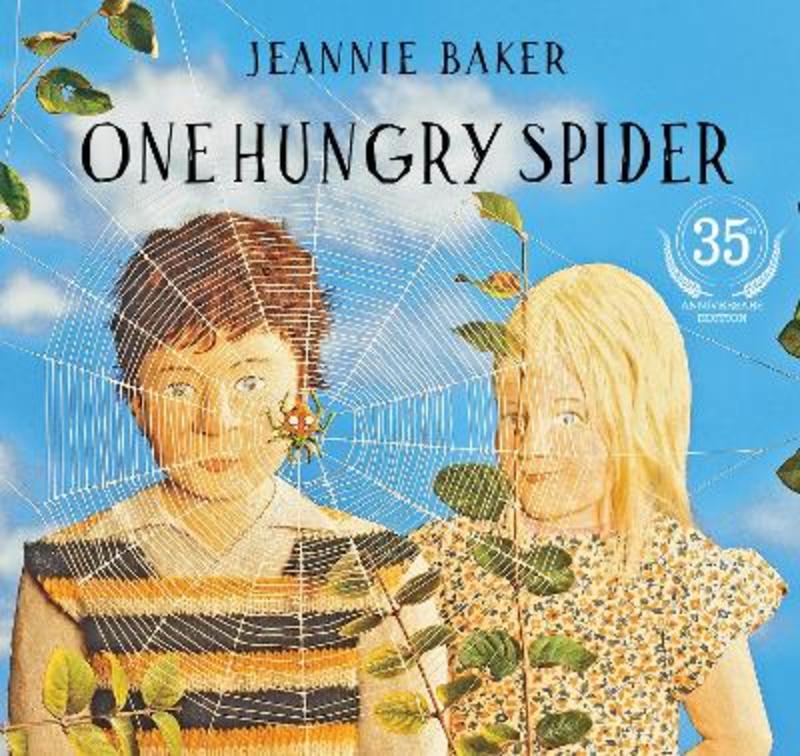
[no, I don’t know either. I guess kids like reading about hungry spiders.]
Different social spider species deal with this in different ways. But there’s one particular strategy that has evolved several times, over at least three lineages of social spider. It’s called matriphagy, from the Latin root mater (mother) and the Greek suffix phage (to eat or feed on).
Yes, there are several species of spider where the baby spiders eat their mothers. Alive.
Look, from an economic / evolutionary perspective it makes perfect sense. If there’s a general shortage of calories, it’s the young who suffer first and most. Everyone may be hungry, but if the colony is going to survive? You particularly need to make sure the kids get fed.
Also, a lot of spiders are semelparous anyway — meaning, they only breed and give birth once, and then they die. Like salmon, yes? Remember Charlotte in Charlotte’s Web?

[did you cry when Charlotte died? no shame, lots of us did.]
So if you’re checking out anyway, might as well make sure it benefits your kids.
The details, though… Mm, second trigger warning I guess?
[here’s a Hawaiian Happy Face Spider, and yes it’s a real thing that exists]
Okay so the paper is here. How it works: The mother spider eats as much as she can, fattening herself up. Since the colony is always on short rations, this means that not all females will reproduce. (Side note: you can imagine how over time this might evolve from “not all females will reproduce” to “only a few females reproduce” to “there’s just one Queen who reproduces”. The social spiders haven’t gone very far down that road, and maybe they never will, but… yeah, it’s interesting.)
When she’s good and ready, she lays her eggs, then watches them until they hatch. Then she’ll feed the baby spiderlings by regurgitating food, like a mother bird. Like semelparity, this is another fairly common spider behavior that’s been, let’s say, adapted to circumstances. Not all spiders do maternal care, but among the ones that do, brood-feeding is pretty widespread.

[babies swarming around Mom’s mouthparts for a snack, (c) 2015 Mor Salomon]
And here’s where we go out of the blue and into the black. The act of regurgitating food starts a hormonal cascade within the mother which causes her internal organs to start dissolving. Furthermore, they dissolve in a very particular order: first peripheral muscles and nerves, then viscera, then the digestive system itself. The mother literally regurgitates her own internal organs to feed her ravenous children.
And when she can’t give anything more, her babies swarm over her and finish her off.

To make all this even more interesting, the cascade doesn’t start until the babies have hatched and start demanding food. If the egg sac is removed — say, a probing bird picks it off — the mother keeps living and may lay another egg sac. If the sac hatches, but the babies are promptly removed, same-same. But once the process is triggered, it’s irreversible.
And while all this is subjectively gruesome, objectively it makes perfect sense. The mothers who let themselves get eaten had more babies that survived, and so their genes tended to spread. It’s a rational economic decision. At the end of the day, the math wins. The math always wins.
Happy Halloween!
{ 7 comments… read them below or add one }
Mike Huben 10.31.26 at 1:06 pm
“Because effective is not the same as efficient. Yes, those big webs can capture more prey. But they don’t seem to capture more prey per spider.”
I’ll be charitable and presume you mean more prey MASS per spider. But efficiency is not simply measured by output: you have to consider inputs as well. Do they use less silk per spider for example? Do they recycle the silk efficiently? Are energy costs of constructing the communal web lower per spider? Do the webs last longer? Does your 80% source discuss this?
I’ve seen social spiders several times here in Ecuador, and it appears that the webs last many days, as opposed to many orb weaver webs that are rebuilt from scratch every day.
D. S. Battistoli 10.31.26 at 2:55 pm
Fascinating!
Stegodyphus dumicola might be an even better example than S. lineatus, since S. dumicola is a social spider and S. lineatus only subsocial, per the papers cited on their respective Wikipedia pages (on which I rely because I’m not an arachnologist).
S. lineatus spiders live more or less alone after they get big enough; male spiders come over to female spiders’ webs to mate. Female spiders are polyandrous, and male spiders destroy existing egg sacs (for obvious reasons).
S. dumicola, on the other hand, slightly complicates your maternal-investment thesis, since hatchlings devour not only their mother, but all adult female spiders in the web, including, per Wikipedia, “unmated virgin ones.” Perhaps not too much, though: given the size of broods, this may be an illustration of J.B.S. Haldane’s quip that he would not sacrifice himself for his brother, but “I would lay down my life for two brothers or eight cousins.”
Apparently all or nearly all Stegodyphus spp. are matriphagal, but less than 20% of species are also social. From your research, do spiders from other geni also arrive at sociality through matriphagy, or is that a route specific to Stegodyphus?
steven johnson 10.31.26 at 6:44 pm
Not sure you should characterize the mother spider’s dissolution as letting the children eat her. The word “let” has a connotation of aa willed course of inaction.
Alan White 11.01.26 at 5:30 am
Another naturalistic gem. Evolution is a gem with fantastic facets.
LibraryGuy 11.01.26 at 9:00 pm
“The math always wins.”
Echoes of the short story “The Cold Equations,” by Tom Godwin.
Thomas P 11.02.26 at 12:32 pm
Another possibility is that even if the average is lower, the risk of long periods with no food is reduced. A good average doesn’t help if you starve to death during a bad streak.
JH from RVA 11.02.26 at 8:48 pm
A moral economy of spiders! Who’d have thunk it? Was Tolkien on to something?