Reading the literature on social media and the Arab Spring, there’s a recurring sentiment I’ve run across:
– Jeff Neumann: Social Media Didn’t Oust Tunisia’s President — The Tunisian People Did
“Did social media have an effect on events in Tunisia? Undoubtedly, yes. Is this a social media revolution? Absolutely not.”
– Achalla Venu: What happened in Tunisia and then in Egypt?
“So the common trait between the revolution in Tunisia and the ongoing revolution in Egypt is — they all are human revolutions not caused by Twitter, Facebook, You Tube, Flickr and many others but they all played their part.”
– Jillian York: Not Twitter, Not Wikileaks: A Human Revolution
“I am glad that Tunisians were able to utilize social media to bring attention to their plight. But I will not dishonor the memory of Mohamed Bouazizi–or the 65 others that died on the streets for their cause–by dubbing this anything but a human revolution.”
Despite their affirmation of the importance of social media during the uprisings, these authors (and many others) want to assure us that their analysis remains appropriately human-centered, that they are not making the terrible mistake of describing tools as if they had some sort of agency.
But here’s the funny thing — we describe our tools as having agency all the time. This isn’t a mistake, or an accident. It’s an essential part of our expressive repertoire around technology. [click to continue…]
The _American Prospect_ has published a “review essay”:http://prospect.org/cs/articles?article=bubble_trouble I wrote on Eli Pariser’s “The Filter Bubble”:http://www.amazon.com/gp/product/1594203008/ref=as_li_ss_tl?ie=UTF8&tag=henryfarrell-20&linkCode=as2&camp=217145&creative=399373&creativeASIN=1594203008 (I’m not quite sure when this went up on the WWW; I’ve been travelling). It’s an interesting book, which takes some of the empirical developments that Tyler Cowen enthused about in _The Age of the Infovore_ and comes to diametrically opposite conclusions about their normative implications.
bq. What Cowen sees as enhancing individual autonomy, Pariser sees as restricting personal development. Instead of constructing personal micro-economies that allow us to make sense of complexity, we are turning media into a mirror that reflects our own prejudices back at us. Even worse, services like Google and Facebook distort the mirror so that it exaggerates our grosser characteristics. Without our knowing, they reshape our information worlds according to their interpretation of our interests … We are beginning to live in what Pariser calls “filter bubbles,” personalized micro-universes of information that overemphasize what we want to hear and filter out what we don’t. … Cowen’s ideal world—where the private vice of self-centered information leads to the public virtue of a lively interactive culture—is unlikely to be self-sustaining. It’s also difficult to see how regulation could pop information bubbles. … As Harvard political theorist Nancy Rosenblum has argued, partisanship creates its own checks and balances. As long as partisans are contending for a majority of public support, they have to temper their own beliefs in ways that will allow them to appeal to the public and to respond to potentially persuasive arguments from their opponents. Democratic competition is not a complete solution. It does not protect individuals from a narrowing of their horizons. … Even so, democracies are far more robust against information bubbles than Pariser believes.
In March, I wrote about ICANN’s current leadership, and how it is costing the organization its key people and international reputation. I publicly addressed ICANN’s Board of Directors with my concerns during its San Francisco meeting, and was astonished by the level of support for my view. My aim was to make very public an issue that was deeply damaging to the organization behind closed doors and help make it impossible for the Board to continue to publicly ignore.
ICANN’s Board has now decided not to renew Rod Beckstrom’s contract as CEO when the deal expires in 2012.* There had been calls for Beckstrom to resign or be fired before the end of his contract, but I’m glad the Board is ensuring that the search for a new CEO is not rushed unnecessarily. Hasten slowly, as my grandmother used to say.
As many know, the Board’s new Chair, Dr. Steve Crocker, has spent considerable time over the past year or so on regular phone calls to Rod Beckstrom, not so much in coaching mode as providing a sounding board and voice of experience. That solid working relationship is a credit to both and will help to ease the transition to new leadership.
The Board has given itself time to think hard about a new CEO and make sure the decision is the right one. Presumably they will set up a search committee. I hope that committee can include or consult members of the Internet community. Here are some points the search committee might consider.
‘Multi-stakeholder’ is not a slogan. It’s ICANN’s DNA.
Rod’s most obvious legacy is a largely new, mostly American executive team with shallow ties to the global Internet naming and numbering community. They will need to work hard with the community to show they understand that ‘multi-stakeholder’ is more than a slogan, and that transparency and accountability are not optional. [click to continue…]
I’ve seen this kind of article many times but is it correct? I’d say that I’ve generated several million words in papers, newspaper articles, blog posts and so on since I got my first Mac in 1984 (a bit over 100kw/yr for 25+ years, for something like 3 million), and also attracted maybe 10 million more in blog comments (over 100k of non-spam comments. Of that, I’ve lost
* a fair bit of material I produced before 1990, when hard disk space was very expensive, and stuff had to be stored in various external disk formats. Sadly that includes my first econ theory book and a book of satirical songs I turned out in the 1980s. Mostly this was a case of physically losing, or accidentally overwriting, the data rather than possessing it, but being unable to read it any more.
* The first year or so of comments on my blog in the now-obsolete Haloscan system.
* The blog has also suffered a lot of linkrot, including internal links to its older incarnations
* A lot of my older text is in formats that can now only be read by extracting a text-only format, and some old stuff (eg pre .qif financial records) is in formats that are no longer readable in any way. But again, that’s mostly a problem with pre-1990 stuff.
Compared to my slightly obsessive desire to preserve every revision of every piece I’ve ever written, those are substantial losses. But compared to my paper records, my digital stuff is almost perfectly complete, not to mention instantly accessible and searchable.
Prompted by a passing thought about TextMate, I thought I’d make a comprehensive, accurate, unbiased, and irrefutable survey of text editors by way of comparison to locations in The Lord of the Rings.
I’m at the beach and kid-wrangling, so not in any position to write long blog-posts. But I am intrigued by this “James Fallows post”:http://www.theatlantic.com/technology/archive/2011/07/google-so-far-so-good/241426/ suggesting that Google Plus is reasonably non-privacy invasive (for values of non-privacy invasive that include all your search data etc are belong to us).
bq. One of the immediate appeals is how quick, ergonomically easy, and aesthetically nice it is to set up “circles” that match the natural patterns of your real life. One for immediate family, one for “friends you actually know,” another for “professional acquaintances who are sort of friends,” etc. Or by interest. In my case: airplane people, beer people, China people, tech people, Atlantic people, NPR people, etc. …. The other immediate appeal is that the privacy bias seems set in your favor, rather than constantly playing hide-the-ball with you, as Facebook does. The reason I hate and mistrust Facebook is its constant record of changing the privacy terms, not saying it’s done so until it’s caught, and always setting the default in the least private and most advertiser-exploitable way.
This suggests that Google Plus doesn’t have the deficiencies that “drove me away”:https://crookedtimber.org/2010/05/14/an-internet-where-everyone-knows-youre-a-dog/ from Facebook (which is not to say that it doesn’t have others). I’d be interested to hear from those who are better connected than I am, and have Google Plus accounts, whether this is true, how they find the experience, etc etc.
I haven’t logged onto Facebook in, like, 5 months. (So if you tried to friend me or poke me or whatever, and I didn’t respond, it’s nothing personal, man.) However, when I got a request to marry Belle Waring, I figured I might as well accept. Sudden and unexpected, to be sure. But what have I got to lose, marrying my own wife? To keep a short story short: reader, I married her!
I woke up this morning, in my own bed, beside my sleeping wife. It’s working out great. I am a devoted husband, with no pending invites to stray. Now I don’t need to log onto Facebook for, like, 5 more months.
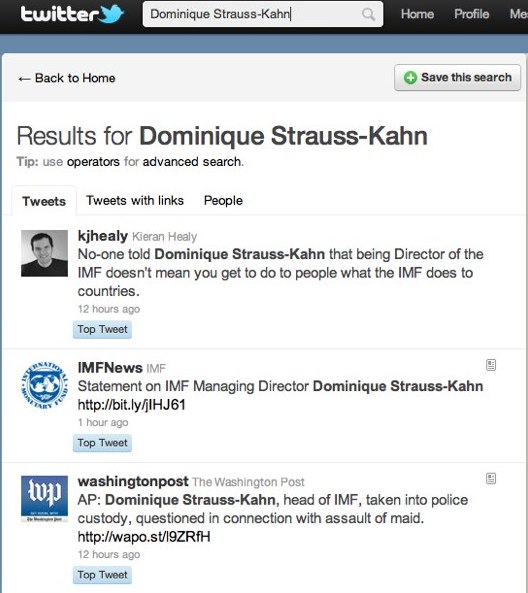
In case you were wondering who the go-to sources on l’affaire Strauss-Kahn are, at least according to Twitter:
The consequences of getting retweeted all over the place mostly involve being introduced to the range and sophistication of twitter spam and followbots.
I’ve been meaning to respond to this “very interesting Tom Slee post”:http://whimsley.typepad.com/whimsley/2011/03/blogs-and-bullets-breaking-down-social-media.html for weeks and weeks.
bq. Maybe we should stop talking about “information and communication technologies” or “the Internet” or “new and social media” as a single constellation of technologies that have key characteristics in common (distinctively participatory, or distinctively intrusive, for example), and that are sufficiently different from other parts of the world that they need to be talked about separately. The Internet is still pretty new, so we tend to look at it as a definable thing, but digital technologies have now become so multifaceted and so enmeshed in other facets of our lives that such a broad brush obscures more than it reveals. [click to continue…]
Last week, I did something I never expected to do. At the ICANN meeting in San Francisco, I stood up in front of several hundred people and the ICANN Board of Directors and delivered a full and frank criticism of the management of ICANN’s current CEO, Rod Beckstrom.
The response to this speech was overwhelmingly strong and supportive, both in the immediate and lengthy applause and, since then, in a constant stream of handshakes, twitter and facebook shout-outs, and emails – many of which were privately sent by current members of the ICANN staff. I am re-producing my comments here so that they may be more widely available and spark further public debate.
I know the Internet community well enough to say that this is not a popularity contest, and the support I’ve received for my comments isn’t personal. There is a widely shared and profound disquiet at how this organization has been managed, horror at the near-vandalism of the damage done, and a growing sense that it must stop. [click to continue…]
As part of its campaign to be able to buy and sell IPv4 addresses in the profitable end game of numbering availability, Depository Inc., a US company led by David H. Holtzman (formerly of NSI) has written to ICANN complaining about the US regional Internet registry, ARIN. Depository wants bulk access to ARIN’s IP Whois in order to ensure accuracy of its own records, and says it doesn’t intend to use the database for direct marketing. ARIN rather unconvincingly argues that Depository’s stated use would contravene the community-developed acceptable use policy. Without bulk Whois, it’s hard to see how Depository can reliably sell routable address space to its own putative registrants. But how could a private firm with no obligation to the multi-stakeholder process or global Internet community get its hands on addresses and legitimately sell them on?
Many of the initial Internet address allocations were enormous; giving rise to the oft-stated complaint a few years ago that MIT had far more IP addresses than China. Initially, Internet address blocks were doled out to techies ‘in the know’ and in countries that got their Internet acts together quickly. In the early 2000’s, the UN’s International Telecommunication Union (ITU) – which had initially ignored the Internet or railed against it – started clamouring to be the numbering authority. ITU’s argument that a closed shop of rich country engineers could not be allowed to divvy up the global public pool of address space resounded strongly with its largely developing country membership. But those interested in developing the Internet itself, and not simply using IP addresses as a communications ministry cash cow, agreed that the while the ITU proposal might arguably be fair, it was far from efficient. Something had to be done. [click to continue…]
The debate about social media and autocratic regimes can be (roughly) divided into two camps: idealists and realists. Idealists — my camp — believe social media will, on average, improve leverage for citizens seeking representative government; realists believe it won’t.
Because the events in North Africa and the Middle East are so important, both in themselves and in what they will lead us to expect about the future, I have been reading realist arguments especially closely in this period, and it was in this spirit that I came across Kremlin’s Plan to Prevent a Facebook Revolution, by Andrei Soldatov, an intelligence analyst at Agentura.ru.
A lot of our politics is about symbolism. And symbolically intellectual property represents itself in the contemporary United States as a kind of property—it’s right there in the name. But it’s better thought of as a kind of regulation. Patents and copyrights are modeled, economically, the same as you would model any state-created monopoly.
I think the idea that intellectual property is property is too entrenched, at this point, for this to be an effective rhetorical strategy. Furthermore, rhetoric aside, philosophically the real breakthrough would be for people to realize that defending property rights is not tantamount to defending freedom. What strong IP protection generates is not a free market but something more like information feudalism: a market-unfriendly clusterfuck of fiefdoms and inescapably inefficient lord-vassal terms-of-service arrangements that any friend of freedom, in any ordinary sense, ought to look upon with disgust. The reason why libertarian rhetoric – defend property rights! – can underwrite feudalism, of all things, is that a certain sort of libertarianism, i.e. so-called propertarianism, really just plain is a form of feudalism. I’ve made the case at length.
I don’t see much hope of making a snappy rhetorical case that would break the unhealthy property = freedom link. But I think it might actually be possible to sidestep it by coming up with something like ‘information feudalism’ or ‘cyberfeudalism’ as a catchy term for IP rent-seeking or patent trolling. (Of course, ‘rent-seeking’ and ‘patent trolling’ are already pretty snappy.) To put the point another way, lots of folks are so averse to ‘government regulation’ that you will never get them to trade ‘private property’ talk for ‘regulation’ talk, as Yglesias suggests. But really what these folks are operating with is a kind of centralized = lots of regulation; decentralized = deregulated mental shortcut. The advantage of ‘feudalism’ would be to break that by making vivid the obvious possibility that decentralized stuff can still be too highly regulated, in effect.
UPDATE: turns out someone wrote the book already. Or at least picked a great title already.
Actually they do a pretty good job. I particularly like the kid who not only establishes the function of the record player, but also immediately discovers scratching.

 . Or at least picked a great title already.