Archive for the 'Family Life' Category


Arthur Miller’s Son

Posted by John Holbo

In Vanity Fair. Some excerpts:

No photograph of him has ever been published, but those who know Daniel Miller say that he resembles his father. Some say it’s the nose, others the mischievous glimmer in the eyes when he smiles, but the most telling feature, the one that clearly identifies him as Arthur Miller’s son, is his high forehead and identically receding hairline. He is almost 41 now, but it’s impossible to say whether his father’s friends would notice the resemblance, because the few who have ever seen Daniel have not laid eyes on him since he was a week old …

“Arthur was terribly shaken—he used the term ‘mongoloid,’” Whitehead recalled. He said, “’I’m going to have to put the baby away.’” A friend of Inge’s recalls visiting her at home, in Roxbury, about a week later. “I was sitting at the bottom of the bed, and Inge was propped up, and my memory is that she was holding the baby and she was very, very unhappy,” she says. “Inge wanted to keep the baby, but Arthur wasn’t going to let her keep him.” Inge, this friend recalls, “said that Arthur felt it would be very hard for Rebecca, and for the household,” to raise Daniel at home. Another friend remembers that “it was a decision that had Rebecca at the center.”

Within days, the child was gone, placed in a home for infants in New York City. When he was about two or three, one friend recalls, Inge tried to bring him home, but Arthur would not have it. Daniel was about four when he was placed at the Southbury Training School. Then one of two Connecticut institutions for the mentally retarded, Southbury was just a 10-minute drive from Roxbury, along shaded country roads. “Inge told me that she went to see him almost every Sunday, and that [Arthur] never wanted to see him,” recalls the writer Francine du Plessix Gray. Once he was placed in Southbury, many friends heard nothing more about Daniel. “After a certain period,” one friend says, “he was not mentioned at all.” …

Marcie Roth remembers seeing Daniel for the first time when he was about “eight or nine.” Now the director of the National Spinal Cord Injury Association, Roth worked at Southbury during the 1970s. “Danny was a neat, neat kid,” she says, “a very friendly, happy guy.” Although there were close to 300 children at Southbury at the time, everyone, she says, knew Danny Miller. This was partly because they knew who his father was and partly because Daniel “was among the more able of the young children with Down syndrome,” Roth says. But mainly it was because of Daniel’s personality. “He had a great spirit about him,” she says. This was no small achievement, because, according to Roth, “Southbury Training School was not a place you would want your dog to live.” …

Bowen recalls the first time she met Daniel: “He was just a delight, eager, happy, outgoing—in those days even more so than now, because of his isolation.” He showed her his room, which he shared with 20 other people, and his dresser, which was nearly empty, because everyone wore communal clothing. “I remember very clearly trying to respond with happiness, but it was very hard, because there was nothing there,” she says. “He really had nothing. His sole possession was this little tiny transistor radio with earplugs. It was something you’d pick up at a five-and-dime. And he was so proud to have it. You couldn’t help but think, This is Arthur Miller’s son? How could this be?”


The Wedding Presents

Posted by Harry

Our wedding was, in so far as any can be, a happy accident, and nearly as low-key as possible (we had four guests, I made dinner, and the secretary in the UC Davis Philosophy department who was a minister of that church that the Revd. Jim was with in Taxi, signed the papers with us. She subsequently presided over an even more minimalist wedding, inspired by ours, over lunch on a workday in the outstanding student cafeteria they used to, and for all I know still, have there). So, no family, and not much in the way of gifts.

So you might think I’m not one to offer advice on what to ask for for a wedding present. But, as ever, I have strong opinions, after 15 years of marriage, about what is actually worth having, and feel obliged to pass them on to my excellent friends who are about to tie the knot, and have relatives who will not only attend the wedding but are keen to give them gifts. Here are my 4 top picks:

Continue reading “The Wedding Presents”


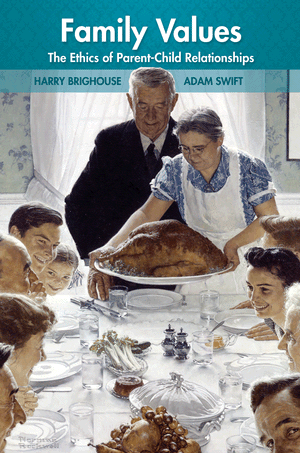
Family Values, Image Sought

Posted by Harry

You can help! I’m giving a brownbag talk at UW Madison’s Center for the Humanities in December, and the administrator, despite knowing me well enough to know that I have no aesthetic or design sense at all, has asked me for an image to go on the poster for my talk. The title is “What so great about the family anyway?”, and the description is as follows:

The phrase “family values” is often associated with a conservative political agenda, and liberals, committed as they are to ideals of personal freedom, have tended to shy away from being judgmental about the different familial arrangements people choose. Recent work in egalitarian political philosophy has focussed on the moral justification of the family; what “family values” are actually justified? Harry Brighouse will talk about this work, showing that there is interesting common ground between some conservatives and some egalitarians, and will discuss the significance of abstract theorising about values for family policy.

So far, we have between us come up only with three flippant ideas, based on very quick googling, but worth sharing: the Reagans; the Bushes; and these guys. Any better ideas? In deference to my lack of good sense, it would be kind to flag flippancy.


Progressives and eugenics

Posted by Henry

This is a pretty weird post from Ross Douthat.

Ezra writes that it’s “very unfair” to apply the word “eugenics” to, say, the contemporary trend toward the elimination of Down’s Syndrome by selective abortion, because “traditionally, the term has been used to denote efforts to direct or encourage breeding by high status, socially dominant individuals in order to select for their characteristics, and discourage breeding by low status individuals (criminals, the insane, blacks, etc) in order to wipe their characteristics from the gene pool. For Ross to conflate that with parents who decide to abort infants with medically disastrous genetic mutations is a real stretch.” First of all, Down’s Syndrome is not a “medically disastrous” genetic mutation, unless you take an extremely broad definition of the term “disastrous.” Second, while the means of “traditional eugenics” were obviously very different from what’s emerging now – involving state power rather than parental choice, and selective breeding/sterilization rather than prenatal genetic screening and abortion – the ends were the same: the genetic improvement of the human species through the scientific management of the reproductive process.

Does Ross seriously believe that people who have abortions because their foetus appears likely to have Tay-Sachs syndrome or Downs syndrome are doing so because their “end” is “the genetic improvement of the human species?” Can he even realistically contend that the genetic improvement of the human species crosses most people’s minds when they are making this kind of decision?? This claim seems to me to be ridiculous on its face, regardless of your underlying position on whether abortion is a good or bad thing.

What’s going on here, as best as I understand it, is something like the following. There’s a long-standing label in US politics called “progressive,” which used to mean something like “social democrat or non-revolutionary socialist.” As vaguely-left Democrats have increasingly become disenchanted with the term ‘liberal’ and its milksop connotations, they too have begun to embrace the term “progressive.” However, for them, it doesn’t mean ‘social democratic, but instead something like ‘vaguely pro-union liberal with balls’ (or ovaries depending … you get my drift). This in turn has led critics on the right to start harking back to some of the old-style socialist progressives’ sins, and to try to hang them around the necks of Matt Yglesias, Ezra Klein and company.

Here, Ross has been trying to assert in a series of posts that there is some sort of continuity between ‘old’ progressives’ views on eugenics, and ‘new’ progressives’ views on abortion. Which is kinda nonsensical. The modern liberal position on abortion isn’t rooted in the imperative towards genetic improvement of the species, or anything like it. It’s rooted in a particular notion of individual rights. That’s why they call it ‘choice’ rather than ‘embrace your genetic duty by destroying imperfect foetuses for the benefit of mankind.’ The old-style eugenics of H.G. Wells, Swedish social democrats, Anglo-American family planners etc has nothing to do with modern liberalism, or with liberals who have started to call themselves progressives. Instead, if it’s an embarrassment for anyone, it’s an embarrassment for social democrats like myself, who have some real continuities with that older tradition (although hopefully not with that particular part of it).


The Last Typing Wife

Posted by Kieran Healy

Question: what is the latest—i.e., most recent—example you know of an academic’s first book where, in the acknowledgments, the author thanks his wife (or some other person’s wife, as in “the redoubtable Mrs Elizabeth Arbuthnot”) for typing and retyping the manuscript with great patience, forbearance, accuracy, and so on? The acknowledgments to academic books are a mini-institution with pretty clear rules that change only slowly over time and show a high degree of homogeneity, particularly for first books. Up until a certain point, the endlessly patient and also busily typing wife was a fixture in them. But no longer. How precisely, I wonder, can her extinction be dated?

My hypotheses are: (1) The typing wife disappeared earlier than the typing employee, but (1a), The typing employee has also now disappeared. (2) Things must have been in decline for a long time (typewriters are not exactly a new technology, and then women started going to graduate school on their own account), but the big drop-off comes some time in the 1980s, as cheap computers and word-processors arrive. I suspect specimens continued to appear into the 1990s, however. (3) The typing wife may have disappeared from acknowledgments faster than actual wives doing actual typing disappeared in practice. (4) I expect variance across fields due mostly for reasons of technological affinity. But I’m not sure how fine-grained this is.

As evidence for (2), as an undergraduate in 1993 not in possession of a computer, and not lucky enough to be attending a university with any decent computing facilities, I along with almost all others hand-wrote all my essays and regular coursework. But it was a requirement of both my honours theses that they be typed, so I had to marry pay someone to do that. The following year, though, I had saved up and bought a powerbook and typed my MA paper myself. So it seems reasonable to think that academic books published around this time might still have phantom typists working away – though maybe by then it was people who took a typewritten manuscript and retyped it on a wordprocessor. But I want specific examples. So the main question is, in whose set of acknowledgments is the most recent typing wife to be found?


A genuine right to part-time work

Posted by Ingrid Robeyns

Judith Warner wrote a column in yesterday’s NYT (unfortunately behind the pay-wall) on the need to make part-time work genuinely available for all American workers. She argues that study after study shows that up to 80% of mothers, both those holding jobs or caring at home, want to work part-time, but that currently only 24% do so because “part-time work doesn’t pay”:

Women on a reduced schedule earn almost 18 percent less than their full-time female peers with equivalent jobs and education levels, according to research by Janet Gornick, a professor of sociology and political science at City University of New York, and the labor economist Elena Bardasi. Part-time jobs rarely come with benefits. They tend to be clustered in low-paying fields like the retail and service industries. And in better-paid professions, a reduced work schedule very often can mean cutting down from 50-plus hours a week to 40-odd — hardly a “privilege” worth paying for with a big pay cut.

Continue reading “A genuine right to part-time work”


Facebook Madness

Posted by Kieran Healy

Just look what it’s doing to otherwise sober economists:

What have you done, Henry?


Annals of Personal Responsibility

Posted by Kieran Healy

So checking the post today I found a letter addressed to my son, inviting him to apply for a Citibank Platinum Select Mastercard. Up to 40,000 American Airlines airmiles included! I’ve had a chat with the little guy about it (I still call him the little guy—corny, I know, but other Dads will understand), and he won’t be signing up, partly because it’s a bad deal (18.24 percent variable rate, annual fee after the first year), but mostly because he is six and a half weeks old.


Parents and children

Posted by Michael Bérubé

I believe my last post here—almost a month ago—was all about not having enough time in the day. Well, today my summer finally begins. I returned the last of my twelve graduate seminar essays, and I dropped off the First Child. I left him the car in which we drove 800 miles in one day, and flew back to central Pennsylvania the next day. Now that’s efficiency! We decided to forego the traditional father-son knife fight upon parting, because I had myself a one-way airline ticket that I’d purchased only eight days before, and we figured I would attract quite enough attention in the airport without having to explain away sundry fresh flesh wounds.

Nick turned 21 last month, and will begin his senior year of college in the fall. I don’t know whether that makes me the CT contributor with the oldest child, but I figure I’ve got a shot at that dubious distinction. And so, for my return-from-little-hiatus post, I’m going to dilate a bit about parents and professors.

Continue reading “Parents and children”


The Elementary Structures of Kinship

Posted by Kieran Healy

Seeing as the kids are on the front page, indulge me a bit. My wife had a baby boy early yesterday morning (hurray!) and this morning I brought our three-year-old daughter up to see the new arrival. She has in principle been getting used to the idea of being a big sister for a while, and was excited to meet him. As we’re walking in she says, “What is that thing on your wrist, Daddy?” “It’s so that people here know that I’m your little brother’s daddy,” I said. She stopped walking and looked up at me. “But … but you’re my daddy,” she said.

Onward to sibling rivalry, I suppose.


Corrections

Posted by Belle Waring

I have been meaning to write an update to my post of last month. When I skimmed the first accounts of the captured British sailors’ time in Iran I was under the impression they had been subjected to full-on mock execution, of the Dostoyevsky type. That is, told they were going to be executed, lined up and blindfolded, etc. Reading more I learned that it was more of a confused situation (still very alarming, no doubt), in which they were blindfolded and cuffed and could hear weapons being cocked. So, not actually torture (and some people pointed this out in the thread at the time.) It was scary as hell, no doubt, and I hope I’m never in that situation, or at least that, if I am, John Derbyshire is there to rush the armed soldiers and bite their throats out. I’m still ready to go nuclear, though, and I actually learned a lot reading that not-flamewar comments thread.

On the other hand, I thought that the comments to Kieran’s post on Megan’s difficult situation were unusually useless for the most part. This from John Quiggin was good, though:
Continue reading “Corrections”


Kiss kiss boom

Posted by Kieran Healy

Nora Ephron remarks somewhere that a baby is a hand grenade thrown into the middle of a relationship. But there are a lot of people looking for someone to pull the pin:

So if some men think my urgency for kids is unappealing, FUCK THEM. In the first place, it is not something I can control, neither the wanting nor the fact that maternal age matters, and you can not shame people for what they can’t control. In the second place, they are fooling themselves about having an indefinite period of healthy sperm and energy for young kids and young women willing to be with them.

That second point reminds me of another Ephron line:

Sally: It’s not the same for men. Charlie Chaplin had babies when he was seventy three.
Harry: Yeah, but he was too old to pick them up.