From the category archives:

Food and Drink

Artificial Meat

by Jon Mandle on November 30, 2009

I don’t know how I missed the breakthrough in fish stick technology mentioned so casually in this article from the Sunday Times:

SCIENTISTS have grown meat in the laboratory for the first time. Experts in Holland used cells from a live pig to replicate growth in a petri dish.
The advent of so-called “in-vitro” or cultured meat could reduce the billions of tons of greenhouse gases emitted each year by farm animals — if people are willing to eat it.
So far the scientists have not tasted it, but they believe the breakthrough could lead to sausages and other processed products being made from laboratory meat in as little as five years’ time.
They initially extracted cells from the muscle of a live pig. Called myoblasts, these cells are programmed to grow into muscle and repair damage in animals.
The cells were then incubated in a solution containing nutrients to encourage them to multiply indefinitely. This nutritious “broth” is derived from the blood products of animal foetuses, although the intention is to come up with a synthetic solution.

The Dutch experiments follow the creation of “fish fillets” derived from goldfish muscle cells in New York and pave the way for laboratory-grown chicken, beef and lamb.

The Vegetarian Society reacted cautiously yesterday, saying: “The big question is how could you guarantee you were eating artificial flesh rather than flesh from an animal that had been slaughtered. It would be very difficult to label and identify in a way that people would trust.” Peta, the animal rights group, said: “As far as we’re concerned, if meat is no longer a piece of a dead animal there’s no ethical objection.”

That’s the “big question”? I’m guessing that Dr. Kass will find this even more repugnant than the public licking of an ice cream cone.
In your face, beer snobs!

by Daniel on July 30, 2009

Even the President of the USA agrees with me about Budweiser. I suppose it was never on the cards that any of them was going to order a black-and-tan.

[click to continue…]

Ahem

by Daniel on November 21, 2008

Budweiser, eh?

I asked the brewmaster, Jean-Marie Rock, which American beer he likes best. He thought for a moment, squinting down his bladelike nose, and narrowed his lips to a point. Then he raised a finger in the air. “Budweiser!” he said. “Tell them that the brewer at Orval likes Budweiser!” He smiled. “I know they detest it, but it is quite good.”

Thanks very much for the heads up to Luis Enrique and Unfogged. Sweet vindication, albeit coming from a guy with pointed lips. Other gems from the article:

“When a brewer says, ‘This has more hops in it than anything you’ve had in your life—are you man enough to drink it?,’ it’s sort of like a chef saying, ‘This stew has more salt in it than anything you’ve ever had—are you man enough to eat it?’ ”

Microbrewers, gahhh.

Expert knows best

by Eszter Hargittai on August 17, 2008

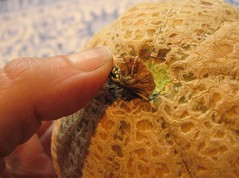
A Ripened Melon - Chef's choiceI just had a deliciously sweet cantaloupe. How did I know how to pick it? My favorite* chef, Chef Susan aka Chef Q posted some advice on the topic recently. Not only is she an amazing cook and baker, she is also an excellent photographer so her posts are illustrated with helpful images. I forgive her for all the pounds I gained last year due to her cooking (hey, at least I finally started a regular exercise regime) and thank her not just for all the great meals I’ve had the good fortune to experience, but also the helpful material she shares online.

[*] It’s actually a tie with my Mom, but she’s not officially a chef. Of course, that hasn’t stopped her from publishing a cookbook (see some of her recipes here).

Photo credit: Susan Beach

The Riordans

by Henry Farrell on July 26, 2008

Tyler Cowen evidently doesn’t realize that he’s touched upon a significant cultural phenomenon when he praises Biddy White Lennon’s “Irish Food and Cooking,” co-written with Georgina Campbell, and remarks that BWL has “a great name to write a book like this, no?” Biddy White Lennon was one of the mainstays of Irish rural soap opera, _The Riordans_, which did as much as anything to help shepherd Ireland into modernity. The Wikipedia entry on _The Riordans_ is a gem, providing a really nice encapsulated history of the show and its relationship to social debates in Ireland.

The Riordans tackled many ‘conservative versus liberal’ issues from its very start. Its start coincided with the coming into force of the Succession Act which for the first time granted to the wife of a farmer an automatic right of succession to the family farm, so removing the danger that after her husband’s death she could be left with nothing, with the property being willed to a total stranger. The issue was at the time controversial; banks until the 1970s would not allow a wife to open a bank account except with the approval of her husband. Conservatives suggested that the new Act, which had been pushed through in the face of opposition by then Minister for Justice Charles Haughey, would undermine the traditional family and lead to the sale of a farm owned by a family, were a farmer’s marriage to break up. Liberals argued that the reform was one of social justice and a long-overdue recognition of the rights of farmers’ wives. …

The show also focused on a range of farming issues, from the promotion of new farm technology to safety on farms. (In the 1970s Tom and Benjy featured in a television advertisement urging farmers to have metal framed cabs put onto their tractors to protect themselves from serious injury should the vehicle overturn.)

Other issues were also raised, such as illegitimacy, poverty, the problems of old age, marriage break-up, sexual activity, the dramatic changes in the post-Vatican II Catholic Church, and most famously contraception, when it was revealed that Benjy’s wife, Maggie, for medical reasons could not risk having a second pregnancy. The decision of the couple to use contraception (the Pill) caused considerable controversy and criticism from “family values” organisations and some in the Catholic Church. The show was on many issues both praised and criticised in the national media and even in Dáil Éireann while civil servants in the mid 1960s criticised the image portrayed of a ‘farm advisor’ sent out to advise farmers on new advances in farming but who in the series was seen drinking in the pub and gossiping.

Of course, as was the usual course with good Irish shows which touched on social and political controversies (see e.g. _Scrap Saturday_, _Nighthawks_), the show was axed without warning.

I’ve a particular fondness for Biddy White Lennon’s cooking books (although I haven’t seen this one, which Tyler describes as a ‘revelation’), being a graduate of _Biddy White Lennon’s Leaving Home Cookbook_, a volume which I received when I first went to college and couldn’t fry a rasher to save my life, and which contained recipes for such then-exotic foodstuffs as pita bread.

Map of things to do in Budapest

by Eszter Hargittai on June 22, 2008

A lot of people I know are heading to Budapest these days (whether for pure touristy reasons or for one of the many meetings being held there) so using the My Maps feature on Google Maps, I’ve compiled some annotated recommendations for visitors. These include pastry shops mostly visited by locals with desserts to die for. No, seriously, these are a must and visiting the city without going to some of these would be sad and wasteful.

I also include a pointer to a grocery store with the goal of finding the Hungarian snack Túró Rudi (details: check the dairy section for items that look like a candy bar in a red-dotted wrapper). I would say it’s the most missed item by Hungarians abroad. It’s basically lemony sweet farmer’s cheese coated in dark chocolate. Yum! Wikipedia conveniently has more info, not that words can possibly convey the experience. Some companies new to the country in the ’90s have tried to create other versions (e.g., with fruit filling or milk chocolate coating), but I would rather not even acknowledge those as they’re ridiculous imitations. On the topic of grocery stores, someone recently complained that they couldn’t find any fruits and veggies in them. That’s because other than the gigantic supermarkets, these tend to be sold in separate venues.

I didn’t bother listing most of the traditional sights included in guide books, numerous Web sites and guides will point those out. I do highlight, however, an incredibly touching Holocaust memorial on the Danube (first link on my map). It’s relatively new and not something one would stumble upon by chance, yet definitely worth visiting and now you know where to find it.

Fat Americans

by Chris Bertram on June 17, 2008

… and, increasingly, fat British too.

For Europeans, one of the really disconcerting things about visiting the United States is the size of the meals. Ok, there’s the phenomenon that the restaurant staff will let you take home what you don’t or can’t eat (and that’s an idea that many Europeans feel uncomfortable with), but there’s still the fact of the sheer volume of stuff that gets put on your plate. It seems it wasn’t always this way. Via someone in my del.icio.us network, I came across this article on how portion sizes have changed in the US over the past twenty years. And not only are American meals bulkier, they’ve also increased two or three times in calorific value. That can’t be good.

Becoming Drusilla

by Chris Bertram on May 19, 2008

I first became aware of Dru because she was a member of the Bristol Flickr group, and I was looking to buy a camera. What better way of deciding than to look through other people’s photos, and see what the ones I liked were taken with? So there was Dru, a slightly mumsy, middle-aged woman with a young daughter and a Morris Traveller. In other words, extrapolating from the various signifiers, I’d formed an impression of what Dru must be like. Then I met her, at one of our monthly get-togethers, in the Royal Naval Volunteer. And then she spoke. “Bloodly hell!” I thought to myself, “you’re a bloke … or used to be.” A very quick update of my mental image of Dru took place.

It isn’t very often that people I know have their biography published. In fact, through not paying attention again, I’d failed to notice that Dru’s was coming out. Only when a friend send me a link to the Guardian , with the question “Is this Flickr Dru?” did I catch on. Well, Becoming Drusilla isn’t so much a biography as the record of a friendship, and what happens to it when one of the parties announces their desire to change sex.
[click to continue…]

Crooked Timber dining notes (MCXVIII) — Squirrel

by Chris Bertram on April 16, 2008

This being a blog with global reach, you never know whether what you take to be exotic isn’t mundane in the region where your snarky fellow-blogger or commenter lives or comes from. So, with that caveat, I report that I had “squirrel cocotte” for my dinner last night, with, appropriately enough, hazelnuts. Now I’ve ticked it off the list of stuff I’ve eaten, I probably won’t choose it again from a menu, but nor would I turn it down if offered by a friend. Dark, intense, a bit like venison, with hints of chocolate (since you ask).

The price of Starbucks

by Chris Bertram on February 21, 2008

Martin O’Neill has an interesting review of a new book about Starbucks.

bq. In the centre of Xi’an, the ancient Chinese capital, there is a gleaming concrete and glass Starbucks. Although a caramel macchiato costs more than a slap-up lunch for four in any of the city’s traditional cafes, this has not stopped it from doing brisk business.

Read the whole thing, as they say.

Logistics of a chocolate party

by Eszter Hargittai on December 14, 2007

It’s that time of year when I think about chocolate even more than usual. Along those lines, I’m hosting a chocolate birthday party tonight (I can’t believe it’s taken me this many years to think to do it!) and am not sure yet how to handle the logistics of the blind taste test. I guess it doesn’t have to be that complicated, but if anyone has any experiences and lessons learned, please share. I’m supplying about ten types of chocolate (from high-end to not exactly) and guests will bring their own contributions. I’ll remove the wrappers and place the chocolate on plates. I figured I would number these and hand out sheets where people can rank order. But perhaps they should just comment and rate. I’m not sure. Any thoughts? Part of the point is to see who decides that their absolute favorite is the cheapest relatively generic brand vs the super special imported variety.

I’m also looking for any additional ideas for such a party. I’ve gotten some nice chocolate Q&A cards that I’ll spread out across the place. I’m making some large printouts of chocolate photos (using this nifty tool). And I’ll likely have a couple of fondue pots going thanks to gifts from previous birthdays. Of course, I’ll have plenty of other food (and not just sweets!) and drinks (spiced wine anyone?) to allow people to cleanse their palettes between morsels. Anything regarding the chocolate theme that I should add?

Giving credit where its due: the chocolate party blind taste test idea comes from my friend Diane who hosted a very successful version back in grad school so it is a tested concept. I just don’t remember the logistical details.

Tipping points

by Henry Farrell on May 16, 2007

Tyler Cowen provides a sociological explanation of tipping norms in the US.

The real question is why America is structured so that waiters and waitresses can sell feel-good services (“you are a generous tipper and a fine man”) to strangers, in return for money. In other words, how did waiters end up as fundraisers …? Most cross-cultural explanations of tipping start with the agency problem between diners and servers (“can you bring my drink now?”), but I believe that is the wrong approach. I view tipping as correlated with effective fundraising in other areas, and Americans as being especially willing to set this additional fundraising arena in motion.

I think that he’s right not to focus on the agency problem, but I also suspect as a first approximation that any sociological explanation has to refer to different norms about equality and conspicuous consumption. Certainly, my personal experience of eating out in Germany during the couple of years that I lived there was that tipping beyond the nominal 50c to 1 euro that indicated you had enjoyed your meal was not only not obligatory, but actively frowned upon by the waitstaff. It suggested (or so my German friends told me) that you were trying to demonstrate your superiority to them by playing Lord/Lady Bountiful.

I tend to regard myself as Crooked Timber’s online myrmidon of a number of rather unpopular views; among other things, as regular readers will have seen, I believe that the incitement to religious hatred legislation was a good idea (perhaps badly executed), that John Searle has it more or less correct on the subject of artificial intelligence, that Jacques Derrida deserves his high reputation and that George Orwell was not even in the top three essayists of the twentieth century[1]. I’m a fan of Welsh nationalism. Oh yes, the Kosovo intervention was a crock too. At some subconscious level I am aware that my ideas about education are both idiotic and unspeakable. But I think that all of these causes are regarded as at least borderline sane by at least one fellow CT contributor. There is only one major issue on which I stand completely alone, reviled by all. And it’s this; Budweiser (by which I mean the real Budweiser, the beer which has been sold under that brand by Anheuser-Busch since 1876) is really quite a good beer. I have been threatening this post in comments for a while now, and here it is:
[click to continue…]

In-N-Out-N-Back-N-Again-Later

by Kieran Healy on April 22, 2007

In-N-Out is opening a franchise in Tucson soon, not too far from where I live. This may well pose problems for my, uh, ruthless nutrition and fitness regime. I’m not a connoisseur of American fast food, but In-N-Out is pretty damn tasty. Sonic is apparently also worth a bypass. I mean detour. Two locations recently opened in Tucson, but I’ve never eaten there. I think the last really good fast food chain I ate at was a while ago in Auckland, where I got to try the frighteningly large burgers and dangerously tasty kumara fries at Burgerfuel, on Ponsonby Road.

Welsh Cakes

by Harry on February 4, 2007

There are some dishes which you just can’t imagine that anyone in their right mind would dislike. Others, however much you love them, you assume to be idiosyncratic tastes. Such was always the case with Welsh Cakes, which I love, but long presumed that was because I associate them with long childhood walks in West Wales and visits to my maternal grandparents. Prompted by a colleague, I felt forced to bring an “ethnic” food to the final session of a class we taught (after, I should add, evaluations), and rushed off some welsh cakes because they are low effort and I had the ingredients to hand. I found that everyone raved about them and, in fact, that has turned out to be a universal reaction. So, add this to your CT recipe book:

[click to continue…]