What does it mean to be an academic in different parts of the world? What comes along as the same job description – a bundle of teaching, research, and impact tasks – varies enormously from place to place. Not only the financial conditions of universities differ, but also the social standing of researchers. This is probably what one needs to expect in a world shaped by inequalities along so many lines – geopolitical power, financial resources, cultural influence, race, gender etc. But arguably, there are additional problems within academia. For example, certain academic centers, typically situated in the Global North, dominate the discourse in whole fields, and the opportunities to gain international visibility are distributed very unevenly across countries.
Last summer, I had written on this lack of Global Science Equity. It is problematic for at least two reasons. The first is moral: some of the global inequities are so stark that they stand in blatant contrast to the meritocratic rhetoric still widely used within academia. When being situated in favorable circumstances gets framed as “talent” or “excellence,” and being from a disadvantaged country as “lacking quality,” this is an unjust distortion of the facts, which leads to misguided distributions of respect and recognition across academics worldwide.* The second is epistemic: academic research works best if diverse perspectives and approaches are taken into account, not if there are steep status hierarchies and historically grown centres of gravity that determine what research gets done and under which paradigms.
Of course, knowing that some things are unjust is not the same as knowing what would be ideally just – a point that Amartya Sen has famously made, arguing that we can move away from injustice even though we may not have a blueprint of a perfectly just world. Some inequalities in the situation of researchers across the globe are probably unavoidable, given the manifold differences between countries (if only something like being in the “wrong” time zone, which makes participation in online events difficult). Hence, the term “Global Science Equity” (instead of “Global Science Justice”) is meant as a way of capturing the imperative of reducing the most massive imbalances and unfair disadvantages and moving in the right direction.
These are some of the considerations that led us – Amal Amin, Flavia Maximo, Darlene Demandante, and me – in 2025 to start a survey among researchers about their working conditions and experiences. We had hoped to complement some of the existing research on related topics, for example the reports by the Global Young Academy on the state of young scholars in different parts of the world (on Africa here; on Latin America and the Caribbean here), or various reports about the experiences of women in science (e.g. here) and in science organizations (e.g. recently here on national academies).
Methodology
We had hoped to reach sufficient numbers of participants to do sophisticated statistical analyses about, say, how much travel money for international conferences doctoral students in Latin America vs. Sub-Saharan Africa get. Alas, the numbers of responses were not large enough for that level of detail, despite our efforts to circulate the survey on social media and in various science organizations (e.g. Women in Science Without Borders, Societies for Women in Philosophy, Global Young Academy, Rede Brasileira de Mulheres Cientistas). We were probably too ambitious, wanting to cover a broad variety of issues and leaving many open-ended questions in order to get a good grasp of the different social experiences.
Nonetheless, we got 146 answers, enough for some statistics – and certainly for some qualitative analysis. We are extremely grateful to everyone who took the time to share their experiences. We here present some of the results, in full awareness that the sample is small and we thus cannot claim statistical significance.** We start with some descriptive statistics, and then move on to the more qualitative parts of the survey. Originally, the survey was in English; on request from colleagues in Brazil, Flavia produced a Brazilian translation as well.
64 participants were from OECD countries and 82 from non-OECD countries. Female academics were 115 of the respondents, 29 were male and 2 identify with another gender; this probably reflects our dissemination efforts in several organizations for women researchers. Regarding race/ethnicity, 49 identify themselves as White; 26 as Black; 21 as Asian; 11 as from Middle East and North Africa; 10 as Latinx/Hispanic and 5 as multiracial; 17 persons did not declare their race/ethnicity.
Some quantitative data
|
a) Do you work in the country in which you grew up? |

The data show striking asymmetry between OECD and non-OECD respondents regarding geographic mobility. While OECD-based researchers are almost evenly split between those who remained in their country of origin (31) and those who did not (32), non-OECD respondents show a strong tendency toward working in their country of origin (75 out of 82). This pattern – if representative – suggests that geographic mobility in academic careers might operate differently across geopolitical contexts. In OECD systems, international mobility is both structurally incentivized and often institutionally required for career advancement. In non-OECD contexts, by contrast, the concentration of researchers working in their countries of origin may reflect constrained mobility for economic reasons.
This economic interpretation suggests itself because in our data, mobility resources were sharply unequal. Among parsable answers to our question about annual travel funding, non-OECD respondents cluster at $0, while OECD respondents cluster around $2,000, reaching up to $6,000. 44% of Non-OECD participants reported having no funding at all for traveling. This is an inequality with direct implications for participation in international networks, invitations, and collaboration ecosystems that shape grant and publishing outcomes.
These outcomes are also shaped by language barriers. English dominance is system-wide, with most participants reporting that they are expected to publish in English. But compliance burdens differ: overall, Non-OECD respondents are more likely to report needing language editing before submission, which takes time and money – though of course, there are also Non-OECD countries, e.g. India, in which English is the dominant academic language. Non-OECD respondents more frequently face the extra step of language editing, and also show a higher overall rate of personal payments for such language services. Some, however, expressed the hope that with affordable AI language editing options, these unequal burdens may become smaller.
|
b) Have you had career interruptions resulting from family duties (e.g. parental leave) – if yes, please specify brief |
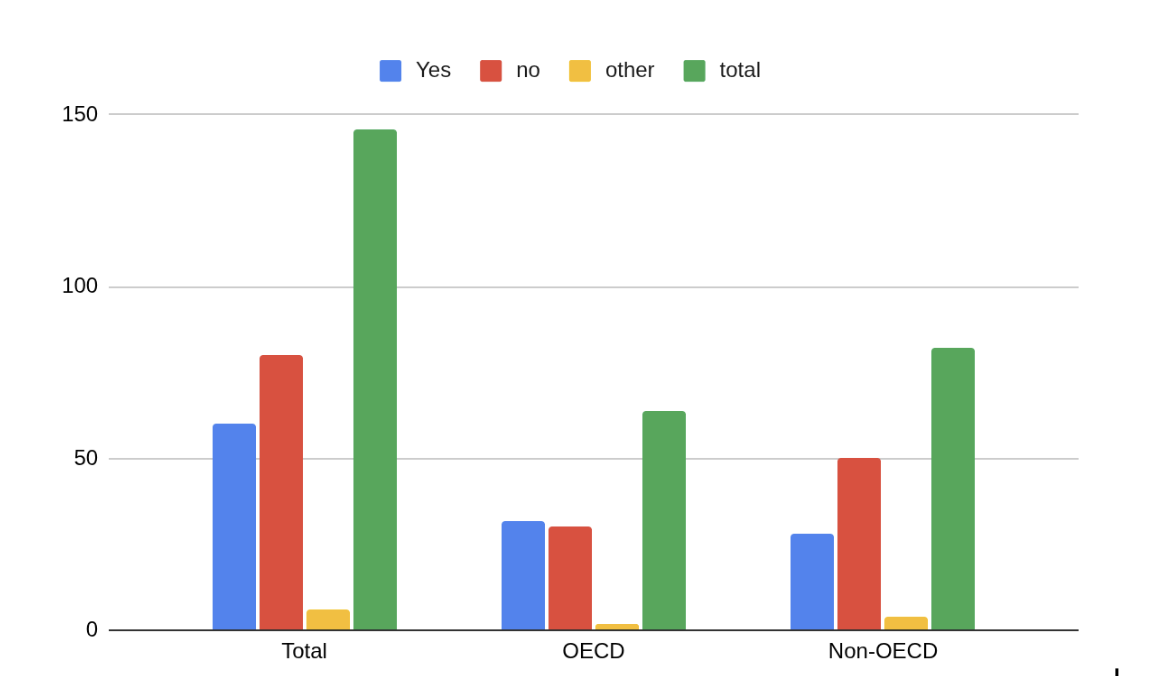
Across the full sample, 60 respondents (41%) reported career interruptions due to family duties, against 80 who did not; 6 for reasons that they did not want to disclose. The majority career interruptions were with female academics (52) and mostly due to maternity leave (but note that we had a high number of female respondents, as reported above). The OECD subsample shows a near-equal distribution (32 yes, 30 no), while non-OECD respondents report fewer interruptions in relative terms (28 yes, 50 no).
These figures must be read with caution, because lower reported interruption rates among non-OECD respondents do not necessarily indicate more favorable conditions. They may, instead, reflect the absence of institutional policies such as parental leave policies, which means that the data – if representative – risk underrepresenting the actual burden of care (and note that we were not able to control for rates of parenthood among researchers at all, another potentially confounding factor). Yet another factor might be different cultural understandings of parenthood (and in particular motherhood) and the social acceptability and affordability of outsourcing care work. More research is needed to illuminate these differences.
|
c) Do you have to take on other jobs, in addition to your “day job” at a research institution or university, in order to make ends meet? |
That 60 out of 146 respondents (41%) reported needing supplementary employment to sustain themselves financially represents a significant indicator of structural precarity within academia. The disproportion between OECD (23 yes) and non-OECD (37 yes) contexts is notable, though not as sharp as might be expected. This means that precarity, while more pronounced outside OECD countries, is by no means absent within them, especially in earlier career stages. These findings complicate the assumption that academic labor would always mean stable professional employment (maybe especially for women). Labour precarity appears across different career levels, but especially among doctoral students, independent scholars, and researchers without permanent contracts.
Another datapoint may be related to the need to earn an additional income. In our responses, OECD affiliation correlates with earlier academic timing in this dataset: the clearest marker is age at PhD completion (median 30 in OECD countries vs. 34 in Non-OECD countries ), coupled with much younger OECD doctoral/postdoctoral ages. This points to different structurings of academic pathways, with people from non-OECD countries taking longer to get academic degrees and academic positions, maybe because of the need to also pursue other endeavors to maintain oneself, in academic systems with less structural funding for young researchers.
Some qualitative data
On many other issues, we asked qualitative questions. Let us emphasize once more that we cannot claim statistical representativeness here (nor, obviously, verify the claims made by participants).
Concerning experiences of discrimination, there were many entries in which women or people of color reported being a minority in their field, which made them feel not at home at academic events, but there were also reports of direct discrimination by academic managers, and of sexual harassment of the form that one can, sadly, call “classic.” One participant claimed to experience discrimination as a man because women were given preference in his field; while we cannot judge this specific case, it raises the problem of how to morally and practically deal with the disappointment of men in previously male-dominated fields that are being opened up to women (or along other lines), and about how to win them as allies in the fight against discrimination. One person pointed out that when “voices from the South” are invited, those might exclusively be those of Indigenous peoples and local communities (which are undeniably also of great importance), not those of scholars from these countries.
When it comes to journals, many respondents focused on the theme of substance over formalities. For example, papers should not be rejected (by editors or reviewers) because of small linguistic issues that are difficult to avoid for non-native speakers; instead, there would, ideally, be help with linguistic issues at the stage of acceptance.
Many respondents also reacted to the question about “token representation”: researchers from disadvantaged groups being included because this makes projects look better, without being taken fully seriously. At least 30 provided answers that directly reported such experiences. Some expressed great anger about it, others saw it as an unavoidable consequence of affirmative action programs and were therefore more ambivalent about it.
Overall, a key insight from these qualitative data is that inequity in science is multidimensional, runs across different dimensions, and sometimes takes unexpected forms. For example, when it comes to languages, researchers from English-speaking non-OECD countries may experience fewer problems than those from non-English-speaking OECD countries. There are invisible obstacles such as chronic illnesses which lead to very different forms of exclusion, than, say, being visibly radicalized. For some scholars, time zones are a great challenge when it comes to international academic events or digital calls, for others, different academic calendars, for some, both.
To give some concrete examples: Young scholars at conferences on other continents may suddenly find themselves in unsafe situations because their phones do not work there and they cannot afford to pay for phone data, and they get lost on the way back from the conference dinner because no printed maps were provided. A form of exclusion that is probably relatively new is that international scholars from certain countries who work in the US cannot travel outside the country because they fear that they might not be allowed back in.
Let us also note that several participants pointed out that we should have paid more attention to class as a category of inequity, e.g. when researchers come from very high class-positions in non-OECDs countries compared to people from disadvantaged class backgrounds in OECD countries – a point very well taken.
Towards global science equity
One respondent from the Global North wrote: “I would like […] to hear voices from the Global South telling rich universities from the Global North what we can do that will be useful to and welcomed by them. I don’t know whether the voices are speaking and I’m not hearing them, but I think a lot of Global North academics would be enthusiastic about being involved with initiatives that help to equalise things, but nobody has any idea what to do – and they don’t want to make suggestions that might come across as (or indeed unwittingly be) patronising or racist”
By combining the responses to the open-ended questions in our survey regarding best practices in international projects, cooperations, or scientific associations, we can provide some answers to this question.
Diversity as a default aspect of science
Whether in terms of gender, race/ethnicity, class, age, nationality, language, or models of scientific knowledge, diversity was seen by many respondents as a key element for a global science equity. Inclusiveness along all these dimensions should not be something one has to argue for and justify, but be accepted as a mandatory dimension of academic work, whether it is in organizing conferences, running research teams, or reviewing for and editing journals. Participants highlighted the need for more diverse collaborations, respecting local realities, with knowledge transfer between different countries.
Including early-career academic researchers was repeatedly suggested as a way to reduce power imbalances: offering mentorship, funding and training opportunities, and thinking about capacity building as a core goal. Also, providing support for childcare was often raised, as well as sensitivity to the needs of people with special medical needs or disabilities.
Simple suggestions that can be easily adopted into daily academic life were mentioned, such as more flexibility when it comes to the use of English; providing translation and language editing support or even allow submission in other languages, with the possibility of a later translation; awareness of the academic calendar in the Global South when scheduling conferences or meetings; moving meeting hours around to make it easier for participants in different time zones.
Quite some participants who had either little travel funds, or care responsibilities, or both, pointed out the advantages of online conferences and regretted the fact that after the end of the Covid-Pandemic, far fewer opportunities for online participation in international academic events remained intact. This raises the question of how in-person conferences might do more to keep open channels for those who cannot easily attend, whether as part of conferences or in the form of, say, digital reading groups or seminar series.
Geopolitical redistribution of funding
The unequal distribution of research, publication, and conference participation funds is one of the driving factors of the lack of Global Science Equity. As a solution, respondents suggested specific funds for including researchers from poorer countries in international events; hybrid options in conferences for participants for whom international travel is difficult; conference or membership fees that are differentiated according to GDP of the country of residence; or research funding opportunities where emerging countries compete with each other, not with better-resourced countries from the Global North. Transparent funding structures, with clear guidelines on fund allocation, disbursement, and reimbursement to avoid inequities or delays were also pointed out as best practices.
In addition to the lack of visibility for researchers from the Global South, who cannot obtain funding for publications, conferences, or projects, the concentration of resources in countries of the Global North has been experienced by some respondents as a form of control over scientific knowledge. One participant wrote that “collaborations should be equal, not the one who brings the money calls the shots. They can have the money as bait but they cannot do the research without the local partner, especially in the Global South.” Another respondent pointed out that countries of the Global South often continue to be treated as case studies for research from countries of the Global North, without being granted a leading role in theoretical production.
Horizontal academic relationships
Many respondents called for fair and transparent procedures in all aspects of scientific knowledge production. Some expressed the hope that it would be possible to achieve more equity when younger researchers get more of a say. As one participant wrote: “I think getting younger generations more involved is key to changes – and part of the struggles as scientific associations are often dominated by older academics with rather stubborn views”.
The generational difference in positions of power (often intersecting with a lack of female representation) has often been identified as problematic. Therefore, a broader distribution of decision-making power is essential for working towards more equity in science, with strategies that allow all researchers, and not only those with insider knowledge or a powerful mentor at their side, to participate equally. Such strategies include simplifying bureaucratic processes for accessing resources; standardizing reporting formats; using open science practices, sharing data, protocols, and outcomes for the benefit of all partners, and eliminating the “friend-factor” in scientific relationships. An implicit theme in many answers was the endogamy of access to funds, networks, and visibility among researchers from the same institutions and the same countries, typically higher GDP and situated in the Global North. As long as the right to define what counts as “good science” remains exclusively in these circles, without attention to different local circumstances and different epistemic opportunities, the inequities of the global science landscape will be difficult to overcome.
One final thought: A structural problem that might arise from the multiplicity of discriminatory experiences that we have described is that many academics may feel disadvantaged one way or another. While true in some sense, this may make us overlook the really drastic differences on a global level that matter far more, morally speaking. It reinforces an attention economy that is all too often dominated by old path dependencies (what were the “leading” centers in a certain field half a century ago?). The practical steps described above may help, in concrete ways, to overcome these unjust and epistemically harmful hierarchies, and to move towards more Global Science Equity.
This post has been written by Flavia Souza Maximo and Lisa Herzog. We would like to thank Amal Amin and Darlene Demandante for their support in the phase of setting up and distributing the survey, and Paulo Savaget for his help in analysing the data and commenting on a draft version. AI was used for summarizing some of the data, with manual doublechecking. All remaining errors are ore own.
—————-
* If you’re skeptical of this claim, have a look at the distribution of Nobel prizes and other international science prices – looking at those, one might think that vast parts of the world do not even have academic research…
** Also, it may be the case that our survey has been filled in mostly by people who feel that they have been treated inequitably in some way or another by the academic system. We had been open about the framing, which is preferable in terms of research ethics, but this might have biased the sample by not appealing to those think that there are no issues with equity in the scientific system.
{ 6 comments }
D. S. Battistoli 04.17.26 at 12:33 pm
Flavia and Lisa, this is fascinating; are you planning to publish your results after this?
If the point I am about to raise seems like a nitpick, it is only because of the strength of your article: if you do publish in other fora, I might suggest revising your graphs in one of the two following ways:
a. remove the total-response bar and leave readers who want to count total responses to add up the values of each other bar (you might facilitate this by placing value tags at the top of each bar);
b. remove the total-response bar and add a label to each cluster of bars (i.e. OECD, non-OECD, etc.) of the format “n=62” as a substitute.
I suggest this because the total bar, being always taller than all other bars, makes it harder for readers to quickly understand the delta that is most important: that between “yes” and “no,” for instance. A change to either (a) or (b), above, might increase the legibility of your graphics.
Again, a glancingly minor point, for whose triviality I heartily apologize. What fascinating work!
Kenny Easwaran 04.17.26 at 6:34 pm
The charts are all split by “OECD” and “non-OECD”, but it’s a little unclear to me whether it is split based on where a researcher is currently based or where they grew up. Before looking at any data, my guess would be that people who grew up in OECD countries would be more likely to work in their home country and less likely to be work in another country, while people who work in OECD countries would be more likely to have grown up in a different country and less likely to work in their home country. I can’t quite tell if the first chart supports that intuition or refutes it.
One other issue I see – in many cases, it seems plausible that the most concrete thing an OECD country institution can do to support people from non-OECD countries is to admit them into their graduate programs and to hire them into permanent positions. Many of the features interpreted here as inequalities could actually be direct consequences of this sort of activity.
John Q 04.18.26 at 12:13 am
Trump is doing his best at levelling down by destroying the dominant position of the US. Assuming that the rich world is now going to be rebuilt around the EU, it’s important for Europe to promote a more co-operative and equitable global approach.
MM 04.18.26 at 4:35 pm
On the first question, the bars in the bar chart do not match the numbers in the textual narrative. Unfortunately my OCD stopped me from reading further.
TF79 04.19.26 at 5:16 pm
@4 Yes, it looks the chart that answers the third question in part C is duplicated in part A – I was similarly confused by the text and graph in part C at first (“striking asymmetry”). Presumably there’s a correct figure that goes in part A that can be put up because the mobility point is an interesting one.
Moz of Yarramulla 04.21.26 at 4:17 am
Coming in late: IME class can be a major enabler for non-OECD postgrads studying in OECD countries. I studied with a couple, one of whom made a couple of salient points (back ~1990!)
First, that he wasn’t so much exceptionally brilliant as smart and rich. People from his country studying here absolutely had to be rich. At the very least rich enough to attend university in their home country, but ideally also rich enough to afford to study in a white country. “we have rich people from our country and other countries” is a pretty shallow version of equity (at least in Australia, where a PhD stipend helps but the total cost is still IIRC over $100,000).
Second, that him taking a job in an OECD country meant he would not be contributing to his home country. Which matters at a social level, if every academically gifted student leaves the country what happens to it?
My thought: the deluge of LLM slop is likely to result in personal connections becoming more important rather than less. This is going to make it even harder for the likes of Ramanujan to be noticed. Perhaps publishing in non-English, local journals will become more useful? Especially languages where LLMs remain weak.
Comments on this entry are closed.