She told me she’d be ten minutes late, which was fine. But when it was nearly twenty minutes I messaged – where are you? Shall I walk towards you?
My daughter sent a picture of a bit of the state library she was in, people at desks etc. We’re here, is this where you are?
I am outside, I said. But I walked inside anyway. I compared the picture to what I saw. It kinda looked the same. But the floor in the picture was parquetry. Mine wasn’t. I started to wander to find the right room, calling my daughter on the phone as I did so.
Where are you?
Near the cafe. I walked to the cafe. No daughter there.
More descriptions followed. And then something clicked.
Wait, I said. Are you in MELBOURNE?
Hang on, she replied. Are you in SYDNEY?
We were to meet at the state library. Both cities have one. I thought she was in Sydney (in my defense, that is where she had told me she would be). She thought I was in Melbourne, because I often am and the Victorian state library is where we often meet.
Much hilarity ensued. This is such an US thing to do.
As it happened I was in the state library of New South Wales in Sydney beginning my Fellowship, gleefully flashing my Fellows card to go into staff-only bits of the library, claim a desk. Eating my home-made lunch in the staff kitchen on the third floor.
And checking out the first of an archival collection that describes what people actually did when they found gold in the 1850s gold rush and sold to one of the many, many banks popping up in gold towns – or else to the local grocery storekeeper. Gold digger stories of being swindled by tricks with the scales are part of the lore of the era.
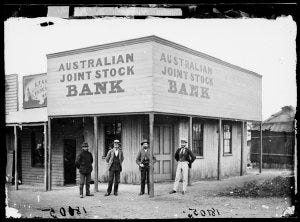
Image: Australian Joint Stock Bank, Gulgong – SLNSW
The project is called: What happened to the gold? Reconsidering risk, money and the rise of modern banking at the 175th anniversary of the NSW Gold Rush.
By the 1937 Royal Commission into banking (which is another starting place for me), the bank of New South Wales told the government that one third of its capital reserves was from the sale of gold during the gold rush.
They were almost certainly selling to the Bank of England, to whom the 1844 Bank Charter Act had granted a monopoly on note issuance, linked to…the yellow stuff that magically1 appeared in California in 1848, and then in 1951 in Victoria and New South Wales.
The people who dug it up in the middle of Australian nowhere2 typically sold the gold for maybe £3-4 per ounce and felt rich, for a while.
One of a squillion bazillion observers of the gold rush said:
I do not believe that gold seeking in Australia has been remunerative to any class of men as a class….men who picked up fortunes are very rare. One never meets them.
He did, however, blame the diggers themselves, suggesting that they spent it all ‘useless, new-fangled luxuries’.
A bit mysterious where those luxuries went, isn’t it? Though we kinda know from the report to the Royal Commission where the profits ended up.
I think this is going to tell us something about the development of modern, everyday banking and its links to the City and the 1844 Bank Charter Act, the joint materiality and abstractions of gold and money and the growth of the banking profession. We will see. It’s my first day, after all.*
At least I was at the right state library, unlike some other people.
*This gold project is part of a much bigger project that is centred on the labour (I think including technology) and matter – the stuff, including money, ledgers, deposit slips – of banking and finance. It is early days, but expect to hear more about it very soon. Ideas – please let me know!
(I’m running a bit late on posting about this, sorry. The next update will be sooner than you think!)
{ 6 comments }
oldster 03.04.26 at 12:11 pm
Okay, but do you have any other evidence that Melbourne and Sydney are distinct places? Because, I have always thought it was safer to assume that they are one, for reasons of parsimony inter alia.
D. S. Battistoli 03.05.26 at 10:50 am
What a wonderful teaser—I look forward to reading the next update!
On a formatting note, the process of copying this over from your substack seems to have left the content of your footnotes behind, while bringing across hyperlinks to the substack page, which is subscriber-only.
Laban 03.05.26 at 11:20 am
It’s a pity most gold finds now aren’t nice chunks of native gold, but involve crushing vast amounts of rock then treating with cyanide.
https://www.rnz.co.nz/news/thedetail/588545/a-gold-mine-an-australia-mining-giant-and-a-community-divided
MisterMr 03.05.26 at 12:58 pm
The idea that workers who enter in a new shiny trade spend all in dubious luxuries is common, not just for gold diggers.
I think that most of those people were people who had no money to begin with and no social position, so they couldn’t really gauge if/how much money they were going to actually gain.
Who were those gold diggers? if they were immigrants maybe they sent money back home.
John Q 03.06.26 at 3:53 am
The failure of free banking in the crisis of 1893 is notable because it discredits many US-specific explanations of similar failures there
Hannah Forsyth 03.11.26 at 10:16 pm
@oldster, very good point.
@Laban – oh dear. Cool though that hobby gold miners are making some cash in the current (weird) boom.
@MisterMr – some people (the very poor and people of colour mostly) are deemed undeserving of anything. F*cking protestant ethic.
Apologies @D. S. Battistoli – I keep trying to remove the silly footnotes I tend to add into the substack, but they seem to become invisible once I paste them into WP. I will try to be more assiduous.
@John Q – that is VERY interesting. I’ve not spent much time on the 1890s crashes, but I did access the amazing volume of the Victorian Royal Commission in 1895 last week and am now very keen to think about this.
Comments on this entry are closed.