
From the category archives:
Academia

A friend writes:
I am putting together a teaching workshop in my department that will focus on strategies for reaching out to students who have gone missing or are falling behind. Any suggestions of short things to read that I could circulate ahead of time?
I don’t know of any short readings, but thought that some CTers might and that, even if not, a post might generate a discussion worth reflecting on.
All I have are anecdotes and I’m inhibited from telling them because the people involved might recognise themselves — the more detailed the anecdote, the more useful, but also the more likely they are to recognise themselves. My main strategy, if you can call it that, is to write gentle emails to students who are persistently absent, in a tone that invites them back to class without bugging them or being harsh. This almost always elicits a response, and several students have observed, later, that the tone of the email was important because the student had missed enough classes that they were embarrassed to come back, and some of their absence was just caused by previous absences.
Here’s one that I feel confident the student in question will recognize, but will be fine with:
“Are you doing ok? I’m just writing because you missed class last week, and I wondered if you’re doing ok. Don’t worry, I’m not giving you a hard time: mainly I want to nudge you to be sure you’re in class on Tuesday because it will be fun, and you’ll make good contributions.”
Obviously, the final phrase is only there because it is sincere (I knew she would make good contributions if she came to class, and in this case knew that she probably knew that too). Occasionally such an email prompts much deeper interaction — obviously, some persistently absent students are just absent, but others have real problems that they are not handling well, and need help with. But even though such emails usually get a response, and always a friendly one, they are not all successful — in the class from which the above email is taken another student persisted in absenteeism, and wouldn’t get help.
Anyway — if you can recommend reading that’d be great, and if you can’t, but have stories that of things that have worked, or haven’t worked, that’d be great too.
Antonin Scalia has died. Cass Sunstein, one of Obama’s favorite law professors and, for a time, regulatory czar in Obama’s administration, had this to say from his perch at Harvard Law School:
Devastated by Justice Scalia’s death. One of the most important justices ever, a defender of the Rule of Law, and a truly wonderful person.
— Cass Sunstein (@CassSunstein) February 13, 2016
(Suddenly I see the wisdom of Bill Buckley’s famous quip about Harvard.)
In the coming days, the retrospectives on Scalia’s career and predictions of what is to come will be many; they’ve already begun.
But for me Scalia is a figure of neither the past nor the future but of the present.
If you want to understand how Donald Trump became the soul of the Republican Party, you need look no further than Antonin Scalia. Scalia is the id, ego, and super-ego of modern conservatism. He was as outrageous in his rhetoric (his unvarying response to any challenge to Bush v. Gore was “Get over it!”) as he was cruel in his comportment. Sandra Day O’Connor was the frequent object of his taunts. Hardly an opinion of hers would go by without Scalia calling it—and by implication, her—stupid. “Oh, that’s just Nino,” she’d sigh helplessly in response. Even Clarence Thomas was forced to note drily, “He loves killing unarmed animals.” He was a pig and a thug. (Sunstein, by contrast, believes “he was a great man, and a deeply good one.”) And he was obsessed, as his dissent in PGA Tour v. Casey Martin shows, with winners and losers. They were the alpha and omega of his social vision. He was the Donald Trump of the Supreme Court.
And the second most misunderstood judge of the Supreme Court, as I argued in a lengthy profile of Scalia, which originally appeared in the London Review of Books and which I revised extensively for one of my chapters in The Reactionary Mind. I reproduced that chapter in four parts on my blog. Here they are again.
Prologue: I’ve Got a Crush on You
Scalia’s mission, by contrast, is to make everything come out wrong. A Scalia opinion, to borrow a phrase from New Yorker writer Margaret Talbot, is “the jurisprudential equivalent of smashing a guitar on stage.” Scalia may have once declared the rule of law the law of rules—leading some to mistake him for a stereotypical conservative—but rules and laws have a particular frisson for him. Where others look to them for stabilizing checks or reassuring supports, Scalia looks for exhilarating impediments and vertiginous barriers. Where others seek security, Scalia seeks sublimity. Rules and laws make life harder, and harder is everything. “Being tough and traditional is a heavy cross to bear,” he tells one reporter. “Duresse oblige.”
Scalia’s conservatism, it turns out, is less a little platoon than a Thoreauvian counterculture, a retreat from and rebuke to the mainstream, not unlike the hippie communes and groupuscules he once tried to keep at bay. It is not a conservatism of tradition or inheritance: his parents had only one child, and his mother-in-law often complained about having to drive miles and hours in search of the one true church. “Why don’t you people ever seem to live near churches?” she would ask Scalia and his wife.  It is a conservatism of invention and choice, informed by the very spirit of rebellion he so plainly loathes—or thinks he loathes—in the culture at large.
Left unresolved, however, the contradiction reveals the twin poles of Scalia’s faith: a belief in rules as arbitrary impositions of power—reflecting nothing (not even the will or standing of their makers) but the flat surface of their locutionary meaning—to which we must nevertheless submit; and a belief in rules, zealously enforced, as the divining rod of our ineradicable inequality. Those who make it past these blank and barren gods are winners; everyone else is a loser.
Act Three: Affirmative Action Baby
Scalia preys on and profits from the very culture of liberalism he claims to abhor: the toleration of opposing views, the generous allowances for other people’s failings, the “benevolent compassion” he derides in his golf course dissent. Should his colleagues ever force him to abide by the same rules of liberal civility, or treat him as he treats them, who knows what might happen? Indeed, as two close observers of the Court have noted—in an article aptly titled “Don’t Poke Scalia!”—whenever advocates before the bench subject him to the gentlest of gibes, he is quickly rattled and thrown off his game. Prone to tantrums, coddled by a different set of rules: now that’s an affirmative action baby.
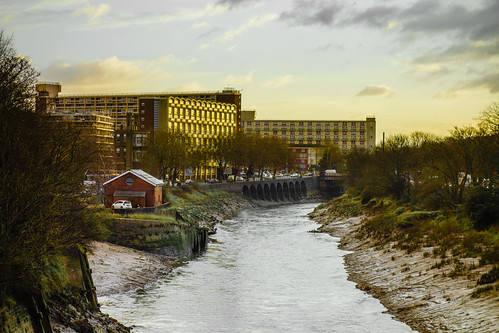
I wouldn’t normally post two pictures of the same scene in consecutive weeks, but this one seemed worth it. The Avon is tidal at Bristol and the river was also swollen by the heavy rain from Storm Imogen (yes, we’ve started doing that US thing of naming our weather). So, the same view, shot from the same place at the same time of day, but quite different.

A few days ago, Matt Yglesias wrote me an email which asked a great question about American politics and the seeming movement to the left of the Democratic Party. In the wake of Bernie Sander’s landslide victory in New Hampshire over Hillary Clinton, Matt’s question seems even more pressing and interesting. With his permission, I quote it below:
What’s your theory as to how the labor-liberal forces inside the Democratic coalition seem stronger than every (Hillary is now against TPP and facing a fierce challenge from a socialist) even as actual labor unions seem weaker than ever. This is 180 degrees the opposite of the trajectory that I and everyone else were forecasting 10 years ago where either there would be a labor revival (card check, etc.) or else Dems would drift right without an anchor. [click to continue…]
I posted the other day about the [UK government’s proposal to ban charities from using government funds to try to influence policy](https://crookedtimber.org/2016/02/06/the-uk-government-moves-to-purge-the-public-conversation-of-unwanted-voices/). Many commenters thought “nothing to see here, no big deal”. Now it appears that the clause applies quite generally to organizations receiving government grants, [stating](https://www.gov.uk/government/news/government-announces-new-clause-to-be-inserted-into-grant-agreements):
>The following costs are not Eligible Expenditure: Payments that support activity intended to influence or attempt to influence Parliament, government or political parties, or attempting to influence the awarding or renewal of contracts and grants, or attempting to influence legislative or regulatory action.
The [implementation guidance](https://www.gov.uk/government/uploads/system/uploads/attachment_data/file/498271/Implementation_Guidance_for_Departments_on_Anti-Lobbying_Clause.pdf) then includes the following:
>Q12: Where departments use third party organisations (either public, private or
charity sector) to administer grants on their behalf, will the clause need to be
included in the T&Cs between the third party and the grant recipient?
>A: Yes. Departments will need to ensure that the clause is included in all grant agreements that the Department
ultimately funds, subject to exceptions signed off by Ministers. This guidance should be shared as necessary.
Unless ministers grant specific exceptions then, government grants to bodies like the Institute for Fiscal Studies and the National Institute of Economic and Social Research to conduct research into policy, must not aim to “influence legislative or regulatory action”. The same would go for university-based researchers in receipt of government money vie HEFCE or the Research Councils. Still more absurd than this is the picture that emerges when the clause is combined with the government’s own “Impact Agenda” which forms part of its “Research Excellence Framework”. Under this, university researchers who apply for grants are required to demonstrate “impact” which may include influencing government policy, but it will now be a contractual condition that you may not do this thing that you must do.
Given that this is so irrational, I’m tempted to conclude there must be a misunderstanding here. The alternative is that the clause will be enforced selectively against bearers of unwelcome news.
(Alerted to this by Martin O’Neill on FB).
The Plain People of Crooked Timber: Belle. What is your deal even. You said you would post trivial idle thoughts alla time and instead you just ghost. And you haven’t even posted your annoying end-of-the-year mix of all the sucky songs from the previous year!
Well, gentle readers, I…I don’t have a great excuse because surely if I can play Candy Crush and lie awake at night looking at Pinterest for three solid hours I could post something. But I feel as if I should post something intelligent if I haven’t said anything in so long! I get similar email guilt; the feeling of shame at not having checked my email recently enough becomes a crippling barrier which prevents me from checking my email in a vicious cycle of anxiety. This is because contrived anxiety is actually more manageable than motivated anxiety. Our life is kind of sucking right now? One thing that’s awesome is that my mom, who got diagnosed with stage IV lung cancer that had metastasized to her brain over a year ago, is not merely alive and in charge of her faculties, but felt well enough to fly the 24 hours to Singapore and stay for a month. We went to Ubud in Bali also, to this villa that was just the schwaa. (The following is not, though it appears to be, the least helpful, most out of touch with reality advice because it is useful to our Antipodean readers/contributors who, it appears, must perforce go to Bali with some frequency because the entire population of Australia appears to be there at all times. Villa Bali is the best. It’s only economical if there are several of you, like four minimum, but then you have your own kitchen, can go to the grocery store and don’t need to pay for any restaurants so it can easily be cheaper than a mid-range hotel and is 50x more fun.) OTOH, Stage IV lung cancer sucks! It’s normally the stage when they tell you, “you’re about to die, bro.”
On Tuesday night, Alexandra Schwartz, a critic at The New Yorker, posted a piece criticizing the young supporters of Bernie Sanders. Ordinarily, I’d be mildly irritated by an article titled “Should Millennials Get Over Bernie Sanders?” In this instance, I’m grateful. It clarifies the dividing line between Sanders’s supporters in the electorate and the liberal journalists who can’t abide them.
First, some context. Exit polls from Iowa, according to Vox, show that “Sanders absolutely dominated young adult voters, in a way that even Barack Obama couldn’t in 2008.” Eighty-four percent of voters under 30, and 58% of voters between 30 and 44, cast their ballots for Sanders. More generally, as countless articles have noted, younger voters are shifting left, embracing ancient taboos like socialism and other heresies.
Schwartz finds this all puzzling:
Bernie would not be pressing Hillary without the support of the youth of America, a fact that I—a voter north of twenty-five, south of thirty—have pondered over the past few weeks with increasing perplexity.
Why are young people, she asks, “rallying behind the candidate who has far and away the most shambolic presentation of anyone on either side of this crazy race?”
A second’s Google search turns up an answer: [click to continue…]
On this day, the first of February, in 1934, the New York Times carried Franklin Roosevelt’s proclamation of a new gold value for the US dollar. Previously it had been worth 25 8/10 ounces of gold 9/10 fine; now it would be worth 15 5/21 ounces of gold 9/10 fine—or, as it is more commonly said, the dollar had been valued at $20.67 to an ounce of pure gold and now it would be $35 to an ounce of pure gold. But the US was not in 1934, nor would it ever again be, on a gold standard.
As we move into the last days before Iowa, it’s useful to review some of the very best things that have been written on Donald Trump. Much of it is recent.
1. Hands down, I’d say Jodi Dean has penned the central text for understanding Trump.
Donald Trump cuts through the ideological haze of American politics and exposes its underlying truth, the truth of enjoyment. Where other candidates appeal to a fictitious unity or pretense of moral integrity, he displays the power of inequality. Money buys access — why deny it? Money creates opportunity — for those who have it. Money lets those with a lot of it express their basest impulses and desires — there is no need to hide the dark drives when there is none before whom one might feel shame (we might call this the Berlusconi principle). It’s the rest of us who bow down.
As Trump makes explicit the power of money in the contemporary US, he facilitates, stimulates, and circulates enjoyment (jouissance). Trump openly expresses the racism, sexism, contempt, and superiority that codes of civility and political correctness insist be repressed. This expression demonstrates the truth of economic inequality: civility is for the middle class, a normative container for the rage of the dispossessed and the contempt of the dispossessors. The .1 % need not pretend to care.
The freedom from civility, the privilege of enjoying superiority, incites different responses, all of which enable people to enjoy — get off on — this political round.
Some of the underpaid and exploited enjoy through Trump. Not only does he give them permission to…
2. Earlier this week in Salon, Steve Fraser offered a bracing comparison between Trump and his most important predecessor: [click to continue…]
Hillary Clinton is taking flak today for her summary repetition of the white supremacist Dunning School of historical interpretation, which held that the attempt in the 1860s and 1870s to provide African Americans with their civil rights was a terrible imposition on the white folks of the South.
[Lincoln] was willing to reconcile and forgive. And I don’t know what our country might have been like had he not been murdered, but I bet that it might have been a little less rancorous, a little more forgiving and tolerant, that might possibly have brought people back together more quickly.
But instead, you know, we had Reconstruction, we had the re-instigation of segregation and Jim Crow. We had people in the South feeling totally discouraged and defiant. So, I really do believe he could have very well put us on a different path.… let’s also think about how we do try to summon up those better angels, and to treat each other, even when we disagree, fundamentally disagree, treat each other with more respect, and agree to disagree more civilly, and try to be inspired by, I think, the greatest of our presidents.
I’ll leave critiques of the Dunning School in other hands because I think they’re obvious, sadly, and Clinton should really know better. I’ll even forgo detail on the obvious point that if you’re a modern Democratic presidential aspirant asked who’s the greatest of the US presidents, your answer is Franklin Roosevelt.1 Instead I want to focus on Clinton’s counterfactual: “had [Lincoln] not been murdered”. [click to continue…]
This isn’t how the story is supposed to end. Podcast by podcast, day by day, step by freezing, wind-blown step, Henry Worsley has been documenting his solo trek at the South Pole. He was no under-prepared amateur. It was his third trip to the pole and his first time doing it alone. He was following the route of Anglo-Irish merchant navy officer Ernest Shackleton’s race to the pole a century ago. Although Scott’s journey is better known, Shackleton is respected for having run a tighter expedition and, crucially, for making the necessary sacrifices in glory-seeking and his own food rations to bring all his men home. He famously said of his second expedition ‘a live donkey is better than a dead lion, isn’t it?’ and it is.
Stuck in his tent for two days, too ill to move, Worsley finally called for rescue late last week. He died yesterday of peritonitis that caused multiple organ failure.
Every day for the past couple of months, Worsley has been doing a daily update on his progress and talking about what it is like to be alone and pressing on through some of the worst conditions on earth. E, who served under Worsley, had been following the podcasts. (Most nights he would get into bed and put it on, and I would grumpily roll over and tell him to use his headphones.) At the end of each recording, Worsley would answer questions, many of them from the children who listened in each day. There was something sweetly old-fashioned about that. He would satisfy questions like ‘what is it like to celebrate Christmas on Antartica?’ with a condensed but not unrealistic description of life in the white darkness.
I will never understand why people want to climb Everest or walk to the Pole. The human drive to ‘conquer’ landscape and survive in hostile environments is wholly alien to me, and probably to most of us. It just seems to be one of those quirks that the human race throws up from time to time, and without which we probably wouldn’t have survived. It’s not an instinct that finds much outlet in late capitalist life. Most of us are not very brave. Most of us avoid physical discomfort and unnecessary exertion whenever we can. But in ways epigenetic and day-to-day practical, most of us depend on people who do not.
Worsley wasn’t a thrill-seeker or a for the hell of it risk-taker, or one of those people who only feels truly alive when he is fighting for his life. He was doing this trek for a reason, and he was doing it because he could. It can sometimes be easier for officers to slot back into civilian life, and he felt a deep obligation to support military charities that help wounded and other soldiers in transition. Worsley had already met his fundraising goal. He was just thirty miles from journey’s end. He was almost there. He was almost home. The story wasn’t supposed to end this way.
Rod Dreher has a great quote today from Edwin W. Edwards:
“With me, the people know the butter might be rancid, but it’s going to be spread on their side of the bread.”
Dreher’s point: “That’s Trump for you, ain’t it? I bet he’ll win the GOP primary in Louisiana going away.” [click to continue…]