With the time of year, it is hard to remember which day of the week it is. So here, one day late, is a shot in our cab on a rainy night after watching Liverpool beat Leicester 1-0.

From the category archives:
With the time of year, it is hard to remember which day of the week it is. So here, one day late, is a shot in our cab on a rainy night after watching Liverpool beat Leicester 1-0.
Moustafa Bayoumi is a professor of English at Brooklyn College, where I teach political science. His book, “This Muslim American Life,” came out in September. It’s a fascinating collection of pieces—sometimes hilarious, often unsettling, always probing and provocative—about, well, Muslim life in America, past and present.
There’s a mini-memoir about the time Moustafa worked as a Middle Eastern extra on “Sex and the City 2″; a Philip-Roth-like story about his discovery of a terrorist named Mustafa Bayoumi in a detective novel (that really did happen); a loving deconstruction of the Islamic undertones and overtones of John Coltrane’s music (“A Love Supreme” becomes “Allah Supreme”); a harrowing essay on how the American military uses music to terrorize and torture its victims (the phrase “Disco Inferno” takes on a whole new meaning); a long and learned history of the relationship between Muslim Americans and African Americans.
The book ranges widely, but it’s held together by a single premonition: that the wrenching changes of the War on Terror have been not only legal and political but also cultural. They are not confined to foreign policy or domestic policing; they extend to the most intimate and personal spaces of social life. They have created among all of us—Muslim and non-Muslim alike—a new set of experiences and sensibilities, a new sense of community and collectivity. At the same time, Moustafa’s book is a long, sustained insistence that we understand all the ways in which people—particularly Muslim people—live their lives outside the War on Terror. “This Muslim American Life” documents the oozing influence of the state, but with its sense of humor and history, shows just how much of the Muslim American experience lies beyond that influence.
A literary critic and gifted essayist, Moustafa brings his formidable skills as a reader of texts to his analysis of contemporary political culture. He’s got that eye—and ear—for the way our most incidental phrases, those stray bits of language, betray our deepest feelings. Where other books on the War on Terror focus on high acts of state, Moustafa finds his materials in the most unexpected places: yes, in the fine print of a legal statute, but also in standup comedy, in the parables of Kafka, in the penultimate paragraph of newspaper article. His archive is everywhere.
Moustafa and I have been friends for years, and we’ve often talked over drinks or dinner, on campus and in cafés, about the topics he addresses in his book. But it wasn’t till I sat down with “This Muslim American Life” that I truly saw the unity of his vision. So I decided to do what we always do when either of us has a book or an idea we’re excited about: sit down with him and talk about it.
Salon ran the interview this morning.
A brief conversation with 2 students crystallized for me why two things I have been doing in my classes for a while work well, and I want to recommend them to other teachers; and also make a recommendation for students.
Background to the conversation. The class is very small, just 14 people (this is unusually small — my normal class sizes are around 25, 80-100, 150-170). R&M live together; G, who is also in the class, lives with them. They have a 4th roommate, MA. Class was once a week on Wednesday nights.
R: “MA might come to class on Wednesday. I mean, it’s like she’s in the class, so she might as well just come along”
Me: “What do you mean?”
M: “Well, we all just argue about class in our apartment for half the week, and she can’t really avoid it”
R: “Yes, as soon as the memos start coming in on Sunday, we start reading them to see what everyone says”
M: “We always look to see what S [a very poised, provocative, freshman] says, because at least one of us will disagree with her”
R: “And even if M and I agree, G always disagrees with us. Our apartment is just full of argument from Sunday through Wednesday”
So what are the two things I do?
Benedict Anderson has died. I’m hoping someone like Henry or Chris writes something more substantive in the coming days about his contributions. While I read Imagined Communities, it never touched me in the way it has so many other scholars and students. Reading people’s comments on Facebook and Twitter, I’m struck by how intellectually diverse his audience was, how ride-ranging his reach. All morning, people from so many different fields and persuasions have been testifying to Anderson’s impact upon them and their work. Which leads to a thought: I’d put Anderson up there with Clifford Geertz and, increasingly, Jim Scott as among the most influential scholars of the last half-century. All of them scholars of Southeast Asia. I’m sure other people have noticed this and/or perhaps written about this, so forgive my saying the obvious, but what is it about that region that has made it such a site of transformative scholarship and fertile reflection?
Update (10:45 am)
Somehow or other, it seems, Henry actually has already posted here on Anderson’s death. Weirdly, I only just saw it. Maybe he and I were writing at the same time? Anyway, read Henry.
Thomas Piketty’s *Capital in the Twenty-First Century* is an important and valuable contribution to political economy, both empirically and philosophically. Piketty grounds his theory in vast empirical data,rather than settling for elegant mathematical models. He courageously embraces the fact that economic theory is inevitably value laden, and proposes a theory of the historical dynamics of wealth accumulation in order to offer an updated moral critique of capitalism. Grounding his prediction in the historical data and profoundly simple mathematics, Piketty projects that economic inequality is likely to increase and to favor those who own inherited capital over time. He advances the normative judgment that rising inequality is unjust and must be
contained. Although Piketty raises important concerns about the
possibility of growing wealth inequality, he fails to normatively ground
or argue for his presupposition that this inequality is unjust. Since
relative poverty can coincide with high levels of objective or
subjective well-being, this presupposition is brought into question.
However, there are causes of inequality (including wealth inequality)
that clearly can be shown to be unjust. By considering other forms and
causes of inequality and oppression, we can distinguish between those
forms of wealth inequality that are unjust and those that are
normatively benign. In this way Piketty’s concerns about growing wealth
inequality from inheritance can be partly justified, though of course
not empirically verified. Piketty’s argument for the injustice of
growing economic inequality has two parts. The first part is an
empirical, economic argument for the claim that returns from inherited
wealth will far outstrip income. This argument can be summarized as
follows. Let *r* be the rate of return on capital, and *g* be the growth
rate of the annual flow of national income.
1. If *r>g*, then (wealth) inequality will grow over time.
2. Individuals who own a greater amount of capital earn a larger *r.*
3. Growth, *g*, is likely to be slower in future.
4. If *r* is great enough and g is low enough, then there will be ever
more capital from older, inherited wealth, than from wealth saved
from income.
5. Hence, (wealth) inequality will increase, and inherited wealth will
make up the greatest amount of capital. [click to continue…]
Our friend Erik Olin Wright has s long essay on How to be an Anti-Capitalist at Jacobin. Read the whole thing here.
An excerpt:
The Four Types of Anticapitalism
Capitalism breeds anticapitalists.
Sometimes resistance to capitalism is crystallized in coherent ideologies that offer both systematic diagnoses of the source of harms and clear prescriptions about how to eliminate them. In other circumstances anticapitalism is submerged within motivations that on the surface have little to do with capitalism, such as religious beliefs that lead people to reject modernity and seek refuge in isolated communities. But always, wherever capitalism exists, there is discontent and resistance in one form or other.
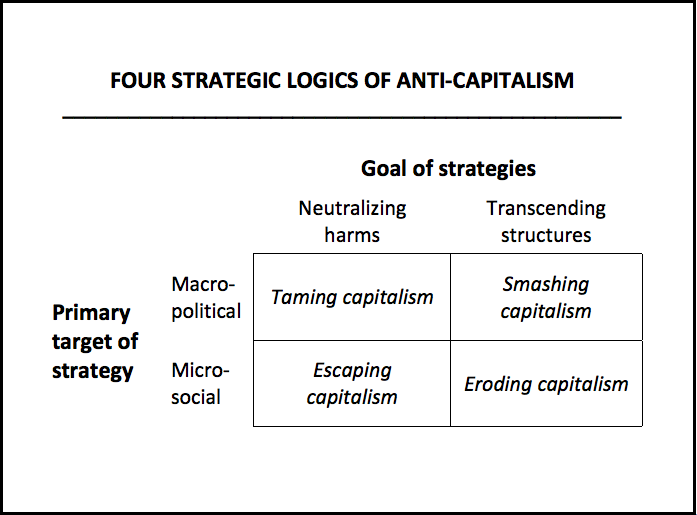
Historically, anticapitalism has been animated by four different logics of resistance: smashing capitalism, taming capitalism, escaping capitalism, and eroding capitalism.
These logics often coexist and intermingle, but they each constitute a distinct way of responding to the harms of capitalism. These four forms of anticapitalism can be thought of as varying along two dimensions.
One concerns the goal of anticapitalist strategies — transcending the structures of capitalism or simply neutralizing the worst harms of capitalism — while the other dimension concerns the primary target of the strategies — whether the target is the state and other institutions at the macro-level of the system, or the economic activities of individuals, organizations, and communities at the micro-level.
Taking these two dimensions together gives us the typology below.
Loyola University, a Catholic university in Chicago, is opposing a union drive among its contingent academic workers. On the grounds that it would violate the university’s First Amendment religious liberty.
What is at stake here, is Loyola’s guaranteed First Amendment rights of religious freedom and autonomy—essentially our right to define our own mission and to govern our institution in accordance with our values and beliefs, free from government entanglement. The United States Supreme Court long ago ruled that the First Amendment provides an exemption from NLRB jurisdiction in order to protect an institution’s religious liberty and identity. We are not alone in raising this issue, as religious institutions across the country have opposed NLRB jurisdiction in similar union-organizing situations on the same grounds that we have raised. Our position before the NLRB is not driven by anti-worker sentiment or hostility to organized labor. By raising the jurisdictional issue at the hearing, we are simply seeking to maintain our right to religious freedom, to protect the heart and soul of our institution and its mission.
Here’s what Pope Leo XIII had to say on the topic of labor unions and Catholic teaching in Rerum Novarum (1891):
The most important of all [workers’ associations] are workingmen’s unions, for these virtually include all the rest. History attests what excellent results were brought about by the artificers’ guilds of olden times. They were the means of affording not only many advantages to the workmen, but in no small degree of promoting the advancement of art, as numerous monuments remain to bear witness. Such unions should be suited to the requirements of this our age – an age of wider education, of different habits, and of far more numerous requirements in daily life. It is gratifying to know that there are actually in existence not a few associations of this nature, consisting either of workmen alone, or of workmen and employers together, but it were greatly to be desired that they should become more numerous and more efficient. We have spoken of them more than once, yet it will be well to explain here how notably they are needed, to show that they exist of their own right, and what should be their organization and their mode of action.
Ninety years later, Pope John Paul II reiterated that position in Laborem Exercens (1981):
All these rights [of workers], together with the need for the workers themselves to secure them, give rise to yet another right: the right of association, that is to form associations for the purpose of defending the vital interests of those employed in the various professions. These associations are called labour or trade unions….Their task is to defend the existential interests of workers in all sectors in which their rights are concerned. The experience of history teaches that organizations of this type are an indispensableelement of social life, especially in modern industrialized societies.
As did the National Conference of Catholic Bishops in their 1986 pastoral letter Economic Justice for All:
The Church fully supports the right of workers to form unions or other associations to secure their rights to fair wages and working conditions. This is a specific application of the more general right to associate. In the words of Pope John Paul II, “The experience of history teaches that organizations of this type are an indispensable element of social life, especially in modern industrialized societies.”(58) Unions may also legitimately resort to strikes where this is the only available means to the justice owed to workers.(59) No one may deny the right to organize without attacking human dignity itself. Therefore, we firmly oppose organized efforts, such as those regrettably now seen in this country, to break existing unions and prevent workers from organizing.
And just a few months ago, the Archbishop of Chicago had this to say on the topic:
Similarly, the Church has consistently taught that workers have a right to have a voice in the workplace, to form and join unions, to bargain collectively and protect their rights. And the Church has never made a distinction between private and public sectors of the work. It was not 4 Msgr. Higgins who called unions “indispensable,” but Pope, now Saint, John Paul II in his powerful and still timely encyclical “On Human Work’” Work and unions are important not simply for what a worker “gets,” but how they enable a worker to provide for a family and participate in the workplace and society. Unions are important not simply for helping workers get more, but helping workers be more, to have a voice, a place to make a contribution to the good of the whole enterprise, to fellow workers and the whole of society….Across the twentieth century and into the twenty-first, ten Popes have affirmed and expanded this very vision.
…
For example in view of present day attempts to enact so-called right-to-work laws the Church is duty bound to challenge such efforts by raising questions based on longstanding principles. We have to ask, “Do these measures undermine the capacity of unions to organize, to represent workers and to negotiate contracts? Do such laws protect the weak and vulnerable? Do they promote the dignity of work and the rights of workers? Do they promote a more just society and a more fair economy? Do they advance the common good?” Lawmakers and others may see it differently, but history has shown that a society with a healthy, effective and responsible labor movement is a better place than one where other powerful economic interests have their way and the voices and rights of workers are diminished.
…Ad [sic] I have to admit not every claim of religious freedom is valid and the law has to protect the basic rights of all.
…
The Archdiocese of Chicago employs 15,000 full and part-time employees in its agencies, seminaries, schools and parishes. We strive to be a just employer. I have asked our Archdiocesan staff to review all of our human resource policies to ensure we are practicing what we preach about the dignity of work and the rights of workers. We will work earnestly to address any gaps. After all, like everyone we also need to be accountable. Because the Archdiocese is an employer, some employees and some unions may want to organize in our workplaces. Some Archdiocesan employees are already organized and we work with their union to advance our mission and our mutual obligations to workers. Others are not. And that is because some “jobs” in the Church are really ministerial positions, and must answer to a higher law than those passed by legislatures, we may have differences in this area. But if we stay firm in our commitment to principled dialogue, we can resolve differences and move forward together.
The position of the Catholic Church on the right of workers to form trade unions, even within Catholic institutions (that exception that the Archbishop of Chicago carves out at the end of his address is pretty limited and certainly does not apply to adjunct instructors at a university that does not impose denominational or sectarian obligations on its faculty or students), is clear.
In the name of the First Amendment, in the name of a religious freedom to be Catholic and to follow Catholic teachings, Loyola claims the right not to be Catholic and to suspend Catholic teachings.
Below, I review, in usual rather semi-detached style, the book by friend-of-the-blog Doug Henwood on Hillary Clinton’s candidature for President. A capsule summary might be: he’s against it. I’ve posted the cover image below because it’s so fantastic.

The meaning of the image is discussed in the book
Fifteen years ago, NYU announced a plan to expand its law school by tearing down Edgar Allan Poe’s home on West Third Street, where Poe wrote “The Cask of Amontillado,” revised “The Raven,” and acquired his own literary magazine. The announcement provoked some resistance; 70 scholars signed a letter in protest. They lost. Four years later, a nine-story, 170,000 square-foot Furman Hall was formerly opened. The Poe House was completely gone; a version of its facade was reconstructed a half-block away. According to a historical preservationist:
Walking by, you would never know this was supposed to be the actual remnant of a 19th-century house. It looks tacked on. It’s a facade, literally and figuratively.
Like the capitalist society they serve, universities erase the past all the time. Most of the time we don’t care. For the sake of progress or real estate values, we live with it. Or embrace it.
When politicized university students ask that we revisit the nation’s racial past, however, that we rename buildings not to remove memory but to revise it, we become the most ardent preservationists. Even law professors who said not a word about the destruction of the Poe House.
If the revision in question is for the sake of capitalism, we sigh, whisper an All That’s Solid Melts Into Air, and move on. If it is for the sake of knowledge and anti-racism, we say no, in thunder.
On Wednesday, students at Princeton University occupied the president’s office. They had a list of demands regarding the status of students of color at Princeton. One of them was that Princeton remove Woodrow Wilson’s name from all campus buildings and programs because of Wilson’s enthusiasm, expressed in word and deed, for white supremacy.
Having been an undergraduate at Princeton in the late 1980s, I knew this demand would generate a lot of heat. Unlike John C. Calhoun, whose name adorns one of Yale’s residential colleges, Wilson is Princeton. He was an undergraduate there, a professor there, and the university’s president. It was from Princeton that he launched his national political career, first as governor of New Jersey, then as president of the United States. I thought to myself: no matter what your position is on the politics of naming, campus protests, discussions around race today, this is going to be interesting.
On Thursday, after a 32-hour standoff, the students’ occupation ended with, among other things, Princeton committing to opening a dialogue about possibly removing Wilson’s name from some parts of the campus. While the agreement brought the occupation to an end, I suspect the controversy has only just begun. Yale can easily get rid of Calhoun; his name was only attached to Calhoun College in 1932. Wilson is different: in part because of his national stature, in part because of his embeddedness at Princeton, in part because Princeton is, in some ways, still a Southern university.
Wilson’s past is Princeton’s present. Not just in terms of race—one need only eat at the university’s Prospect House, where many of the servers are black, to get a sense of just how many buttons are now being pushed—but in terms of how Princeton conceives itself politically. Princeton’s motto, “In the Nation’s Service,” originated with Wilson, and is fundamental to Princeton’s sense of itself as a training ground for the country’s ruling class, particularly in government. There’s simply no way Princeton can extricate itself from its entanglements with race without revisiting its entanglement with national power. Not just domestically but also internationally: Wilson did not leave his race politics behind when he headed for Versailles; they went there with him. Likewise American power and its Princeton servants.
How far Princeton is willing to bend on this issue, in other words, will tell us something about the outer boundaries of a leading university’s willingness to confront its racial past.
I dedicated my Salon column to the controversy and its resolution. I focused less on these issues I’ve discussed here, than the politics of free speech and memorialization on campus, and the contributions these students have made to our national consciousness.
And that’s why we owe these students at Princeton a debt. Universities are supposed to be educational institutions: Their first educational constituency is their students, of course, but their second is the nation. Most of us are fairly ignorant about how central race and racism were to Wilson’s politics. By forcing this question, not only on Princeton’s campus but throughout the country, Princeton’s students are actually doing the job that Princeton itself is supposed to be doing: they’re educating all of us.
…
Too often in our debates about freedom of speech, we assume that it already exists and that it is campus activists, particularly over questions of race, who threaten it. But what Princeton’s students have shown is that, before they came along, there was in fact precious little speech about figures like Wilson, and what speech there was, was mostly bland PR for tourists and prospective students. Even more important, Princeton’s students have shown us that it is precisely the kinds of actions they have taken — which are uncivil, frequently illegal and always unruly — that produce speech. Not just yelling and shouting, but also informed, deliberative, reasoned speech.
…
Besides, there’s any number of ways to take Wilson’s name off a campus building — without erasing the past. Princeton could put up a plaque that says, “This building was once named after Woodrow Wilson in honor of his achievements as president of Princeton, governor of New Jersey and president of the United States. In 2015, after lengthy campus discussions of Wilson’s racial policies — including his decision to segregate the federal bureaucracy — the university decided to remove his name from this building and to rename it the W.E.B. DuBois School of Public and International Affairs, in honor of Wilson’s most formidable critic on matters of race.”
And then we could have another debate: about how DuBois would have been appalled to see his name adorn a building on a campus where dining hall workers, many of whom are black (it’s telling that the demographic on campus that has the highest percentage of African Americans is “all other staff”), make less than a living wage if they are parents and are often treated as if they were servants.