by Kieran Healy on March 29, 2007
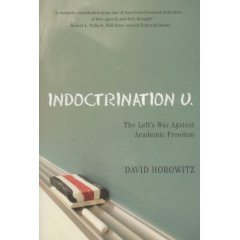
This is just too funny. John Lott, having had his lawsuit against Steven Levitt and _Freakonomics_ thrown out, has gone and written a knock-off called — I’m not making this up — Freedomnomics: Why the Free Market Works and Freaky Theories Don’t. The jacket design is right out of the “David Horowitz playbook”:https://crookedtimber.org/2007/03/22/cover-story/, too.

Presumably it’s blurbed by Mary Rosh. Now if you’ll excuse me I have to get back to the final chapters of my two forthcoming books, Greedonomics: A rogue trader shoots first and Fritonomics: Exploring the hidden side of snack foods.
by Henry Farrell on March 28, 2007
Scott has a “new article”:http://www.insidehighered.com/views/2007/03/28/mclemee over at _Inside Higher Ed_ talking about Borders, and reviewing the “Indies Under Fire”:http://www.indiesunderfire.com/index.html movie that I “mentioned”:https://crookedtimber.org/2007/02/16/indies-under-fire/ a few weeks ago. It sounds like a more complex and interesting movie than I expected from watching the trailer. Which reminds me – Jim Johnson suggested a while back that I should do a post on good bookshops, and consider linking to them in addition to/instead of Powells and Amazon when I review books. I have mixed feelings about linking to Amazon, which is a vociferously non-union operation, but get the impression that many or most CT users buy stuff there. So what good, alternative bookstores are out there? I’ll start by singing the praises of “Prairie Lights”:http://www.prairielights.com/ in Iowa City which I visited this weekend, and which was teh awesome. Fabulous selection of small press books, and a book buyer who, after a brief conversation about Rick Perlstein’s forthcoming, came over to snoop shamelessly through the pile of novels that I was buying at the cash register (the kind of customer profiling I can live with happily). Other recommendations?
by Henry Farrell on March 28, 2007
I blogged a while back about Paul Park’s “A Princess of Roumania,” which was the first in a series of four fantasy novels. I recently finished the third in the series, The White Tyger (“Powells”:http://www.powells.com/partner/29956/s?kw=Paul%20Park%20White%20Tyger, “Amazon”:http://www.amazon.com/gp/redirect.html?ie=UTF8&location=http%3A%2F%2Fwww.amazon.com%2FWhite-Tyger-Paul-Park%2Fdp%2F0765315297%3Fie%3DUTF8%26s%3Dbooks%26qid%3D1175103188%26sr%3D8-2&tag=henryfarrell-20&linkCode=ur2&camp=1789&creative=9325) which is just as wonderful. The novels are profoundly character driven in a way that few genre novels are; they deliberately and specifically refuse to conform to a conventional quest narrative. No-one knows exactly what they’re supposed to do; they’re making it up as they go along. All of the main protagonists (and some of the minor ones) are in some sense or another _doubled_; their selves are split in two so that they have difficulty in explaining their motivations to themselves. The book is less a conventional fantasy story in which the story is external to the characters, determining who they are and what they do, than a working through of the ways that individuals make up their own fantasies, spinning out _ex post_ narratives to explain their actions to themselves and others. The main protagonists don’t know themselves.
This is most obvious in the character of Baroness Ceaucescu, who sees herself as the heroine of an opera, smoothing away the grubby and selfish motivations for her actions and reconfiguring them as the essential elements of a grand and inexorable tragedy, where she has no personal responsibility for what she does. She steals every scene that she’s in. The three novels are vertiginous, and a little jarring. They don’t have the feeling of safeness and stability that most fantasy novels do. All that is solid melts into air. Yet nor are they self-consciously or coyly reflexive (their contingency doesn’t seem playful to me; rather it appears like a very serious attempt to talk about how the world is). I don’t want to say more about _The White Tyger_ for fear of ruining surprises; I do want to recommend it (and I can’t wait to see what the fourth and final novel does).
by Michael Bérubé on March 22, 2007
Greetings, O Timberites! Welcome to “spring,” unless it’s now “autumn” for you. (I hate these fashionable nods to “global relativism,” but I’m informed that some CT readers and contributors are adherents of some kind of Southern Hemisphere Standpoint Epistemology.) I fear that my nasty reputation has preceded me to this prestigious blog, but just for those of you who might be wondering who I am and why I’m here, my name is Michael Bérubé. I teach literature and cultural studies at Penn State University, where I also co-direct (with my wife, Janet Lyon) Penn State’s Disability Studies Program. In future posts, I will be more than happy to remedy this blog’s inexplicable inattention to (a) disability studies and (b) professional hockey in North America, but first, I should probably mention by way of introduction that I published two books last fall, one of which features my <a href=”http://www.michaelberube.com/images/uploads/berube_rhetorical.jpg”> ginormous looming ghostly head</a> and the other of which has been widely lauded for its innovative jacket design:
Hey, hold the phone!
[click to continue…]
by Harry on March 22, 2007
Blackwell has just published the latest of the Blackwell Philosophy Anthologies: Philosophy of Education: An Anthology (UK
(UK ) edited by (almost full disclosure) my friend and collaborator Randall Curren. I was approached about editing an anthology myself a few years ago, and thought about it but, mainly out of laziness, never got around to it. Curren’s anthology is so good that it makes me cringe at the thought of how any volume I might have edited would have compared with it. I suppose that from outside the field it just looks like a good anthology, but from inside it reveals a wonderfully broad conception of the field, and it’s clear that an enormous amount of work must have gone into constructing it.
Philosophy of education suffers from being somewhat marginal within Education, and not well respected within Philosophy (for example, I’ve never seen an advertisement in Jobs for Philosophers with Philosophy of Education as an AOS, nor do I know of a Philosophy PhD program in the US which regularly, if ever, offers Philosophy of Education graduate seminars. I don’t offer them, and nor do the other philosophers of education I know within philosophy departments).I doubt many philosophers know much of the field beyond Plato’s, Aristotle’s and Rousseau’s contributions, and knowledge that Locke said something relevant but no idea what it was. (Anyone who does know that much knows more than I did when I started working in the field).
If you wanted to know more, Curren’s Anthology would be the perfect place to start.
[click to continue…]
by Henry Farrell on March 20, 2007
I’m thinking of getting an electronic reader, now that display technologies are finally catching up, but have been unimpressed with reviews of the Sony Reader, which seems to be the market leader in the US. The iRex Iliad looks to have better specs, but I haven’t seen any proper reviews of it. It doesn’t handle proprietary DRM stuff, but that’s not what I’m interested in reading – I want it more to reduce the load of book and article manuscripts that I always seem to lug with me when I am going from place to place. Anyone out there who has this machine (or another competitor), and is prepared to offer advice/opinions?
by Eszter Hargittai on March 18, 2007
What do you get when you sort approximately 800,000 published papers into 776 scientific paradigms? If you have an interesting visualization expert working with you on the project then you get this map (or click here for an even larger version). Seed Magazine has more on the details and Brad Paley’s Information Esthetics Web site tells you how you can get your own copy just for paying shipping and handling charges.
This map is just one project of Katy Börner’s cool Places and Spaces: Mapping Science initiative at Indiana University. Check out that site for more goodies.
Brad also has some other intriguing projects, like this calendar (an alternative to what we usually use). One of my favorites, however, remains his TextArc work for alternative ways of visualizing text. For example, check out his representation of Alice in Wonderland.
UPDATE: I’ve been meaning to blog about Jim Moody’s related work as well so I should’ve remembered to include a link to his visualizations, too: co-citation of physical and bio sciences, dynamic visualization of sociology co-authorship network.
by Chris Bertram on March 17, 2007
Pierre Assouline’s excellent blog at Le Monde “has some figures”:http://passouline.blog.lemonde.fr/2007/03/17/langlais-regne-en-librairie/ for the provenance of novels published in French translation:
bq. in 2006, 41.4% of novels published in France were translated from a foreign language…. English is, naturally, in first place with 2503 titles but the extent of English domination is surprising: 75.5 per cent of the total! In the runners-up spot are German and Spanish with 134 titles (4%), followed by Italian (108 titles or 3.3%). Juste après, on trouve l’allemand et l’espagnol avec 134 titres (soit 4%) suivis par l’italien (108 titres soit 3,3%). …. Russian (which is in decline) and the languages of the East [meaning? CB] are neck and neck (with 44 titles translated in the year), then come the Scandinavian languages and Japanese. The only notable breakthrough is the Chinese novel, with 37 titles translated.
by Kieran Healy on March 12, 2007
And I got this cool present:
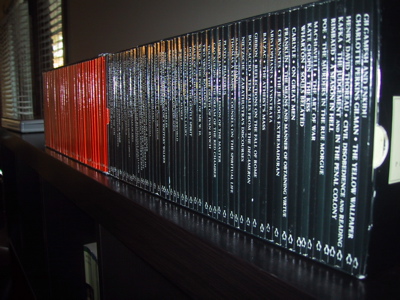
These are Penguin 60s, the original (orange) series and the Classics, which Penguin brought out in 1995 for their 60th anniversary. (They recently issued a similar series for their 70th, though not in the United States.) When they came out I really wanted the Classics collection, but had no money. I remember there was a certain amount of snotty declensionist commentary on the sort of people who would only spend 60p for excerpts of Civilization rather than reading the originals entire. Well, you can always have The Complete Penguin Classics delivered to your house for a mere $7,989.50 (don’t worry, shipping is free). About 750lbs worth and 77 linear feet of shelving, apparently — according to an Amazon reviewer who actually bought it. If you’re not up to that, just take The American Collection or the 19th Century British Collection instead, which are a bit cheaper.
by John Holbo on February 24, 2007
A bemused follow-up to my Frankenstein post. Here’s what you get tangled in, trying to edit this stuff into shape (plus YouTube goodies!). [click to continue…]
by Maria on February 22, 2007
by John Holbo on February 20, 2007
So it happened like this. I noticed that the Gutenberg Project version of Mary Shelley’s Frankenstein didn’t indicate which edition – 1818 or 1831. The two are rather different, as the author rewrote whole passages. Example: I just read a piece by Brian Aldiss in which he asserts, in passing, that H.G. Wells must have been misremembering when he wrote that “Frankenstein, even, used some jiggery-pokery magic to animate his artificial monster.” But: this would only be clearly wrong concerning the 1818 version, which is actually more ‘scientific’. An appendix to a recent edition of the 1818 edition notes: “the 1831 reader is allowed to think that the faculty at Ingolstadt [where young Victor gets his schooling] in the 1790s, even the previously sympathetic Waldman … were indeed teaching arcane magic under the name of natural science.” That’s sort of debatable, as a reading of the 1831 edition, seems to me. But it probably explains Wells’ impression.
Anyhoo. The Gutenberg version is definitely 1831. But, since Gutenberg editions are – Frankenstein-fashion – cobbled from the corpses of works passed into the public domain – it seemed possible that it was maybe a bit of both. Also, there are lots of typos (you get what you pay for.) Mostly just misplaced commas, colons and semicolons, but hundreds of those. (I’m convinced that the main export of Victorian England was the overused semicolon. Seriously, Shelley’s punctuation is bizarre. What’s with all the colons followed by dashes? Is that really necessary? Oh well.) So for the last few weeks I’ve been working through it, a chapter a night, with a public domain (1912 Everyman) edition of the 1831 edition in hand. I’m up to chapter 18. When I’m done I’m going to make a nice public domain edition. (Maybe do a book event.)
So here’s my question. When I’m done, I’d like to double-check it against an appendix to a still-in-copyright 1818 edition, which gives all the differences between the 1818 and 1831 editions. On the one hand, I really ought to be working from public domain material. On the other hand, I’m not exactly copying this appendix; merely verifying the correctness of text I’ve independently produced. Suppose I end up adding, subtracting or shifting 100 characters worth of punctuation, thanks to consultation of this appendix? Would that be a violation of copyright? Seems a bit weird if it is. 100 character total ought to be fair use, right? There must be copyright traditions concerning editorial questions like this, yes? Am I allowed to treat the appendix as containing information I am allowed to use freely?
UPDATE: Ben Wolfson has related, deep thoughts: “Punctuation marks can be very expressive, especially em dashes (my favorites!—maybe tied with semicola), so why ought one restrict their use to single isolated occurences? Surely in combination they can achieve heretofore undreamt-of degrees of subtlety in expression. (My gloss on the comash was that it implies a degree of reticence or hesitancy, and then:—suddenly elsewhere, or the dam is burst.)”
by Harry on February 19, 2007
From Avner Offer’s The Challenge of Affluence , perhaps the best first paragraph of an academic book:
Affluence breeds impatience and impatience undermines well-being. This is the core of my argument. For detail and evidence, go directly to the chapters; for implications, to the conclusion, which also has chapter summaries.
I’ve been longing to read this book since I first heard about it (several years ago) but, on reading the first paragraph, felt obliged to lend it to someone else for several weeks. I’ll tell you all about it when I’m finished with it. Be patient.
Other great academic first paragraphs?
by Henry Farrell on February 16, 2007
Charlie Cray forwarded me a link to this forthcoming “documentary”:http://www.indiesunderfire.com/index.html on the demise of independent bookstores and the rise of chains. This is something that I have more ambiguous feelings about than many lefty academics. On the one hand, there are independent bookstores in DC and elsewhere that I love, cherish, and try to shop in whenever I get a chance. But on the other, I grew up in a small town without a bookshop of any description whatsoever, a place which was a little like Penelope Fitzgerald’s “Hardborough”:http://www.nytimes.com/books/97/09/07/reviews/970907.07cunning.html?_r=1&oref=slogin before Ms Green arrives. A couple of times a year I would go to Fred Hanna’s when we visited relatives in Dublin, but the rest of the time I relied on what I could get from the local library or the small rack of paperbacks at the local newsagent. I’d have killed for a chain bookstore somewhere close by, and I find it hard to imagine that my teenage equivalent somewhere out there in the heartland today wouldn’t feel the same way.
There is something being lost as independent bookstores close; a lot of valuable, local knowledge possessed by smart, book-obsessed employees who could give good leads on other books that you ought to read if you liked or were interested in _x_. But the increase in choice provided by the spread of chains (and the Internet) to places that were badly served in the past isn’t to be discounted either. What is a more unalloyed tragedy in my eyes (and not only mine; I think I’m stealing this claim from Teresa Nielsen Hayden) is the demise of the kind of variegated paperbook rack in the newsagent/drugstore that got me reading in the first place. These mixed together bestsellers, unabashed junk, and all sorts of other obscure, semi-obscure and eccentric books. They got me hooked on reading. My impression is that these racks aren’t out there any more, in either Ireland or the US – the places that had them have either gotten rid of them altogether, or only use them to sell the same five or six bestsellers that everyone else is selling.
by Maria on February 11, 2007
As of January 1st, 2007, I’ve been keeping track of all the books I read/start. This is mostly because by the time I get to the end of the year and want to make a satisfying round-up of what I’ve read, what I’d recommend or trash, I find I can’t remember more than half a dozen of them. Two years out of three, I’m between homes and most of my books are in storage again, so I can’t run a finger along the shelf to prompt a memory of the year’s reading. Also, in a spirit of self-improvement I started lots of non-fiction books and know myself well enough to realise that a reporting system may be the only thing that makes me finish them. And finally, because my partial training in history and the social sciences gives me faith that data collected even for subjective purposes can be revealing of unexpected things. We shall see. [click to continue…]


