From the category archives:

Culture

Five Days in London, May 1940

by Harry on April 30, 2007

Its difficult for a republican to watch The Queen, and for several reasons. First, its not very good — Helen Mirren is fine, of course, but none of the set pieces rings true, Cherie is overacted and implausible, anyone who has watched enough Rory Bremner could have written the Campbell/Blair dialogue, and, although the actor playing Blair captures his mannerisms, he does so too obviously (why didn’t they just cast Bremner, I wonder?). Second, just as at the time 10 years ago, one’s loyalties are torn. Of course, in some sense one wants the monarchy abolished. But, while one finds the Queen utterly despicable in most respects, her reaction to the collective insanity of a large part of her nation does her credit. The indecent and frankly lunatic mourning of millions for someone they didn’t know and who was, basically, a manipulative wastrel, bemused at the time. My feeling was something like: “Well, if this is what sinks the monarchy, what’s the point? Let’s just keep the sods”. Finally, and crucially, you just cannot suspend your knowledge that, in the end, the Queen wins, with Blair’s help. There’s just no dramatic tension for anyone over the age of 18 who is not senile.

Which brings me to the question which started bugging me about half way through the film: why isn’t there a film of Five Days in London, May 1940 (UK)? Author John Lukacs tells the story of the first 5 days of Churchill’s premiership, the period during which the war was not won, but, more importantly, was not lost. The focus is on the struggle between Churchill on the one hand, and the defeatists Chamberlain and Halifax (Halifax having, apparently, been the King’s preference for Chamberain’s successor), with Clement Attlee and Arthur Greenwood, having joined the War Cabinet when Labour became part of the coalition government, starting out as observers but then getting drawn in to the battle. You see Attlee starting to realise that he had play the self-abnegating role as Churchill’s ballast that he maintained throughout the war. (A possibly apocryphal moment, which the ungossipy Lukacs does not treat us to, has Attlee pointing out to Greenwood that if Churchill loses to the Tory grandees civilisation in Europe will be gone, Greenwood retorting that if so, “it won’t be our fault” and Attlee responding “I don’t want to go down in history as someone whose fault it wasn’t when civilisation was destroyed”). Lukacs takes the struggle a day at a time, interweaving the high-level political struggle with documentary accounts of the mood of the country. The characters are larger than life; there is no collective insanity; and the stakes are high. Best of all, when you’re reading it, you keep forgetting what the outcome is going to be. It’s a thriller — perfect material for a movie, and a much better one than The Queen.

I hope it’s not a spoiler to reveal that Churchill’s faction won, and civilisation was saved to live another day. What a relief!

Childhood Horrors

by Kieran Healy on April 26, 2007

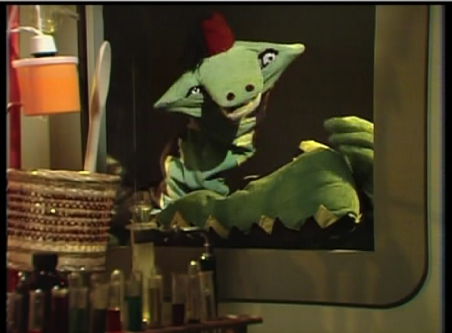
Sneaky SnakeSo, in a fit of nostalgia I picked up a DVD of Wanderly Wagon episodes. Although marketed as “Vol 1” it seems to be a slightly haphazard collection of episodes, as these were the days (the 1970s) when most programs were not preserved on videotape. The second scene in the first episode re-introduces us to the character shown here, Sneaky Snake. I had forgotten about his fez. But the tiny rush of adrenaline that I felt as he hoisted himself up on his bench (prehensile tail and all) next to Dr Astro reminded me how much he used to scare the bejaysus out of me when I was a kid. Something about the eyes. Always looking at you they were. On second thoughts, maybe I’ll hold off on making my own kids watch this stuff.

[click to continue…]

Roots

by Harry on April 25, 2007

Three days late, this one’s for Daniel (youtube). Who else but S of H would use a song lamenting a lost England to celebrate our immigrants? Me, I’m a rootless cosmpolitan, if an ultra-English one (CB’s adjective, not mine). More enthusiasm about Show of Hands here.

Transatlantic Crossings

by Scott McLemee on April 15, 2007

My friend Scott Kaufman asked me to point you to the book event The Valve is hosting on Amanda Claybaugh’s The Novel of Purpose. He was even considerate enough to write this post for me — links and all! [Though, truth to tell, I did edit it a little bit. And the fact that I am saying as much in brackets shows that there are limits to how much control of the author function I will give up.– sm]

Miriam Burstein has already thrown her hat into the ring. And Scott [SEK, that is, not me-sm]* has written a briefer on the context in which Claybaugh’s book is, as we say in the [academico-litcrit] biz, “intervening.”

So if you find the 19th century, social reform, literary realism or the works of Dickens, Bronte, and Twain at all interesting, I [or we? something like that-sm] suggest you check it out.

* [this is kind of like “Temptation Inside Your Heart” on the “lost” Velvet Underground album which has a couple of tracks of Lou Reed commenting on the song and arguing with his own commentary: “I can talk to myself if I want to….”-sm]

“It’s Short for Emo-tional”

by Scott McLemee on April 9, 2007

As if the good people of Grand Forks, North Dakota don’t have enough to worry about, a local news station has alerted them to the menace of a mutant subculture:

[ we’re having a glitch with the video embed, but it’s also available here. ]

This is tone-deaf even by TV news standards. Even someone who will never see 40 again (yours truly for example) can tell that at least some of the material presented here as typical of “emo culture” has obvious satirical intent.
[click to continue…]

Freaks and Geeks

by Harry on April 5, 2007

Terry Gross interviewed Jake Kasdan on Fresh Air yesterday. Most of it was enabling him to plug a soon-to-be-out movie, and talking about his currently-in-progress movie, both of which sound very good. But much more interesting was the discussion of Freaks and Geeks, on which he was a director and co-producer. Interestingly, though, he misinterprets one of the central events.

Before proceeding with the spoiler, I should explain why, if you haven’t seen Freaks and Geeks, you should not read on until you’ve watched it (easy to do because its now on DVD, all 18 episodes, not just the 12 that were aired). Freaks and Geeks was the best thing on American TV in the past 20 years or so, and that means that it is better than, e.g., the Sopranos). If you have ever gone to school, at least in an English-speaking country after about 1960, you’ll recognise some aspect of your experience; and almost everything is believable. I knew two of the central characters when I was at school (in southern England); Lindsey is even dressed the same as one of my friends. You knew one or two of them too. Brilliantly written, perfectly cast, it’s what TV ought to be.

[click to continue…]

Free Stuff

by Scott McLemee on March 20, 2007

Last month I mentioned that Political Theory Daily Review had found a sponsor — the magazine Bookforum. As it happens, the new issue just arrived in my mailbox yesterday, even before it reached the newstand, which doesn’t always happen.

Well, now you can read it, too. As of the April/May issue, nearly all of the contents are online for free. It looks like a couple of items are print-only, out of about 45.

I’m still partial to the paper version. Easier on the eyeballs, for one thing; plus, the ads in a book publication actually count as information that I want to see. But at a time when most newspaper review sections are shrinking when not disappearing, it’s good that one publication seems to be doing well enough to make its content available to the largest possible readership.

DVD on DVD

by Harry on March 13, 2007

When the baby arrived, a friend lent us the entire first season of Bewitched on DVD. Now several seasons are on sale in amazon’s fantastic Classic TV Sale. Browsing through the sale brings back many memories. I’ve watched American classic TV in three stages. First, as a kid in the 70s, I saw whatever got imported to the UK at the time (including oldies like Bewitched). Then, in LA in the mid-eighties I watched the true classics — Dick Van Dyke (DVD on DVD — get it!), The Flying Nun, and The Addams Family – in reruns. The new-to-me-at-that-time show I found it hardest to watch was I Dream of Jeannie, not because it is amazingly sexist (which it is) but because by the mid-80s it was impossible to watch Larry Hagman playing a comic role. Finally, now that the DVD revolution has made everything, however bizarre, readily available, I’m watching whatever I can get my hands on with my kids. Still, guidance would be appreciated. You know what I’m like: recommendations welcome. And hurry so that I can get a good deal.

Showy spending

by Henry Farrell on January 19, 2007

Becks at Unfogged and Scott Lemieux both wonder why the hell the _New York Times_ publishes articles like this.

FOR some people, the most elusive aspect of owning a vacation home that sits beyond big-city borders isn’t finding the time to enjoy it. It’s finding someone to service the deluxe appliances inside.

“We called Viking over the holidays every year,” Rosemary Devlin said of her half-decade-long (and mostly futile) efforts to schedule manufacturer service for her mutinous dishwasher. The appliance was installed along with a suite of Viking cousins when Ms. Devlin and her husband, Fay, whose main house is about 20 miles north of Manhattan in Irvington, N.Y., built their six-bedroom ski house on Okemo Mountain in Ludlow, Vt.

The _Financial Times_ (which has its biases, but is still in my opinion the best newspaper out there), has an entire bloody weekend supplement devoted to this kind of stuff, with the classy title How To Spend It. While a fair number of its readers are presumably City types who can afford the pieds-a-terres and fancy toys lovingly detailed in its pages, I would imagine that most of its readers aren’t. Someone who I was chatting to about this recently suggested that it’s an aspirational thing; while most of its readers can’t afford this stuff, they’d like to be able to, and are more likely to buy a newspaper that allows them at least to daydream about it. Or perhaps the marketing types think that readers would prefer to be addressed _as if_ they were in a position to “Spend It” even when they aren’t. Any other plausible explanations?

Same-Sex Marriage Revisited

by Harry on January 10, 2007

Thanks to everyone for the suggestions concerning anti-same-sex marriage readings for my contemporary moral issues course. I was quite nervous about the topic, because I anticipated very strong feelings among the students, especially because we discussed it in the wake of the entirely unsurprising to me but shocking to many of them success of the anti-same-sex-and-civil-unions amendment in November. I emphasized at the beginning of the segment that I wanted the full space of reasons to be explored, and encouraged them to look for both anti- and pro- arguments, and reminded them that when someone argues for a claim in class they should be taken just to be exploring a reason, so there should be no presumption that they are committed to an undesirable conclusion. All to no avail. Not one student was willing to speak up against same-sex marriage, despite the fact that an anonymous survey revealed that 15% of them are strongly opposed. Interestingly, and in my view rather optimistically, conversations that I had with a number of pro-same-sex-marriage students coming from the Wisconsin heartland revealed that their views were completely at odds with those of their parents (well, their fathers) but not those of their fellow high school students, including those who remained in the towns from which these students came. Is there good survey data about the distribution of opposition to same-sex-marriage across age groups?

I used Margaret Somerville’s The Case Against Same-Sex Marriage, Lee Harris’s The Future of a Tradition, and Stanley Kurtz’s The End of Marriage in Scandinavia. And the truth is that the case against same-sex marriage seems pretty weak, unless someone can come up with some much better papers. Fortunately, I had some disagreements with Ralph Wedgewood’s excellent pro-same-sex-marriage paper which we also used. But the anti-papers are not very strong at all. I’ll focus mainly on the Somerville paper, then make a couple of comments about the others.

[click to continue…]

Spooked

by Maria on November 23, 2006

After nine lovely Mondays spent anticipating the evening’s installment of Spooks, series 5, it’s all over. Monday is back to being plain old boring old Monday and Brussels seems even greyer than usual. Which isn’t to say this series was stellar. It was bigger and sexier, with more explosions and grander conspiracies. But the noisier Spooks gets, the less it seems to say. Spooks always had an eerie talent for anticipating world events – it started filming in the months before 9/11 – but fact is now so much stranger than fiction.

Two more of the few remaining characters from the first series have been dismissed. The only discernible character arc in the whole of series 5 was that of our hero, Adam, who spiralled further and further downward, with a quick stop off to bang his nanny. Actually, his story was a good one, and put the lie to most action-led tv series where characters bounce back from the deaths of loved ones within an episode or three. But the entry of a new female lead (Ros, played by Hermione Norris) flattened the entire series and crowded out two far more interesting and sympathetic characters, Zaf and Jo. Which is a pity, because Hermione Norris has the animation of a wooden cadaver. She’s no more credible doing hand to hand combat with Mossad agents than she is laying a glamorous honeytrap for a Saudi playboy.

The original strength of Spooks was the ordinariness of the spies and their struggles to reconcile their normal lives with the weird reality of their working world. Tom might have been an SAS-trained killer, but he had terrible taste in girlfriends and was never far from a nice cup of tea. The younger spies put their lives on the line every working day, but as junior civil servants they couldn’t really afford to live in London.

I know it’s dramatically useful for tv show characters to have no life outside of work, except for the occasional relative who can be placed in jeopardy. But it’s dull, dull, dull (not to mention deeply unquestioning of live-to-work capitalism). Life in the bubble suffocates the characters and makes them less believable. And that kills precisely what was so great about Spooks. Series five squeezed its characters into a smaller and less lifelike world, just as it inflated the scale of the threats a mere seven people face off. It’s now recycling stories – like the embassy hostages – from earlier series, but that only shows how much the Spooks has lost its own plot.

Paintings to see before you die

by Maria on October 30, 2006

The Guardian has a lovely new arts blog that leads off with a piece about the 20 paintings to see in the flesh before you die:
“van Eyck, The Madonna of Chancellor Rolin, c.1435, Musée du Louvre, Paris
Caravaggio, The Burial of St. Lucy (1608), Museo di Palazzo Bellomo, Syracuse, Sicily
Rembrandt, Aristotle with a Bust of Homer (1654), Metropolitan Museum of Art, New York
San Rock Art, South African National Museum, Cape Town
Paul Cézanne, Mont Sainte-Victoire from Les Lauves (1904 – 6), Pushkin Museum of Fine Arts, Moscow
Michelangelo, Moses (installed 1545), Church of San Pietro in Vincoli, Rome
Leonardo da Vinci, The Adoration of the Magi, (c. 1481), Uffizi Gallery, Florence
Mark Rothko, The Rothko Chapel (paintings 1965-66; chapel opened 1971), Houston, Texas
Vermeer, View of Delft (c.1660-61), Mauritshuis, The Hague
Matthias Grünewald, The Isenheim Altarpiece (c.1509-15), Musée Unterlinden, Colmar, France
Hans Holbein, The Dead Christ, (1521-2), Kunstmuseum, Basel
Velázquez, Las Meninas (1656), Museo Nacional del Prado, Madrid
Funerary Mask of Tutankhamun (1333-1323BC), Egyptian Museum, Cairo
Jackson Pollock, One: Number 31, 1950, Museum of Modern Art, New York
Masaccio, The Expulsion of Adam and Eve from Paradise (c.1427), Brancacci Chapel, Santa Maria del Carmine, Florence.
Pablo Picasso, Guernica (1937), Reina Sofia Museum, Madrid
Titian, Danaë (c. 1544-6), Museo Nazionale di Capodimonte, Naples
Raphael, The School of Athens (1510-11), Stanza della Signatura, Vatican Palace, Rome
Parthenon Sculptures (“Elgin Marbles”), c. 444 BC, British Museum, London
Henri Matisse, The Dance (1910), Hermitage Museum, St. Petersburg, Russia.”

The comments unfairly criticise Jonathan Jones’ selection as too European, but he says himself it’s a subjective list of paintings so serious or affecting as to be worth travelling to see. And he invites readers to suggest their own. It’s an interesting take in the age of mechanical reproduction. The suggestions so far lean heavily on the 20th century, with the odd old master thrown in. I hope the Guardian’s commenters take up Jones’ challenge to broaden the field.

I’ve seen maybe a quarter of Jones’ list (if we allow ‘seen’ to include works I have shuffled past in the Louvre). But I’d still add to it Chagall’s stained glass windows in the Hadassah Hospital in Israel. They are deeply moving and can only be properly experienced by going there. You haven’t experienced Chagall till you’ve experienced him with light coming through (although the Chagall gallery in Nice comes close). Secondly, I’d add Monet’s Nymphéas which have been specially hung in curved rooms at the Orangerie in Paris. A recently attempted visit confirms the Orangerie is still impossible to get into, so this addition to the list is really wishful thinking.

The Guardian’s arts blog also reminds me to post a link to a wonderful stage interview of Gael Garcia Bernal at the NFT a couple of weeks back. The character GGB most identifies with is the sweet but irresponsible Julio from Y Tu Mamá También, but his thoughtful comments about politics and inequality in Mexico show this actor has more to say for himself than your average horny teenager.

Fear of a Monotheistic Cyborg Planet

by Scott McLemee on October 6, 2006

If someone hinted two years ago that one day I would be eagerly awaiting the third season of a remake of Battlestar Galactica, my response would have been something like, “Get away from me, crazy person, because that is crazy, what you are saying to me.”

The original series ran in the late 1970s and was very, very dumb. Sure, it’s interesting to learn that bits of Mormon theology were embedded into the show. And I suppose some people will now be entertained by those vintage haircuts. But don’t be fooled by the sickly glow of nostalgia. The show was junk. Let’s put it this way: There was a robotic dog.
[click to continue…]

You Should Read The Weblog

by Belle Waring on September 14, 2006

C’mon it’s The Weblog. You’re missing out on insightful posts like this one from Dominic, on how Fay Weldon is the antichrist:

The model of libidinal economy endorsed by Weldon is essentially that of middle-class parenting: let your children have the smallest possible amount of what they clamour for – sweets, television, computer games – and make their access even to that conditional on an unremitting parade of good manners and the assiduous consumption of vegetables. In such a manner is exorbitant desire acknowledged through gritted teeth – when it is not being exploited to secure obedience. All of this is fair enough in extremis, which is where most parenting of small children is done, but it is nauseating to encounter an adult person still willingly enthralled by such a ruthlessly petty system of restraint and reward. If adolescence has any purpose at all, it is to shatter those bonds.

Read the whole thing, because it really is an excellent little essay. On a lighter note, you can be astounded by the unparallelled quote-mining skills of Adam Kotsko:

In Moral Man and Immoral Society (1932), Reinhold Niebuhr quotes a Southern politician protesting against suffrage tests for black voters “on the ground that they would discriminate in favor of the educated Negro against the servile, old-time Negro”:

Now, sir, the old-time Negro is assassinated by this suffrage plan. This new issue, your reader, your writer, your loafer, your voter, your ginger-cake school graduate, with a diploma of side-whiskers and beaver-hat, pocket pistols, brass knucks [sic] and bicycle, he, sir, is the distinguished citizen whom our statesmen would crown at once with the highest dignities of an ancient and respectable commonwealth.

I think I speak for all of us when I say, humina whatsa ginger-whisker beaver-hat whaaaaa? The Weblog has many other fine posters, too; I’m sure your life needs more Ben Wolfson. McLemee may be shy to hype The Weblog, but I’m not. Go ye, and read of it. Also, ginger-cake.

Britain, the German version ….

by Chris Bertram on September 2, 2006

I guess my Irish co-bloggers are rather used to foreigners thinking that they come from a gigantic theme park that bears no resemblance to their country as it actually is. For me it was rather more of a shock, when, for family reasons, I got dragged along to British Day in Hamburg ( photo gallery ). This was the UK (assisted by the Irish who seemed to count as honorary Brits for rugby and drinking purposes) as depicted in _Horse and Hound_ or _Country Life_ , re-enacted by enthusiastic Germans. There was polo, there was rugby, there were endless stalls selling Harris tweed and barbour jackets, there was a welly wanging contest, and a Highland games section where characters called Otto and Diemut (or something like that) tossed the caber whilst dressed in Royal Stewart tartan. English boarding schools — though not the really famous ones — were there too, touting for business among the Hamburg anglophiles: “send Hans to Hogwarts and make him into a real gentleman” was the message. Really quite bizarre. I’m afraid I missed the “last night of the Proms” part, where enthusiastic Hamburgers joined in the singing of “Land of Hope and Glory”, but I could hear it all in the distance. And the stall that came closest to the actual lives of most of us … Indian food, naturally.