Scott at his other place blogs about the latest McCain video (which is so staggeringly bad at achieving its purported aims that it doesn’t make sense _except_ as a dogwhistle video).
From the category archives:
Religion
Steve Fuller gets a good kicking from the excellent Steven Poole:
bq. … Fuller happily adopts ID’s rhetorical tactics: speaking of biologists’ “faith”; forgetting to mention (or merely being ignorant of) the wealth of evidence for evolution in modern biology that wasn’t available to Darwin himself; and even muttering about the “vicissitudes” of fossil-dating, thus generously holding the door open for young-Earth creationists, too. The book is an epoch-hopping parade of straw men, incompetent reasoning and outright gibberish, as when evolution is argued to share with astrology a commitment to “action at a distance”, except that the distance is in time rather than space. It’s intellectual quackery like this that gives philosophy of science a bad name.
(Hat tip: SO)
I was lucky enough to see Martha Nussbaum give a lecture in Chicago a couple of weeks ago, based on her new book Liberty of Conscience: In Defence of America’s Tradition of Religious Equality

I just spent an hour trying to make my way through the Popage – I had forgotten that the papal procession would be wending its way along Pennsylvania Avenue, which inconveniently cuts between my Metro station and my office. Eventually, the Pope made his way through, waving at the cheering crowds on both sides of the street, but even afterwards the street was closed (for some unexplained reason which I suspect had more to do with DC police overtime than security needs, they aren’t letting people cross the street again for another couple of hours).
It was an interesting contrast with the last time that I had seen a Pope in person – when John Paul II came to visit Ireland in 1979, I, along with a very significant chunk of the rest of the population, went to see him. This was probably the high-water mark of the Catholic Church’s influence in Ireland – the 1980s saw a series of largely successful defensive actions against encroaching secularism, while the 1990s saw a series of unsuccessful ones against teh gay (finally legalized in 1993), the introduction of condoms (which had previously been available only by prescription in order to try to limit their use to married couples), divorce, and the right to travel to obtain an abortion.
In particular, I was struck by the similarities between the 1979 Popemobile and the 2008 version – either the engineers haven’t much imagination, or there isn’t all that much you can do to improve the basic design (although I don’t remember the original having bulletproof glass). Nor was the 1979 experience complicated by evangelical Christians with bullhorns vigorously denouncing ‘false religion’ and telling the cheering nuns and folks in Pope Benedict t-shirts that they were all going to go to hell unless they were born again in Christ. Finally, I was intrigued by this sign (apologies for blurriness of photo; the camera on my phone is garbage), which seemed to me to have dark undertones that were presumably not intended by the person who was waving it about.

It seems to be children’s TV and organ procurement week here at CT; before I get started into something new I should probably note that Russell Arben Fox has said everything I wanted to say in my earlier postbut has put it far more thoughtfully and eloquently. As the father of a two year old with an interest in the topic (albeit one whose TV diet is restricted to 2 hours on weekends, much to his disgruntlement), I’ve become much more intimately acquainted with the offerings of US children’s TV than I ever imagined possible or desirable. I’m especially interested in how US TV deals with the product of foreign cultures. Sometimes, it improves on them, as in the three dimensional _Noddy_ show. Not that it’s much good or anything, but the original books weren’t much cop either, and the frank racism of the original has been replaced by a soothingly multicultural Toytown in which PC Plod, oddly enough, is the only character to maintain a real English accent (I suspect serious dubbing of the UK original).
As an Irishman, I’m naturally more interested in _Jakers: The Adventures of Piggleywinks_ which is probably the most influential depiction of my native culture that millions of American children will ever be exposed to. And it’s surprisingly well done in my opinion – not classic Sesame Street good, but still not at all bad – you feel that the creators have taken some care in putting it together. Bits of the background, such as the national school ring reasonably true to my own upbringing, and even if it’s a concatenation of cliches, they’re well researched cliches. Most of the characters even have real Irish brogues (unlike other shows with bigger budgets), although the grandfatherly narrator seems to have mysteriously picked up a pronounced Dublin working class accent somewhere in his peregrinations between Raloo Farm and Amerikay.
Still, there’s one glaring omission from its depiction of rural Irish life in the 1940s – there’s no mention (at least in the episodes I’ve seen) of the Roman Catholic church, or any other church for that matter. Apart from their occasional utterance of the eponymous expression of surprise, you’d think that the villagers were as godless a crowd of humanists as ever warmed the cockles of PZ Myers’ heart. I can understand why the program producers made this choice – it would be hard to tackle the role of the church in 1940’s Ireland without falling into the one set of cliches or the other, and the bits after the main show seem designed to highlight the universalities of the immigrant experience rather than the particularities of one small country. But it still feels odd to me every time I watch the program; having grown up in a small market town with less than 2,000 inhabitants myself, I can testify that the Catholic church was not only important but omnipresent. It organized and disciplined the community in good ways and in bad. When I was around nine years old or so, we were told by the headmaster of the local Christian Brother’s school (the unloved Brother Ryan – I sometimes wonder what’s happened to the vicious old bastard since) that the local cinema was to be boycotted because it had dared to show _The Life of Brian._ One boy who broke the boycott, and was caught, got several strokes of the stick in front of the class for his pains; none of us found this at all remarkable at the time. Of course, the country (and the town, on the couple of occasions I have been back through it) have changed dramatically in the interim, and not entirely for the better; while I wouldn’t want to go back to the Ireland of the 1970s, let alone the 1950s, I find the consumerism and materialism of the new Ireland pretty unpleasant in its own way too.
John Gruber twittered the following:
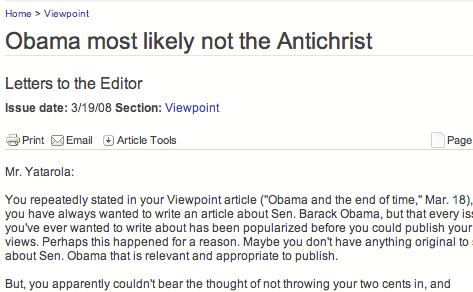
bq. Suggestion for Gallup: how many Americans both (a) are offended by sermons of Obama’s Christian pastor and (b) think Obama is a Muslim?
Which led me to check out this Pew Center Report:
bq. The recent controversy surrounding sermons by Obama’s former pastor, Rev. Wright, and Obama’s March 18 speech on race and politics have attracted more public attention than other recent campaign events, according to Pew’s weekly News Interest Index. Nearly eight-in-ten (79%) say they heard at least something about Wright’s sermons (51% a lot, 28% a little) and about half (49%) have seen video of the sermons. … There is little evidence that the recent news about Obama’s affiliation with the United Church of Christ has dispelled the impression that he is Muslim. While voters who heard “a lot” about Reverend Wright’s controversial sermons are more likely than those who have not to correctly identify Obama as a Christian, they are not substantially less likely to still believe that he is Muslim. Nearly one-in-ten (9%) of those who heard a lot about Wright still believe that Obama is Muslim.
In yet more sin news, according to Bloomberg (and others), the Vatican has updated its list of mortal sins to include “seven social sins”:
1. “Bioethical” violations such as birth control
2. “Morally dubious” experiments such as stem cell research
3. Drug abuse
4. Polluting the environment
5. Contributing to widening divide between rich and poor
6. Excessive wealth
7. Creating poverty
The Times Online observes that “The Catechism of the Catholic Church states that ‘immediately after death the souls of those who die in a state of mortal sin descend into Hell.’” And while acknowledging that “there is no definitive list of mortal sins,” they provide a list of:
The original offences and their punishments
Pride – Broken on the wheel
Envy – Put in freezing water
Gluttony – Forced to eat rats, toads, and snakes
Lust – Smothered in fire and brimstone
Anger – Dismembered alive
Greed – Put in cauldrons of boiling oil
Sloth – Thrown in snake pits
Interesting, in a that-wacky-Pope kind of way. But their source is a little peculiar: The Picture Book of Devils, Demons and Witchcraft, by Ernst and Johanna Lehner. They neglect to mention the subtitle: “244 Illustrations for Artists and Craftspeople.”
And the new list seems to suffer from some … um … padding: 5, 6, and 7 are not the same, but if you avoid excessive wealth and don’t create poverty, it seems you’ve got a pretty good jump on not “contributing to widening divide between rich and poor.” Not to mention that number 2. threatens circularity, while “Drug abuse” seems kind of vague to me. Perhaps not the best thought-out list.
But upon further investigation, it’s not clear that the Vatican intended to produce a new list in the first place. According to the AP: “Vatican officials, however, stressed that Girotti’s comments broke no new ground on what constitutes sin.” As far as I can tell, in an interview Bishop Gianfranco Girotti commented: “If yesterday sin had a rather individualistic dimension, today it has a weight, a resonance, that’s especially social, rather than individual.” And he gave some examples (although I admit to being a little unclear about how they are social in a new way). But it doesn’t seem that he gave seven examples. And, frankly, I can’t even tell if he intended his examples to be of mortal sins. My advice: avoid anything that is “morally dubious” until the situation is clarified.
Via Lindsey, I read this paper by Simon Blackburn (pdf) which appears, again, in Philosophers without Gods: Meditations on Atheism and the Secular Life
Blackburn’s chapter is, for the most part, an argument against versions of respect for religion that hinge on interpreting the claims of religious believers as not being the kinds of claim that can be true or false, and he makes that argument rather well. The point in dispute, though, is whether we can truly respect people who have what we regard to be false beliefs. He thinks not:
We can respect, in the minimal sense of tolerating, those who hold false beliefs. We can pass by on the other side. We need not be concerned to change them, and in a liberal society we do not seek to suppress them or silence them. But once we are convinced that a belief is false, or even just that it is irrational, we cannot respect in any thicker sense those who hold it—not on account of their holding it. We may respect them for all sorts of other qualities, but not that one. We would prefer them to change their minds.
Rowan Williams doesn’t need me to defend him, having, preumably, better placed and more powerful friends (one in partiuclar). But here goes anyway. One of my several Anglophile (and this one a rare Episcopalian) in-laws just sent me (approvingly) this piece from the Sunday Times, and added the following, rather lovely if a little unlikely, quote, recommending a different version of multiculturalism from that to which he takes the Archbishop to be committed (which, I gather from googling, comes from Mark Steyn):
In a more culturally confident age, the British in India were faced with the practice of “suttee” — the tradition of burning widows on the funeral pyres of their husbands. General Sir Charles Napier was impeccably multicultural:
”You say that it is your custom to burn widows. Very well. We also have a custom: When men burn a woman alive, we tie a rope around their necks and we hang them. Build your funeral pyre; beside it, my carpenters will build a gallows. You may follow your custom. And then we will follow ours.”
The Monkey Cage writes about an experiment on people’s perceptions of photos of a young woman wearing a headscarf and without one. I don’t see any information on how careful the surveyors were to ensure randomness, whether they carried out statistical tests of significance etc etc (this appears to have been put together by a general social research firm, rather than academics). Still, if the results don’t have major problems, then they make for interesting reading. Not all the inferences that people make about the veiled, as opposed to the unveiled woman, seem unreasonable. Unsurprisingly, more people consider the woman to be more conservative when they see the headscarf photo (this seems to me to be not an unreasonable inference; people who display overt symbols of religiosity often are more conservative). But there are some other judgements that are a little bit less pleasant.
Subjects displayed considerably more aversion to the covered woman. Specifically, they were less likely to want to live near her. While 89% said that they would like the uncovered woman as their next-door neighbor or in their neighborhood, only 62% said that about the covered woman. One-fifth (19%) actually said they wanted her to live “outside of the US.”
More here.
!http://www.themonkeycage.org/headcovering-thumb.PNG!
Thanks to recent developments in the Democratic primaries, trivialization of Martin Luther King’s legacy is off to an all-time early start this year. But Christopher Phelps has just published an excellent overview of recent historical work on MLK that knocks some of the ceremonial tinsel off — the better to see the real figure, who would never get a word in edgewise today.
The latest volume from the King Papers Project, for example
comprises King’s sermons from 1948 to 1963, which remind us of King’s immersion in the black Baptist church and of the wide range of theological sources and social criticism he drew upon. For King, Christianity was the social gospel. His outlook was astonishingly radical, especially for the McCarthy era. In a college paper entitled “Will Capitalism Survive?” King held that “capitalism has seen its best days in America, and not only in America, but in the entire world.” He concluded a 1953 sermon by asking his congregation to decide “whom ye shall serve, the god of money or the eternal God of the universe.” He opposed communism as materialistic, but argued that only an end to colonialism, imperialism, and racism, an egalitarian program of social equality, fellowship, and love, could serve as its alternative. In a 1952 letter responding to Coretta’s gift to him of a copy of Edward Bellamy’s utopian socialist novel Looking Backward (“There is still hope for the future … ,” she inscribed on its flyleaf), King wrote, “I would certainly welcome the day to come when there will be a nationalization of industry.”
The volume’s assiduous editorial annotation permits us to locate King in lived dialogue. We discover, for example, that his 1952 sermon on “Communism’s Challenge to Christianity,” delivered at Ebenezer Baptist Church, prompted a letter of retort from Melvin H. Watson, a Morehouse College professor and Ebenezer congregant, who attempted to set King straight on the virtues of Stalin. Watson, a holdover from the Communist-led Popular Front, helps us place King’s democratic radicalism in bold relief while providing a concrete illustration of how black communities retained a strong left-wing presence even after the 1940s.
The whole article is available online from The Chronicle of Higher Education. Looking over the passage just quoted, I had a flashback to various hopeless arguments with Chron copyeditors — for it is singularly absurd not to have capitalized the “c” in Phelps’s line mentioning that King “opposed communism as materialistic.”
The international Communist movement (corporate world headquarters in Moscow, later with rival franchise based in Peking) was indeed materialistic, yes. But would King have opposed communism, tout court? “From each according to his ability, to each according to his need”?
I doubt that very much: “And all that believed were together, and had all things in common; and sold their possessions and goods, and parted them to all men, as every man had need.” (Acts 2:44-45)
One of the commenters to my post below suggested that Mike Huckabee was unlikely to do well among Catholics. Philip Klinkner (who is really blogging interesting stuff on the races) has some county-level data from Iowa suggesting that this is true.
!http://www.henryfarrell.net/klinkner1.jpg!
GOP caucus results (counties won by Huckabee in blue; by Romney in red)
!http://www.henryfarrell.net/klinkner2.jpg!
Distribution of Catholics in Iowa (the redder the county, the more Catholics)
An eyeballing of the graph suggests that the parts of the state where Huckabee had most trouble were indeed, more often than not, those places where there were more Catholics. Klinkner runs a regression testing how percentage of population religious, percentage of population Catholic, percentage of population evangelical, and percentage of population rural affected voting for Huckabee, and finds that the coefficient for Catholicism is negative, high, and statistically significant.
Update see here for Klinkner’s response to some of the methodological criticisms.
Via Lindsey, I see that Christianity Today has an interesting interview with Philip Pullman; the extended interview is at Peter Chattaway’s blog here. Well worth reading. My favourite quote is the same as Lindsey’s (no doubt because I can identify with it pretty well, and it helps explain why I liked HDM so much; though my atheism is more of the low-CofE-veering-on-Methodism kind):
My answer to that would be that I was brought up in the Church of England, and whereas I’m an atheist, I’m certainly a Church of England atheist, and for the matter of that a 1662 Book of Common Prayer atheist. The Church of England is so deeply embedded in my personality and my way of thinking that to remove it would take a surgical operation so radical that I would probably not survive it.
I can’t argue with most of the selections in “The Nine Most Badass Bible Verses” — except for thinking that at least one violent episode might have been cut in favor of something from the Song of Solomon booty call.
Plus it’s a problem that the list implies a ranking, because no way Elisha and the bears (2 Kings 2:23-24) should come in at a mere number 8:
23 From there Elisha went up to Bethel. As he was walking along the road, some youths came out of the town and jeered at him. “Go on up, you baldhead!” they said. “Go on up, you baldhead!” 24 He turned around, looked at them and called down a curse on them in the name of the LORD. Then two bears came out of the woods and mauled forty-two of the youths.

And what do we learn from this? Valuable lessons for today:
Christians are constantly asking for prayer in schools to help get today’s kids in line, but we beg to differ. We need bears in schools. If every teacher had the power to summon a pair of child-maiming grizzly avengers, you can bet that schoolchildren nowadays would be the most well-behaved, polite children, ever. It’s a simple choice: listen to the biology lesson, or get first-hand knowledge of the digestive system of Ursus horribilis.
It should be pointed out that even after his death, Elisha continued to kick ass. II Kings 13:20-21 tells us that when a dead body was thrown into his tomb and touched Elisha’s bones, it sprang back to life. It’s unknown whether Elisha had this power in life, as well as death, but we like to think he did and that he had the habit of killing his victims with bears, resurrecting them, and then promptly re-summoning the bears to kill them, again. He’d just repeat the whole thing over and over until he got bored.
via Ralph Luker