From the category archives:

Social Science

Contradictory beliefs

by Chris Bertram on September 22, 2011

It isn’t a good thing to have contradictory beliefs. Since I’ve notice what appear to be such beliefs in myself recently, I thought I’d share, both because I guess that there are others out there who also have them, and in the hope that Crooked Timber’s community of readers can tell either that I should discard some of them (on grounds of falsity) or that I’m wrong to think them contradictory. So here goes.

Belief 1: As a keen reader of Paul Krugman, Brad DeLong (yes, really), our own John Quiggin and other left-leaning econobloggers, I believe that most Western economies need a stimulus to growth, that austerity will be counterproductive, and that without growth the debt burden will worsen and the jobs crisis will get deeper.

Belief 2: As someone concerned about the environment, I believe that growth, as most people understand it, is unsustainable at anything like recent rates. Sure, more efficient technologies can reduce the environmental impacts of each unit of consumption, but unless we halt or limit growth severely, we’ll continue to do serious damage. There are some possibilities for switching to less damaging technologies or changing consumption patterns away from goods whose production causes serious damage, but the transition times are likely to be long and the environmental crisis is urgent.

Belief 3: Some parts of the world are just too poor to eschew growth. People in those parts of the world need more stuff just to lift them out of absolute poverty. It is morally urgent to lift everyone above the threshold where they can live decent lives. If anyone should get to grow their consumption absolutely, it needs to be those people, not us.

Belief 4: The relative (and sometimes absolute) poverty that some citizens of wealthy countries suffer from is abhorrent, and is inconsistent with the status equality that ought to hold among fellow-citizens of democratic nations. We ought to lift those people out of poverty.

If I were to attempt a reconciliation, I’d say that this suggests zero or negative growth in material consumption for the wealthier countries but a massive programme of wealth redistribution among citizens at something like the current level of national income, coupled with a commitment to channel further technological progress into (a) more free time (and some job sharing) or a shift in the mix of activity towards non-damaging services, like education (b) switching to green technologies (c) assistance to other nations below the poverty threshold. All of those things need mechanisms of course if they’re to happen — and I’m a bit light on those if I’m honest, outside of the obvious tax-and-transfer. What we don’t need is more in the way of “incentives” to already-rich supposed “wealth creators” and the like. What we certainly don’t need is a strategy that purports to assist the worst off in the wealthiest countries by boosting economic activity without regard to the type of activity it is, in the hope that this gives people jobs and, you know, rising tides, trickling down and all that rigmarole. The trouble is that Belief 1, which I instinctively get behind when listening to the austerity-mongers, is basically the same old tune that the right-wing of social democracy has been humming all these years. It is just about the only thing that will fly for the left politically in a time of fear, joblessness and falling living standards, but it seems particularly hard to hold onto if you take Belief 2 seriously.
Money, sex, economics and stuff

by Chris Bertram on September 16, 2011

Aside from containing a brilliant exposition of how blogospherical “rebuttal” actually works — basically endless posts by halfwits repeating that X (an eminent scholar) is an ignoramus because X has contradicted the received wisdom of a tribe — this post by Dave Graeber at Naked Capitalism has to be one of the most informative and entertaining pieces I’ve read in a long while. What happens when the findings of anthropologists about earlier societies clash with the a priori assumptions of economists about how things _must_ have happened? Well, you can guess. The really interesting stuff is in the anthropological detail, so read the whole thing, as they say, but I’ll just quote Graeber on economics and scientific method:

bq. Murphy argues that the fact that there are no documented cases of barter economies doesn’t matter, because all that is really required is for there to have been some period of history, however brief, where barter was widespread for money to have emerged. This is about the weakest argument one can possibly make. Remember, economists originally predicted all (100%) non-monetary economies would operate through barter. The actual figure of observable cases is 0%. Economists claim to be scientists. Normally, when a scientist’s premises produce such spectacularly non-predictive results, the scientist begins working on a new set of premises. Saying “but can you prove it didn’t happen sometime long long ago where there are no records?” is a classic example of special pleading. In fact, I can’t prove it didn’t. I also can’t prove that money wasn’t introduced by little green men from Mars in a similar unknown period of history.

Via Chris, on Twitter (I hope I’m not preempting him here), an Open Letter from a Keynesian to a Marxist by Joan Robinson, and “Zombie Marx“, an essay by Mike Beggs. Here is Robinson, writing in 1953:

I was a student at a time when vulgar economics was in a particularly vulgar state. … There was Great Britain with never less than a million workers unemployed, and there was I with my supervisor teaching me that it is logically impossible to have unemployment because of Say’s Law. Now comes Keynes and proves that Say’s Law is nonsense (so did Marx, of course, but my supervisor never drew my attention to Marx’s views on the subject). … The thing I am going to say that will make you too numb or too hot (according to temperament) to understand the rest of my letter is this: I understand Marx far and away better than you do. (I shall give you an interesting historical explanation of why this is so in a minute, if you are not completely frozen stiff or boiling over before you get to that bit.) When I say I understand Marx better than you, I don’t mean to say that I know the text better than you do. If you start throwing quotations at me you will have me baffled in no time. In fact, I refuse to play before you begin. What I mean is that I have Marx in my bones and you have him in your mouth. … suppose we each want to recall some tricky point in Capital, for instance the schema at the end of Volume II. What do you do? You take down the volume and look it up. What do I do? I take the back of an envelope and work it out.

And here is Beggs:

There are generations of economists who would call themselves Marxists, or admit Marx as a major influence, who have … engaged with other strands of economic thought and folded them into their worldview, have worried little about dropping from their analyses those aspects of Marx’s argument they believed to be wrong or unhelpful, and have felt no need to pepper their writing with appeals to authority in the form of biblical quotations. But in each generation, there are others who have defended an “orthodox” Marxian economics as a separate and superior paradigm, which can only be contaminated by absorbing ideas from elsewhere. … If we are to engage in these ways with modern economics, what, if anything, makes our analysis distinctively Marxist? It is the two-fold project behind Capital as a critique of political economy: first to demonstrate the social preconditions that lie beneath the concepts of political economy, and especially their dependence on class relationships; and second, to demonstrate these social relations as historical, not eternal. These two strands of Marx’s thought are as valid as ever. The way to apply them today is … is to deal not only, not even mainly, with economic high theory, but also with the applied economics produced every day in the reports and statements of central banks, Treasuries, the IMF, etc., and ask, what are the implicit class relations here? Why are these the driving issues at this point in history? What are the deeper social contradictions lying behind them? The pursuit of a separate system of economics as something wholly other from mainstream economics isolates us from the political and ideological space where these things take place: better, instead, to fight from the inside, to make clear the social and political content of the categories. A side effect is that we learn to think for ourselves again about how capitalism works, to be able to answer the kinds of question DeLong raised against Harvey, no longer lost without the appropriate quotation.

The Blank #Slatepitch

by Henry Farrell on June 4, 2011

Via the “ICCI blog”:http://www.cognitionandculture.net/ICCI-blog/the-dark-side-of-evolutionary-psychology.html, some sixty-odd evolutionary psychologists have published a collective letter, disassociating themselves from Satoshi Kanazawa.

bq. We have previously pursued the usual scientific channels open to us to counteract what in our view is Kanazawa’s poor quality science by reviewing and rejecting his papers from scientific journals, and by publishing critiques of his papers in the scientific literature. This has not stopped him from continuing to produce poor quality science and promoting it directly to the public. We have therefore taken the unusual step of making this statement to counteract the damage we believe he is doing to the perception of our discipline in the media and among the public. … Many of these critiques completely undermine the work: the statistician Andrew Gelman, for example, has re-analysed the data Kanazawa used in 2007 to suggest that “Beautiful people have more daughters” and has demonstrated that Kanazawa’s conclusions are simply not supported by the data. Despite this, Kanazawa has not withdrawn the critiqued paper nor published a correction. … The peer review process is not perfect and appears to have failed when dealing with Kanazawa’s poor quality work.Those of us who have reviewed his papers have had experiences where we have rejected papers of his for certain journals on scientific grounds, only to see the papers appear virtually unaltered in print in other journals, despite the detailed critiques of the papers given to Kanazawa by the reviewers and editors of the journals that rejected his papers.

I’ve no doubt that Kanazawa’s work is bad by the commonly accepted standards of evolutionary psychology. But as the ICCI blog politely suggests, there is a broader problem with the field that the collective letter doesn’t address as directly as it should. Evolutionary psychology has benefited from media attention, but also been distorted by it – there are significant incentives to produce ‘shocking’ and ‘contrarian’ findings. I saw this first hand a few years ago when I got involved in an email discussion with the co-editor of an evolutionary psychology journal which had published one of Kanazawa’s more egregious stinkers. When I pushed the person in question on how obviously bad the piece was, the response was that:

bq. I happen to think it is a great thought provoking document, and one of the few in the last ten years that have actually gotten people to talk about issues. … I would rather have an article that causes people to think and talk and yes, argue and criticize than to publish an article that is one more facet of the same old thing.

There’s something to be said for stirring it up every once in a while. But there’s also something to be said for trying to get things right. Typically, academic journals are supposed to emphasize the latter rather than the former. It’s beyond dispute that Kanazawa can produce “thought provoking”1 articles that get people to “argue and criticize.”2 But the peer review process is supposed to do a bit more than to verify that your ideas are daring and controversial. That at least one journal editor (and surely more than one, given Kanazawa’s publication record) in the field don’t seem to understand this suggests that there is a problem.

1 If “thoughts” can be taken to encompass internal queries-to-self along the lines of ‘how the fuck did this ever get published?’

2 The joint letter mentions some 24 critiques of his papers by 59 social and natural scientists. If Satoshi Kanazawa did not exist, theorists and methodologists would have to invent him as a cautionary example.

Update: I should probably link manually to Cosma’s webpost responding to this since, you know, that whole Trackback thing doesn’t work so well anymore. I should also say that while I am no very great fan of Stephen Pinker’s work, the title of this post should not be read in any way as implying that it’s on a level with Kanazawa’s ( I just don’t think of halfway decent puns often enough that I can easily junk them).

The Statistical Abstract of the United States

by Kieran Healy on April 15, 2011

I saw this report go by on the Twitter saying that, in the wake of the latest budget deal, the Census Bureau is planning on eliminating the Statistical Abstract of the United States, pretty much the single most useful informational document the Government produces. The report says,

When readying the FY2011 budget, the Census Bureau tapped teams to do thorough, systematic program reviews looking for efficiencies and cost savings. Priorities for programs were set according to mission criticality, and some cuts were made to the economic statistics program. According to Tom Mesenbourg, deputy director of the Census Bureau, “difficult choices had to be made” in order to reduce expenditures on existing programs and move forward with new initiatives in FY2012. Core input data that the Bureau of Economic Analysis relies on to produce the National Income and Product Account tables, for example, would be retained. New data sets needed to be added to the Census of Government regarding state and local government pensions (e.g., cost of post-retirement employee benefits). In addition, FY2012 requires funding for the planning stages of the 2012 Economic Census; data collection begins in 2013. So what’s left to cut? It was felt that the popular Statistical Abstract of the United States—the “go to” reference for those who don’t know whether a statistic is available, let alone which agency/department is responsible for it—could be sacrificed. Staff will be moving to “Communications,” digitizing the data set. It is hoped that the private sector—commercial publishers—will see the benefit of publishing some version of the title in the future.

Bleah. When it comes to the United States, the print and online versions of the SA are a peerless source of information for all your bullshit remediation needs. What’s the median household income? What does the distribution of family debt liability look like? How many people are in prison? How many flights were late, got diverted, or crashed in the past few years? How many women hold public office? What sort of families get food stamps? Who does and doesn’t have health insurance? What percentage of households own a cat, a dog, a bird, or a horse? (The fish lobby seem to have lost out on that one.)

In his early days as a pundit, Paul Krugman got a fair amount of mileage from columns that consisted mostly of taking some claims about the U.S. trade balance or industrial structure, looking up the relevant table in the Abstract, and calling bullshit on the claim-maker. (Of course, that was in those far-off days when all this were nowt but fields, Krugman was still a Real Economist—i.e., he had yet to win the Nobel Prize in Economics, or say rude things about Republican economic and social policy—and he patrolled the boundaries of his profession against the incursions of pop internationalists.) So, properly used, the SA might even make you famous.

In the meantime, maybe this is all a feint or post-budget posturing by the Census Bureau. I have no idea. But I really do hope the abstract doesn’t go away anytime soon, or become the property of some gobdaw publisher looking to sell me tabulations of data the government has already collected using public money.

Transparency and Revenue at the ASA

by Kieran Healy on April 11, 2011

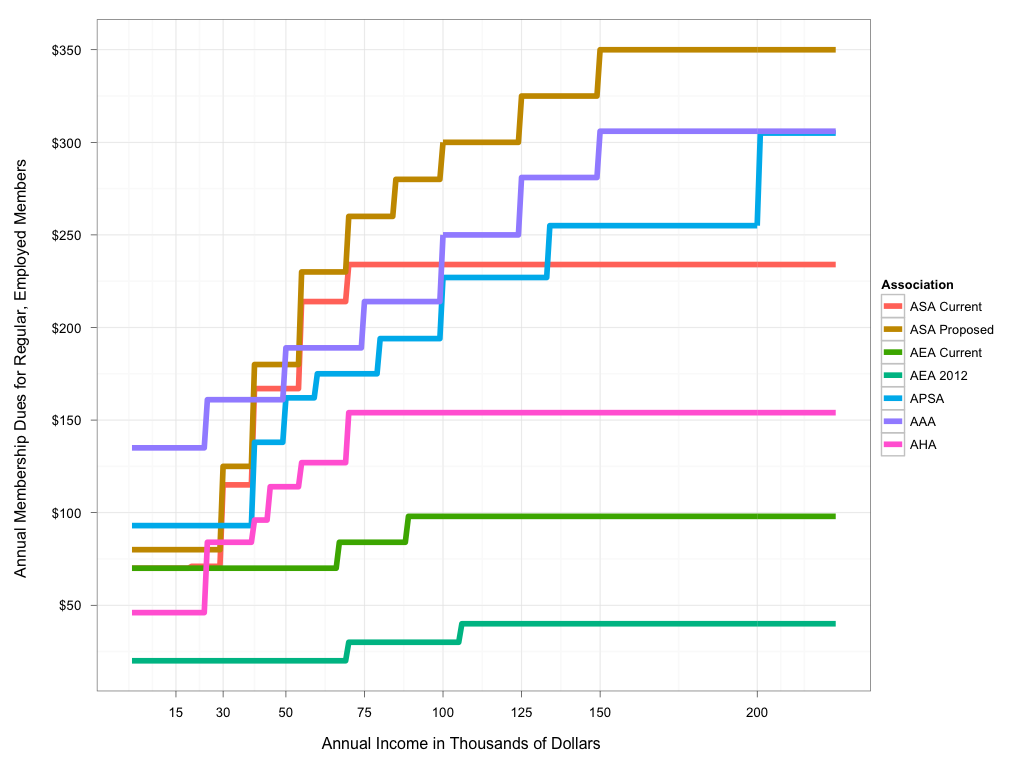
dues-comparison

How cost of membership compares across selected social science disciplines. Click for a PDF version.

The American Sociological Association is one of the more expensive associations one can join in the social sciences, and a proposed dues increase would make it just about the most expensive right across the income spectrum. (More data on that here.) The rationale for the increase says a lot about the importance of a progressive dues structure, which no-one disagrees with, but nothing about why additional funds beyond the (routine) cost-of-living increase—which the proposal will certainly raise—are needed in the first place. Perhaps there are good reasons, but they haven’t been forthcoming thus far.

So, there’s a petition at http://asatransparency.org requesting a better explanation from ASA for this proposal. If you’re a sociologist and feel the ASA should do more to explain and justify this increase to its members—which is of course consistent with either supporting or opposing the increase itself—please consider signing it.

Davies quits, Gaddafi still hanging on

by Kieran Healy on March 3, 2011

The Guardian reports that LSE Director Howard Davies has resigned in the wake of the school’s connections to the Gaddafi family and its acceptance of large donations from them.

Update (March 2nd): The ASA has just posted their audit statements for the past two years. Looks like someone from HQ was reading Prof. Disgruntled.

My pet Theory of Professional Academic Associations is that the discipline’s organizational life inverts its core intellectual commitments. Thus, Political Science is the discipline of government and especially of democracy. Yet, the last time I checked, all of the high-level positions in APSA are decided by committee deals rather than free and fair elections by the membership. Or, Economics is the discipline of decentralized coordination through the efficient operation of the market. Yet its job “market” is in fact an administered queue, with departments explicitly ranking their candidates, departments effectively ranking themselves, and a direct matching process operating between the two as top-ranking candidates slot into open positions in top-ranked schools. (This mechanism also includes an effective method of rent-extraction from Deans in the form of a salary ratchet.) And, to get to the present case, Sociology is the discipline that analyzes the many forms of collective social action, on the one hand, and is the social science most oriented towards the exposure of the workings of power, on the other. So naturally it follows that the ASA is not very good at organizing anything, and that its financial arrangements are as secretive as legally possible.

So, via Brayden King at OrgTheory come the efforts of The Disgruntled Sociologist to ferret out some of these details by way of the ASA’s tax statements and discusses them in a series of detailed posts. Some of the more striking findings include the following:

  • The ASA spent $10M on a “condo.” (Its office building, a couple of blocks from the White House.)
  • From 2003 to 2008, total revenue has been flat, but revenue from dues has increased substantially — almost 17%.
  • The staff of the ASA grew 26% in five years. Wages and salary increased roughly the same amount.
  • Total expenses for the the ASA ($7.6M) are greater than any of their peer organizations: American Political Science Association ($6.2M), American Economic Association ($7.1M), American Anthropological Association ($4.7M), and American Historical Association ($3.5M).
  • Total compensation of headquarters staff for the ASA is substantially higher than for the other organizations (with the exception of the AEA, which lists more than twice the number of employees).
  • The ASA has substantially higher interest expenses than the other organizations.
  • In 2008 the ASA spent its cash reserves of $1.8M – “from approximately $3M at the beginning of the year to $1.2M at the end,” presumably to make up for that year’s 28% loss in investments.
  • The ASA has $8M in bond liabilities (mostly stemming from the purchase of the DC offices).
  • The big change in liabilities comes in the ominous category, “Other liabilities.” This increases twentyfold, from $101,000 to $2,000,000. The ASA describes these liabilities on the tax form as an “interest rate swap obligation.”

An interest rate swap obligation? As in, a derivative? Looks like investment advice gone badly wrong to me. [Update: It turns out the swap obligation is a hedge against the cost of servicing the debt on the Condo, rather than a separate investment.] Now, perhaps there is a perfectly reasonable explanation for all of this, and there is nothing odd about these points at all. (I note in passing from the comparative data that the ASA reported 100 unpaid volunteers the last year it filed. Meanwhile, the AEA reports zero volunteers.) The thing is, though, that this is the first that members have heard of any of this. The most recent audited financial statement available is for 2007, and as far has I can tell you cannot actually navigate to it from anywhere on the website. Instead you have to search for it directly. Meanwhile the official organs of communication to members (newsletters and so on) have been completely silent about these financial downturns. The level of transparency is astonishingly low in comparison to its peer associations.

Another threat to the humanities and social sciences?

by Ingrid Robeyns on December 13, 2010

A group of scholars at the Freie Universität in Berlin is distributing via E-mail and their website alarming information about downsizing of the EU research funding in the Humanities and Social Sciences. The EU is currently drawing up its 8th framework program, in which it decides how to allocate its money – to which fields, for what type of research, what the conditions are, etc. Apparently it is not only a matter of less money going to the humanities and social sciences (which, to the best of my knowledge, is already a small percentage of what the other sciences get; sadly I forgot the exact figure, but — from the top of my head — less than 20%). In addition, the ‘impact’ or ‘valorisation’ discourse/ideology seems to take hold here too, since according to the information which is spread by the scholars from Berlin, EU funding for the humanities and social sciences would be earmarked for more applied research, and to research that contributes to the competitiveness of the EU on global markets.

It’s the last week of term at my University, and I happen to have a heavy teaching load this term, which means I have no time to properly check this out. So consider this as the mere spreading of information and the opening up of space to discuss these issues in greater depth by those of you who know more about this, and/or have currently more time at their disposal to investigate this. I’ll invite some EU research directors to join the debate.

Crowding out the big society?

by Chris Bertram on November 1, 2010

Windsor and Maidenhead Council (UK) “is planning a reward scheme”:http://www.guardian.co.uk/politics/2010/oct/31/council-plans-big-society-reward (supermarket tokens and the like) for volunteers to help implement David Cameron’s “Big Society”:

bq. it is likely residents would get a loyalty card similar to those available in shops. Points would be added by organisers when cardholders had completed good works such as litter-picking or holding tea parties for isolated pensioners. The council says the idea is based on “nudge theory” – the thought that people don’t automatically do the right thing but will respond if the best option is highlighted. Points would be awarded according to the value given to each activity. Users could then trade in their points for vouchers giving discounts on the internet or high street.

Maybe the Council should have read more widely, since according to another body of literature (Bruno Frey, “Sam Bowles”:http://www.sciencemag.org/cgi/content/abstract/320/5883/1605 ), they risk sending out a signal that only a mug performs good works for no reward. An interesting natural experiment, to be sure, but not one that I’d wish on the residents of Windsor and Maidenhead.

A Conversation about Causation and Counterfactuals

by Kieran Healy on October 21, 2010

Philosophy TV hosts a conversation between Ned Hall and L.A. Paul on the counterfactual analysis of causation. It is, of course, must-see TV on any plausible account of necessity.

In the interests of full disclosure, something, something, something. I’ll think of it in a minute.

I recently had the pleasure of attending the “European Society for Philosophy and Psychology conference in Bochum, Germany”:http://www.ruhr-uni-bochum.de/philosophy/espp2010/index.html . The highlight for me was attending a talk by “Michael Tomasello”:http://email.eva.mpg.de/~tomas/ of the Max Planck Institute, Leipzig on pre-linguistic communication. Getting home, I ordered a copy of Tomasello’s “Why We Cooperate”:http://www.amazon.com/exec/obidos/ASIN/0262013592/junius-20 in which he argues, on the basis of detailed empirical work with young children and other primates, that humans are hard-wired with certain pro-social dispositions to inform, help, share etc and to engage in norm-guided behaviour of various kinds. Many of the details of Tomasello’s work are controversial (the book is essentially his Tanner Lectures and contains replies by Silk, Dweck, Skyrms and Spelke) and I lack the competence to begin to adjudicate some of the disputes. But this much is, I think, clear: that work in empirical psychology and evolutionary anthropolgy (and related fields) doesn’t – quelle surprise! – support anything like the Hobbesian picture of human nature that lurks at the foundations of microeconomics, rational choice theory and, indeed, in much contemporary and historical political philosophy.
[click to continue…]

The Tasmania Effect

by Henry Farrell on August 2, 2010

Charlie Stross has been blogging about “the minimum population”:http://www.antipope.org/charlie/blog-static/2010/07/insufficient-data.html needed to sustain an advanced industrialized civilization (and why he thinks this means no colonization of space etc). This is a topic I have _no expertise on_ beyond a broad interest in the less Sunday-supplement inclined versions of evolutionary anthropology, which have given this question some thought. See, for example, Robert Boyd and Peter Richerson’s account of “the Tasmania effect” (p. 272 of _The Origin and Evolution of Cultures_ ) as excerpted below. While I can’t vouch for this argument myself (and it seems to be based more on modeling than on empirical evidence, which is reasonable when you don’t have as much direct evidence as you would like, but not entirely satisfying), it is interesting and (to me) plausible,. Further, it suggests an additional twist to Charlie’s argument – that because human beings cannot learn _precisely_ what their teachers are trying to convey, you need a larger population to counter for the lossy transmission of useful techniques.

bq. What is less well understood is the extent to which technology is likely a product of large-scale social systems. “Henrich (2004b)”:http://www2.psych.ubc.ca/~henrich/Website/Papers/HenrichAmericanAntiquity2004.pdf has analyzed models of the “Tasmanian Effect.” At the time of European contact, the Tasmanians had the simplest toolkit ever recorded in an extant human society … Archaeological evidence indicates that Tasmanian simplicity resulted from both the gradual loss of items from their own pre-Holocene toolkit and the failure to develop many of the technlogies that subsequently arose only 150km to the north in Australia … Henrich’s analysis indicates that imperfect inference during social learning, rather than stochastic loss due to drift-like effects, is the most likely reason for this loss. This suggests that to maintain an equilibrium toolkit as complex as those of late Pleistocene hunter-gatherers likely required a rather large population of people who interacted fairly freely so that rare, highly skilled performances, spread by selective imitation, could compensate for the routine loss of skills due to imperfect inferences.

A fresh look at the left and right political blogospheres

by Eszter Hargittai on April 28, 2010

It’s exciting to see a paper about blogs across the political spectrum that goes beyond the by-now rather common practice of looking at who talks to whom among bloggers (e.g., whether there are any cross-ideological conversations going on). Yochai Benkler, Aaron Shaw and Victoria Stodden of Harvard’s Berkman Center for Internet & Society have just released “A Tale of Two Blogospheres: Discursive Practices on the Left and Right” showing some significant differences in types of blog platforms used (with different affordances), co-authorships and levels of participation among blogs of different political persuasions. Here is one example of specific findings (based on analyses of 155 top political blogs):

Over 40% of blogs on the left adopt platforms with enhanced user participation features. Only about 13% of blogs on the right do so. While there is substantial overlap, and comments of some level of visibility are used in the vast majority of blogs on both sides of the political divide, the left adopts enabling technologies that make user-generated diaries and blogs more central to the site to a significantly greater degree than does the right. (p. 22.)

There are lots of other interesting results in the paper so I highly recommend reading it [pdf].
It’s very clearly written and summarizes related literature well so in case this is not an area you’ve been following, this is a good piece with which to start to familiarize yourself with related debates. If it is an area that you’ve been following then this is a must-read to see some truly original contributions to the literature.

For more on this elsewhere, Ari Melber has an interview with Yochai Benkler on this research in The Nation.

Oiks and toffs

by Chris Bertram on March 24, 2010

If you are one of the people who hasn’t yet read “Ian Jack’s piece”:http://moreintelligentlife.com/content/ian-jack/5-boys on the photo that symbolizes the British class system then you should. (h/t “The Online Photographer”:http://theonlinephotographer.typepad.com/the_online_photographer/blog_index.html .)