For those in the Bay Area, I thought I’d mention that I’ll be giving a talk at Wiki Wednesday this evening at 6pm. The topic is digital media use by youth. Feel free to come by. Also, feel free to join the group at other times in the future, these meetings are held every month.
From the category archives:
Timberites
Remember that weird spam we were recurrently getting in our index.php file? I spent several days looking for the source of it, to no avail. Turns out that our host, DreamHost, had been hacked and several thousand account passwords obtained. These were used — in our case I guess more than once, but details are still extremely hard to find — to access the index files of many sites. DreamHost have apparently sent out a letter to affected customers, but we were affected and haven’t heard a word, and as yet there’s nothing on their website, either. Here’s another person who was affected. All very frustrating. We’ve changed our shell passwords and all that, so I suppose we’ll just wait for some details and an explanation from DreamHost.
_Update_: I wrote to DH techsupport this morning, and just received a response. They say, in part:
bq. We had not sent out the emails regarding dedicated machines yet, as we
were performing additional research. Those emails will be going out very
shortly. I do apologize for the delay, and discovering this on another
blog. To secure your account you will need to change your FTP password. The
logins that we were noticing tended to be automated, and frequently would
overwrite the same files repeatedly. While perhaps not comforting, this
does mean that they generally weren’t looking for personally identifiable
information or uploading other hacking scripts that could serve nefarious
purposes. … Again we are very sorry for the trouble this may
have caused; the email will be going out shortly.
So if they were aware that users with dedicated as well as shared servers were affected, maybe they’re weren’t undercounting the number of people hit by this. But if so then it wasn’t really true when they said all affected customers had been notified.
I have a new bloggingheads up with Ross Douthat- we spend the hour discussing the parlous state of American conservatism. Looking through the early comments, I get some well deserved grief for my tv manner. I find it hard to concentrate on a webcam, and I have a terrible habit of clicking randomly around on a computer when I am talking to someone or thinking (I’m one of those people who find the new _New York Times_ ‘helpful’ feature of pulling up a dictionary when you click on a random word, _really annoying_ ) I also have some academic tics; viz. I don’t interrupt people very often (interruption is considered pretty rude in a seminar). And I’m sure there’s more. It would be interesting to hear from readers with media experience about dos and don’ts of live TV or its cheapo webbed cousins. What kinds of things should you do? Should you not do? (I remember Brad DeLong had some tips on how to prepare yourself for TV interviews a long while ago, but I can’t find them).
 Few people with an interest in space travel have the resources to make that dream a reality. In a few minutes, Charles Simonyi will be one of those people. He’s among the few space tourists who’ve paid the $20-$25 million for the experience. He has been chronicling his adventures at charlesinspace.com, an interesting and informative Web site where users can get answers about the various aspects of his preparation and travel. (You can watch the launch live here or click on the link above to choose your preferred player.)
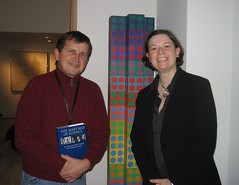
I had the opportunity to meet Charles Simonyi last October when I was in the Seattle area giving a talk at Microsoft Research. I consider my experience a classic case of cultural capital at work. Both of us having grown up in Budapest – and it turns out just a few blocks from each other, although a few decades apart – likely was not enough of a reason for him to bother responding to my email. Rather, I suspect it was our shared interest in the Hungarian artist Victor Vasarely that prompted him to invite me for a tour of his house. It was super fun, Charles Simonyi has some wonderful works by Vasarely and others, and I very much enjoyed the opportunity to see his collection.
We also took a brief tour of his library in which he has some interesting original documents related to space travel. His passion for the topic is obvious and contagious. I look forward to the updates on his site about this amazing adventure.
In the above picture, I stand next to Charles Simonyi (he’s holding my father’s book The Martians of Science) with a Vasarely sculpture behind us. Photo credit goes to Marc Smith who kindly invited and hosted me on this visit to MSR.
When a rumor began to circulate during the first week in January that Michael Bérubé would soon be shutting down his blog — confirmed in due course by an official statement/explanation — it was big news in this little world of “web” “logs.” Sure, there are plenty of places online where you can find discussions of Stuart Hall, economic populism, Ralph Nader, the NHL, and disability studies. Just not all in the same place at the same time. Bérubé had been at it for three years, during which he built up a large readership and even managed to include a number of blog entries in a collection of essays published by a university press.
So when the news got out, there was a general groan of dismay from many quarters of the academic and lefty/progressive commentariat in the United States. And in particular from that subset of each consisting of hockey fans. The shutting down of Bérubé’s blog also met, it must be said, with cheering from members of the Peoples’ Revolutionary Committee for a Committee of Revolutionary Peoples who were still upset that he had occasionally written disobliging things about Slobodan Milosevic.
No doubt there were also sighs of relief — gentle tears of gratitude, even — elsewhere.
It was in short an epochal event: the end of an institution, the twilight of an era, etc. Then came February and it all really was history.
Well, after some downtime–during which he’s probably written a couple of books–Michael Bérubé is now joining Crooked Timber. He is being taught the secret password (“Is there no help for the widow’s son?”) and handshake even now. In the meanwhile, please join me in welcoming Michael back into the fray.
Looks like everyone around here is just too shy to mention it, but all this week Crooked Timber has been among the blogs discussed and/or vivisected by “Movable Snipe,” a regular feature at the website Jewcy.com. The various CT-related entries are all conveniently available here.
[click to continue…]
Another bloggingheads, this time with Megan McArdle on global warming, minimum wage and healthcare, for those as wants to see (not as much in the way of fireworks as those who have seen our interactions in the blogosphere might expect).
I’ll mimic Chris’s announcement by mentioning that my old, erratic, permalink-less eyesore of a “blog” (if that was even the word for it) is dead, now that Arts Journal has offered to host something a bit more normally bloggy. It’s called Quick Study, and even has RSS feeds. It feels like I’m finally on the cutting edge of several years ago.
I’ve got a busy week ahead, at two public events to which everyone around Madison is welcome, if they can bring themselves to leave their homes. The first is Tuesday night, at the Madison Public Library. UW Madison’s Center for the Humanities is sponsoring a 2-part forum on the topic of The Good Childhood (cool poster here). The speakers tomorrow are myself and Sally Schrag (an expert on child ddevelopment and educator of child-care workers); next Tuesday (the 13th) we’ll have Anne Lundin (of our SLIS department) and Carole Trone, who is a historian of childhood. Several respondents will also be at one event or another, including a newly minted member of the Wisconsin House of Representatives, and an excellent local elementary school principal.
On Wednesday and Thursday our Educational Policy Studies department is hosting its annual conference. This year the topic is “Education and Educational Research in an Era of Accountability: Insights and Blindspots“. The Keynote Speaker on Wednesday night is Richard Elmore. I’m speaking on Thursday at 9 am on the topic “Values in Evaluation: Why Empirical Evidence is Never Enough”. I’m currently trying to figure out how many nice things to say abut NCLB. This will be followed by excellent sessions looking at empirical evidence and the problems of gathering it. The past few conferences have been great, and the only thing that threatens this one is the weather.
Doing the usual stroll through Bloglines a little while ago (168 feeds and counting), I read:
The Weblog’s military aggression this week against The Valve and Long Sunday has been a radically unqualified success. Further action against Crooked Timber will be unnecessary at this time because The Valve and Long Sunday have been transformed into beacons of democracy and hope for the entire academic blogosphere.
That sounds less like serious de-escalation than momentary retrenchment before an eventual attempted conquest. If you want to watch one of the more self-aware blogspats in recent memory, check out the comments section for this entry at The Weblog, the field headquarters for this bloodstained militarist operation.
It’s now up to more than 400 comments. One of them indicates that the invasion of CT was originally scheduled for this weekend. The above-quoted statement indicates otherwise, but that may be an effort to throw everyone off guard.
My book, Last Best Gifts: Altruism and the Market for Human Blood and Organs, is reviewed this weekend by Virginia Postrel in the _New York Times_. Obviously, I’m delighted: Virginia’s review is generous and perceptive, and in many ways it’s hard to think of a better choice of reviewer. For one thing, as many readers will probably know, Virginia is herself an organ donor — she gave one of her kidneys to her friend Sally Satel — and now regularly writes about the organ shortage and market incentives. For another, she has also followed the growth of economic sociology as a subfield, writing a very good piece about it for the Boston Globe a while ago. And last, she has a generally libertarian point of view, and the stereotype is that libertarians and academic sociologists should be flinging abuse at each other on the topic of altruism, self-interest and the market — especially when it comes to markets in things like human organs. I wrote the book partly in the hope that it would advance the debate beyond some of the entrenched clichés that both sides cling to. Virginia’s review encourages me that I might have been in some way successful in this respect.
I’m on Bloggingheads again, this time with Mark Schmitt, for thems thats are interested to watch.
Does the Daily Show owe our former co-blogger Ted Barlow, a writing credit?
Watch and decide …
I’m sure you’re all tearing your hair out with frustration or worry, so I apologise for not posting much. For the past week I have been on a very tiny island on the south end of the Rangiroa atoll, in French Polynesia. No internet access there. Also no electricity.
In other news, it turns out that if you write a book called Last Best Gifts then the website for it gets a _big_ surge in hits from Google searches in the weeks before Christmas, but not because people are suddenly interested in the topic.
Thanks, Chris. And thanks to the people who contributed to the excellent comment thread. Let me try to continue the discussion by attempting to clarify what I had in mind in the passage that Chris quotes.