From the category archives:

US Politics

Assault Deaths within the United States

by Kieran Healy on July 22, 2012

The chart in “America is a Violent Country” has been getting a lot of circulation. Time to follow up with some more data. As several commentators at CT noted, the death rate from assault in the U.S. is not uniform within the country. Unfortunately, state-level and county-level mortality data are not easily available for the time period covered by the previous post—though they do exist, going back to the 1940s. What I have to hand is a decade’s worth of US mortality data courtesy of CDC WONDER covering 1999 to 2009. I extracted the assault deaths according to the same criteria the OECD uses (for the time period in question, ICD-10 codes X85-Y09 and Y87.1). The estimates are adjusted to the 2000 U.S. population, which isn’t identical to the standard OECD adjustment. But the basic comparability should be OK, for our purposes.

First, it’s well-known that there are strong regional differences in the assault death rate in the U.S. by state and region. Here’s what the patterns look like by state from 1999 to 2009.
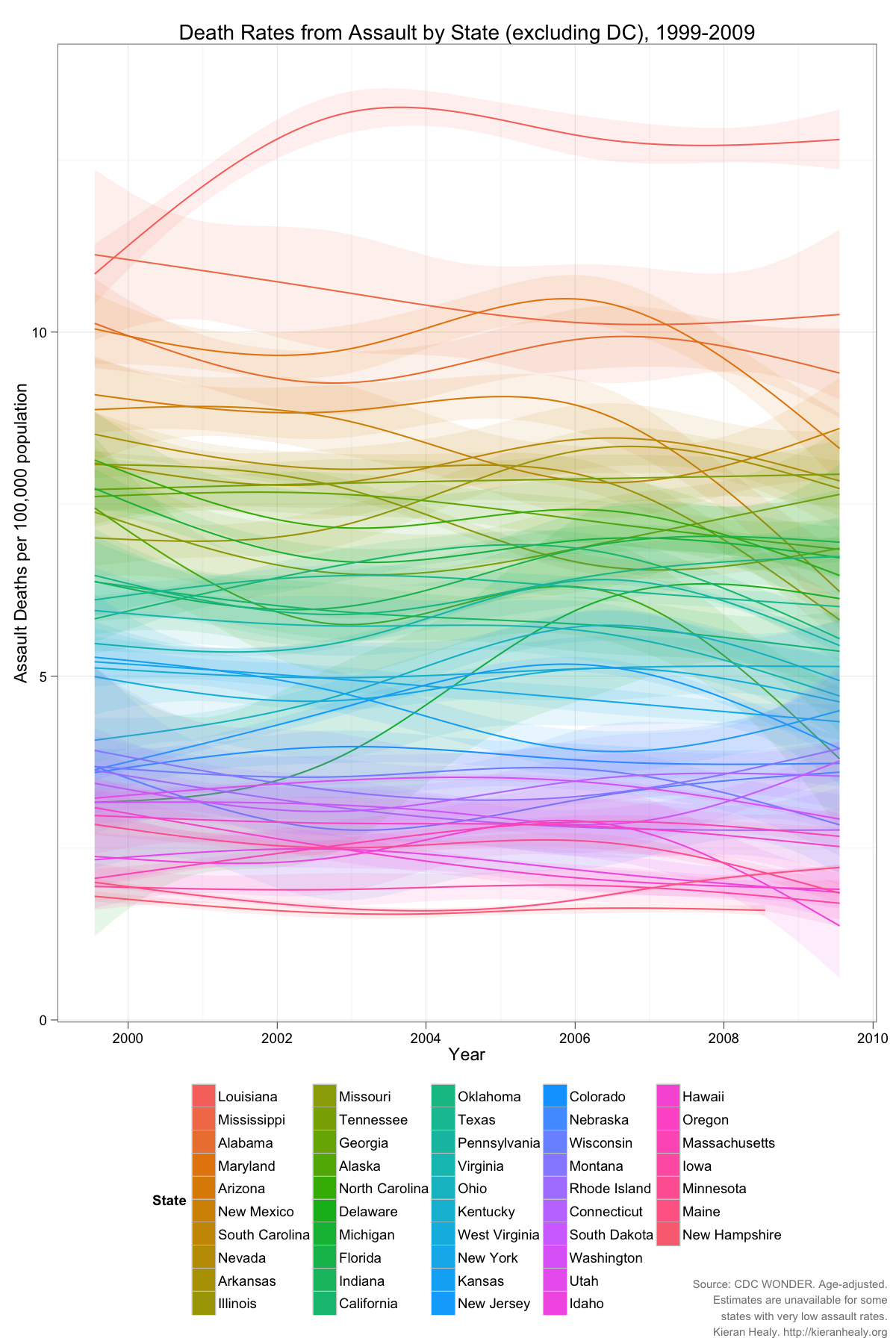
Assault death rates by State

Trends in the Death Rate from Assault, 1999–2009, by State. Click for a larger PNG or PDF.
[click to continue…]

America is a Violent Country

by Kieran Healy on July 20, 2012

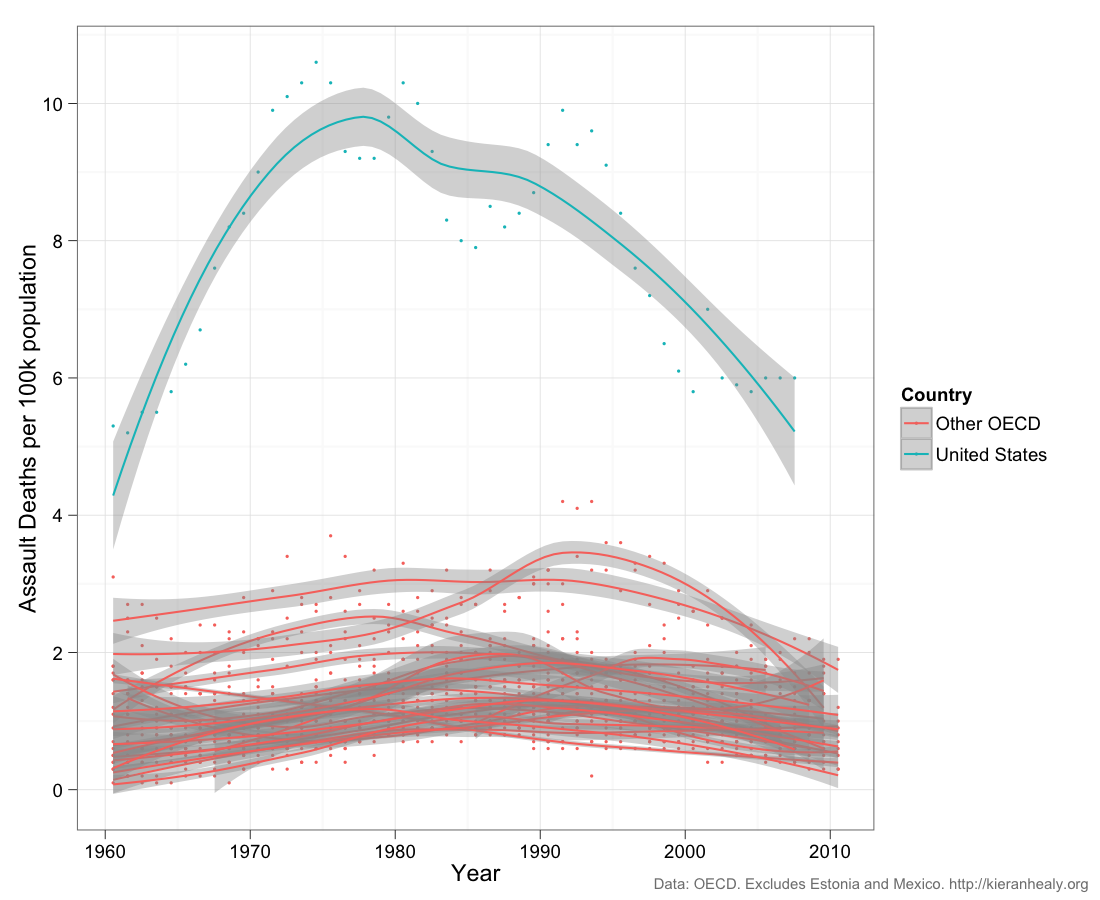
The terrible events in Colorado this morning prompted me to update an old post about comparative death rates from assault across different societies. The following figures are from the OECD for deaths due to assault per 100,000 population from 1960 to the present. As before, the most striking features of the data are (1) how much more violent the U.S. is than other OECD countries (except possibly Estonia and Mexico, not shown here), and (2) the degree of change—and recently, decline—there has been in the U.S. time series considered by itself. Note that “assault” as a cause of death does not distinguish the mechanism of death (gunshot, stabbing, etc). If anyone knows of a similar time series for homicides specifically, let me know.

Click for a larger version.

Here are the individual time series.

[click to continue…]

Retroactively

by Kieran Healy on July 16, 2012

Or, Greedo shot first

Posner dumps (on) Repubs

by John Q on July 7, 2012

The intellectual trend away from the political right has been going on for some time, reversing the trend in the opposite direction that dominated the 1970s and 1980s[1]. But this NPR interview with Richard Posner who says

there’s been a real deterioration in conservative thinking. And that has to lead people to re-examine and modify their thinking

is probably the most notable single example so far, for several reasons.

[click to continue…]

Fast and Furious?

by John Holbo on June 28, 2012

Like Kevin Drum, I haven’t really been following this Fast and Furious thingy. (I didn’t like the movies either.) And, like Drum, I’m amazed at the Forbes CNN Fortune piece he links to. If this is right, everything everyone has been saying about the case is wrong. Unlike Drum, I say it’s possible to extract the nub, like so: [click to continue…]

Open Data Seminar

by Henry Farrell on June 25, 2012

Another Crooked Timber seminar, albeit on an issue rather than an author. Last month, Tom Slee wrote “two”:http://whimsley.typepad.com/whimsley/2012/05/why-the-open-data-movement-is-a-joke.html “posts”:http://whimsley.typepad.com/whimsley/2012/05/open-data-movement-redux-tribes-and-contradictions.html on the Open Data movement which got a lot of interesting argument going. To push the contradictions further, we’ve invited a number of people with differing perspectives to write short pieces on the theme of when and how, if ever, open data makes for better politics. Contributors are:

Henry Farrell (blogger at Crooked Timber)
Steven Berlin Johnson (author of _Emergence_, _Where Good Ideas Come From_, and the forthcoming _Future Perfect: The Case for Progress in a Networked Age_)
Tom Lee (director of Sunlight Labs at the “Sunlight Foundation”:http://sunlightfoundation.com/)
Beth Noveck (professor at New York Law School, author of _Wiki Politics_, and former Deputy Chief Technology Officer at the White House)
Clay Shirky (author of _Here Comes Everybody and _Cognitive Surplus_)
Tom Slee (author of _No-One Makes You Shop at Walmart_)
Victoria Stodden (assistant professor of statistics at Columbia, Big Data public intellectual)
Aaron Swartz (in no need of introduction to CT readers
Matthew Yglesias (author of Slate‘s Moneybox column).

As per the last seminar, posts will be put up (nearly) every weekday for the next several days. And yes – as commenters will surely notice, the sex ratio is off again (all I can say is that this is not the result of any lack of effort, I’m not happy about it, and I’d be grateful for suggestions in comments).

Lessig’s Republic, Lost

by Henry Farrell on June 25, 2012

The Montana decision today has provoked me to write up the review of Larry Lessig’s _Republic Lost_ (Powells, Amazon)that I’ve been planning for the last few months. Short version: there is a lot to like about the book. If you are looking for a good account of the systematic corruption of American politics, this is that account. If you are looking for the account that might convince your centrist/moderately conservative aunt or uncle that there is something wrong, even better – Lessig writes far better than I can for that audience, although he makes it reasonably clear that his allegiances are left-of-center. This said, there’s a lot to disagree with too. Most broadly, I don’t think that his updated version of early twentieth century progressivism will do what he wants it to do, although it could surely help. The fundamental problem that Lessig sees is one of money in politics – if one can cleanse out the Augean stables by attacking dubious relationships between politicians and lobbyists and fundraisers, one could win back the Republic. The fundamental problem that I see is one of economic inequality – even if there are no obvious quid-pro-quos between legislators and those wanting to sway them, the system will remain corrupt. In short – if there is a friendly argument between Lessig and Chris Hayes (and I suspect there is), I think that Chris has the better of it.

[click to continue…]

Imperialist Doublethink

by Henry Farrell on June 22, 2012

A rather remarkable “editorial”:http://www.washingtonpost.com/opinions/asylum-for-julian-assange/2012/06/2-/gJQAZpuJrV_story.html on the Assange-Ecuador story from the _Washington Post_ today:

bq. There is one potential check on Mr. Correa’s ambitions. The U.S. “empire” he professes to despise happens to grant Ecuador (which uses the dollar as its currency) special trade preferences that allow it to export many goods duty-free. A full third of Ecuadoran foreign sales ($10 billion in 2011) go to the United States, supporting some 400,000 jobs in a country of 14 million people. Those preferences come up for renewal by Congress early next year. If Mr. Correa seeks to appoint himself America’s chief Latin American enemy and Julian Assange’s protector between now and then, it’s not hard to imagine the outcome.

So on the one hand, the _Washington Post_ believes that the notion that the US has an ’empire’ is self-evidently ridiculous. On the other hand, it suggests that if Ecuador is impertinent enough to host an individual whom the US doesn’t like (but would have a hard time pressing charges against), it should and will express its displeasure by crippling Ecuador’s economy and threatening the livelihood of 400,000 of its citizens. These few sentences are rather useful, despite themselves, in talking to the nature of the American imperium, the doublethink that maintains it, and the usefulness of providing/withholding market access as a means of imperial coercion.

The Declaration of Independence

by Kieran Healy on June 20, 2012

Charlottesville, June 19th, 2012

The More or Less Unanimous Declaration of the Board of Visitors

When in the Course of human events, it becomes necessary for a Board to dissolve the administrative bands which have connected a President with a University, and to assume for themselves the powers of the earth, the separate and equal station to which the Laws of Nature and the Bond Market entitle them, it is best to do it secretly, quickly, and in the middle of the night.

However, a decent respect to the opinions of mankind requires that they should declare the causes which impel them to the separation, especially when one is unexpectedly faced with large, angry crowds on the Lawn at two o’clock in the morning and a quite stupendous media shitstorm thereafter.

[click to continue…]

Prebuttals, part 2

by John Q on June 13, 2012

The facts about inequality in the US, and increasingly in other developed countries, are now so clear-cut that the defenders of the status quo have little solid ground left on which to stand. So, they are mostly confined to arguments that have already been effectively rebutted. As new talking points emerge, it’s become increasingly easy to pick them out before they are fully formed and have a prebuttal ready.

That’s the case with data showing that income inequality arises mainly from differences in current incomes* rather than from inheritance. As I pointed out a couple of months ago, the absence of large inherited inequalities is a logical consequence of the fact that the distribution of income in the postwar generation was relatively equal.

Sure enough, here’s the prebutted talking point, stated by John Cochrane[1], who asserts

There are a lot of facts: the widening distribution comes from a skill premium, not inherited wealth.

He goes on with some older points, long rebutted

It’s new people getting rich, not the old rich keeping more money. It’s pretax income, not the rich keeping more money.  Consumption inequality is much less than income inequality. And so on.

In reality, income mobility is falling not rising, and the tax system has become less progressive not more. And I’ve dealt with the consumption inequality point here and here.

fn1. This is a bit disappointing to me. In his technical work in finance theory, which overlaps with mine, I’ve found Cochrane to be admirably precise in his analysis and sensible in his comments on the critical issue of the equity premium. But his contributions to the broader public debate over the past few years have been very poor (of course, there are plenty who say the same about me).

* As JW Mason points out in comments, much of the growth in income for the rich has taken the form of capital gains rather than higher salaries. Piketty and Saez rank income-earners based on income net of capital gains, which obscures this fact.

International law and drone strikes

by Chris Bertram on June 8, 2012

This post is really a bleg, aimed at the international lawyers out there. I’ve been looking into the legal basis for US drone strikes in Pakistan, Yemen and Somalia, strikes that on some estimates have caused over a thousand civilian deaths. As far as I can see, the strikes need to pass the regular tests of discriminating between combatants and non-combatants and not causing disproportionate “collateral damage”. They also need to get past the UN Charter’s ban on using force against the territorial integrity of other states. This article by Jack Goldsmith claims there are two ways to do this (1) by getting consent from the “victim state” and (2) by properly invoking the right of self-defence re the non-state actors concerned and claiming truly that the victim state is “unwilling or unable” to deal with the threat posed.

The United States in its drone campaign appears to be relying on self-defence and this “unwilling or unable” test. This strikes me as deeply problematic on two grounds. The first is that the _Caroline_ test, that necessity of self-defence be “instant, overwhelming, leaving no choice of means, and no moment of deliberation” seems not to be met. But I suppose the United States could claim that it is simply continuing a campaign of self-defence that began after September 11th 2001 and has continued since. (Could that really justify extending “self-defence” to take in new sovereign territories?) The second reason is that it looks to me as if the doctrine the United States is relying upon would also have justified “targeted assassinations” by other states on US soil at various times against individuals or groups planning or engaged in actions against those states, whom the US was unwilling to suporess. So, for example, both Cuba and Nicaragua in the past and maybe Iran today could invoke a similar doctrine with as much justification. Say it ain’t so?

Obama, drone-strikes and human rights

by Chris Bertram on June 5, 2012

I’ve been reading some of Glenn Greenwald’s recent posts with increasing horror as he details the apparent willingness of the US drone campaign to attack events where non-combatants will certainly be present, such as funerals and to try to evade moral and legal responsibility by redefining “combatant” to include any military-age male in a strike zone. I’ve also been monitoring various liberal sites and blogs for signs of a reaction and not seeing much (please correct that impression in comments). Sites that obsess about non-combatant immunity if the people firing the rockets are from Hamas are silent. Blogs that take attitudes to historic human rights violations as a litmus-test of political acceptability, have nothing to say as a liberal American President bombs civilians on the territory of nominally friendly states. Fortunately, I’m not an American citizen, so I don’t have a moral decision to take about whether to vote for Obama or not this year. If I were, I don’t think it would be an easy decision to take. Romney is clearly remarkably close in political belief to Obama, but will be beholden to the crazy Republican right, as Obama is not. That provides people with a reason to vote for Obama. But the 2009 Nobel Peace Prize winner doesn’t _deserve_ the vote of anyone who cares about human rights, even if, pragmatically they might feel they have to give it to him.

A recent study by the Washington University School of Medicine in St. Louis found that women using IUDs and other methods like under the skin implants or Depro-Provera injections were much less likely to have an accidental pregnancy than women using ordinary birth control pills, the trans-dermal patch, or the vaginal ring. (CT readers who are not up-to-the-minute on ladyissues may be interested to learn that the ring is a polymer, well, ring, which is inserted into the vagina, and then releases hormones over the course of three weeks. The birth control type is replaced after four weeks. Another version is used to treat the effects of menopause and has a different schedule.)

The women using the pill etc. were, in fact twenty times as likely to have an accidental pregnancy as the other group. “We know that IUDs and implants have very low failure rates — less than 1 percent,” says Brooke Winner, MD, a fourth-year resident at Barnes-Jewish Hospital and the study’s lead author. “But although IUDs are very effective and have been proven safe in women and adolescents, they only are chosen by 5.5 percent of women in the United States who use contraception.” In this case the study provided the various types of birth control at no cost. Worth noting, when the cost barrier was removed, the percentage of women choosing long-acting contraceptives went way up, to 75%.
[click to continue…]

Converts, conversely

by John Q on May 27, 2012

Back in 2005, I wrote about the common experience of dealing with “ people who’ve shifted, politically, from positions well to my left to positions well to my right” (taking as an example, Nick Cohen). Paul Norton, about the same time, wrote along similar lines.

At the time, I mentioned that there weren’t many examples of people going in the opposite direction[1].  But as a commenter points out following this Ryan Cooper link to my last post on the collapse of the rightwing parallel universe, there are now lots of prominent US examples: David Frum, David Stockman, Andrew Sullivan, Bruce Bartlett and just now Michael Fumento. I’m quite surprised by Fumento, who has always appeared to me as a stereotypical culture warrior.

Of course, there isn’t an exact symmetry here, essentially arising from the fact that, whereas most of the L-R conversions happened at a time when the left as a whole was conceding a lot of intellectual and political ground to the right, the current situation is one where the US conservative movement and their international offshoots have moved sharply to the right and remain politically potent. So, it’s much more plausible for those making the R-L shift to claim “I didn’t abandon the conservative movement, it abandoned me”.

Still, never having had such a conversion experience I find it fascinating to observe. Particularly striking is the fact that a sharp change in position doesn’t much change the confidence with which views are expressed. Someone who was cautious and sceptical before a change in view will remain so afterwards. More strikingly, converts who held their old views with absolute confidence, will be equally confident of their rightness in abandoning those views.

fn1. Some earlier examples that occur to me now (all US) are David Brock, Michael Lind and Kevin Phillips. No tendency of this kind is evident in Australia as yet – I’d be interested in views from other countries.

Good lines

by Henry Farrell on May 19, 2012

From Curtis White’s article on philanthropy in the current issue of Jacobin:

bq. In the United States, everyone may enjoy freedom of speech so long as it doesn’t matter. For those who would like what they say to matter, freedom of speech is very expensive.

It goes on:

bq. It is for this reason that organizations with a strong sense of public mission but not much money are dependent on the “blonde child of capitalism,” private philanthropy. This dependence is true for both conservative and progressive causes, but there is an important difference in the philanthropic culture that they appeal to. The conservative foundations happily fund “big picture” work. … On the other hand, progressive foundations may understand that the organizations they fund have visions, but it’s not the vision that they will give money to. … If there is need for a vision, the foundation itself will provide this. Unfortunately, according to one source, the foundation’s vision too often amounts to this: “If we had enough money, and access to enough markets, and enough technological expertise, we could solve all the problems.”

Have I mentioned recently how happily superannuated “Jacobin magazine”:http://jacobinmag.com/ makes me feel? You should all be subscribing.