From the category archives:

US Politics

How (not) to defend entrenched inequality

by John Q on January 25, 2012

The endless EU vs US debate rolls on, but now with an odd twist. Although the objective facts about economic inequality, immobility and so on are far worse in the US than the EU, the political situation seems more promising. (I’m not talking primarily about electoral politics but about the nature of public debate.)

In the EU, the right has succeeded in taking a crisis caused primarily by banks (including the central bank, and bank regulators) and blaming it on government profligacy, which is then being used to push through yet more of the neoliberal policies that caused the crisis. And, as we’ve just seen, formerly social democratic parties like New Labour in the UK, are pushing the same line.

By contrast the success of Occupy Wall Street have changed the US debate, in ways that I think will be hard to reverse. Once the Overton window shifted enough to allow inequality and social immobility to be mentioned, the weight of evidence has been overwhelming.

This post by Tyler Cowen is an indication of how far things have moved. Cowen feels the need, not merely to dispute some aspects of the data on inequality and social mobility in the US, but to make the case that a unequal society with a static social structure isn’t so bad after all.

Update Cowen offers a non-response response here. Apparently, disliking arguments for inherited inequality, such as his point 3 (because of habit formation, social mobility reduces welfare) is a “Turing test” for reflexive leftism.

[click to continue…]

Selling Votes

by John Holbo on January 20, 2012

Why aren’t citizens allowed to sell their votes to the highest bidder? (Bear with me for a minute.) You may at first be inclined to say that it’s like the stricture against selling yourself into slavery: we don’t let citizens strip themselves of the most basic political rights and liberties. But I’m not talking about disenfranchising yourself permanently. Let’s focus just on the case in which you sell one vote in one particular election, or on a particular measure. It’ll grow back. You can vote next time. It’s like working for pay, rather than selling yourself into slavery. A short-term surrender of rights and liberties for the sake of something you want: namely, cash. It’s hard to see that giving up the right to vote in one election – which you honestly may not care much about – would be permanently crippling to someone’s status as a free citizen. (We let people not vote. Why not let them not vote for an even better reason?) [click to continue…]

Yesterday, in protest at draft US laws that would harm the Internet ostensibly to fight digital content piracy, websites including Wikipedia, Flickr, BoingBoing and many thousands more went voluntarily dark. Crooked Timber was proud to be one of them.

Why should a global blog care about American legislation?

For all the talk of the unintended consequences of SOPA’s anti-piracy measures, it is no accident that Crooked Timber could one day end up as collateral damage of this legislation. SOPA/PIPA are the latest in a long line of laws that seek to externalize the enforcement costs of a beleaguered business model.

We could lose our domain name and more, and with no effective recourse, simply because a commenter posts a link to allegedly pirated content. Or because a touchy content owner doesn’t like us linking to them, and doesn’t like what we write. I say these unintended consequences are not accidental because to the intellectual property zealots who privately draft our public laws, Crooked Timber would simply be an acceptable level of road-kill. Funny how ‘tough choices’ are bad things that are done to other people, eh?

More broadly, you should care because SOPA/PIPA are explicitly extra-territorial. SOPA degrades the domain name system in ways that have been repeatedly and explicitly spelt out to US politicians by Steve Crocker and Vint Cerf, two of the guys who invented the DNS the Internet. They were ignored.

(Somehow, it’s ok for law-makers to screw up part of the critical infrastructure while cheerfully admitting they have no clue how it works. Think how that would go down with, say, healthcare or the economy. I know most of them have no clue, but can you imagine them announcing that to a hearing and everyone laughing sympathetically? Yes? Welcome to my world.) [click to continue…]

Goodbye Walker?

by Harry on January 18, 2012

Fantastic news. The recall for Walker in Wisconsin needed about 550,000 signatures; a couple of hours ago about 1 million were turned in; in addition the recalls against 4 Republican state senators, including Scott Fitzgerald, the Republican Senate leader (about 30% over what was needed in his case) have gathered more signatures than needed. Signatures will be challenged, no doubt, but its unlikely that challenges will be successful. Prediction: once the Dems get a candidate this will be the most vicious, highest spending, election in Wisconsin history. I’ll provide links for non millionaire out of staters to help counterbalance the contributions of multi millionaire out of staters when the time comes.

Wealth Problems

by Henry Farrell on January 13, 2012

John Sides “posts some results”:http://themonkeycage.org/blog/2012/01/13/does-mitt-romney-have-a-wealth-problem/ suggesting that while voters mostly understand that Barack Obama and Mitt Romney are rich, they are more likely to think that Mitt Romney doesn’t care about their interests because he is rich, than Barack Obama.

bq. The better one thinks “personally wealthy” describes Romney, the better one thinks that “cares about the wealthy” describes him (the correlation is 0.60). But the same correlation for Obama is much smaller (0.18). People’s perception that Obama is personally wealth[y] does not translate as strongly into the perception that he cares about the wealthy. Moreover, people who perceive that Obama cares about the wealthy are actually a bit MORE likely to perceive that he cares about “people like me,” the poor, and the middle class. The correlations are not always large, but they are positive—e.g., the correlation between believing Obama cares about the wealthy and cares about “people like me” is 0.19.

This obviously has implications for the kind of ‘how the 2012 US presidential elections are likely to play out’ questions that we usually don’t have much to say about here at CT (our partial reticence doing its little bit to cancel out the volubility on this topic in the rest of the political blogosphere). But there is a more interesting general point – _should_ people think that the Democrats are more likely than the Republicans to be biased in favor of the rich.

Interestingly, this survey suggests that public opinion sort-of accords with what evidence we have. Larry Bartels has carried out research on the US Senate (which for a variety of reasons makes it easier to do useful comparisons than e.g. with presidents). And his findings suggest the following. First – if you look at a set of politically salient issues, senators from both parties are totally unresponsive to the opinions of constituents in the bottom third of the income distribution. Second, that Republicans don’t care about the views of voters in the middle of the income distribution either, while Democrats do care significantly. Third, that Republicans care almost three times as much as Democrats about the views of those in the top third of the distribution. Overall, senators tend to be much more responsive to the opinions of better off people than of middle income people, and don’t care at all about the bottom third. These measures are of course somewhat crude – if one had better data, one could subdivide the population further (top 10%, top 1%), and perhaps find an even more striking relationship.

Clive Crook Changes His Mind

by Henry Farrell on January 11, 2012

“This column”:http://www.bloomberg.com/news/2012-01-11/europe-learns-from-u-s-so-why-not-vice-versa-commentary-by-clive-crook.html by Clive Crook today:

bq. Democrats therefore find themselves having to deny the obvious. Obama wants to make the country more like Europe? Ridiculous. A straw man. But it isn’t ridiculous. What’s ridiculous is the idea that Republicans take for granted and squirming Democrats tacitly endorse — that making the U.S. more like Europe would be a disaster. … The biggest step the U.S. needed to take in Europe’s direction, and the longest overdue, was health-care reform. The Affordable Care Act is a start. … Obviously, political cultures differ in deep ways, so there will never be One True Capitalism, right for everybody. … Still, Europe’s biggest economies all reflect a social- democratic tradition that puts more emphasis on collective provision and the guiding hand of government than seems natural in the U.S. The American political tradition stresses the rights and responsibilities of individuals; it exalts private enterprise and almost celebrates risk. These are choices that countries should be free to make.

bq. … Europe’s politicians looked at the U.S. and decided they needed, among other things, more American incentives and more American creative destruction. … They said so explicitly: Unlike their U.S. counterparts, they weren’t embarrassed to point to the other model. … On the other hand, Europe can teach the U.S. a thing or two about social insurance — and not just in health care, the most egregious failure of the American economic model. Help for the unemployed has traditionally been ungenerous in the U.S. … Republicans might also ask whether America is living up to the merit-society ideal. … In America, land of opportunity, if you are born poor, your chances of staying poor are higher than in Europe. The trade-off between economic vitality and economic security cannot be eliminated. But its terms can be improved in the U.S. and Europe, if each pays closer attention to the other.

presents a “striking contrast with this one”:https://crookedtimber.org/2009/03/11/let-us-rally-to-protect-the-delicate-flower-of-rugged-individualism/ from three years ago.

bq. Where has France gone too far, in the view of an American liberal? … Presumably, liberals approve of the universal health care, the generous and extensive welfare state, the comprehensive worker protections, the stricter regulation, the vastly more-generous subsidies for higher education, the stronger unions, the higher taxes, and especially the higher taxes on the rich. … Perhaps some liberals privately long to make the United States over in the image of France, but the great majority, I imagine, are more interested in taking the things they regard as best in the European economic model—all the things I just listed—and combining those “socially enlightened” policies with the traditional economic virtues of the United States. Take French social policies and welfare-state institutions and add them to the American work ethic, spirit of self-reliance, and appetite for change. Et voila, the best of both worlds. Color me skeptical. Culture shapes institutions and vice versa. Culture—that bundle of traits of self-reliance, self-determination, innovation, and striving for success—underpins the American exception. … In ordinary times, this culture makes it hard for a government to push the United States in a European direction … it would be an error to assume that the policy transformation that some liberals long for—and which Obama, if his budget is any guide, appears to be aiming for—would leave America’s unusual cultural traits unaffected. … the American exception is alive and well, and that it is more than likely the secret of this country’s awesome success. … I would need to think long and hard before casting it for “transformation.” Repairs here and improvements there, of course, but transformation? It would be a shame to see America revert to the Western European norm.

NB that I am noting, not criticizing, this apparent change of heart. People have different attitudes to returning prodigals. Except in the case of continued rank hypocrisy, I’m by and large in favor of killing the fatted calf (or at the least, keeping it nicely plump in the hopeful anticipation that the change will stick).

The enduring scandal at Guantanamo

by Chris Bertram on January 9, 2012

The position of the last British detainee at Guantanamo, Shaker Aamer, is in the UK news today. He’s never been charged with anything and was “cleared for release” under the Bush administration. He is in failing health. For protesting about his own treatment and that of others, he is confined to the punishment block. It seems the reason the Aamer can’t be released today is that the US Congress has imposed absurd certification requirements on the US Secretary of Defense, such that Panetta would be personally reponsible for any future criminal actions by the released inmate. One of the reasons why the US Congress has put these obstacles up is because of claims made by the US military about “recidivism”, claims that also get some scrutiny in the report. It would seem that subsequent protests about conditions in the camp, writing a book about it or making a film, are counted as instances of “recidivism”. Astonishing. You can listen to a BBC radio report here (start at 7′ 40″) (I’d been thinking about Guantanamo anyway, because of the “superb and moving article by Lakhdar Boumediene in the New York Times, “:http://www.nytimes.com/2012/01/08/opinion/sunday/my-guantanamo-nightmare.html which you should also read.)

Whilst it is good to see this issue getting more coverage in the mainstream media in the UK and the US, it is depressing how little uptake there has been among politicians and, indeed, the online community. The long-term detention, mistreatment and probable torture of people who have never been convicted of anything, ought to be a matter uniting people across the political spectrum who care about human rights. Unfortunately, outside of a small coterie of activists, the best you get is indifference or even active hostility. Indeed, those who campaign on behalf of the inmates have themselves been villified (by conservatives or the “decent left”) for such “crimes” as comparing the Guantanamo regime to past totalitarian governments (as if such comparison is more offensive than the acual treatment of the detainees). Depressing.

In My Family, We Always Toast Marshmallows

by Belle Waring on January 8, 2012

Did Ron Paul vote for MLK day, as Andrew Sullivan (quoting Chuck Todd) suggested in his debate live-blogging? “9.40 pm. Chuck Todd notes that Ron Paul voted for the MLK national holiday. Gingrich voted against. I find the notion that Ron Paul is a racist to be preposterous.”

Sadly, No!

Ta-Nehisi Coates thoughtfully quotes some Ron Paul newsletters so you don’t have to read them:

Boy, it sure burns me to have a national holiday for Martin Luther King. I voted against this outrage time and time again as a Congressman. What an infamy that Ronald Reagan approved it! We can thank him for our annual Hate Whitey Day.

Hate Whitey Day is actually one of my favorite holidays. It doesn’t have all the pressure to be perfect, like Christmas, or everybody getting along, like Thanksgiving. Just white people cowering in their houses/retreating to their heavily armed compounds in rural Oklahoma while America’s non-white population runs riot, more or less totally burning shit down. And the clean-up and re-building costs always add a bump to the January jobs report, as Matthew Yglesias has noted.

The question of whether Ron Paul’s having voted for MLK day would bring about the state of mind in which one would find the charge of racism against Mr. Paul “preposterous” is left as an exercise for the reader.

P.S. The real Sadly, No!

Simple, Docile, Gifted

by Henry Farrell on December 28, 2011

Via “David Moles”:http://chrononaut.org/2011/12/01/but-the-sabres-of-jeb-stuarts-cavalry-and-the-bayonets-of-picketts-division-had-on-the-slopes-of-gettysburg-embodied-him-forever-in-a-revivified-tory-party/, Winston Churchill’s Grasshopper-Lies-Heavyesque exercise in the genre of alternative history within an alternative history deserves a wider readership. I give you the counter-counter-historical bit of “If Lee had not won the battle of Gettysburg.”

bq. If Lee after his triumphal entry into Washington had merely been the soldier, his achievements would have ended on the battlefield. It was his august declaration that the victorious Confederacy would pursue no policy toward the African negroes which was not in harmony with the moral conceptions of western Europe that opened the highroads along which we are now marching so prosperously

bq. But even this famous gesture might have failed if it had not been caught up and implemented by the practical genius and trained parliamentary aptitudes of Gladstone. There is practically no doubt at this stage that the basic principle upon which the color question in the Southern States of America has been so happily settled owed its origin mainly to Gladstonian ingenuity and to the long statecraft of Britain in dealing with alien and more primitive populations. There was not only the need to declare the new fundamental relationship between master and servant, but the creation for the liberated slaves of institutions suited to their own cultural development and capable of affording them a different yet honorable status in a commonwealth, destined eventually to become almost world wide.

bq. Let us only think what would have happened supposing the liberation of the slaves had been followed by some idiotic assertion of racial equality, and even by attempts to graft white democratic institutions upon the simple, docile, gifted African race belonging to a much earlier chapter in human history. We might have seen the whole of the Southern States invaded by gangs of carpetbagging politicians exploiting the ignorant and untutored colored vote against the white inhabitants and bringing the time-honored forms of parliamentary government into unmerited disrepute. We might have seen the sorry force of black legislators attempting to govern their former masters. Upon the rebound from this there must inevitably have been a strong reassertion of local white supremacy. By one device or another the franchises accorded to the negroes would have been taken from them. The constitutional principles of the Republic would have been proclaimed, only to be evaded or subverted; and many a warm-hearted philanthropist would have found his sojourn in the South no better than “A Fool’s Errand.”

Since the JSTOR version is apparently a straight reprint of Churchill’s original 1930 essay, I’m presuming it’s not in copyright any more, and have put it up here taken it down as I understand from comments that it is still in copyright.

Reappraisals (updated)

by John Q on December 26, 2011

As an Australian, I’m not much accustomed to think of political leaders in heroic terms[1], something that reflects the fact that nothing our political leaders do matters that much to anybody except us, and even then most of the decisions that really mattered have always been made elsewhere. So, I’m fascinated by the US activity of ranking presidents and other political leaders, and eager to try my hand.

What has brought this to mind is running across George Will’s campaign against Woodrow Wilson, who always seemed to be presented in hagiographic terms until relatively recently. Much as it goes against the grain to agree with Will on anything, he surely has the goods on Wilson: a consistent racist, who lied America into the Great War, and used Sedition acts and similar devices to suppress opposition. His positive record appears to consist of a variety of “Progressive” measures (in the early C20 sense of the term) many of which were inherited from Teddy Roosevelt, and few of which were particularly progressive from a left viewpoint[2], and his proposal for the League of Nations, where he comprehensively screwed up the domestic politics, leading the US to stay out of the League.

[click to continue…]

Solidarity

by Tedra Osell on December 16, 2011

<a href=”http://colorlines.com/archives/2011/12/in-home_care_workers_finally_get_federal_minimum_wage_and_overtime_protections.html”>This is huge</a>: medical homecare workers will start to be treated as actual workers, with overtime and minimum wage requirements, rather than volunteers. At some point perhaps other groups of workers excluded from that kind of basic protection–waiters, other domestic workers, farm laborers–will also overcome the racist legacy of not counting Certain Classes of People as “real” workers.

In the meantime, for god’s sake tip well and if you’re not paying the person who cleans your house or mows your lawn or delivers your newspaper or nannies your kids two weeks bonus wages at some point during the year (it doesn’t have to be during the Big Spending Season, but everyone is entitled to a vacation, and don’t give me this crap about how they’re “self-employed” and it’s “their responsibility” to budget for their own vacation), you suck.*

*Possibly not if you live in a country in which people who do this kind of work actually get the same benefits and protections as so-called “professionals.”

American Criminal Justice System B0rken, Film at 11

by Belle Waring on December 13, 2011

This excellent article from Mother Jones’ Beth Schwartzapfel details how a guilty rapist tried repeatedly to confess to a crime of which another man had been convicted, only to succeed after the innocent man had died. The ensuing exoneration was so complete that then-Governor Rick Perry had to issue a pardon to the dead man, not something Texas governors are generally inclined to do. Rick Perry’s faith in Texas’ system, however, remains serenely unshaken.

A string of devastating stories has put Texas justice, in particular, under a cloud. In addition to Cole’s postmortem exoneration and the execution of Cameron Todd Willingham, chronicled in The New Yorker in 2009, there is also the case of Anthony Graves, who served 18 years for a gruesome murder while the true killer confessed again and again. Graves was finally freed in 2010 following a Texas Monthly exposé.

Cole, Willingham, and Graves were all convicted under prior Texas governors. But Perry has done little to improve the state’s criminal-justice system, which has almost a million people in its grip. In 2001, he vetoed a bill banning the execution of the mentally disabled. In 2003, he cut the prison system’s budget by $230 million, slashing education programs, drug treatment, and food; when an independent auditor warned that was untenable, Perry cut the auditor’s office too. In 2007, his administration backed a bill making some child sex offenders eligible for the death penalty. While Perry has signed legislative reforms covering eyewitness identification and access to DNA testing, the system still offers scant options for the many people imprisoned for crimes they did not commit.

Radley Balko’s blog The Agitator remains an indispensable source of information on cases like these, as well as the uncountable cases in which the War on [Some People Who Use Some Kinds] of Drugs* has metastasized into a cancer that gets untrained local law enforcement rolling out in surplus military gear to perform ill-advised and pointless SWAT-style raids. (With tanks. No, really.) And shoot everybody’s dog when they get there. And maybe their grandmother. Seriously, don’t read the blog if you don’t want to hear about the cops shooting someone’s dog every goddamn day. His recent coverage of the OWS movement has been…how shall I say this…not all I would have hoped from a lover of liberty, but no one’s obliged to agree with me all the time, and it’s not as though it’s rendered the blog unreadable or something.
*Courtesy of Lawyers, Guns and Money. Like Sadly No!, we are aware of all internet traditions.

The Attractions of Fascism

by Henry Farrell on December 12, 2011

Once upon a time, when I was in graduate school with some free time on my hands, I ended up co-writing a paper with my friend Barb Serfozo on the dubious sexual origins of the American right’s depiction of women as feminazis. One passage that I found, from Newt Gingrich and William Forstchen’s co-authored novel, _1945_ has stayed with me. The hero of the book, evocatively named “James Mannheim Martel,” is “watching a Nazi parade”:http://www.baen.com/chapters/1945chp1.htm.

bq. Again, Martel became uneasily aware of how his own blood was set racing by the sense of power and glory that drenched the entire artificial drama. It was like being aroused by a woman one despised. No matter the revulsion, despite the inner certainty that never would one yield; beneath all moral rectitude there lurked a dark, compelling attraction.

Lurid misogyny, and a political fantasy and sexual fantasy that are so intertwined with each other as to be indistinguishable, all wrapped up in one enticing bundle!

At one point, Gingrich was supposed to be writing a novel with his friend, noted “authority on the political attractions of Fascism”:http://www.jerrypournelle.com/debates/history.html, Jerry Pournelle. I don’t know what happened to it, but I imagine it would have made quite interesting reading (Inferno, Pournelle’s ‘Benito Mussolini redeems himself in an updated version of Dante’s hell’ schlock-epic with Larry Niven, is certainly entertaining if your tastes run to certain varieties of kitsch).

Inequality and Schools

by Harry on December 12, 2011

Helen Ladd and Ted Fiske have an excellent piece in today’s Times explaining the relationship between educational inequality and income inequality, drawing on Sean Reardon’s contribution to Whither Opportunity?: Rising Inequality, Schools, and Children’s Life Chances. An excerpt:

The Occupy movement has catalyzed rising anxiety over income inequality; we desperately need a similar reminder of the relationship between economic advantage and student performance.

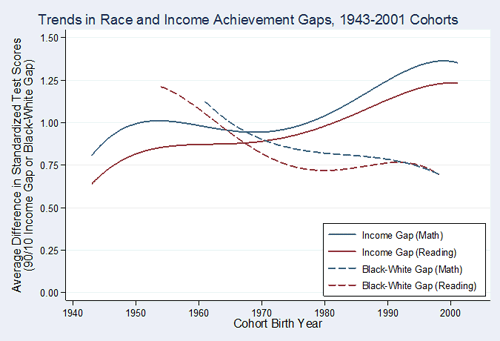
The correlation has been abundantly documented, notably by the famous Coleman Report in 1966. New research by Sean F. Reardon of Stanford University traces the achievement gap between children from high- and low-income families over the last 50 years and finds that it now far exceeds the gap between white and black students.

Data from the National Assessment of Educational Progress show that more than 40 percent of the variation in average reading scores and 46 percent of the variation in average math scores across states is associated with variation in child poverty rates.

International research tells the same story. Results of the 2009 reading tests conducted by the Program for International Student Assessment show that, among 15-year-olds in the United States and the 13 countries whose students outperformed ours, students with lower economic and social status had far lower test scores than their more advantaged counterparts within every country. Can anyone credibly believe that the mediocre overall performance of American students on international tests is unrelated to the fact that one-fifth of American children live in poverty?

The most striking graph in Reardon’s chapter shows the change in achievement gaps between black and white students (which declines from Brown on) against the change in gaps between children from the highest and lowest income deciles (which starts to rise as income inequality starts to rise, perhaps unsurprisingly):

More on Whither Opportunity? another time, but for now read the whole thing.

Too Depressing

by Belle Waring on December 8, 2011

I can’t believe the Obama administration caved on this.

For the first time ever, the Health and Human Services secretary publicly overruled the Food and Drug Administration, refusing Wednesday to allow emergency contraceptives to be sold over the counter, including to young teenagers. The decision avoided what could have been a bruising political battle over parental control and contraception during a presidential election season.

Thanks a lot, Kathleen Sebelius. God knows we wouldn’t want one of the groups least likely to use contraceptives properly to be able to easily get their hands on some Plan B. Up next: banning over-the-counter sales of paracetemol. Ha.

Belated Update: Reading below I do see that excerpt is misleading if you haven’t read the whole article; they didn’t take Plan B away from existing over-the-counter-sales, they just refused to extend it to full OTC status which would extend to those 17 and younger.