From the category archives:

US Politics

Booing too good for him?

by John Holbo on September 25, 2011

No, I’m not thinking about our Daniel. I’m working up to a proper follow-up to my conservative cognitive dissonance posts. This isn’t really it, alas, but it’s a start.

It makes no sense for conservatives like Jim Geraghty to express this sort of concern about the booing of Stephen Hill at the GOP debate. (Hill is, as you probably know, the gay soldier who asked about DADT):

Rereading the transcript of last night’s debate, I am struck that Rick Santorum did not thank Stephen Hill, a gay soldier in the U.S. Army currently in Iraq, for his service. Nor did anyone else on that stage.

Whatever you think of “Don’t Ask, Don’t Tell” or homosexuality, Hill is risking his life on behalf of his country.

And for sure it doesn’t make sense for Santorum himself to have responded to subsequent questions about the booing, like so: [click to continue…]

Two weeks ago I made a post that was as comprehensively misunderstood, relative to my intent, as anything I have written in quite a while. So let me try again. I meant to assert the following:

1) Sometimes Republicans (conservatives) make loud, radical, extreme ‘philosophical’ claims they don’t really mean. Democrats (liberals), on the other hand, don’t ever really do this.

I was interpreted by some as asserting the following:

2) Invariably, whenever Republicans (conservatives) seem to say something crazy or radical, they don’t mean it. They are always moderates about everything. In fact, they are liberals. We can ignore any appearances to the contrary.

Well, I for sure didn’t mean 2. Crikey.

In general, the way to keep 1 clear of 2 is by applications of ‘some’, and appropriate cognates. (I’m saying that sometimes Republicans/conservatives do something that Democrats/liberals never do, not that Republicans/conservatives never don’t do this thing that Democrats/liberals never do.) It may be that my original post was insufficiently slathered with ‘some’. For present post purposes, if I should ever seem to be saying 2), add ‘some’ until it turns into some variant on 1). On we go. [click to continue…]

Neo-Liberalism Again

by Henry Farrell on September 6, 2011

“Matt Yglesias”:http://thinkprogress.org/yglesias/2011/08/31/308874/justice-department-moves-to-block-attt-mobile-merger/, after complaining about the “endless Internet circle jerk over “neoliberalism,”” tries to be a little more conciliatory.

I think when I tried to raise this issue as it pertained to craft beer, I wound up coming across as unduly accusatory and prompted a lot of unproductive responses. So to put the issue as clearly as possible, I wonder if adherents to an anti-neoliberal theory of progressive politics believe the right thing for President Obama to do is to consider the pro-labor benefits of the merger to be an _independent argument_ in favor of the merger that deserves weight alongside other issues. The CWA has an argument on the merits about this that I think isn’t crazy, but the question that I think is philosophically interesting is whether the labor angle deserves consideration apart from the “official” argument about anti-trust economics.

I think the answer to this question is a no-brainer: yes. If you believe, as Jacob Hacker and Paul Pierson, Paul Krugman etc believe, that the decline of the US labor movement is an important explanatory factor for the rise of inequality in the US, and if you believe that inequality is a problem, then of course you want to think about the consequences of anti-trust policy for union strength. Weakening unions can plausibly further increase inequality, by weakening actors who used to serve as an important counterweight to e.g. financial interests. But I am not at all sure that Matt himself has any deeply rooted philosophical objections to this way of thinking. In a “more recent post”:http://thinkprogress.org/yglesias/2011/08/31/309483/patents-and-inequality/ he quotes a Dean Baker argument that patents and intellectual property contribute to inequality, and concludes:

The general idea is that we shouldn’t accept the view that a world of parasitic finance, asymmetrical globalization, government-sponsored intellectual property monopolies, and Fed engineered wage-suppression constitutes a “free market” outcome relative to which the left wants redistribution.

This seems absolutely right to me – but also to call for an emphatically non-neoliberal approach to politics. As Matt is saying in this post, profound political inequalities are baked into the cake of our current market economy. But if this is right, then it is implausible that we can let markets do their thing, and then worry about the distributional issues later, since inequalities, the power of financial interests, etc not only are part of the system as it is, but also make it very unlikely that we will ever get to the stage of doing substantial redistribution. While Dean Baker (whom Matt is relying on in this post) depicts his reform agenda as a set of pro-market measures, they are not by virtue of this, neo-liberal measures (which would suggest that we should let the market organize itself, and then worry about distribution later). Instead, Dean wants to restructure markets from the get-go so as e.g. to rein in the political power of finance by taxing certain transactions, getting rid of the ‘too big to fail’ problem etc. This political program (like all political programs) emphasizes some problems and de-emphasizes others. But it is, emphatically, a political program, with a theory of what is wrong with the US political economy, and how to fix it.

To put it another way: I think that Matt sometimes adopts neo-liberal language, and is surely friendlier to neo-liberal ideas than, for example, someone like me. But I also think that his agenda – if he were really to draw out its implicit politics – is rather more radical than he is usually prepared to let on. If he is uncertain about whether Chicago-style anti-trust thinking should sometimes be trumped by political considerations, then he should look again at the arguments around the Microsoft trial, which connect directly to the intellectual property questions that he worries about (as a lot of post-Chicago people argued, monopolies tend to stifle innovation in a variety of ways). It isn’t only pro-labor people who would like to see other arguments than George Stigler-style reasoning play a role in anti-trust decisions. If he believes (as he seems to) that inequality is a bad thing, and that current IP policy helps to foster inequality, then he should draw political conclusions from these causal connections.

For what it’s worth, I think that the open information agenda, and the political inequality agenda have a lot more in common than most people think (I have been planning for some time to do more writing on this over the next year). I think it would be a lot more useful to frame the argument as one between different ways of restructuring markets so as to tackle problems of inequality at their source than as one between neo-liberalism and its critics. For one thing, even while different ways of thinking about markets and inequality might point in different directions in specific instances, it would be easier to figure out the trade-offs, especially as they are trying to reach the same end-goal. For another, it would be easier to identify the possible political actors and coalitions that might support the one, or the other, set of reforms, and possible points of agreement or disagreement between them. Both of these would conduct towards better debate.

American electoral politics: a brief introduction

by Michael Bérubé on September 3, 2011

[Now updated for clarity and symbolic reasons!]

I can see from the comments on <a href=”https://crookedtimber.org/2011/09/02/romney-and-obama/”>John’s post below</a> that there is some confusion out there about the way the American political system works.  Specifically, there seems to be some serious misunderstanding of the dynamics of national elections in the US.  So let me try to clear this up once and for all.

You are welcome.

Basically, post-Watergate America works like this.  It’s what you might call a “twelve-step” program.
[click to continue…]

Must We Act As If They Mean What They Say?

by John Holbo on September 3, 2011

Brief thoughts about that Bill Keller op-ed on candidates’ religions, and the kerfuffle that kicked up. But only by way of kicking off in the direction of what’s really going on here. The religion stuff needs a more general frame.

Keller is just being reasonable. If candidates say ‘my faith is a private matter and all that need concern the voters is how I will conduct myself in office,’ fine. But if candidates play up faith, for political advantage; if they announce that their religious views and values inform their political views and policy proposals, then obviously that makes religion fair game. Because in politics, your politics has to be fair game. Keller’s critics suggest that arriving at any such conclusion is tantamount to proposing something like a religious test for public office. Or worse! It’s an attempt to ban Christians from public life! But no. He’s only ruling out one or another of a couple possible norms that are so absurd that no one would ever advocate them explicitly. That you can’t fault politicians for concealing their policy objectives, so long as the politicians favor the policy on religious grounds. Or that you can’t fault politicians’ policy proposals, period, so long as they advocate the policy on religious grounds. Something like that. That’s nuts, so Keller is just being reasonable.

But, like I said, I don’t think this is the right way to think about this issue. For one thing, it misses that the religious case is just a special case of a more general phenomenon. Let me switch over to a question Kevin Drum asked last week: why do Republicans get a free pass? He’s absolutely right that they do. [click to continue…]

Romney and Obama

by John Q on September 2, 2011

I was thinking about the possibility of an Obama v Romney matchup in next year’s election and it struck me that, in a lot of ways, Romney looks like Obama’s role model. That’s true in terms of their signature policy achievements (very similar health care policies), their general lack of (and even disparagement of) commitment to particular policies or principles, and their acceptance of the centrist view of the world in which the correct position is always midway between extremes, however those extremes may have been determined, and whatever their substantive content. Romney’s success in winning office in Massachusetts was a model for Obama’s success in what is (at least in Obama’s view and that of his advisors) an essentially rightwing country. Romney even gets some diversity points for being a successful member of a minority group.

As a temporary alien and permanent foreigner, I don’t have to worry about voting. But, of course, like everyone else on the planet, I will be significantly affected by the outcome. Still, as long as the Congress remains divided, it’s hard to see a choice between Obama and Romney making a big difference (of course, I thought that about Bush v Gore, so there you go).

Facing new challenge, Romney stakes out fresh position

by Michael Bérubé on August 25, 2011

Deepinaharta, Texas — Republican Presidential hopeful Mitt Romney said today that if he should win the White House in 2012, his administration would seek to introduce legislation barring corporations from having abortions.

“Corporations are people too,” Romney said to a dwindling group of supporters who seemed to be distracted by a picture of Texas governor Rick Perry <a href=”http://www.rumproast.com/index.php/site/comments/chimpy_w._mcflightsuit_ii/”>in a flight suit</a>, “and they should be denied the same basic reproductive rights that I once supported and now oppose for people.”  Romney went on to say that people-corporations should enjoy the same tax and regulatory relief as corporation-corporations, “giving job seekers and job creators alike the freedom to innovate and to invest their money as they see fit.”

Romney did not respond to a question as to whether his administration would permit corporations to merge with other corporations of the same sex.

[click to continue…]

Wisconsin recalls

by Harry on August 10, 2011

We had the first set of recall elections for the Wisconsin State Senate yesterday. 6 Republicans, all elected in 2008 (during the Obama general election) were up; the Dems needed to take 3 in order to flip the Senate. In the end, they got two (districts 18 and 32), which is roughly what they expected. There had been talk of them hoping for District 14, but that didn’t seem realistic to me. It is a natural swing district, but the Dem candidate was uninspiring, turned out to have numerous moving violations and had, rather unfortunately, been caught on tape saying that paying child support to his exwife was a low priority; and Luther Olsen, the incumbent, has a strong personal following among independents which, given his competence and affable personality, was going to be hard to shake. His gamble (that he would be more likely to hold on to office if he caved into the Governor than he was to ever hold a committee seat again if he resisted) paid off. The appalling Alberta Darling held on to her seat despite a (to me) surprisingly strong Democratic showing, and I suppose it is still just possible that the results will turn out to be dodgy, reliant as her majority was on the reporting of Waukesha County, whose clerk is not renowned for her carefulness. But it’s unlikely. And there are some reasons not to be cheerful: the defeat of Randy Hopper, whose private life has been moderately scandalous, and who does not seem to have been living in his district, should have been much easier than it was.

Two Democrats face recalls next Tuesday (the 16th). The recall effort against the Dem senators was basically an attempt to divert energy and resources from the Republican recalls, but, perhaps predictably, the Rep candidate for the 12th district, a teapartier, has attracted a lot of out of state money (the estimate for yesterday’s elections is that $30 million was spent on the 6 races). If you want to pledge your own in or out of state support for Jim Holperin, the more vulnerable of the two Dem incumbents, click here.

Where does this leave things? Well, if things go well next week, the Reps will have a 17 to 16 majority in the Senate, vulnerable on a day to day basis to Dale Schultz, the one Republican who voted against the collective bargaining law, and who has been enjoying being seen as an independent. Some are declaring victory: as John Nichols points out, these were gerrymandered Republican seats, which have been Republican for a long time, and, as I indicated, privately I heard from a number of Democrats that they would be amazed to get 3, and please to get 2. And there is a case for saying that the momentum has been surprisingly strong, given that the protests ended in March.

Still, I am not personally thrilled, despite having not had high expectations. The left is clearly still galvanised, but the right has maintained its strength well. Walker has pissed off a lot of constituencies, but there isn’t enough momentum at the moment to make it clear that a recall will work, let alone that an as yet unknown Democrat can beat him. A recall of the Governor would require the collection of 550k signatures in 60 days, and because of the rules around recall, that signature collecting process cannot begin till November. If Darling, or even more so Olsen, had been defeated, it would have been a lot easier to convince an electable Democrat (i.e. Russ Feingold [1]) to declare prior to a recall which, in turn, would have made a recall more likely to succeed. All in all: things are not good, but they are not as bad as they might have been.

If anyone can find me a good link for contributing to the No (thanks Steve) campaign on the Ohio Collective Bargaining Limit Repeal, I’ll post it later. Update: contribution page here.

[1] Several other Democrats are regularly mentioned as potential candidates, but I am not aware of any who are dying to run, and no good candidate (that is, any candidate I would be interested in seeing become Governor) already has the kind of name recognition that would make it easy to define themselves in the campaign as anything other than the antiWalker candidate.
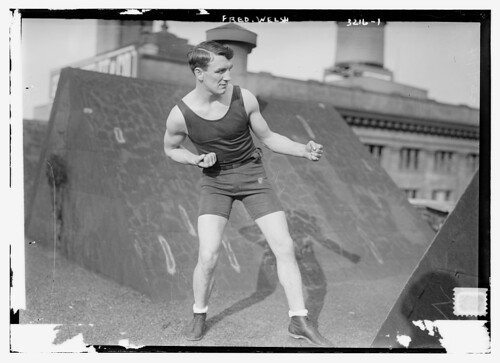
Another Boxer

by John Holbo on August 7, 2011

This one goes with the others. (Having posted two, it would be more strange not to post a third.)

Fred Welsh (LOC)

In other news, I notice that Erick Erickson has some difficulty with the is/ought distinction. He reasons that, since Republicans in fact will not raise taxes under any circumstances, it follows that one can’t fault Republicans for not raising taxes. That would be like blaming the rain for raining. Or something. A nice illustration of the advantages and disadvantages of extreme intransigence for political life, perhaps.

The problem with “left” neoliberalism

by Chris Bertram on August 5, 2011

This is just a short post seeking, for the purposes of mutual clarification, to highlight where I think the real differences lie between someone like me and “left neoliberals” like Matt Yglesias. I think that something like Yglesias’s general stance would be justifiable if you believed in two things: (1) prioritarianism in the Parfit sense and (2) that real (that is, inflation adjusted) income levels reliably indicate real levels of well-being, at least roughly. For those who don’t know, prioritarianism is a kind of weighted consequentialism, such that an improvement in real well-being counts for more, morally speaking, if it goes to someone at a lower rather than a higher level of well-being. So prioritarism is a bit like a utilitarianism that takes a sophisticated and expansive view of utility and weights gains to the worse-off more highly. This view assigns no instrinsic importance to inequality as such. If the best way to improve the real well-being of the worst off is to incentize the talented (thereby increasining inequality) then that’s the right thing to do.
[click to continue…]

Prebuttals

by Henry Farrell on August 4, 2011

“Matt Yglesias”:http://thinkprogress.org/yglesias/2011/08/04/287553/the-new-labour-record-on-income-growth/ responds to Chris’s post below, by suggesting that British “lefties”‘ criticisms of New Labour’s record on inequality are discredited by a Lane Kenworthy graph, which he says he’ll take as a decisive argument in favor of what he calls “progressive neo-liberalism,” “until [he sees] a rebuttal of it.” But didn’t we have a rebuttal of Yglesias’ interpretation from “Brian Weatherson”:https://crookedtimber.org/2010/10/01/fun-with-gini-coefficients/, the last time he was pushing this line, back in October 2010? Perhaps he found this rebuttal inadequate in some way. But even if this were so, one would have thought that Lane’s own quite specific and limited explanation of what the graph suggests – that it showed that the UK poor probably did better under Labour than they would have under the Conservatives – might have given him pause (I’m quite sure that Chris, for all his dislike of New Labour, would agree with Lane’s claim here).

I also should note that he had a “go”:http://thinkprogress.org/yglesias/2011/07/30/283784/the-diversity-of-privilege/ last week at John Quiggin’s arguments about inequality, where he suggested that NYU professors had it pretty good, and that:

bq. a lot of the political dialogue I see online seems to consist of a slightly strange form of class resentment in which intellectuals, nonprofit workers, or public servants express bitterness about the high incomes of businesspeople whose lives they don’t actually envy.

I wrote a somewhat ill-tempered post in response to this, and then deleted it, because I wasn’t greatly looking forward to policing the comments section. So I’ll limit myself to saying that Yglesias’ aside certainly doesn’t do justice to the genuine and quite serious debates around inequality, which, as far as I can see, are not being driven by ‘class resentments’ but by a genuine and well-founded dismay about the current state of the US political economy. Enormous disparities of wealth help reinforce huge disparities in political power (see e.g. Bartels’ findings on how the interests of different economic segments get represented in the electoral process) in a self reinforcing cycle. That’s a problem – and it’s a _particularly big problem_ for someone who wants to concentrate on maximizing growth first, and only on sharing out the goodies afterwards. As “Cosma says”:http://cscs.umich.edu/~crshalizi/weblog/778.html in the best post on this broad set of topics that I’ve read to date.

bq. “When you tell us that (1) the important thing is to maximize economic growth, and never mind the distributional consequences because (2) we can always redistribute through progressive taxation and welfare payments, you are assuming a miracle in step 2.” For where is the political power to enact that taxation and redistribution, and keep it going, going to come from? A sense of _noblesse oblige_ is too much to hope for (especially given how many of our rich people have taken lots of economics courses), and, for better or worse, voluntary concessions will no longer come from fear of revolution.

To be clear – I think that Matthew Yglesias is an extremely smart and interesting writer, even when I disagree with him, as I often do. He’s a net contributor to US public debate. But when he comes up against this particular set of issues, he has an unfortunate tendency to wave difficulties in his position away by making -unsubstantiated imputations about the motives of people who bring up the problem of wealth inequality, and- (update: now withdrawn – see his comment below) referring to graphs which don’t actually say what he thinks they say. I wish he’d do better.

Update – I see that Chris has also updated his post in response.

Adorno Made Him Do It

by Michael Bérubé on August 4, 2011

Shorter <a href=”http://www.mindingthecampus.com/forum/2011/07/breitbart_thinks_back_on_his_c.html”>Mark Bauerlein</a>: The leftist books Andrew Breitbart didn’t read in college eventually inspired him to slander Shirley Sherrod.
[click to continue…]

It was the blogosphere that did it.

by Henry Farrell on August 1, 2011

Some remarkable logic on display in the Washington Post ombudsman’s defense of Jennifer Rubin’s notorious jihadism in Norway post.

bq. There are other reasons I got so many e-mails on Rubin; they have much less to do with terrorism and tragedy and more to do with modern technology and partisan politics. Liberals and conservatives don’t talk to each other much anymore; they exist in parallel online universes, only crossing over to grab some explosive anti-matter from the other side to stoke the rage in their own blogosphere. The liberal blogosphere, propelled by tweets, picked up Rubin’s piece and spread it around rapidly, helped by a trifecta of posts from theatlantic.com. … This brings us back to the shootings in Norway, an act committed by a disturbed man who drew some of his inspiration from extremist Web sites. A blogosphere given to vitriol and hasty judgments ought to consider the possible consequences of its own online attacks.

If I understand the logic of this column correctly, the ombudsman, one Patrick Pexton, thinks something like the following.

(a) Bloggers are partisan and don’t usually engage with people on the other side. In this sense, they are rage-filled extremists.
(b) Breivik was partly inspired by rage-filled, extremist websites.
(c) _Therefore,_ rage-filled extremist leftwing bloggers ought to consider their own culpability, and shut the hell up about Jennifer Rubin.

I can’t remember the term for this logical fallacy (it’s of the ‘all cats have fur – all dogs have fur – therefore all cats are dogs’ variety). No doubt someone who, unlike me, took Philosophy 101, will inform me in comments within moments of publication. But an awful lot of work is being done by the elasticity of the notion of rage-stoking extremism here. And this is not to mention the intimation that James Fallows and Ta-Nehisi Coates are rage-filled hatebloggers …

However, there is a serious point to be extracted from this muddle. Which is that discussions of online extremism often tend to confuse two, quite different forms of extremism (here, I think Cass Sunstein’s work has had quite some problematic consequences). One is not really extremism at all – it is common or garden partisanship. That is, it is plausible that online interactions makes vigorous partisanship (in which you perceive yourself as in competition with the other side, perceive little value in direct intellectual exchange with them etc) more prominent, either because it makes it easier for partisans to find each other and organize, makes people’s partisanship stronger through mutual reinforcement, or both. Here, though, there is a crucial moderating influence. Partisans are engaged in political contention through _electoral competition._ This (as Nancy Rosenblum argues) has a substantial moderating effect – in the end, they need to win votes by influencing people if they want to succeed. This also leads to all kinds of indirect learning. The second is _actual_ extremism, where people are potentially willing to abandon democratic politics and pursue violent means to achieve political ends. Here, there is no such moderating influence.

There is _no necessary reason_ to believe that the former necessarily leads to the latter. In the US case, the online forces that push towards partisanship on the left tend overwhelmingly push against the other kind of extremism. There is no effective contact between e.g. MoveOn or the Daily Kos on the one hand, and the various subgroups and splinters who are more enthusiastic about violence on the other. When the latter try to influence the former, they get mobbed and repelled. The right is a quite different matter – there are dense social ties between online partisans and anti-Muslim bigots and crazies claiming that universal dhimmidom is right around the corner.

Pexton’s suggestion that leftwing bloggers need to think carefully about whether they too will inspire the mass-murder of scores of teenagers doesn’t deserve a serious response in itself. But it is worth looking at as a specific manifestation of a more pervasive intellectual confusion between two different forms of ‘extremism,’ one of which is not in fact a form of extremism at all.

Gollum and Smeagol on the debt deal

by John Q on August 1, 2011

Responding to the Mordor-inspired debt ceiling deal, I thought it was time for yet another Lord of the Rings post

[click to continue…]

Don’t look at the rich?

by John Q on July 30, 2011

My last post, arguing that the share of US income going to the top 1 per cent of households is now so great that any effective policy must be financed by reducing or more effectively taxing the income of this group produced a range of interesting (and some not so interesting responses). First up, it elicited what appears to be new variants on a couple of standard rightwing talking points. More interesting to me is a response from Matt Yglesias arguing (as I read him) that, even if there is no serious prospect of reversing the shift of income to the top 1 per cent[1], there is still plenty of capacity for progressive political actions based on a broadly neoliberal (US sense) agenda.
[click to continue…]