The death of Osama bin Laden has inevitably produced a gigantic volume of instant reactions, to which I’m going to add. Doubtless I’m repeating what others have said somewhere, but it seems to me that most of the commentary has understated the likely impact, particularly as regard US politics. That impact is by no means all favorable – while the Republicans are the big losers, Obama will also be strengthened as against his critics on the left, among whom I’d include myself (admittedly as a citizen of a client state rather than the US proper).
From the category archives:
US Politics
No-one will be fooled. I demand the White House release video of Obama being born on home plate during the 1961 World Series, with Roger Maris attending the delivery and being heard to remark “That’s a fine-looking future President you have there, Ann”. Oh wait, is the White House REFUSING to release this video? Or maybe—just maybe—are they in fact UNABLE TO? And why do you think that would be? Because the so-called President was IN AFRICA at the time? Because Hawaii wasn’t even a U.S. Territory in 1961? I think you can join the dots yourself. I rest my case.
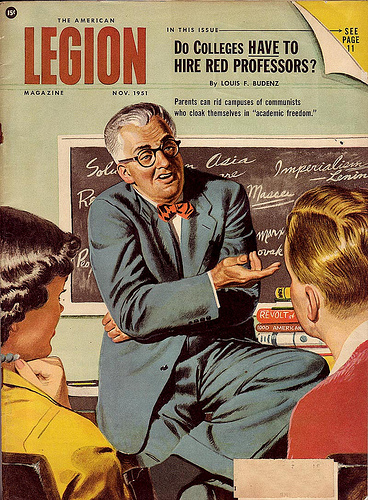
These days the bow tie signifies the opposite, of course. Which only shows their disguises have improved.
And so the year rolls around yet again to Krauthammer Day, the day on which we all celebrate Charles Krauthammer’s “confident assertion”:http://www.aei.org/event/274 eight years ago that:
bq. Hans Blix had five months to find weapons. He found nothing. We’ve had five weeks. Come back to me in five months. If we haven’t found any, we will have a credibility problem.
Or _nearly_ all of us celebrate it anyway. Charles Krauthammer himself seems to prefer to mark the occasion with an entirely unrelated “Run, Paul Ryan Run!”:http://www.washingtonpost.com/opinions/the-racing-form-2012/2011/04/21/AFT4TxKE_story.html?hpid=z2 column. Which is a little sad – after all it has been five months plus five months plus five months plus five months plus five months plus five months plus five months plus five months plus five months plus five months plus five months plus five months plus five months plus five months plus five months plus five months plus five months plus five months plus five months plus thirty days or so since he first put his, and his friends’ credibility on the line. It would be nice to see him (and others) mark the occasion more formally.
Perhaps the problem is that we have never _fixed on exactly how_ to celebrate Charles Krauthammer Day. Easter, Christmas, Hannukah, Festivus etc all have their associated and time-honored rituals, but Krauthammer day has none. Combining suggestions from “George W. Bush”:http://www.youtube.com/watch?v=jA2q00caZsY&feature=related and “Hugh Hector Munro”:http://haytom.us/showarticle.php?id=31, one possibility might be an Exploding Easter Egg Hunt. But then, this would perhaps prove simultaneously too dangerous to be very attractive to participants, and not dangerous enough to really mark the occasion properly. Better suggestions invited in comments.
Update: On the basis of a genuinely insane reading of this post, the execrable Glenn Reynolds gravely “deplores”:http://pajamasmedia.com/instapundit/119106/ my incivility. I don’t read Reynolds these days, for all the obvious reasons, but have quite clear and unfond memories of his own contributions to civil conversaton back in his heyday, such as this “denunciation of Chris Hedges”:http://www.pajamasmedia.com/instapundit-archive/archives/009671.php as a ‘flat-out racist’ for suggesting that Iraq was likely to be a ‘cesspool’ for the US invasion. How this claim comported with his “approving quote of a correspondent”:http://www.pajamasmedia.com/instapundit-archive/archives2/2006/11/post_21.php a couple of years later, arguing that
bq. The ball is in the Iraqis’ court. We took away the obstacle to their freedom. If they choose to embrace death, corruption, incompetence, lethal religious mania, and stone-age tribalism, then at least we’ll finally know the limitations of the people in that part of the world. The experiment had to be made.
and his own conclusion that:
bq. On the other hand, it’s also true that if democracy can’t work in Iraq, then we should probably adopt a “more rubble, less trouble” approach to other countries in the region that threaten us. If a comparatively wealthy and secular Arab country can’t make it as a democratic republic, then what hope is there for places that are less wealthy, or less secular?
has always been a mystery to me. The only plausible way in which Reynolds could have been promoting the cause of civil conversation here was by helpfully denouncing himself in advance as a ‘flat out racist’ so that right minded people could know not to associate themselves with him. Perhaps there’s another explanation – but if so, he has as best I know (as I say I don’t read him these days) been shy about advancing it.
No surprise there, we all knew that. The surprise is to read that headline over a piece by Fred Hiatt (last seen defending George Will’s right to his own facts) in the Washington Post. And the article is actually better than the headline.
Hiatt slams the Repubs not only on climate change and birtherism but on the illogical arithmetic (his words) in the Ryan plan, which all the “serious” pundits were swooning over only a few days ago.
And while he gives a nod to the false equivalence that is virtually mandatory in such pieces, saying “Democrats aren’t honest in these areas, either”, his examples point to Obama understating the need for higher taxes to extend beyond the very rich, and for more serious and costly action on climate change, and he concludes “To say that Republican irresponsibility makes it more difficult for Democrats to speak honestly is not an excuse. But it is a partial explanation”
And, at the end, he calls out the favored candidate of “serious” Republicans (At least, those who aren’t still still clinging to the hope that Romney will somehow become electable), Tim Pawlenty, in terms that would be strong even from one of WaPo’s house liberals, saying
Does Pawlenty believe what he says now? I’ve spoken with the former Minnesota governor. I know he is a smart man. As recently as 2008 he was supporting congressional action to limit greenhouse gas emissions. I do not believe that he believes those 998 scientists are wrong.
Which leads to another question: Should we feel better if a possible future president is not ignorant about the preeminent environmental danger facing our planet, but only calculating or cowardly?
To paraphrase Pawlenty, I don’t know the answer to that one.
I really don’t know what to make of this. Is it
(a) A temporary aberration, with normal service to be resumed shortly
(b) Hiatt breaking out of the Village for some personal reason
(c) The Post management realising that its rightwards trajectory was ultimately bound to be disastrous
(d) An indication that the rapid exposure of the Ryan plan as a fraud, coming on top of increasingly blatant delusionism on climate, and flirtations with birtherism, has crystallised a shift in the Wisdom of the Village, one that finally recognises the fact that the Repubs operate in a parallel universe, where reality is irrelevant.
I’m sure there is some more cynical explanation, probably correct, but until someone points it out, I’m going to hope for (d). A fact-based media-consensus, replacing “opinions on shape of earth differ” would, I think be disastrous for the Repubs. The base would still get their worldview from Fox, of course, but conservative independents would be exposed to the fact that the party they naturally prefer is too crazy to be trusted with political power.
And while I’m at it, I’d like my pony to be a palomino.
I saw this report go by on the Twitter saying that, in the wake of the latest budget deal, the Census Bureau is planning on eliminating the Statistical Abstract of the United States, pretty much the single most useful informational document the Government produces. The report says,
When readying the FY2011 budget, the Census Bureau tapped teams to do thorough, systematic program reviews looking for efficiencies and cost savings. Priorities for programs were set according to mission criticality, and some cuts were made to the economic statistics program. According to Tom Mesenbourg, deputy director of the Census Bureau, “difficult choices had to be made” in order to reduce expenditures on existing programs and move forward with new initiatives in FY2012. Core input data that the Bureau of Economic Analysis relies on to produce the National Income and Product Account tables, for example, would be retained. New data sets needed to be added to the Census of Government regarding state and local government pensions (e.g., cost of post-retirement employee benefits). In addition, FY2012 requires funding for the planning stages of the 2012 Economic Census; data collection begins in 2013. So what’s left to cut? It was felt that the popular Statistical Abstract of the United States—the “go to” reference for those who don’t know whether a statistic is available, let alone which agency/department is responsible for it—could be sacrificed. Staff will be moving to “Communications,” digitizing the data set. It is hoped that the private sector—commercial publishers—will see the benefit of publishing some version of the title in the future.
Bleah. When it comes to the United States, the print and online versions of the SA are a peerless source of information for all your bullshit remediation needs. What’s the median household income? What does the distribution of family debt liability look like? How many people are in prison? How many flights were late, got diverted, or crashed in the past few years? How many women hold public office? What sort of families get food stamps? Who does and doesn’t have health insurance? What percentage of households own a cat, a dog, a bird, or a horse? (The fish lobby seem to have lost out on that one.)
In his early days as a pundit, Paul Krugman got a fair amount of mileage from columns that consisted mostly of taking some claims about the U.S. trade balance or industrial structure, looking up the relevant table in the Abstract, and calling bullshit on the claim-maker. (Of course, that was in those far-off days when all this were nowt but fields, Krugman was still a Real Economist—i.e., he had yet to win the Nobel Prize in Economics, or say rude things about Republican economic and social policy—and he patrolled the boundaries of his profession against the incursions of pop internationalists.) So, properly used, the SA might even make you famous.
In the meantime, maybe this is all a feint or post-budget posturing by the Census Bureau. I have no idea. But I really do hope the abstract doesn’t go away anytime soon, or become the property of some gobdaw publisher looking to sell me tabulations of data the government has already collected using public money.
For those who’ve picked Obama (Democrat) in their fantasy 11-dimensional chess league, here’s the winning line that’s opened up, with annotation. Starting position is Budget compromise.
1. … (Reps) Announce Ryan strategy !? given the requirements to cut taxes, raise defence spending and reduce the deficit, it would have been better to temporise, but Serious Commentators approve
2. (Obama) Wait two days for Ryan plan to fall apart under scrutiny 2 … Keep looking Serious and try to erase worst bloopers from Interwebs ?? Overlooks Wayback machine, screenshots
3. Propose plausible plan, with mix of tax increases and expenditure cuts 3 … Keep looking Serious
4. Announce that debt limit vote must be Up or Down 4 … Cave in if 4 … refuse to lift debt limit, forced loss as in Clinton v Gingrich 1995)
5. Hold line on budget except for more cosmetic expenditure cuts 5 … Cave in if 5 … hold to Ryan plan, 6 make election referendum on Medicare vs tax cuts for millionaires wins easily
6. Wins
Of course, that’s the fantasy version. The likelihood that the Obama (Democrat) who spoke the other day will reappear any time soon is pretty small. In the real world, Obama (Republicrat) will almost certainly meet the Reps halfway and then some.
Matthew Yglesias points to research showing that many white Southerners still refuse to concede on the Confederacy.
roughly one in four Americans said they sympathize more with the Confederacy than the Union, a figure that rises to nearly four in ten among white Southerners. […] When broken down by political party, most Democrats said southern states seceded over slavery, independents were split and most Republicans said slavery was not the main reason that Confederate states left the Union.
This is perhaps, not entirely surprising. What is more surprising to me is that this version of events is officially accepted by the United States. I became a US citizen yesterday, after spending some time over the previous few days reading the US civics study guide to study for the citizenship exam (since I am a political scientist, it would have been particularly embarrassing for me if I had failed it). For better or worse, it’s hard for me to switch off my inner social scientist. Hence, I started paying a different kind of attention when I read that ‘states rights’ is one of three acceptable answers to the civics question ‘name one problem that led to the Civil War’ (slavery and economics are the other two). My understanding, perhaps mistaken, is that ‘states’ rights’ is typically employed as an explanation by those who would prefer to forget (as Ta-Nehisi Coates notes; also here – it was one particular right, the right to own slaves – that was was really at stake in the conflict). The study guide goes on to elaborate that:
The Civil War began when 11 southern states voted to secede (separate) from the United States to form their own country, the Confederate States of America. These southern states believed that the federal government of the United States threatened their right to make their own decisions. They wanted states’ rights with each state making their own decisions about their government. If the national government contradicted the state, they did not want to follow the national government.
after which it does get into a discussion of the relationship between slavery and economic systems in North and South, and its relationship to the Civil War.
This – of course – was only a very small part of the event in question (and in any event I got asked a completely different set of questions on the day) – but it was interesting. Tests of this kind are a very useful way of gauging what is accepted, and what is not accepted as part of the official national narrative, especially when, as in the US, there is no national history curriculum. I was surprised that this was part of the accepted (or at least acceptable) narrative, alongside the expected questions on Martin Luther King, and the origins of slaves in Africa. But perhaps there is a different history of the role of states’ rights in the conflict than the limited one I know (I am obviously not an expert on US history, or on the origins of the Civil War).
It was always highly likely that, given a Republican win in the US House of Representatives, the 1995 shutdown of the government would be repeated, and now it seems virtually certain[1]. Until recently, I’ve assumed that the outcome would be a capitulation by Obama and the Dems. Less likely, but still possible, was repeat 1995 where the Republicans caved, and took the political blame for the shutdown, but one in which there were still substantial budget cuts borne mostly by workers and the poor (actually, I think Clinton had done most of this pre-95).
The events in Wisconsin have shifted the odds, making it much harder for the Reps to shift or share the blame for a shutdown, and therefore more likely that an eventual compromise will be on terms than can be seen as a political win for the Democrats. More importantly, though, they’ve raised the prospect of something much bigger – a genuine popular movement against cuts that could turn the whole debate around.
I have no idea whether anything of the kind is being organized. I hope so, though it would be even better if something like this began as a spontaneous outgrowth of the movement in Wisconsin and elsewhere. That would, I expect, horrify Obama and the Dems even more than it would the Reps, but the example set by the fugitive legislators in Wisconsin suggests that there may yet be some Hope in the Democratic party.
BTW, sorry for posting so much lately. As you can probably tell, I have a lot of really urgent work to leave until the last possible minute.
Update The outcome was a last minute compromise that looks like a win for the Dems, relative to prior expectations. The cuts not much more than they had pre-emptively offered, and the various riders (Planned Parenthood etc) stripped away.
fn1. One problem with being in Australia is that I can’t always keep track of time. It’s already Thursday evening here, and I’ve been thinking of tomorrow as shutdown day, but actually it doesn’t start until midnight Friday DC time, which is still a day and a half away.
Glenn Greenwald looks at the dilemma faced by the Democratic base, and by much of the left globally. He doesn’t offer any answers, and I don’t have many either. The Republicans are getting scarier and crazier, so much so that any repeat of a Nader-style strategy is unthinkable. On the other hand, the fact that the base has nowhere to go, and can’t even justify abstention means that Obama and the rest of the Democratic leadership can and do kick them (or, thinking more globally, us) with impunity.
In some sense, it was ever thus, and the problem is not specific to the left – the Republican base spent years complaining about RINOs in much the same terms. Given a spectrum of opinion, the outcome is likely to be close to the median (calculated with respect to the weight given to particular people’s opinions which commonly won’t be uniform). Those far from the median face a choice which inevitably presents itself, to some extent, as one between lesser and greater evils.
The frustration felt on the left at present is (at least at my case) associated with a feeling that we should be doing a lot better. The case for market liberalism is in ruins after the Global Financial Crisis and it’s obvious that the reconstruction of the system has changed nothing, leaving the bankers unscathed and putting all the burden onto ordinary people. Left positions on lots of specific issues have much more public support than is evident from their political representation. The right screwed up massively over Iraq, is delusional on climate change and so on. And Obama won office easily running hard against Bush’s abuses on civil liberties and for a decent health care plan.
Similar points could be made about the situation in Australia, where the Labor government has essentially adopted the positions of its conservative predecessor (confusingly called the Liberal Party) while the Liberals have moved into the crazier reaches of the right. Over the fold, my own reaction to a recent speech by our Prime Minister Julia Gillard, which illustrates this very well (non-Oz readers may need to Google specific names, but a lot of the themes should be familiar).
J.K. Galbraith remarked that conservatism was engaged in a long search for a superior moral justification for selfishness. But that quest may sometimes become boring, or perhaps too difficult. Not to worry, because occasions to be straightforwardly vicious are more easily found, if you have the taste for it. Its spiteful tone aside, in substance Connick v. Thompson seems to be a Lord Denning Moment for the U.S. Supreme Court. The conservative majority preferred to affirm an obvious wrong rather than face the appalling vista of a brutal and corrupt justice system. To be fair to the system, it’s worse than that. Once the initial wrongdoing came to trial a jury, the district court, and the 5th circuit (twice) all decided the other way. It’s only when we get to Thomas, Scalia, Roberts, Alito, and Kennedy that the system chose to further institutionalize prosecutorial immunity. Stitch-ups should be seamless: if someone could pull at a stray thread, the whole thing might unravel, after all.
Washington, DC – The National Governors Association has announced a voluntary product safety recall of sixteen governors, due to a structural design problem that could pose an immediate safety risk to consumers.
“We didn’t know, when we made these governors available to the public, how truly dangerous they were,” said an NGA representative who requested anonymity because he feared swift and remorseless retaliation from one of the defective governors. “In most cases, they seemed like fully functioning human beings. But now it appears that many of them avoided routine safety checks or managed to buy off safety regulators.”
Jon Wiener on Bill Cronon at the Nation’s blog.
I especially liked this:
He’s not Bill Ayers, the education professor at the University of Illinois-Chicago who happily defends his Weatherman past. Cronon describes himself as a “centrist.” He says he’s never belonged to the Democratic (or the Republican) party. Yet he faces a Republican demand for his e-mail, while Bill Ayers never did.
But also:
The power of this simple fact lies in the way it disrupts the Republicans’ explanation of what they are doing in Wisconsin. They say the new law there ending collective bargaining with public employee unions is an emergency response to this year’s fiscal crisis. They say it’s a response crafted by local Wisconsin state representatives to help their neighbors who are facing big new tax burdens. Cronon suggested that none of this is true: the law is not a response to the current fiscal crisis, it’s been a Republican priority for decades; it’s not a Wisconsin idea, it comes from a national Republican think tank. And the goal is not to protect the little guy in Wisconsin but rather to help the big corporations that fund Republican operations.
One tangential observation. A lot of people round here are getting new email addresses, and migrating sensitive work-related (including student) correspondence to them. Me too.
Additional Update: Imitation is the greatest form of flattery (Michigan: it’ll be in your state soon).
Updates
1) see Anthony Grafton (hat tip: JW)
2) from Cronon’s blog, the Republican Party’s extraordinary response to his second blog post: read in full, but pause, first, to remember Peter Cook (I don’t know why I thought of him, but it does look as it Cook wrote it, doesn’t it?):
For Immediate Release
Contact: Katie McCallum, Communications Director (608) 257-4765
March 25, 2011
In response to Professor William Cronin’s deplorable tactics in seeking to force the Republican Party of Wisconsin to withdraw a routine open records request, Executive Director Mark Jefferson released the following statement:
“Like anyone else who makes an open records request in Wisconsin, the Republican Party of Wisconsin does not have to give a reason for doing so.
“I have never seen such a concerted effort to intimidate someone from lawfully seeking information about their government.
“Further, it is chilling to see that so many members of the media would take up the cause of a professor who seeks to quash a lawful open records request. Taxpayers have a right to accountable government and a right to know if public officials are conducting themselves in an ethical manner. The Left is far more aggressive in this state than the Right in its use of open records requests, yet these rights do extend beyond the liberal left and members of the media.
“Finally, I find it appalling that Professor Cronin seems to have plenty of time to round up reporters from around the nation to push the Republican Party of Wisconsin into explaining its motives behind a lawful open records request, but has apparently not found time to provide any of the requested information.
“We look forward to the University’s prompt response to our request and hope those who seek to intimidate us from making such requests will reconsider their actions.”
3) Today’s Times.
Today’s Times
.
My colleague Bill Cronon tells his story here. This part particularly struck me:
A number of the emails caught in the net of Mr. Thompson’s open records request are messages between myself and my students. All thus fall within the purview of the Federal Educational Right to Privacy Act (FERPA, sometimes known as the “Buckley Amendment,” named for its author Senator James Buckley—the brother of conservative intellectual William F. Buckley). The Buckley Amendment makes it illegal for colleges or universities to release student records without the permission of those students, and is thus in direct conflict with the Wisconsin Open Records Law and Mr. Thompson’s request on behalf of the Wisconsin Republican Party. I don’t know whether Mr. Thompson intended his request to generate a wholesale release of student records, but I myself think that doing so would represent a dangerous intrusion on student privacy. I’m pretty sure the law supports me in this view. If you’d like to review the terms of FERPA, see
http://www2.ed.gov/policy/gen/guid/fpco/ferpa/index.html
and
http://www.access.gpo.gov/nara/cfr/waisidx_04/34cfr99_04.html
A crucial point Cronon makes later is that without confidence in confidentiality many correspondents might either not email, or be less than frank in their emails. I could live with that when it comes to other adults. But my fear is that students, especially perhaps those who most need to break their silence, would refrain from emailing faculty about personal matters. I have been meaning to post for a while on a related issue, which is the very unusual character of some email correspondence between students and faculty — I have had interactions that I would not have had any other way, and therefore not at all prior to email. But on Cronon’s topic: I have emails from students which are deeply personal, expressing worries and sometimes telling experiences under an assumption of complete confidentiality. Sometimes they express ideas that they would not feel comfortable expressing in class, and which constitute some sort of “thinking out loud”. I have total confidence that without this way of communicating with me at least one student would by now have dropped out of college and probably worse, and I’m certain that others would have foregone considerable benefits. And if it were widely known, as it will be if the Republican Party gets hold of Cronon’s records, that no professor, and especially no professor who gets on the wrong side of a legislator of either party, can guarantee confidentiality, many such correspondences would not happen, to the detriment of the students and, at least in my case, the faculty (though the latter should not really count much in the calculation). The worry I have actually remains whether or not FERPA protects the emails of students (which, like Cronon, I’m pretty sure it does) because when they hear a story like this what they hear is “open records” “all emails” etc, comments like Cronon’s and my “pretty sure”, even if they are noticed, are not wholly reassuring. (Given that neither of us are lawyers, even “absolutely certain” would be cold comfort, especially from someone who thought Green Day come from Milwaukee).
Cronon is a moderate — I don’t know him, but have read his work and seen him talk — there is no question that he is sincere in his claim to be an independent.
It is not inconceivable that this is the beginning of a large fishing expedition triggered by the Carlos Lam affair. (Question: is this the end of Carlos Lam’s political career? Have prominent Republicans in Indiana started condemning him yet?)
Update: this is everywhere now. Here’s Krugman. Follow his link to Richard Vedder which seems to have nothing to do with whoever that is, but is riveting nevertheless)
Further Update: Our Chancellor comments.
Yet Another Update: Stephan Thompson, enigmatic man of mystery (thanks Kris).
JM informs me that St. Louis radio host Mark Reardon has been relaying the lies that the administration has been telling about Capitol clean-up after the protests. The original Dept of Administration estimate of $6.5-$7.5 million was met with incredulity by just about everyone including the rather honorable local TV news reporters (I was quite worried that one of the newsreaders was going to corpse when she read it out first, having apparently been given no warning). Of course, the very purpose of the nonsense was to give people like Reardon a figure to peddle, and that propaganda effect has been brilliant. The official figure was revised down, within a day, to $347,000. What’s that, 5% of the original? One might hope that the person who gave the first figure got a good dressing down, but I suspect such hopes would be in vain. This article in the Isthmus airs the beliefs of current and former DOA workers that DOA statistics are being developed in response to pressure from the administration. And, in fact, it may be that there was no damage at all (except, manifestly, to the lawns, which have to need reseeding, surely):
On March 3, the agency’s top lawyer claimed that protesters caused $7.5 million in damage to the Capitol, mostly to marble from the tape holding on signs and banners. Hastings notes that this claim was “flashed across the country” before being revised downward the next day to as little as $347,000.
On Monday, March 7, after the signs were all removed, DOA spokeswoman Carla Vigue said the agency was bringing in an “outside expert [to] determine the amount and nature of the work that will be needed to be done to bring the marble to its prior condition.” On March 9, she said “it may be several days” before this information is in hand.
Now, well more than several days later, no further information has been provided. “Still working on it,” said Vigue on Tuesday.Jacob Arndt has a pretty good idea how much damage to the marble was actually caused: None at all. Arndt owns Northwestern Masonry and Stone, a Lake Mills-based company that he says “does consultation work and has contracts with the state of Wisconsin.” He toured the Capitol early this month with a DOA staffer, inspecting the various types of stone: Kasota-Mankato, Wausau red granite, Dakota red granite, verde jade. “I looked at each of these types of stones,” says Arndt. His conclusion: The painter’s tape used to affix signs left “little or no residue” anywhere. The worst problem he saw was some residue where media had taped cords to the floor, but even this was easily removed with simple cleaning agents. “There’s no damage to the stone,” says Arndt, who has been back in the building several times since, verifying this finding. He says the DOA official who showed him around agrees even the lower cost estimate is “completely ridiculous and politically inspired.”