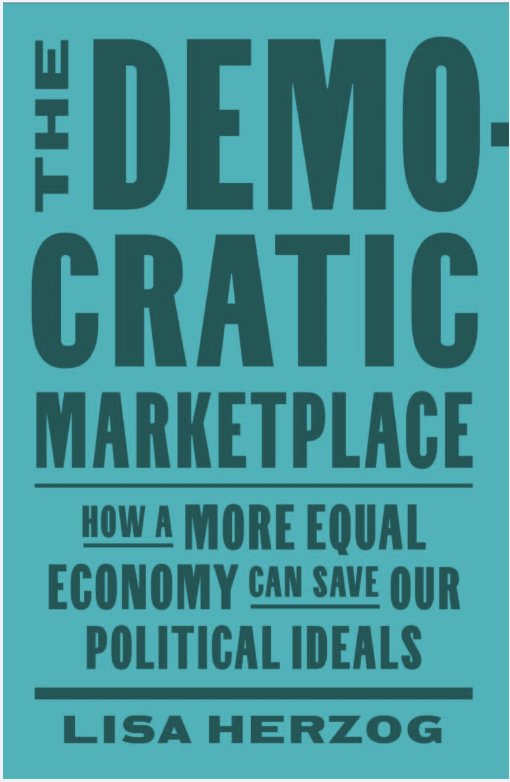
 If you want to know more about how the current form of capitalism is undermining (a thick conception of) democracy, and what can be done about this, then you should read Lisa Herzog’s latest book The Democratic Marketplace. The book is written for a broad audience, and I suspect that anyone who regularly reads this blog will enjoy Lisa’s book and learn something new; and it will also provoke debate and discussion on important questions regarding the state of our economic system, our democracies, and how these two are related.
Lisa argues that genuine democracy (which is much more demanding than merely elections/counting votes) requires that democratic values be embedded in all public spheres of life. And therefore we should democratize the economy. This requires, among other things, workplace democracy, reducing economic inequality, shifting our focus from economic growth to the functions of the economy, and adopting a different policy of time that allows citizens to do the much-needed democratic work.
This Thursday 20 November, between 14:00 and 16:00 hours CET, the Visions for the Future Project is organizing an online discussion of Lisa’s book. Julie Rose and Tom Parr will kick off with comments. The online book workshop will take place via MS Teams. To get the link (which you will get within the next working day after registering), you can register via the link on the bottom of the event’s announcement page. Enjoy the reading, and enjoy becoming inspired to take (more) civic action by reading (and discussing) Lisa’s book!
{ 14 comments }
Seekonk 11.18.25 at 5:19 pm
“democratize the economy”
Here’s a suggestion: Let voters determine the central bank prime rate via periodic online polling.
It’s simple – up, down, or unchanged.
The public knows that there’s no free lunch, and they’ll quickly see the effects of their choices. No need to leave it to supposedly disinterested experts.
JPL 11.18.25 at 10:37 pm
The theoretical explorations called (roughly) “democracy” and “socialism” are coming at one overall real-world problem from different directions. Some of the ideal principles can be stated in equivalent ways in either tradition.
Reason 11.19.25 at 9:05 am
” .. the functions of the economy …” Isn’t this the problem – they aren’t actually defined or even well known. I often yell into the void hopelessly – “What is the economy for” – instead of the more normal question “What can be done to help the economy?” – as though the economy was an organism with it’s own wants and needs, independent of the people it is meant to serve.
MisterMr 11.19.25 at 12:08 pm
@Seekonk 1
You would reach an interest rate of 0 in a very short time, there are more debtors than creditors – but we are already close to 0 so the difference is not very big.
“The public knows that there’s no free lunch”
I’m part of the public and I can tell you that if there is a chance for a free lunch for me I would take it; generally “there is no free lunch” is something that people only tell to others, but do not accept for themselves.
engels 11.19.25 at 1:26 pm
there’s no free lunch
Where do profits come from?
Seekonk 11.19.25 at 8:12 pm
@ #4
I take your point about the prime rate being low in absolute terms. Perhaps my proposal should apply to consumer rather than commercial loans.
I’m not suggesting that anyone be compelled to lend. I’m assuming that a (lower than current) rate would emerge at which they would be willing to lend.
MW 11.19.25 at 11:06 pm
@JPL
Yes, it’s interesting to do a Caroll diagram of the four combinations- Socialist but not democratic (Leninism), democratic but not socialist (Thomas Jefferson, Willmoore Kendall), socialist and democratic (Labour and Social Democratic parties), and neither socialist nor democratic (right wing dictators). Probably even more interesting if “Democratic” is placed on a sliding scale based on how much control the public have over the party- e.g. an anarchist party might be more democratic than one which has a well defined program selected by a core leadership, which the public are nonetheless free to either accept or reject.
engels 11.20.25 at 1:29 pm
Socialist but not democratic (Leninism)
Hence the famous Leninist slogan: “don’t let the workers’ councils get anywhere near power!”
Mike Huben 11.20.25 at 2:37 pm
MW @ #7:
That’s a really good idea. And where do libertarians fit? According to their ideology, neither socialist nor democratic, in with the right wing dictators. Because their ideology was funded by the plutocrats.
Moz of Yarramulla 11.20.25 at 11:34 pm
MW@7: isn’t that the classic political compass, with socialist-capitalist and anarchist-authoritarian axes? Often the s-c axis is replaced by left-right, and sometimes the a-a replaced by green-{something} because ‘black’ and ‘brown’ have other meanings in modern politics so we really lack a term to describe the majority position on ecology “burn it”.
An economy-ecology axis might be informative. Despite being a false dichotomy it is nonetheless assumed to be real by many.
There is also quibbling to be done about how far anarchism is compatible the the tyranny of the majority, especially in states where the voting system strongly encourages having exactly two parties.
Matt 11.22.25 at 5:35 am
so we really lack a term to describe the majority position on ecology “burn it”.
“Orange” fits, for sevral reasons. Though it’s now old enough that many (most?) people won’t get it, there’s the “Agent Orange” connection, the Trump connection, and the color of a big part of a flame.
Hence the famous Leninist slogan: “don’t let the workers’ councils get anywhere near power!”
Like a lot of things, Lenin’s belief in the power of the soviets didn’t survive 5 minutes confrontation with reality. I suppose, in a way, it’s to his credit that he didn’t feel compelled to stick with the idea once it was obvious that it was going to be a disaster, perhaps especially for those in power.
MW 11.23.25 at 2:04 pm
Personally, I prefer “democratic-undemocratic” to “anarchist-authoritarian”, because democracies have existed for long periods of time while anarchist states have struggled to sustain themselves, although their principles influence socialists, democrats, and some conservatives like the Distributists. Similarly, I think democratic vs undemocratic is essentially about the level of public participation in, and control of, the government, wheras authoritarianism is about how the government uses it’s authority- Calvin’s Geneva was both relatively democratic compared to the monarchies which surrounded it, and far more intrusive into people’s daily lives.
MW 11.23.25 at 2:36 pm
The one axes I would add to the political compass is a dispute about human nature- do we live in an optimistic world in which people are often happy to help each other, or do we live in a cynical world in which everyone tries to get as much of what they want as they can? Although this might seem to strongly correlate with a left-right axis, Marxism is often about unmasking the idealistic aspirations of the bourgeouisie as a way of hiding power politics, and similarly Max Weber, although genrally popular as a writer with the centre-left, also tries to expose a world of relative power seeking. Similarly, at least some libertarians see themselves as supporting the means to enavle human cooperation.
(Personally, I’m left leaning and fairly optimistic about human nature).
Ingrid Robeyns 11.23.25 at 6:16 pm
In case anyone had wanted to join the discussion but couldn’t, the recording of the presentation and the comments by Tom Parr and Julie Rose are now online (Q&A is not recorded). See https://visions-for-the-future.sites.uu.nl/events/speaker-series-with-dr-lisa-herzog/
Comments on this entry are closed.