Mostly I leave Sunday photography to our colleague, the estimable Chris Bertram. Still, this Sunday I was walking the dog in the hills above my town. (“My town” being a modest community of a couple of thousand people in the rolling countryside of northern Bavaria.)
[copyright me, yesterday]
And by the side of a grassy meadow, I stopped to photograph this pretty little yellow flower:

[they look so innocent]
A moment with the app revealed that this was Ranuncula bulbus, the Bulbous Buttercup. There are a bunch of species in the genus Ranuncula, which is another way of saying there are a lot of different kinds of buttercup. That’s because buttercups appear to be a recent evolutionary radiation, and a pretty successful one.
But when I did a quick search on these little guys? I found they used to have another name. The Bulbous Buttercup was once known as Saint Anthony’s Turnip.
Saint… what?
Let’s start with the “Bulbous” part. The Bulbous Buttercup is so called because it has a bulb. Specifically, it has a “corm” — an enlarged stem, just below the surface, that stores energy in the form of starch. 
[pedantry: corms are enlarged stems, while true bulbs like onions are enlarged roots]
The next thing to know is that buttercups are pretty toxic to humans. The leaves and stems, the sap, the flowers, and the corm — all bad. Eating one buttercup won’t kill you, but it could make you sick.(1) And buttercups are a significant menace to horses and cattle, who are also vulnerable to the toxins. Google around and you’ll find lots of online articles about how to kill this pretty-but-dangerous little flower if it shows up in your pasture. So while that crunchy little corm has lots of calories — starch and a bit of protein — it’s not going into any salads.
(1) The lethal dose for humans seems to be about 500g, or about a pound of fresh buttercup greens. So you’d have to work at it, fair enough.
However: while humans, horses and cows are vulnerable to the buttercup toxin? Swine are not. Pigs will cheerfully eat a buttercup and ask for seconds. In fact, since the corms grow close to the surface, it’s very easy for swine to root them up. A meadow full of buttercups? For a pig, that’s a tasty, nutrient-rich buffet.
So how does that connect to “Saint Anthony’s Turnip”? Well, that’s easy: it’s because St. Anthony is the patron saint of swineherds.
[Saint Anthony accompanied by a pig, 15th century]
Which… okay, there are a lot of Catholic saints, and most of them are patron saints of something or other. Pretty much every profession has a patron saint, from funeral directors (St. Joseph of Arimathea) to bartenders (St. Armand of Maastricht). (2) “Swineherd” is one of those jobs that basically no longer exists but that was really quite important for thousands of years. So it makes perfect sense that there would be a patron saint of swineherds.
(2) Some professions have multiple patron saints. Lawyers, for instance, have three or four. Catholic lawyers know the Lawyer’s Prayer to St. Thomas More, which gives good advice even if you’re neither a lawyer nor Catholic.
But wait a moment. Is this… the Saint Anthony? Saint Anthony the Great? The third-century Roman who gave up all his wealth and went out into the Egyptian desert to become a hermit, where he was alternately tormented and tempted by demons? That Saint Anthony?
[copyright Michelangelo Buonarotti, c. 1487)
Yup, that’s the guy.
So the original story of St. Anthony comes from a Roman bishop named Athanasius, who wrote a Life of Anthony sometime in the late fourth century. I went back to look at that original text (pdf). And while the Life has both the temptations and the torments, there’s nothing about pigs.
But somewhere, somehow over the centuries a bunch of legends and traditions accreted around St. Anthony. So, there’s a legend that a demon possessed a wild pig in order to threaten the saint, and then Anthony cast out the demon, and the grateful pig became his friend and companion. In another story, Anthony healed the piglet of a wild sow, which caused the sow to follow him around like a pet. There are a number of these.
Which is all perfectly common and normal for saints, especially early / OG saints. (3) But as to why pigs particularly… nobody seems to know.
[but there it is]
(3) St. Anthony is also associated with fire — see him standing in flames in the middle image above? There are like three different legends associated with that and I’m not even going there.
So if you have a nodding acquaintance with European art history, you know there’s a vibrant tradition of pictures about the Temptations of Saint Anthony, from Hieronymus Bosch —
[as Bosch goes, relatively restrained]
— to Salvador Dali.
[Dali painted this for a contest!]
The subject matter gave artists pretty free rein, after all. They could depict the grotesque, monstrous, surreal or erotic —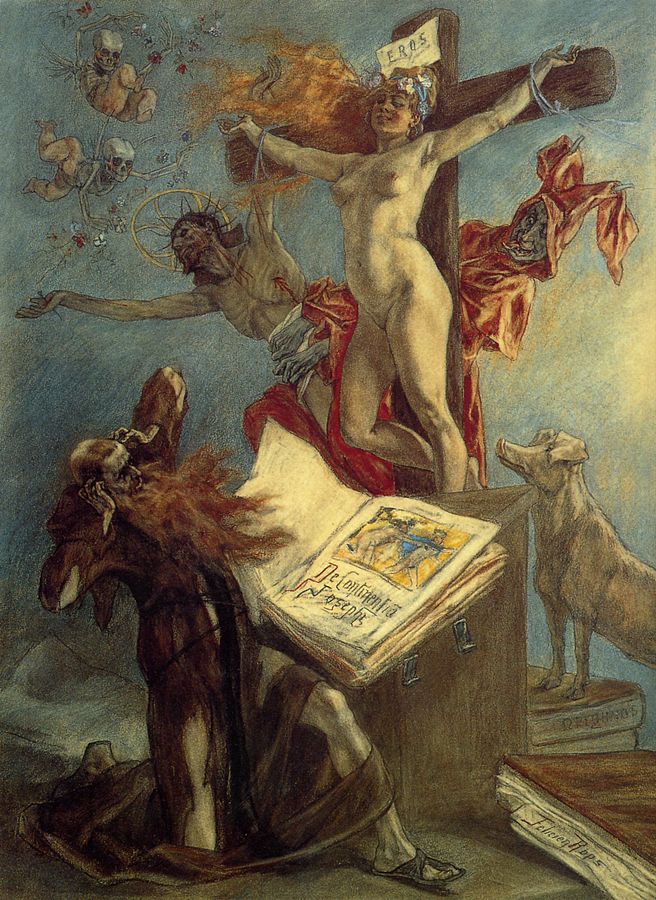
[but note stalwart companion pig]
— sometimes to the extent that the saint himself simply vanishes under a mass of demonic weirdness.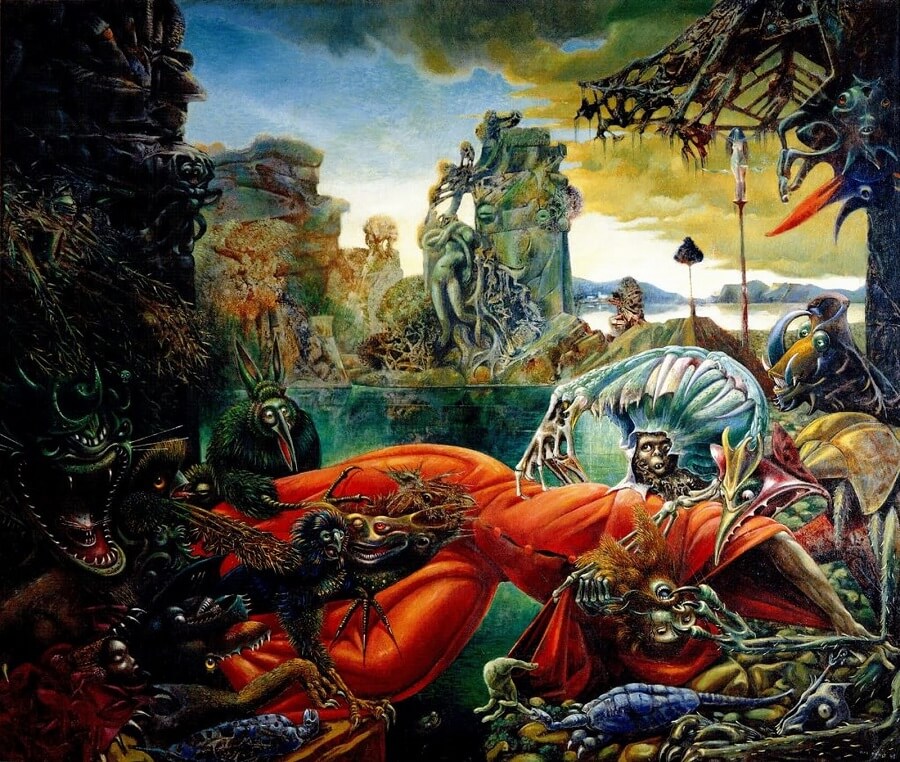
[tbf this is Max Ernst, and… yeah, it’s Max Ernst.]
And of course, the modern internet has joined the fun.
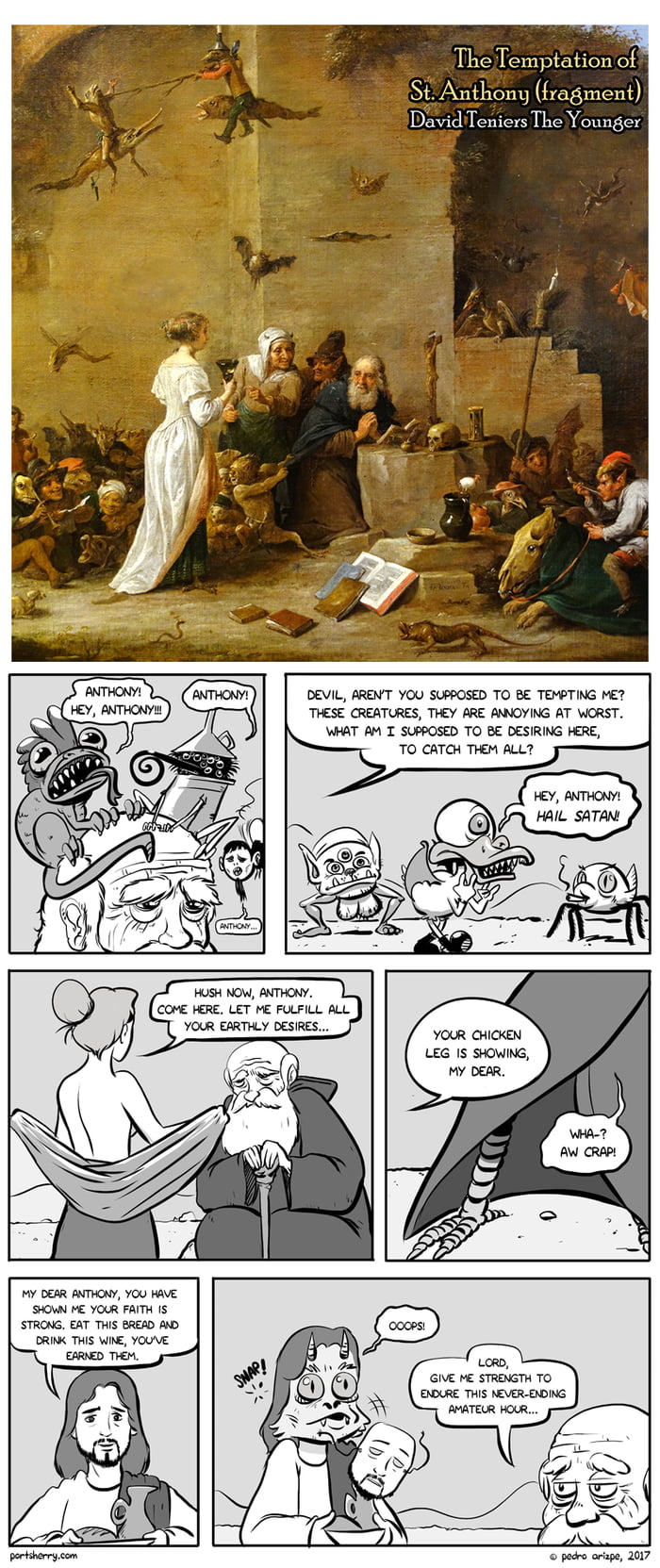
But okay! Somehow St. Anthony became associated with a pig. So you have a tradition of Anthony depicted as tormented and/or tempted, and another tradition showing him with a pig.
[or sometimes both]
And based on the pig connection, Anthony became the patron saint of swineherds. (4) And thus, the pig-edible Bulbous Buttercup became St. Anthony’s Turnip. All done, then?
(4) I went down a whole side-bar rabbit hole on swineherds — everything from the Gadarene Swine to Circe to the dueling shapeshifting swineherds of Irish legend. TLDR, the status of swineherds varied wildly over times and places, but they were associated with various sorts of magic and weirdness way more often than you might think.
Well… there are a couple of other things. In England there was a tradition of taking the smallest pig of a litter — what today we would call the runt — and donating it to the Church. And these little pigs were known as tantony pigs, with “tantony” being a contraction of “Saint Anthony’s”. This in turn led to occasional use of “tantony” as a verb, meaning to follow someone superior like a little pig following its mother. The word is now entirely obsolete, but now and then it still pops up.
The other thing has nothing to do with pigs or saints. If you’re British, Irish or American you might recall a child’s game where a child holds a buttercup under your chin, and if your chin turns yellow, it means you like butter. Nobody has any idea where that comes from, but it’s true that if the sun is shining, and you hold a buttercup under your chin, you can get a surprising yellow-gold glow off the buttercup.
[if you’ve never tried this, check it out, it’s actually pretty cool]
So the reason this happens is because buttercups are very glossy and reflective. Is this just random?
No. According to this paper (“Functional Optics of Glossy Buttercup Flowers”), there are a couple of reasons for it. One is what you’d expect — it’s probably more attractive to potential pollinators. But the other is this:
“Buttercup flowers are heliotropic and when ambient temperatures are low they have approximately the shape of a paraboloid.”
— A heliotropic flower is one that, over the course of a day, turns to face the sun. A paraboloid is the three-dimensional version of a parabola. It has the interesting property that anything striking its inner surface tends to get bounced or reflected directly to a single point in its center. So…
“Under these circumstances, incident sunlight that reaches the petal surface under a large angle will not be reflected to the outside but towards the central flower area where the reproductive structures are located. This will cause increased floral temperatures, which enhances seed and pollen maturation and is preferred by pollinators… Indeed, under natural conditions, the centre of the paraboloid-shaped glossy flowers of the arctic buttercup, R. adoneus, were found to be several degrees warmer than the ambient air.”
In other words, the buttercup is a little solar oven. It focuses sunlight into its center, partly to keep its own genitals warm, but also as a boon to pollinators. On a cool but sunny spring morning, cold-blooded insects will prefer the flowers that literally warm them up, allowing them to bask in concentrated sunlight. 
[like a cozy snuggle in a warm blanket]
So the sun-focusing buttercups will get pollinated preferentially over flowers that don’t have this ability.
If you’re a science fiction nerd, you might remember that an author named Larry Niven once proposed an alien plant called a “sunflower”. It grew a flower with a mirror surface that could reflect and focus sunlight…
A single species of plant evenly dispersed across the land, from here to the infinity-horizon. Each plant had a single blossom, and each blossom turned to follow Louis Wu as he dropped. A tremendous audience, silent and attentive.
He landed and dismounted beside one of the plants. The plant stood a foot high on a knobbly green stalk. Its single blossom was as big as a large man’s face. The back of that blossom was stringy, as if laced with veins or tendons; and the inner surface was a smooth concave mirror. From its center protruded a short stalk ending in a dark green bulb.
All the flowers in sight watched him. He was bathed in the glare. Louis knew they were trying to kill him, and he looked up somewhat uneasily; but the cloud cover held.
“You were right,” he said, speaking into the intercom. “They’re Slaver sunflowers. If the cloud cover hadn’t come up, we’d have been dead the instant we rose over the mountains…”
There was no alien survivor anywhere in the domain of the sunflowers. No smaller plant grew between the stalks. Nothing flew. Nothing burrowed beneath the ashy-looking soil. On the plants themselves there were no blights, fungus growths, disease spots. If disease struck one of their own, the sunflowers would destroy it.
The mirror-blossom was a terrible weapon. Its primary purpose was to focus sunlight on the green photosynthetic node at its center. But it could also focus to destroy a plant-eating animal or insect. The sunflowers burned all enemies. Everything that lives is the enemy of a photosynthesis-using plant; and everything that lived became fertilizer for the sunflowers.
Niven wrote that around 1970. The first papers on buttercup reflectivity appeared in the 1990s, decades later. So, coincidence.
That said… I mentioned at the start that buttercups seem to be a fairly recent and successful evolutionary radiation, with a bunch of related species spread widely across several continents. At a guess, the reflection is probably the reason. Apparently all buttercups do it. And it is, in biological terms, rather novel. (5) So who knows how far the buttercups might take this trend, millions of years from now?
(5) Edit, added one day after the original post: the “paraboloid reflective petals -> miniature solar oven” trick appears to have evolved independently several times, though buttercups seem to go harder than most. I belatedly found this excellent recent survey paper, which gives an overview of the various tricks flowers use to warm themselves up.
Anyway: I snapped a casual photo while walking the dog, and boom — an hour later I was reading about corms, Catholic hagiography, and the physics of paraboloids. We all learned that little Tennyson poem back in school, right?
Flower in the crannied wall,
I pluck you out of the crannies,
I hold you here, root and all, in my hand,
Little flower—but if I could understand
What you are, root and all, and all in all,
I should know what God and man is.
And that’s all.
{ 30 comments }
Kenny Easwaran 05.18.26 at 7:30 pm
I love these!
And I was surprised when you said “that St. Anthony”, because for me, that St. Anthony is actually St. Anthony of Padua, namesake of San Antonio, TX, famous preacher to the fishes, and the patron saint of lost objects (because a book once went missing, and he prayed for it to be found, and the person who stole it happened to bring it back, which was a miracle). But apparently, he was born under the name Fernando, and took the name Anthony after serving at a church dedicated to St Anthony the Great (mentioned in the original post).
https://en.wikipedia.org/wiki/Anthony_of_Padua
Tm 05.18.26 at 9:03 pm
You mention the connection with fire and this deserves further elaboration because there is another botanical and at the same time toxicological connection: ergotism, the disease caused by fungus contaminated grain, was also known as St Anthony’s fire. “The disease’s association with St. Anthony’s Fire is linked to the Order of St. Anthony, a medieval Christian order that provided care for ergotism sufferers”.
https://en.wikipedia.org/wiki/Ergotism
https://en.wikipedia.org/wiki/Hospital_Brothers_of_Saint_Anthony
Anthony the Great has been by far eclipsed by Anthony of Padua who is among the most popular and well known saints (at least in Western Europe). His statues in churches are ubiquitous. I assume his popularity is due to him being depicted as a beardless (in contrast to St Joseph) young man holding a child and a bunch of flowers. Who wouldn’t prefer such a cute patron saint to the old desert hermite?
oldster 05.18.26 at 11:05 pm
Thank you, Doug! A great lark as always. Though I find it hard to believe, on general grounds, that the buttercup is the only paraboloid blossom.
Saints and animals — if you are in Bavaria, then you are in the (broad) neighborhood of Freising, home to St. Korbinian and his bear.
Korbinian was ordered by Gregory the Great to convert the heathen Bavarians, which he did with mixed success — they have been intensely Catholic for centuries now, but are still entirely uncivilized.
In any case, as Korbinian was crossing the Alps, a bear attacked and killed his packhorse. Korbinian rebuked the bear in forceful term, and the chastened bear consented to bear the saint’s baggage. The bear is shown loaded with saddle-bags in many paintings of Saint Korbinian, and the town of Freising has adopted the bear as a mascot.
Like Kenny E, my assumption is that St. Anthony is the Paduan. I had not known about the desert father.
Alan White 05.19.26 at 2:33 am
Another gem! You might patent stream-of-consciousness research. Please keep posting!
J-D 05.19.26 at 4:29 am
Robert Graves, ‘The Devil Is A Protestant’
Doug Muir 05.19.26 at 7:31 am
Kenny @1, In our distracted modern times, I think St. Anthony of Padua gets a boost from becoming the patron saint of Lost Things. The business with helping you sell your house probably didn’t hurt either (iykyk).
Meanwhile OG St. Anthony is maybe slightly out of fashion at the moment. Hermits, monks, wise counsel and resisting temptation perhaps don’t feature as strongly in the current zeitgeist, nor do modern artists need a religious excuse to depict the erotic or grotesque.
Well, he’s been doing heavy lifting for 1700 years. He can step back for a bit until things come around again.
Doug M.
Doug Muir 05.19.26 at 7:42 am
J-D @4, oddly enough I was just thinking of Robert Graves the other day.
The context was thinking about Belisarius (as one does). Because everybody loves Belisarius! And yes, he was brilliant. And he was loyal — amazingly loyal, and he stayed so under extreme provocation. And also yeah he got screwed over by his boss.
But if you actually look at the record? Again and again, we see Belisarius having conflicts with his peers and subordinates — Narses, John, Bessas.
These get explained away as some combination of “Justinian was suspicious of Belisarius, so encouraged divided commands and/or didn’t punish insubordination” and “jealousy of the brilliant handsome general”.
Which… maybe. But on the other hand, maybe Belisarius was capital-D Difficult. Sharp elbows? Thin skinned and easily threatened? High-stepping arrogant SOB? Any of those would fit the available information.
So — why does almost all modern historiography just adore Belisarius? Yes, our main source for him is Procopius, and Procopius basically gives Belisarius a tongue bath. But historians are supposed to be good at working past source bias.
I think the culprit here is Graves and his 1938 historic novel Count Belisarius. It was very well written, very widely read, and Graves’ name already carried huge cachet. And Graves not only tracks Procopius, he gives us a Belisarius who’s nuanced, complex, and utterly sympathetic.
— sorry, totally tangential rant. But, heh, Robert Graves.
Doug M.
Matt 05.19.26 at 9:57 am
I took a class on “Monasticism in the Early and Medieval Church” in college, and we read Athanasius’s Life of Anthony. It’s fun! My favorite part was how he vowed to never wash, and so, when he had to walk somewhere, and there was a stream in the way, the water would part ways around him. I wondered if it was due to excesive body oil build up. Also, he decided to become a monk living in the desert after walking by a church and hearing someone preaching about giving everything one had to the poor and following Christ, so he gave everything he had away. This included his sister, who depended on him – he sent her to an early nunnery. History doesn’t report if she was happy with this. I’d never heard him called “the great” before – just “St. Anthony of the Desert”.
On the “do you like butter” thing – as a kid we’d do this with dandelions. (I don’t think we had any butter cups. At least not growing on school grounds or people’s yards.) But the “joke” was that you’d take the dandelion and rub it hard on the person’s face, making a yellow streak to show they “liked butter”. A nice typical kid joke.
Doug Muir 05.19.26 at 11:08 am
Oldster @3, “Though I find it hard to believe, on general grounds, that the buttercup is the only paraboloid blossom.”
— You are correct! I went back and googled harder, and it turns out there are several other flowers that do this trick. The buttercup does seem to do it harder than most, but apparently it has evolved independently several times.
I found an excellent survey paper on thermoregulation in flowers, which I’ll add to the main post in an edit.
Doug M.
oldster 05.19.26 at 11:46 am
“I found an excellent survey paper on thermoregulation in flowers, which I’ll add to the main post in an edit.”
May I suggest that an entire post could be devoted to thermogenesis in the Arum family (Araceae)? These plants have an alternate metabolic cycle that is powerfully exothermic, which they use for various tricks. In the Corpse Plant, for instance, “the spadix heats up to 37 °C (99 °F), and rhythmically releases a powerful smell to attract carrion insects which feed on or lay their eggs in rotting meat.” It’s close cousin, the Eastern skunk cabbage, “belongs to a select group of thermogenic plants for its capacity to create temperatures of up to 15–35 °C (27–63 °F) above air temperature through cyanide-resistant cellular respiration (via alternative oxidase) in order to melt its way through frozen ground.”
Happy researching! May you tunnel through the data like a skunk cabbage, and rhythmically release your findings like a corpse plant, attracting the carrion insects of the CT readership.
Michael Cain 05.19.26 at 12:51 pm
In this day and age, you know what we need a patron saint of? Auto-correct. A saint you can pray to that today, auto-correct will do you no damage…
J-D 05.19.26 at 1:38 pm
The characters in Count Belisarius are great characters for a work of fiction but of doubtful correspondence with the historical originals, and the version used of the end of Belisarius is one first recorded in writing centuries later, strong reason for doubt.
Tm 05.19.26 at 4:41 pm
I’m a bit confused by this exchange about Belisarius. Is it true that historiography in the Anglosphere is strongly influenced by works of fiction?
NB there’s a very popular German novel that deals with Belisar (but not as its main character), Felix Dahn’s ‘Kampf um Rom’ (1876). I do hope that German historiography isn’t based on this work of fiction (Dahn was a renowned historian, but still…)
steven t johnson 05.19.26 at 6:38 pm
The extract from Niven is yet more proof that so-called hard science fiction is a phrase indicating the science is fictional. (Some working scientists are repelled by this, others find it amusing or even provocative speculation, depending on the writer’s skill and their personal tastes.) Stylistically it is worlds apart from fantasy where the point is to evoke past mythologies or fairy tales or occult philosophies. The style in science fiction is to evoke verisimilitude, to help the suspension of disbelief that the fantastic world can connect to our mundane reality. (Sometimes that’s faked with bad jargon, bad style, which can’t pass muster as real ideas. People who don’t like big words also despise such on principle.)
Which is by way of saying the Niven invention of sunflowers is imaginative and the exposition is pretty skillful. Yet the claim “Everything that lives is the enemy of a photosynthesis-using plant; and everything that lived became fertilizer for the sunflowers…” Well, to my eyes it’s absurd.
Flowering plants typically have animal pollinators. Wind pollinators like grasses tend to have delicate structures to catch air-borne polen? It is typical for worms to come to the surface, but the thought they are exterminated then by Slaver sunflowers makes me wonder where the soil comes from? Plus of course bare ground tends to have major issues with erosion and drainage. (The ashes just another layer to be washed away or leached.) Once started down this path, I could go on. Slaver sunflowers are like Arrakis sandworms, once you see them you can’t help at some point thinking about what you supposedly see.
Of course the sunflowers are basically the opposite of Dune. When I see Dune I wonder where the oxygen comes from? When I imagine sunflower worlds it’s, where does the carbon dioxide come from? (And why isn’t the planet a major fire hazard?)
Doug Muir 05.19.26 at 7:52 pm
J-D @12, Graves was a poet and a novelist, not a historian — although his writing is good enough that it’s really easy to think his knowledge is really broad and deep. Also, IMS this was his second historical novel after I, Claudius, so he was already practiced in the form.
Tm @13, formally no — of course not! History is an academic discipline! Historians carefully examine sources, sift for bias, and strive for objectivity.
In reality… well, those sudden swings in historiography don’t come out of nowhere, and academic history doesn’t exist in a vacuum. I’m not saying historiography is “strongly influenced by works of fiction”. But the production of history is inevitably influenced by the prevailing zeitgeist.
In the particular case of Belisarius, I do suspect that Graves’ very sympathetic portrait had a lasting impact. Belisarius The Tragic Hero is just a more compelling narrative than Belisarius Who Was Smart But Also Pretty Thin-Skinned And Not Really A Great Boss. Does academic training give historians immunity against compelling narratives? I’ll let the academics answer that.
Doug M.
Jim Harrison 05.19.26 at 8:16 pm
My St, Anthony bit: as an aging pedant, my brain has gradually become an attic stuffed with the rubbish of thousands of years of human and inhuman experience. The external world is an even crazier montage. The other day it occurred to me that my world had become a nonstop reprise of the temptation of St Anthony and or maybe I am St Anthony and this chunky acid trip is his/my ongoing temptation.
RobinM 05.19.26 at 8:38 pm
Anent St Anthony of Padua, if I’m remembering correctly, Toni Morrison became “Toni” because she chose that St Anthony as her saint when she converted—while still quite young—to Catholicism.
oldster 05.19.26 at 8:42 pm
“Is it true that historiography in the Anglosphere is strongly influenced by works of fiction?”
Procopius wrote “The History of the Wars,” and Procopius wrote “The Secret History.” These two works differ on so many central points that at least one of them must be largely a work of fiction.
And the historiography of Justinian’s reign — both in the Anglosphere and in the German-speaking world — is strongly influenced by Procopius.
D. S. Battistoli 05.20.26 at 11:17 am
Quite fun.
A perhaps minor note: Anthony the Great, also known as Anthony of Egypt, and Athanasius of Alexandria, were Roman in the same way Jesus and Plutarch were Roman: the Roman Empire had political sovereignty over their homelands. In plainer terms, it’s a bit of a fox pass to call these people Roman.
Anthony seems to have spoken only Coptic, and it’s very silly to call Athanasius Roman because he was a pope: of Alexandria, the first of the apostolic sees to call its bishop a pope (which makes sense, because pope is a word derived from Greek, not Latin).
Oh, and Doug M @7 and @15 I doubt that Robert Graves is the source of contemporary historians and classical studies folks writing admiringly about Belisarius. There are countless cases of classicists rolling their eyes at one or another Graves theory that washes through the attendance of their undergraduate courses and folk who engage with them online.
Whether or not Belisarius was as difficult, temperamental, and thin-skinned as Napoleon, he was also a very successful general, doing what no general of the Western Empire contemporary could do (extinguishing the Vandal Kingdom) and then, you know, sacking Ostrogothic Rome. Rightly or wrongly, military history has a tendency to subordinate questions of personal temperament to questions of strategic success: the idea seems to be that good generals win and bad generals lose, and there is no effect a general might have on their subordinates independent of leading them to strategic victory that would invert what it takes to be a good general.
The exarchates of Africa and Ravenna end up weighing so heavily on one side of the scale that the rest, regardless of Procopius’ bias or what we think about Belisarius’ role in Persian campaigns or his late conflict with Narses, the scale is still stacked. Belisarius gets ranked with ibn Nusayr and Rommel as foreign generals who made the very difficult task of rolling through North Africa and subjugating any polities encountered along the way look easy.
Tm 05.20.26 at 3:35 pm
19: Was sacking Ostrogothic Rome a strategic success? I think that’s the kind of question that serious historiographers might look at from different angles than just “which battles did he win”… Neither Rome nor Africa remained in the empire for more than a few years.
J-D 05.20.26 at 10:16 pm
Belisarius was assigned a task, he set out to achieve it, and he did. By the standards usually applied to military commanders, that’s a success. If the task was never worth achieving in the first place, that’s a failure of the person who assigned the task (in this instance, Justinian).
D. S. Battistoli 05.22.26 at 11:22 am
Tm @20, the exarchate of Africa endured for over a century, and that of Ravenna for nearly two centuries. I’m not disputing your claim; it just depends on what you mean by “a few years.” I guess their existences were not too long in the context of the nearly 1500-year-long history of the empire in the east. But recall that the Western Empire, from Julius Caesar to the fall of Rome, lasted 450 circuits of the sun, while it wasn’t until 1943 that the United States’ age surpassed that of the exarchate of Ravenna at its fall.
MisterMr 05.22.26 at 2:00 pm
@D. S. Battistoli 19
Pedant note: both Anthonys we born after Caracalla’s edict, so they legally were roman citizens (like st. Paul), whereas Jesus and Plutarch were not.
If instead we are speaking of cultural belonging, this is arguable, but by that time the Roman Empire was largely christian and not strictly “Roman”, unless we want to use “Roman” in a stricter sense but then all the Eastern Roman Empire wasn’t all that roman since they mostly spoke Greek.
D. S. Battistoli 05.22.26 at 7:26 pm
MisterMr @23, fair points, all.
Tm 05.26.26 at 8:19 am
Battistoli: My interest isn’t really to judge Belisarius as a historical figure nor am I qualified to do so. In any case it would be pointless to hold events against him in retrospect that happened later or that were outside his control.
My point however is that the Gothic war overall was at best a Pyrrhic victory for the Empire. Italy was devastated and Rome became irrelevant for centuries, the Empire itself was weakened by the decades of war, and the conquest didn’t even last for more than a few years (with the exception of Ravenna as you note). This isn’t, or perhaps only to a small degree, Belisar’s fault. But also I wonder why is he lionized so much in certain quarters when most of his historical legacy has proven (again in retrospect) quite dubious?
Peter T 05.27.26 at 1:42 am
On ‘not strictly Roman’ – what was Roman changed continuously. Etruscans/Samnites/Marsi etc were not Roman in 300 BCE, but very much Romans by 50 BCE. Gauls, the various peoples of Spain and North Africa, Illyria and Britain followed. Augustine or Jerome were very much Romans, as was Emperor Philip the Arab or the Illyrian emperors or Severus (Punic, married a Syrian). The break is not Christianity but, in the west, the arrival of the Goths/Vandals/Franks with very different notions of politics and society. The East continued Roman (Romaioi), changing over time.
Charles S 05.28.26 at 6:59 am
I don’t remember the last time I commented here (years? Decades?), but an error in plant anatomy pedantry demands a response.
Onion bulbs are most definitely not modified roots. They are modified stem/leaf complexes, rather obviously in the case of onions, whose layers are entirely unlike roots. Modified roots as energy storage are called tubers (specifically root tubers, as there are also stem tubers). I looked this up to confirm, as it’s decades since I had plant anatomy classes, but onions being roots is so obviously nonsense to anyone who has ever really looked at an onion. Note the roots growing off of base of the onion, and the smooth transition between the onion bulb and the onion leaves. Look at a scallion and consider what part becomes the bulb as the plant matures. Look at where the leaves start if an onion bulb sprouts (the middle of the onion turns green down to the base and grows, not something separate at the top of the bulb). Compare that to how a potato sprouts, with a stem growing off of the potato, with a clear disjunct between potato root tuber and potato stem.
Charles S 05.28.26 at 7:13 am
But then I’m also wrong, as potatoes are also modified stems (stem tubers), not root tubers. True root tubers include dahlias and sweet potatoes. Hoist on my own pedantry, as it were. Clearly I need to stare at potatoes and sweet potatoes more carefully.
Gav 05.28.26 at 2:35 pm
When my wife and I were visiting Savoca, some time ago, we noticed in one of the churches there an unusual life-sized wooden statue of a man carrying a large pig*. Nobody around at the time seemed to know who or what it represented, or why, but we guessed that it could have been St Anthony the Abbot.
Wandering around the Uffizi a few years later, we noticed a small depiction of St Anthony or rather his pig tucked away on the edge of many of the religious paintings there. The more paintings we looked at, and there were an awful lot of them, there he was. It all seemed pretty random, as though he’d photobombed them. In the end it became like a game of “Where’s Wally” to spot the pig in the painting, and we had several disapproving looks from the other visitors.
More recently again we were in the Basilica of Notre-Dame in Saint-Raphaël and saw a very similar (fairly recent ) statue but instead of a pig he was carrying a remarkably large fish. We didn’t ask.
J-D 05.29.26 at 12:39 am
There is a group of animals known as ‘sea pigs’! However, they are not fish. ‘Sea pigs’, oddly enough, are a kind of ‘sea cucumber’, and like other ‘sea cucumbers’ they are seafloor-dwelling echinoderms.
In medieval times, though, many fictitious or misunderstood kinds of marine equivalents of terrestrial lifeforms were believed in and it’s possible the fish you saw was a real or imagined variety thought to be the aquatic equivalent of a pig. I don’t say this must have been so, but I wouldn’t rule it out.
Comments on this entry are closed.