Google maps said it would take 2.5 hours to drive from our place in the Blue Mountains to Hill End. Maybe we’re slow. And sure, we stopped to check out nearby gold mining village Sofala on the way. But we left home shortly after 8am and arrived at Hill End in time for us to claim early seats at the micro-pub for lunch. That was pretty good timing actually, though no thanks to the Google lady.
The purpose of this day trip was nerdy, for Hill End might have a reasonable claim to be Australia’s Deadwood.
I had never been there. But I had seen lots of pictures like this one (below) of the Australian Joint Stock Bank and the bar (which was right next to bank, where it belongs). I am trying to understand the movement of gold from the gold fields to wherever it ended up, and that means finding out about gold buyers and banks.
As one of those people who likes to do history with their Blundstones on, I decided I needed to go see it. The Tourist Information Centre in Bathurst told me to take snacks and make sure I had a full tank of petrol like I was heading into the Outback – which I have done, a lot. But they spooked me enough to leave it until my beloved and I could go on a day when lots was happening in town and the micro-pub would definitely be open. Priorities.
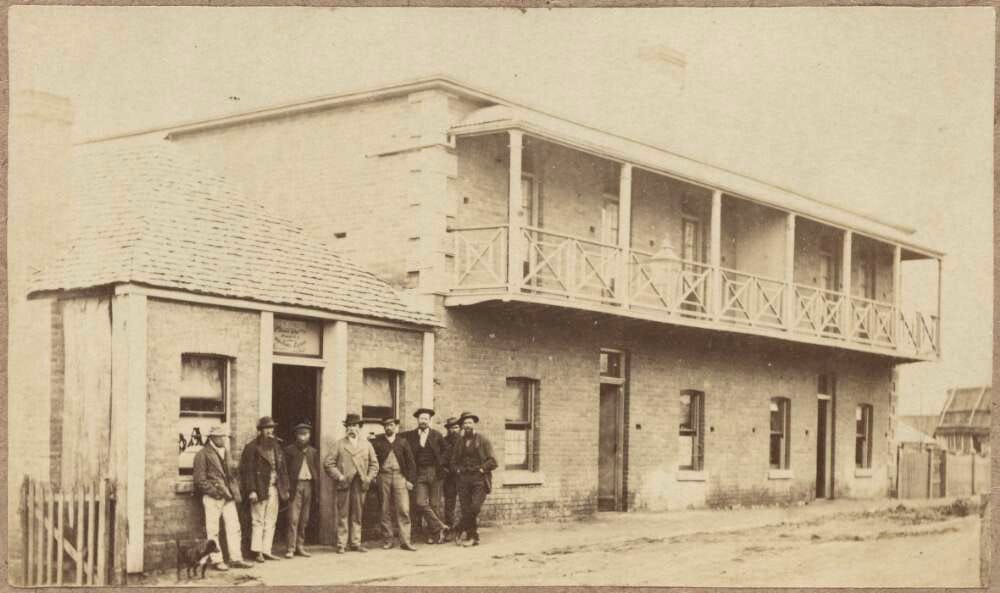
Banks and pubs together at last. Group of men outside the two-storey Australian Joint Stock Bank brick building with corrugated iron roof, John Stewart’s Exchange Hotel housed in the upper storey, and the hotel bar in the smaller building with shingle roof to the left, Clarke Street, Hill End, New South Wales, ca.1872 – National Library of Australia
Hill End is wonderfully set up for history tourism. And its not just the micro-pub (which happens to be housed in one of the old banks. It was research, really).
There is also a really lovely little museum and the streets are full of signs letting you know what was on this spot at the height of Hill End’s growth c.1872.
Around 1872, some enterprising photographers set themselves up on the goldfields, including in Hill End. Newly rich fellas could head into the studio and have their picture taken, which was the Very FancyTM thing to do at the time.
When I first started my permanent (ha!) academic job, I worked across the corridor from Melissa Bellanta, who (among other brilliant things) is a wonderful historian of fashion. She was then working on this article, ‘Business Fashion: Masculinity, Class and Dress in 1870s Australia’ (which was incidentally published in the same 2017 issue of Australian Historical Studies as my ‘Seeking a New Materialism in Australian History’, co-authored with Sophie Loy Wilson based on our many conversations as PhD students, which we’d presented at the Australian Historical Association in 2015).
Melissa’s article uses the photographs taken and collected in what is now the Holtermann Collection (more about that in a sec) to show that the reputation for egalitarianism on the gold fields is not borne out by distinctions in fashion. That is, a distinctive business class is evident in what the blokes in these pics were wearing.
What bohemian journalist Marcus Clarke missed when he cast his eye over what people were wearing in gold towns was the incredible innovation in business fashion that the gold era produced. The tails and top hats he was looking for as markers of elitism were giving way to new types of dress that marked out the man of business as something new entirely.
It was a new phase in the history of capitalism. Several features of it converged on Hill End, including changes in class status and the fashion that signified it.
Photography as instrument of settler invasion
Because of the photographers, Hill End is thus blessed with squillions of pictures of itself c.1872. This is partly because one of the luckiest of the town’s diggers, Bernhardt Otto Holtermann, commissioned the photographers to record every fucking inch of the gold towns as part of his attempt to accelerate the invasion of Wiradjuri land by promoting New South Wales as a desirable place to emigrate.
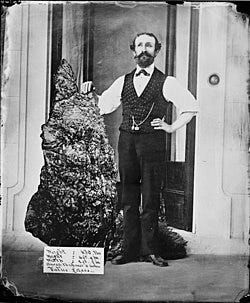
Image: B.O. Holtermann with the Holtermann Nugget, North Sydney, 1874-1876 ? – American & Australasian Photographic Company (8575721367).jpg
Some hiccups in his plans for exhibiting the photographs mean that Holtermann’s responsibility for invasion is only partial. In any case, there was not a lot of need to help. The population of New South Wales in 1851 was 187,243. By 1861 it doubled to 350,860 on the back of the gold rush – a ‘rush that never ended’ as Geoffrey Blainey pointed out, so there were 501,580 in the colony by 1871. Not all of them were in Hill End, only about 8,000 of them c.1872, which was a mere 1.6% of the non-Indigenous population (quite a lot more than the present population of 111, which is 0.00013% of the New South Wales population now).
Walking through Hill End then, the history tourism signs feature pictures from the Holtermann Collection. Sometimes the picture shows a building that looks exactly the same as the one still standing.
Other times, not so much.
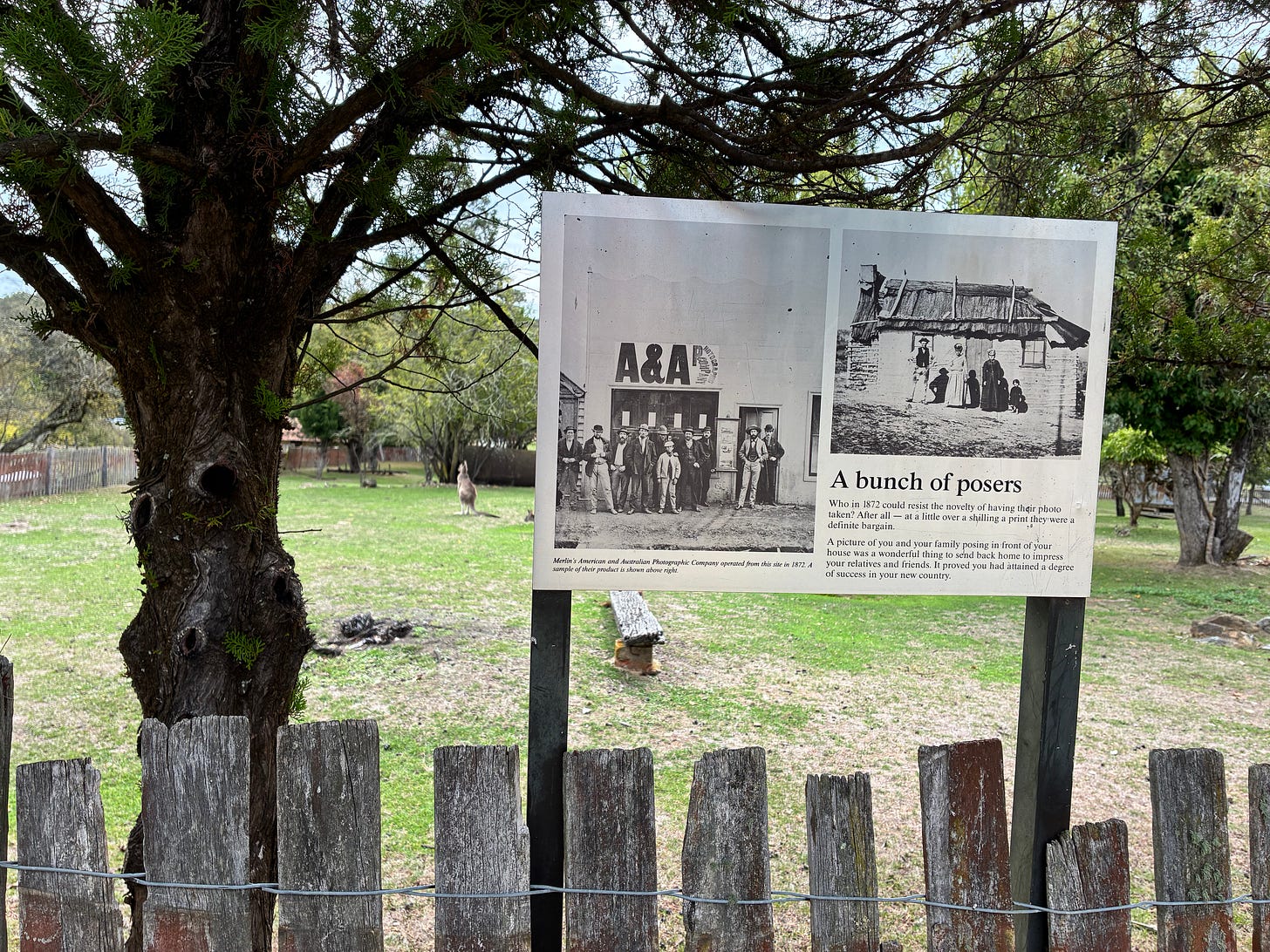
Image: site of the A&A photography studio in Hill End. And yes, that is a kangaroo in the background.
Now, I originally trained as an archaeologist. By the time I finished my honours year, it was clear to me (and likely everyone else) that this was not for me. I went to work in university admin and had a baby and started my history MA.
But apparently some of that archaeology training stuck. Weird how someone just left those bricks there, said my beloved. I looked at him incredulously. That’s a wall, I said. Look. You can see the outline of the building. And this one, see how the wall collapsed outwards. No, my love, it is not just a random jumble of rocks.
A historian who sees absolutely no need for those stupid boots (he wrote a dissertation that included the Salem witch trials while living a short distance from Salem and never went there), my beloved reckons he’s never going to a historical site with me again. [Absolutely untrue, our trip to Gulgong is scheduled].
Fancy Goods
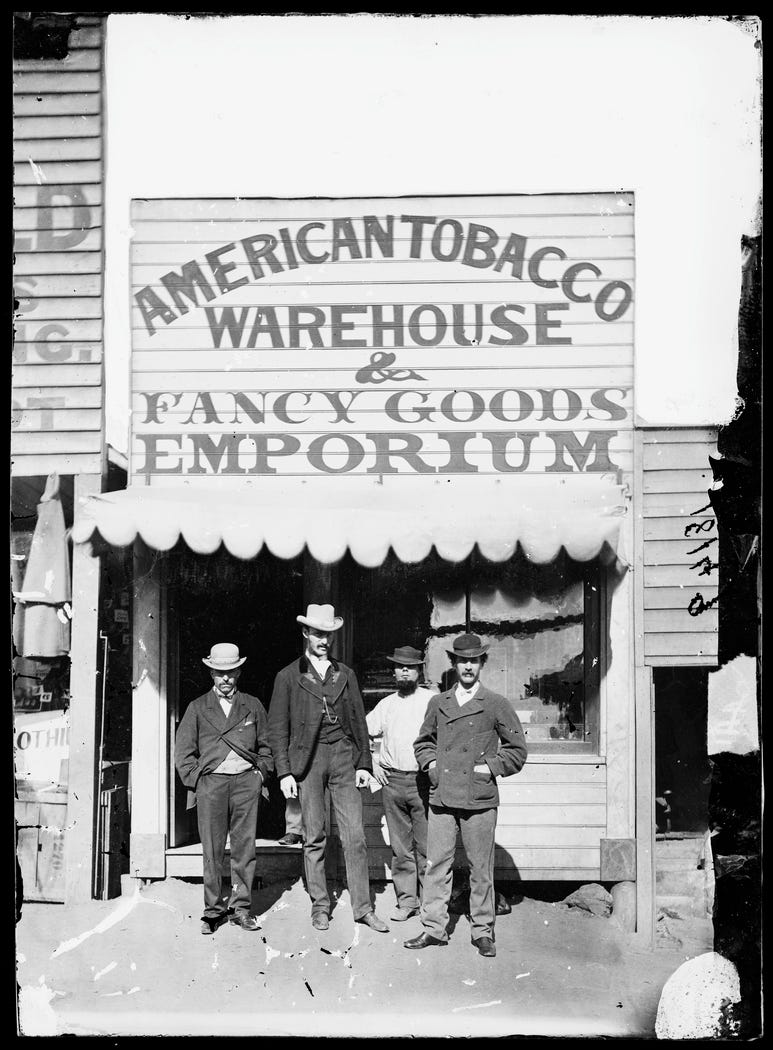
Image: American Tobacco Warehouse & Fancy Goods Emporium, Gulgong American & Australasian Photographic Company, Holtermann Collection, SLNSW [I know it is Gulgong. The Hill End ones refused to download for some reason]
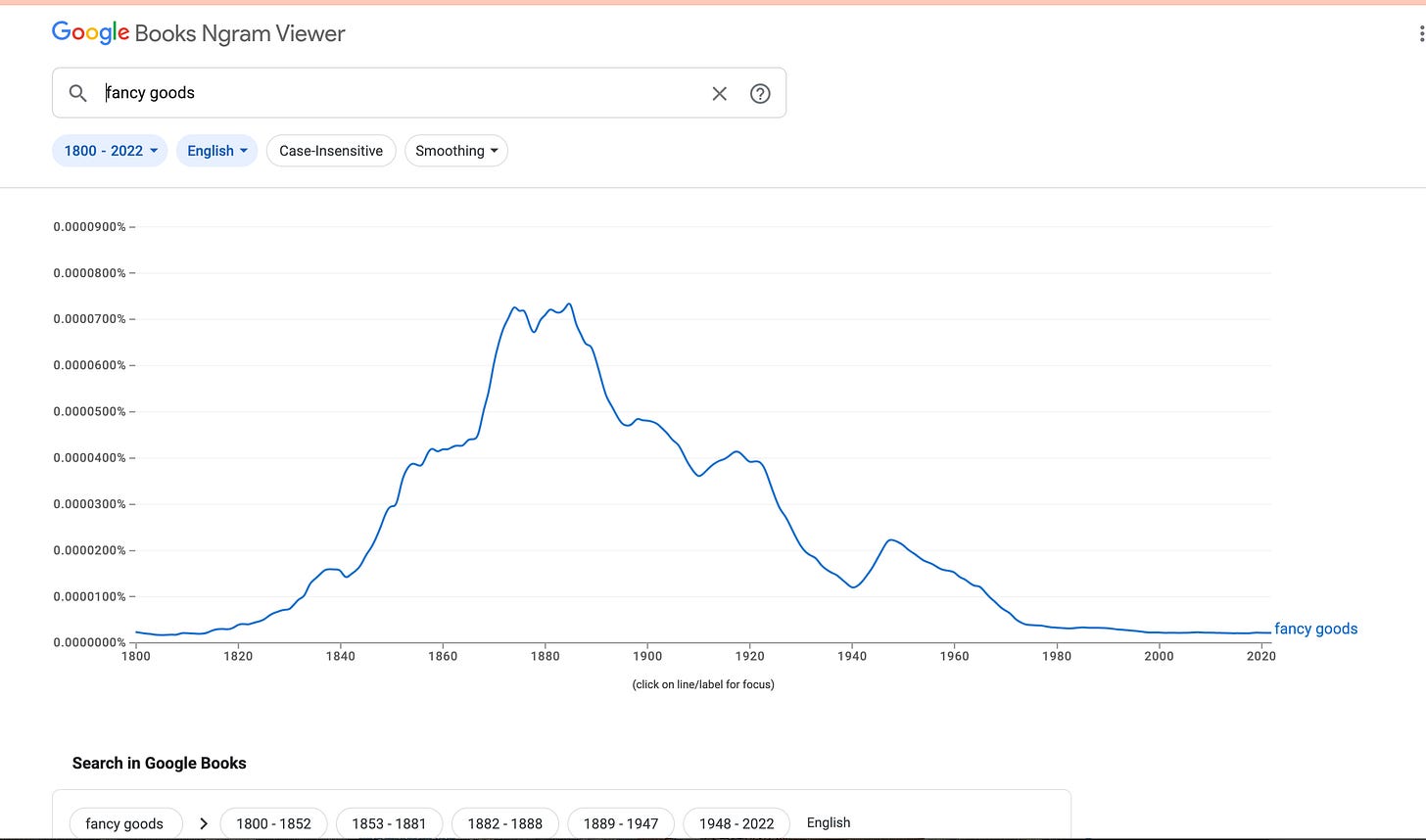
Check out the google NGram on ‘fancy goods’. Hill End’s peak is pretty damn close to peak use of ‘fancy goods’. This is the time for the rise of mass advertising and the gold fields were the best place for it, where people had sudden cash to spend. (How the gold was turned into cash is crucial to this…I’m working on it)].
In one of his editions of The Europeans in Australia, historian Alan Atkinson tells us that this was also the moment where consumer goods were being packaged for individual sale. Rather than heading into a store where a store keeper would bundle up the amount of flour, or butter or whatever for you, there were packets of them.
This is important, actually. Mass distribution and consumption (ok maybe 8,000 or even 501,580 people doesn’t seem ‘mass’ now…but it was a start) became easier with individual packaging rather than transport of bulk goods for distribution in the local grocery store.
And with the very rapid population explosion going on in Australia due to the gold rush, it made feeding people easier.
This was associated with the rise of mass advertising because branding (FancyTM) products was possible with individual packaging.
So branding and advertising became part of the market system. We are pre-plastic at the height of FancyTM Goods, but I think as the inheritors of this change, we can see that it was also pretty environmentally devastating, at least in the end.
The Holtermann ‘nugget’
Since then Lorraine Purcell from the gathering group has been incredibly helpful, telling me which material to read in the State Library (some of which she has produced herself), sending me a USB of stuff and a linking me to list of gold buyers before the banks set themselves up.
On our way back to the car to head home in time for the chickens to go to bed we passed a small park where in 1972 one of the most prolific of Hill End’s historians Harry Hodge commissioned this concrete ‘replica’ of the Holtermann nugget.
Here is my beloved, also replicating Holtermann’s proud stance.
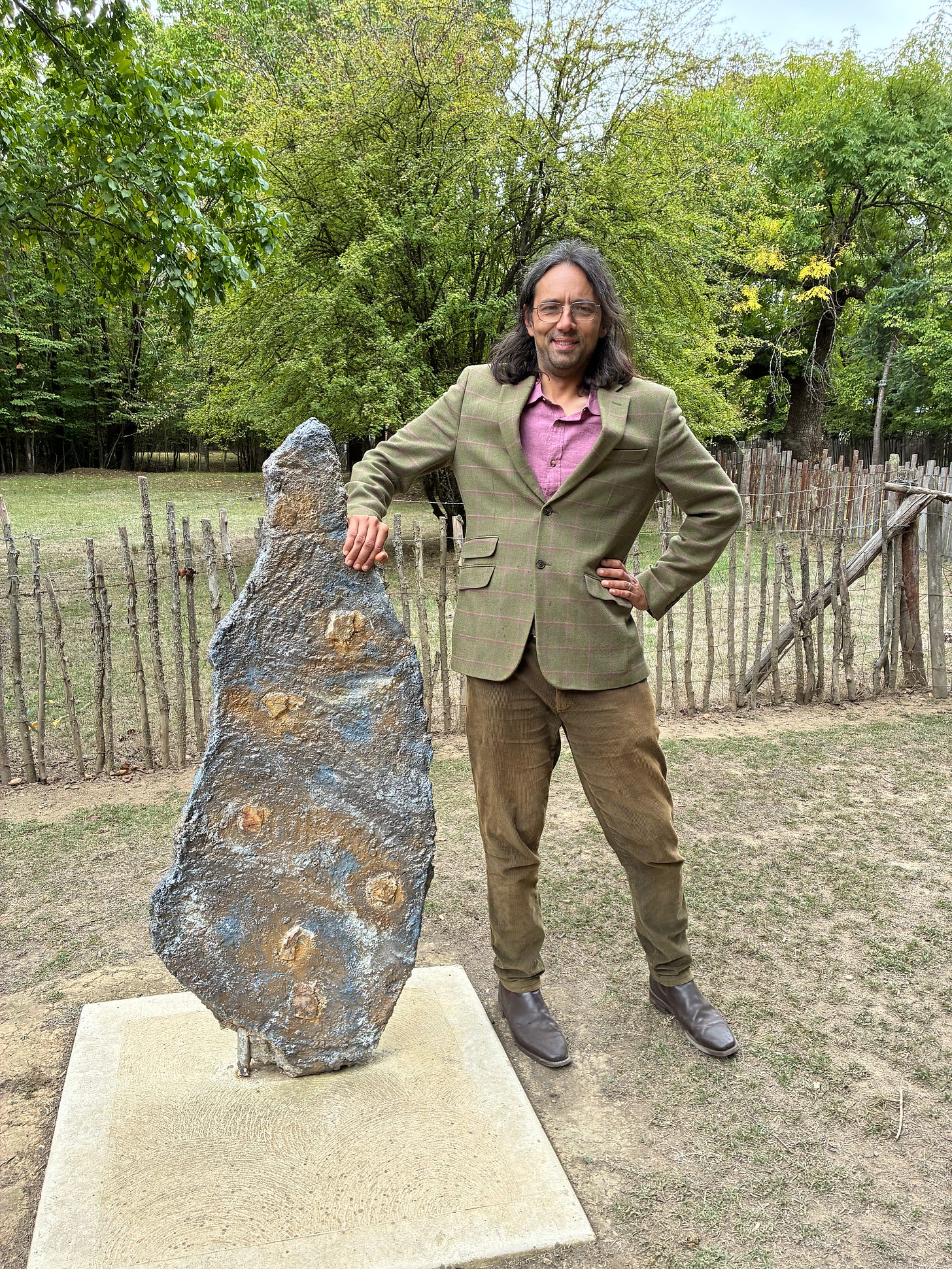
Image: Hannah’s beloved and a very unconvincing piece of concrete in the approximate shape of the Holtermann ‘nugget’.
Was it the end of the rainbow?
Why does all this matter? Look at this moment in the history of capitalism. Gold is newly crucial to the operation of a globalising financial system.
Having just suppressed a very widespread First Nations uprising, the colony of New South Wales (and very soon, Victoria) had reached a point of settler colonisation where the infrastructure was in place to support a massive settler invasion, which would consolidate the effects of recent military efforts.
And consumer capitalism is on the rise, so that digger consumption of ‘Fancy GoodsTM’ will launch a new phase in the history of capitalism.
Global capitalism briefly converged on Hill End (like we did). There was gold at the end of that rainbow for some settlers, perhaps even more for the new class of retailers. In coming posts I’ll talk about what happened to the gold after that and what it meant for the development of global capitalism.
But for now I want to acknowledge its role in consolidating the theft of what always was and always will be Wiradjuri land.
PS This post is produced as part of my CH Currey Memorial Fellowship at the NSW State Library. Early posts from this work were:
https://crookedtimber.org/2026/03/03/golden-missed-opportunities/
https://crookedtimber.org/2026/04/10/cosmic-alchemy/
{ 5 comments }
D. S. Battistoli 06.02.26 at 5:22 am
A bit OT, but this post made me wonder if, given CT’s increasing Australian turn, anyone had posted here on Durkheim’s Elementary Forms of Religious Life as a study of Aboriginal Australians, in addition to as a seminal contribution to sociological theory.
Apparently that has not yet happened. But along the way, I (re?)learned that I had not hallucinated the memory, and that while no contemporary CT posts use hyperlinked footnotes, CT was indeed the first blog I ever visited that did use them.
For any kids in the audience, hyperlinked footnotes were the fancy goods of academic bloggery in the first decade of the 21st century.
And to keep the only tangentially related train rolling (please forgive me, Hannah): for anyone who thinks that it was only with the advent of plastics that individual packaging became bad for the environment, I invite you to visit a supermarket or liquor store, with their great stacks of glass bottles. Before individual packaging, wine and liquors were transported all the way to the last mile in barrels, and only then decanted into glass or earthenware containers that got washed between uses (like the barrels) rather than thrown out or recycled in energy-intensive processes. It’s hard to look at rows of glinting glass without thinking of all the kilowatts shining down like the evening sun. Or like a Holtermann nugget.
K Macdonald 06.02.26 at 11:11 pm
(and the Holtermann nugget image is said to be a pre-Photoshop composite:
https://australian.museum/blog/amri-news/glitter-restored-the-holtermann-nugget/)
JBL 06.04.26 at 12:51 am
Something’s gone wrong with the sentence that begins “Between my (apparently insufferable) archaeological pontificating, we stumbled across the Hill End Family History building, housing the”
JBL 06.04.26 at 12:55 am
Also, sorry to be commenting just about formatting stuff, but: all your images explode well beyond the margin of the column in my view (overlapping the sidebar, or in some cases stretching well off the page); is there some way to set them to not do that?
(I know little about Australia and less about Australian history; this is an interesting post but I don’t have anything intelligent to say about its subject.)
Martin 06.10.26 at 2:14 am
Our school class went on a field trip to Hill End around 1970. I can remember the retired bullock driver and the Chinese mine site (the Chinese cooperated together, which was considered cheating). The trip was run by our history teacher, a Mr Hodge, as I remember.
Comments on this entry are closed.