Before I depart this world, I would like to visit St. Giles’ Cathedral in Edinburgh, Scotland, and see the Jenny Geddes memorial.
I’m told it’s open to the public.
Why? What’s interesting about a stool?
Well, it’s probably impossible to point to a single moment, or a single object, and say “The Enlightenment began here.”. But if you were absolutely forced to choose one moment and one object? One pebble that started the avalanche?
Then Jenny Geddes’ legendary stool, flying through the air on a hot summer Sunday in 1637, wouldn’t be a bad choice.
So the story: back in 1637, King Charles I decided to impose a new prayer book upon the Church of Scotland. 
[Charles I: cool outfits, bad King]
Charles was the King of three Kingdoms — England, Scotland, and Ireland — and all three had state-controlled Protestant churches. The Protestant Church of Ireland was a minority Church, of course. But almost everyone in England belonged to the Church of England, and almost everyone in Scotland belonged to the Church of Scotland.
And these were two different Churches. They were both Protestant, and mostly Calvinist in theology. But they had completely different origins. And they used different systems of Church government, different styles of architecture and art, and — this is key — different prayers. And the Church of Scotland, in particular, was deeply bound up with Scots nationalism.
But King Charles wanted to harmonize the two Churches and bring their practices closer together. (“Why?” is a perfectly reasonable question here, and “because Charles I was stubborn and not very bright” is a perfectly reasonable answer.) So he had some Scots courtiers down in London write a new prayer book that was closer to the English one, and ordered that it be used in Scotland.
[cue ominous music]
This was not well received by the Scots.
There were a lot of different reasons for them to dislike the new prayer book, starting with the obvious one that by forcing Scots to use English-style prayers rather than vice versa, it was a gross offense to Scots nationalism and Scots pride. But also, many Scots were fanatically, almost hysterically, anti-Catholic. And many of these Scots had come to suspect that King Charles, or at least some of the courtiers around him, were far too sympathetic to Catholicism, if not actually closet Catholics themselves. The fact that Charles had a Catholic French princess as his Queen didn’t help here.
Also, while Charles really was a devout Protestant, he thought the Catholic Church had some good ideas about music, art, and the dignity of the clergy. So he was fine with nudging the Church of England towards a more Catholic look-and-feel: more ceremony, more ritual, more stained glass and incense and chanting. Today we’d call it High Church (or, if you’re Low Church, “bells and smells”).
Even in England, many people viewed these changes with suspicion. In Scotland, they were viewed with utter horror. And changing the prayer book was seen as the tip of the crypto-Catholic wedge.
And so: on the first appointed Sunday, when ministers stood up and began delivering prayers, all hell broke loose. In particular, at St. Giles Cathedral — the biggest, most important church in Edinburgh — legend has it that a woman named Jenny Geddes stood up, grabbed a stool, and hurled it straight at the minister’s head, shouting these memorable words: “De’il gie you colic, the wame o’ ye, fause thief! Daur ye say Mass in my lug?“
The fause thief did not, in fact, daur. He fled in terror, wame and all. Services were cancelled, and no lugs were offended by Mass.
[don’t mess with Jenny’s lug]
The historiographically sophisticated CT readership probably won’t be surprised to hear that (1) while a riot definitely took place, it’s not clear that Jenny Geddes started it; and, (2) actually, we’re not completely sure that Jenny Geddes even existed; and, (3) if she did exist and she did throw a stool, the stool is long gone: the memorial is a 20th century reconstruction.
But okay. Putting these quibbles aside, why were Jenny and her stool so important?
Because the Edinburgh riots outraged, outraged King Charles: how dare trash like Jenny Geddes defy him! So instead of backing off, he doubled down. (You may recall what I said about Charles being stubborn, and not too bright.)
This turned what might have been an isolated incident into a sustained storm of national and religious feeling, culminating in the Scottish Covenant. Which was basically the Scots uniting, arming themselves, organizing for war, and rebelling against King Charles (while loudly proclaiming that they weren’t doing any such thing).
The official motto was “for religion, King, and kingdom” —
[see, it’s right here on our flag!]
— but the unofficial motto was “the Kirk (Church) up, the King down, and the English out”.
Now, King Charles wanted to be an absolute monarch. Not because he was evil, but because (1) he was raised that way, and (2) he was surrounded by flatterers who encouraged this, and being a very bad judge of character he believed them, and (3) as a young prince, Charles had spent time at the Hapsburg court in Madrid. And — being not too bright — he had been deeply impressed by the power and grandeur of the Spanish monarchy and its court, without realizing that they were actually a bunch of incompetent bigots who were steadily driving Spain into decline and ruin.
But while Stuart England didn’t have a constitutional monarchy as we’d recognize it, there was one big restriction on royal power: only Parliaments could pass taxes. And English Parliaments disliked this whole absolutism thing.
So Parliament after Parliament refused to give Charles money unless he agreed to some relatively modest restrictions on his royal power. Which Charles, being stubborn, absolutely did not want to do. So eventually, Charles just stopped calling Parliaments. Instead, he decided to “live on his own” — running a modest government while casting about for ways to raise revenue without Parliament.
By 1637 he’d been doing this for a decade and — from Charles’ POV — it was actually working pretty well. True, the English state was running very lean. But England was pretty decentralized anyway: a lot of the actual work of government, from Poor Laws to Justices of the Peace, was done at the local level. By 1637, it looked like Charles’ system of absolutism-on-the-cheap was settling down to be the long-term norm.
The main constraint Charles faced was that he couldn’t fight wars, because wars were very expensive, and would require him to call a Parliament for funds. But Charles had a simple solution for that: he pursued a mostly isolationist foreign policy and didn’t fight any wars.
But in Scotland, Charles stupidly provoked a rebellion. Jenny and her stool — and the hundred thousand Scots who promptly fell into line behind her — meant that Charles had maneuvered himself into the worst possible corner for a would-be absolute monarch. Because now he either had to let ordinary Scots citizens (the Covenanters) dictate terms to him, or — in order to get the funds to suppress the Covenanters with military force — he had to summon an English Parliament, which would immediately try to dictate terms to him.
This led to the following sequence of events:
Charles: Well, I can’t allow an armed rebellion in one kingdom. It might spread to the others! It must be suppressed. I’ll call a Parliament. [calls Parliament]
Short Parliament: We have some terms.
Charles: What? No! [dismisses Parliament]
Scots: Hey, looks like you can’t find any money to suppress us. We’re adding some additional terms.
Charles: Damn it. [calls another Parliament]
Long Parliament [cracking knuckles]: Now we /really/ have some terms.
I love this stuff. But you probably don’t want to read 10,000 words of 17th century English history. So let’s fast-forward a bit:
All of this led, through various twists and turns, to the Wars of the Three Kingdoms, aka the English Civil War. Which led to King Charles getting his head cut off.
[how it started]

[how it’s going]
This in turn led to Cromwell, the Commonwealth, the Restoration, the Glorious Revolution, the Act of Toleration, the Bill of Rights, and… yeah, just a whole lot of history.
Now: if there’s one big question about the last 500 years of world history, it’s probably “Why Europe”. Why did Europe (and not Qing China or the Ottomans or whoever) get the Scientific Revolution, the Industrial Revolution, and the Enlightenment? And why did Europe end up conquering or colonizing — at least for a while — pretty much the entire world outside of China, Japan, Iran and Anatolia?
I’m not going to go into all that today. But consider this: if King Charles had been just a bit less stupid, or the Scots just a bit less ticked off, the rebellion might have been avoided.
And in that case the most likely outcome is that Charles continues to bumble along for another 20 or 30 years until he dies peacefully in bed. (Most monarchs did, after all, including many who were far more odious and incompetent than Charles.) And in that case, we probably don’t get a United Kingdom, and we definitely don’t get a constitutional monarchy or a British fiscal-military state system. Stuart Britain gets the worst of both worlds: a strong King with pretensions to absolutism, at the head of a very weak and perpetually cash-strapped state. England remains, as it was in 1637, a second-rate power, pursuing a policy of isolationism because they can’t afford anything else.
Do we still get a Scientific Revolution? Sure — all the pieces were in place by 1637. We already have Galileo, Kepler, Descartes, Harvey, and Bacon. Leibniz and Newton, Hooke and Boyle were already born. This was a pan-European project from day one. So while the details will be different, the general pattern should be much the same.
Do we still get an Industrial Revolution? Probably, but I suspect it’ll be delayed by a generation or so. And when it happens, its epicenter will be on the Continent, not Great Britain. Unlike the Scientific Revolution, the Industrial Revolution was disproportionately British in origin. And within Britain it was disproportionately — not entirely, but very disproportionately — driven by religious nonconformists. Absolutist Stuart England is going to have a lot fewer of those. Also, without the massive economic disruptions and land transfers of the Commonwealth period, England’s economy is going to be more agrarian, more conservative, more dominated by a handful of noble families. So the train still leaves the station — again, the pieces were in place — but it will move a bit slower.
Does Europe still end up conquering pretty much everything by 1900? Probably yes. But in this timeline the great colonizing power will be France, not the United Kingdom. The map still gets painted, but blue instead of red. The French get India (they almost did anyway), and they keep Canada and the North American interior, penning England’s American colonies east of the Appalachians. Eventually France gobbles up Southeast Asia, the Caribbean, and most of Africa, because they can. We still get European colonialism everywhere, but now most of it is under the Bourbon fleur-de-lys.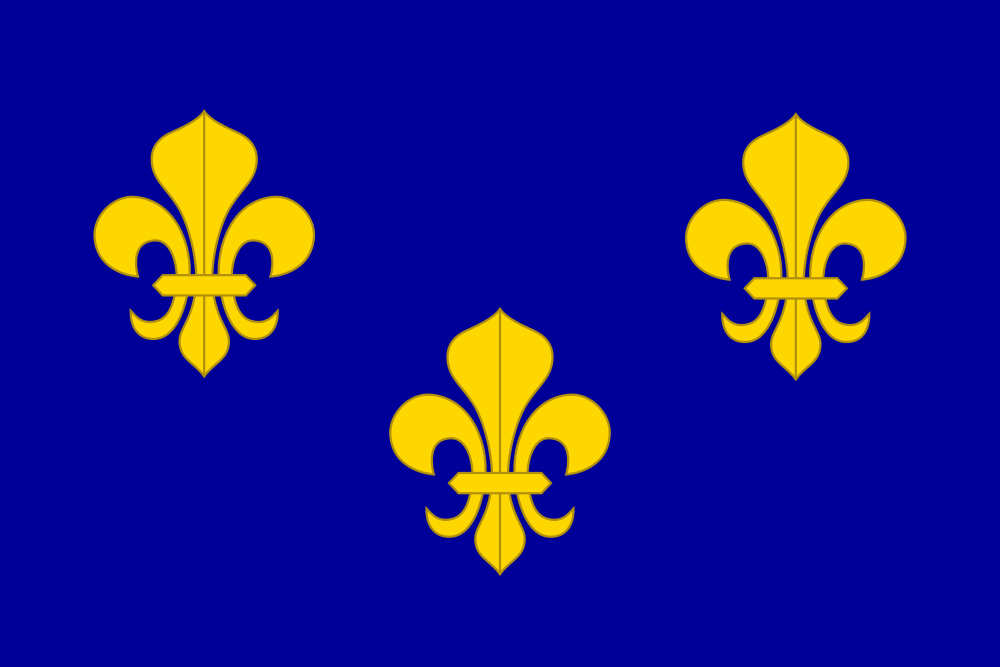
[wider still, and wider, shall thy bounds be set]
There’s no French Revolution, or anything like it. Why would there be? No William of Orange, no Marlborough, no Blenheim or Ramillies. Louis XIV sweeps the pot. No British-led alliances of containment, no Royal Navy cheerfully devastating French trade again and again. Stuart England won’t have the money for those things (and will probably be pro-French anyway). So, no constant wars, ever more global in scope, loading the state with impossible debt. And, of course, no English or American Revolutions as inspiration.
Do we still get an Enlightenment? Okay, here’s where history really jumps the tracks. Without Jenny Geddes and her friends, I don’t think we get an Enlightenment.
There are no works by Hobbes or Locke in this timeline (Hobbes will still be around, but he won’t have much to say). There’s no Commonwealth to serve as a test bed for all sorts of wild religious and political ideas, from putting a King on trial to letting the Jews come back. There’s no Glorious Revolution, no Act of Toleration, no lifting of formal press censorship, no constitutional monarchy, no Bill of Rights. Intellectual and political freedoms will still exist in a few places, most notably the Netherlands. But there won’t be a large, powerful European country that is both little-l liberal and also an obvious economic and military success story.
When we think of the Enlightenment, we probably first think of ancien regime France. But most of the French philosophes were inspired by Britain as a proof of concept. In the universe where Jenny never throws her stool? That won’t happen. Montesquieu won’t spend years in England as a guest of Lord Chesterfield collecting material for _Spirit of the Laws_. Voltaire won’t publish a book of essays admiring the advanced and progressive systems of government and political thought in Britain, because Still Stuart England won’t have those things.
Europe’s dominant political model will be Bourbon / Hapsburg bureaucratic absolutism. There will be odd exceptions like the Dutch and Swiss. There will be internal critics and rebels. But without the British examples in play, it’s hard to see what could seriously challenge that model.
The Enlightenment became a European project, and eventually a world project. But at its beginning, it was deeply rooted in the particular historical experience of 17th century England and Scotland. And that particular historical experience was far from inevitable! In fact, it was very weird and contingent. Starting in 1637, the two British kingdoms quite suddenly took a right-angle turn into uncharted territory. The consequences were momentous, and we’re still living with them.
Anyway. If you go to St. Giles Cathedral? Besides the modest memorial pictured above, there’s also a small plaque erected a couple of centuries later. It reads:
“Constant oral tradition affirms that near this spot a brave Scotch woman Janet Geddes on the 23 July 1637 struck the first blow in the great struggle for freedom of conscience which after a conflict of half a century ended in the establishment of civil and religious liberty.”

And that’s all.
{ 21 comments }
engels 04.14.26 at 11:31 am
Cool. Reminds me a bit of this:
https://www.dailymail.co.uk/news/article-1132130/Pictured-Erected-Iraqis-3m-high-sole-ful-tribute-Iraqi-journalist-threw-shoes-Bush.html
Doug 04.14.26 at 1:06 pm
It wouldn’t have taken too many nudges for both Industrial Revolution and Enlightenment to have gotten their start in Poland, or more properly the Polish-Lithuanian Commonwealth.
Religious dissenters: check, not for nothing was Poland sometimes called the playground of heretics
Strong parliament: check, and in fact the electorate for choosing the king (did I mention electoral monarchy?) was a greater share of the population than the share of British subjects who could vote for Parliament
Kings subject to that parliament: check, Henrician Articles and pacta conventa
Over on the industrial side, you’ve got the Silesian coalfields providing many of the same conditions that formed early British industry. Weavers aplenty, and even though specialized manufacturing and chemistry (think porcelain) were across the border in Saxony. Maybe someone gets lucky and discovers synthetic dyes even earlier.
Anyway, without the legendary stool, the model might well have been Continental, but it need not have been absolutist. Just a couple of nudges or a well-timed tossed Ottoman.
marcel proust 04.14.26 at 1:45 pm
And — being not too bright — [Charles] had been deeply impressed by the power and grandeur of the Spanish monarchy and its court, without realizing that they were actually a bunch of incompetent bigots who were steadily driving Spain into decline and ruin.
Reminds me of several (Republican) US Presidents of my lifetime. Anyone else here recall this?
marcel proust 04.14.26 at 1:45 pm
And — being not too bright — [Charles] had been deeply impressed by the power and grandeur of the Spanish monarchy and its court, without realizing that they were actually a bunch of incompetent bigots who were steadily driving Spain into decline and ruin.
Reminds me of several (Republican) US Presidents of my lifetime. Anyone else here recall this?
David Morrice 04.14.26 at 1:49 pm
“Jenny Geddes, symbol of the revolution of a whole people against an anglicising king, was an invention of the nineteenth century, which was in search of historic defenders of the independence of Scotland’s Kirk; she was alive in 1637, when the stool was hurled in the High Kirk of St Giles to spark off a revolt against Charles 1, but there is no evidence she threw it.” Michael Lynch, Scotland: A New History, 1991, pp xv-xvi.
Doug Muir 04.14.26 at 2:53 pm
David @4, that quote is a good example of the 20th century reacting against the mythmaking of the 19th. And there was some mythmaking, no question.
But “no evidence” is just as bad in the opposite direction, because that’s simply not true. There’s /lots/ of evidence that Jenny Geddes was a real person, and that she threw the stool. It’s just that it’s all from some time later, in the Restoration. There’s no contemporary account.
Now on one hand, accounts 30 or 40 years later are legitimately problematic. On the other hand, this was well within living memory. And lack of contemporary sources is not exactly a weird unknown problem for historians. Like, most accounts of Alexander the Great’s life draw heavily on Arrian, and Arrian was writing /over four hundred years/ after Alexander’s death. But historians take his account seriously.
The very first mention of Jenny Geddes seems to be in 1661, where she’s referred to in passing as “the immortal Janet Geddes”. (And the context is that she’s celebrating the Restoration!)
The first mention of Jenny as the person throwing the stool dates from nine years later, in 1670: “one of them called Jane or Janet Gaddes (yet living at the writing of this relation), flung a little folding-stool, whereon she sat, at the Dean’s head, saying ‘Out thou false thief! dost thou say the Mass at my lug?’ which was followed with so great noyse and confusion…”.
You can find that quote here, in the Chronicle of the Kings of England (1670 edition). It’s on page 478, second column:
https://archive.org/details/chronicleofkings00bake/page/478/mode/2up
— A reasonable next question is, how accurate is the Chronicle? And the answer is, on one hand it’s a it of a mess — gossip, legend, and hearsay are all tossed in together. But on the other hand (1) as far as we can tell, the authors didn’t make stuff up out of whole cloth, and (2) it was extremely popular, going into multiple printings and re-editions for decades. So while it’s not strong evidence of the truth of the legend, it’s very strong evidence that, by 1670, the legend was already in existence.
So if Jenny’s role was an invention — and that’s certainly possible — the invention got started in the 17th century, not the 19th.
Doug M.
Ruben 04.14.26 at 4:19 pm
Here is David Hume on these events:
in the cathedral church of St. Giles, the dean of Edinburgh, arrayed in his surplice, began the service; the bishop himself and many of the privy-council being present. But no sooner had the dean opened the book, than a multitude of the meanest sort, most of them women, clapping their hands, cursing, and crying out, A pope! a pope! antichrist! stone him! raised such a tumult, that it was impossible to proceed with the service. The bishop, mounting the pulpit, in order to appease the populace, had a stool thrown at him: The council was insulted: And it was with difficulty, that the magistrates were able, partly by authority, partly by force, to expel the rabble, and to shut the doors against them. The tumult, however, still continued without: Stones were thrown at the doors and windows: And when the service was ended, the bishop, going home, was attacked, and narrowly escaped from the hands of the enraged multitude. In the afternoon, the privy-seal, because he carried the bishop in his coach, was so pelted with stones, and hooted at with execrations, and pressed upon by the eager populace, that, if his servants, with drawn swords, had not kept them off, the bishop’s life had been exposed to the utmost danger.
(Here)
Being started by Scots nationalists, of lower class, and (worst of all) women, the protest pushes all of Hume’s buttons.
For what it’s worth, I take issue with the claim that the Enlightenment would not have happened without the English Revolution. The Dutch seem to have had enough momentum towards it without it. True, without Hobbes, Spinoza comes out looking a little different, but he would still be recognizable enough.
wp200 04.14.26 at 5:00 pm
The Dutch Republic was already industrialised a century earlier.
It ran on windmills (about 1500 industrial ones in Zaandam alone) and on peat. A large part of the lakes in the country today are the manmade result of peat extraction in the 1700s.
Only problem: no (superficial) coal deposits in the country.
David Morrice 04.14.26 at 7:05 pm
Doug @ 5 – thanks for that response. Lynch is not not denying that Jenny Geddes was a real person; he is questioning the legend about her stool throwing protest. I have not read the 1670 Chronicle of the Kings of England, but David Stevenson, The Scottish Revolution, 1637-44, 1973, pp 336-7, argues that “Doubt is thrown on the authenticity of this account [of Geddes] by the fact that it combines two separate incidents described in a strictly contemporary account of the riots” and references Leslie, Earl of Rothes, A Relation of Proceedings Concerning the Affairs of the Kirk of Scotland, from August 1637 to July 1638, pp 198-200 of the edition edited by D. Laing, 1830 (which I also have not read).
RobinM 04.14.26 at 7:31 pm
I’m not sure we wouldn’t have a United Kingdom if Charles I had bumbled on for a bit longer. Having a King of Scots and a King of England embodied in a single person would surely have continued to be a bit of a strain. Besides, the ambition to have a colony in the Americas would still likely have occurred, sucking most of Scottish wealth into a disastrous Darien scheme. And, too, opening up the English colonies to Scottish shipping, who knows where that might have led? Neither should one forget that England was always eager to bring an end to the way Scotland and France often allied against it?
But back to St Giles. One should take a look at the memorials to the dukes of Montrose and Argyll, on opposite sides of the cathedral. Last time I was there someone had left red roses on the former’s tomb—a bit of Tory romanticism, I imagine—while the latter’s was unadorned.
Doug Muir 04.14.26 at 8:43 pm
Ruben @6, I love me some Hume, but in this case Hume is a secondary source: he’s writing over 100 years later.
There’s a cluster of primary sources from the Restoration / William & Mary years. Annoyingly, they’re not particularly complete or consistent, but that’s often the case with primary sources.
There’s also a single source from 1650 that mentions how “all the commone people, especiallie the women, rose up with such a lowd clamour and uproare, so that nothing could be heard… Others cast their stooles againis the Dean’s face”.
No Jenny here yet, but common people, “especiallie the women”, throwing stools. You can find it here —
https://archive.org/details/historyofkirkofs00rowj/page/408/mode/2up?q=stools
— at page 409.
David @8, “I have not read the 1670 Chronicle of the Kings of England”
— it’s at the link I gave in #5; go look. The text is online: it’s a scan of the the original 1670 edition, page by page. The quote is verbatim.
If you want another primary source, here’s one from 1694:
“The Design was to enter them of the King’s Religion, and then… the Reason of Uniformity holding alike in both Kingdoms, ours ought to be like theirs. But the old Herb-woman at Edinburgh put an end to that Game, for hearing the Arch-Bishop who watch’d the Rubrick, directing him that read the Book to read the Collect for the Day, she made a Gross mistake and cried, The Diewl Collick in the Wemb of thee, and withal threw her Cricket-stool at his Head, which gave a Beginning to the War of Scotland.”
You can find a transcript of that text here, at page 104:
https://quod.lib.umich.edu/e/eebo/A46957.0001.001/1:6?rgn=div1&view=fulltext
I put front and center in the article that “while a riot definitely took place, it’s not clear that Jenny Geddes started it”. That said, there /is/ evidence that she did it: we have primary sources saying so. They’re sparse, inconsistent, and written after the fact, but they exist. By 1650, we have women throwing stools; by 1661, we have “Immortal Janet Geddes”; by 1670, we have the complete anecdote, with Jenny named as the particular stool-thrower.
So when Lynch says there’s “no evidence” of the legend, he’s just plain wrong. The legend was already in existence by 1670.
As to Stevenson and the combining of two incidents — yes, that’s entirely possible. The two incidents in question would be the stool-throwing and the “would you say Mass” quote. There’s a contemporary account where a dutiful young man tries to follow along with the official prayer, and a woman turns, clouts him on the ear, and yells something like the “Mass” quote.
I don’t know if that “throws doubt”, though. If we have two primary sources agreeing that a woman said something like the quote, then probably a woman said something like the quote.
Put another way, the legend combines three things: a woman said the quote, a woman threw a stool, and a woman named Jenny Geddes did something important. Before 1670, we have attestations for those three things /separately/. Starting in 1670, we have sources putting them /together/.
If that first appearance of the complete legend had been 100 years later, I wouldn’t hesitate to say it was an invention combining the three. But in 1670, the events were still within living memory.
FWIW, my own best guess is that on one hand, Jenny did throw a stool, or do some other act that caused her name to be remembered; but that on the other hand, the quote attributed to her is a subsequent embellishment, taking someone else’s words and putting them in Jenny’s mouth for dramatic effect.
Doug M.
Doug Muir 04.14.26 at 9:10 pm
Robin M. @9, “Having a King of Scots and a King of England embodied in a single person would surely have continued to be a bit of a strain.” — we had Kings of England who were Dukes of Normandy for 150 years, and then we had Kings of England who were also Electors of Hanover for 120 years. Yet neither Normandy nor Hanover ended up fused with England. A bit further abroad, the Dukes of Austria were also Kings of Bohemia and Kings of Hungary for 300 years, but Austria and Hungary remained distinct at all times, and still are today.
Also, a dirty little secret of Scottish history is that after Cromwell defeated the Scots at Dunbar, and forced Union upon the two kingdoms at gunpoint… things actually went pretty well. Commonwealth Scotland enjoyed several years of (relative) peace and prosperity, including free trade with England and the colonies. All of that was undone at the Restoration, of course, but it wasn’t forgotten: Cromwell had demonstrated that Union could work just fine.
Montrose and Argyll: both the Montrose and Argyll families have descendants today in the direct male line, which is very unusual. They’re both still Dukes. And for over 300 years, the Dukes of Montrose have without exception been Tories, while the Dukes of Argyll have been Whigs, and then Liberals, and I believe are now Labour.
Doug M.
J-D 04.14.26 at 10:52 pm
According to their respective Wikipedia pages, the present Duke of Montrose is a politically active Conservative, while there are no indications of political activity from any Duke of Argyll for over a century. The 9th and 2nd Duke of Argyll** sat in the House of Commons from 1868 to 1878 as a Liberal (leaving the House to accept appointment as Governor-General of Canada) and was again elected to the House in 1892, as a Liberal Unionist, defeating an incumbent Liberal MP. He died in 1914 and Wikipedia pages for subsequent Dukes of Argyll tell some unusual stories but not about anything political.
Are there any Labour dukes? The Web only wants to tell me about an academic book on labour law written by Ruth Dukes.
** His father, 8th Duke of Argyll in the Peerage of Scotland, was created Duke of Argyll in the Peerage of the United Kingdom in 1892, a distinction which (under the law at that time) created an automatic right to sit in the House of Lords which the Scottish peerage did not: at that time the Peerage of Scotland elected sixteen members from among themselves to sit in the House of Lords and the others did not, unless they also held British or UK peerages.
Matt 04.14.26 at 11:34 pm
Hobbes will still be around, but he won’t have much to say
Maybe he would have been able to finally square the circle!
en.wikipedia.org/wiki/Hobbes–Wallis_controversy
More generally, I like these posts not least because they remind me a bit of one of my favorite TV series, Connections, by James Burke: https://en.wikipedia.org/wiki/Connections_(British_TV_series)
Peter T 04.15.26 at 1:54 am
It’s one of the quirks of European history that a state can be submerged for the best part of a millennium and emerge as a recognisable continuation of its former self – Croatia, Bohemia, Ireland .. Poland was under for a century or so, as was Hungary, the Kingdom of Italy had a shadowy existence for centuries after its practical demise and so on.
Yet Vijayanagar and Champa and the Mon Kingdom are gone forever.
I remain skeptical that the Industrial Revolution was a destined outcome of general growth rather than a product of a fortunate concatenation of circumstances, but it’s fun to speculate.
Matt 04.15.26 at 6:39 am
while the Dukes of Argyll have been Whigs, and then Liberals, and I believe are now Labour.
The 11th Duke of Argyll seems like a pretty nasty fellow, and perhaps especially so if you can trust TV at all: https://en.wikipedia.org/wiki/Ian_Campbell,_11th_Duke_of_Argyll
(The most recent one is the captain of Scotland’s elephant polo team, for what that’s worth.)
Doug Muir 04.15.26 at 7:45 am
Peter T. @14, “I remain skeptical that the Industrial Revolution was a destined outcome of general growth rather than a product of a fortunate concatenation of circumstances”
— I’m open to the “fortunate circumstances” argument. But /at some point/ the IR becomes very likely, if not inevitable. And I think by 1637 that point had been reached.
Doug M.
D. S. Battistoli 04.15.26 at 11:07 am
“But you probably don’t want to read 10,000 words of 17th century English history.”
Oh, you probably don’t want a photo of my 12-volume set of Pepys’ Diary.
It’s funny, reading this, I thought, “well, clearly Doug is not familiar with 17th-c. Dutch history,” and might never have read the work of Joel Mokyr. Then he mentioned William of Orange, and I was inclined to retract my thought, until I realized that he meant William III. There would certainly have been a William III (those stadhouders from the house of Oranje really liked naming their kids Willem). He might not have been a regal passenger to a Glorious Revolution, but he would have been.
There would also have been the forces that have since been theorized in Mahan’s Influences of Sea Power Upon History. Given the history of British naval power dating back to the Elizabethan era and the continental prehistory of the Republic of Letters, I’d have a hard time believing that Ms Geddes’ stool was a necessary and sufficient prerequisite for the complex web of relationships between England, European colonialism, intellectual history, and technological innovation that surrounded the Industrial Revolution. But of course Doug was born in an anglophone country, and he is welcome to offer a theory that without minimally attested events in the anglosphere, world history would never have happened. And of course, I totally support his desire to see historical artefacts when travelling, whether or not they caused the spinning jenny to be invented (I kid—Doug, you need not show whether your claims specifically entail the invention of the jenny).
I like Matt’s reference to James Burke’s Connections @13. I was in second grade when the second series came out, and it rocked my world. A babysitter of mine had the video game that was made out of it; over that, I spent three days puzzling, without being able to make heads or tails.
LFC 04.15.26 at 4:45 pm
From the OP:
There’s a recent book (haven’t read it) by A. Greif, J. Mokyr, and G. Tabellini that addresses this question. According to the summary, the thesis seems to be “the clan v. the corporation.” Here’s the link at the publisher’s site:
https://press.princeton.edu/books/hardcover/9780691265940/two-paths-to-prosperity
p.s. I’m inclined to think that Europe’s relative political fragmentation — the fact that it was, in I. Wallerstein’s terms, a “world-economy” rather than a “world-empire” — has something to do with the emergence of capitalism there — not yet industrial capitalism, but what Wallerstein called “capitalist agriculture.” See his The Modern World-System I: Capitalist Agriculture and the Origins of the European World-Economy in the Sixteenth Century (1974). He adopts Braudel’s idea of the “long sixteenth century,” i.e., roughly 1450 to 1640. (Of course, there are other views in the historiography, as one would expect. There were critiques of Wallerstein’s approach, e.g. by T. Skocpol, R. Brenner, and others.)
Doug Muir 04.15.26 at 8:15 pm
D.S. Battistoli @17, if Charles doesn’t have problems with Parliament, he’s not going to send his daughter off to marry the Prince of Orange. Presumably William II marries someone else, but even if they have a son, and even if they name him William, that son won’t have a claim on the English throne.
(Also, he probably won’t be a once-in-a-century military and political genius. We all owe a lot to William of Orange / William III.)
“minimally attested events in the anglosphere” — look man, I’d /love/ to get a conversation going about “what if de la Gasca had lost the Battle of Jaquijahuana, so that the revolt against the New Laws succeeded, leading to an independent or autonomous Hispano-Incan Peru?”. But I’m not thinking the market is quite there, you know?
“the complex web” — I literally said that I would expect the Scientific and Industrial Revolutions to proceed. But I would /not/ expect British naval power to evolve anything like it did in our world. That was not inevitable. I’m not even sure it was particularly likely.
“Elizabethan naval power” — Elizabeth’s ability to win a defensive war against a much more powerful (but also very distracted and not very competent) opponent has led to some very weird ideas about just what Elizabethan naval power actually was.
Insofar as Elizabeth was able to project creditable state naval force, it’s because (1) she started the war with a huge pile of cash, and (2) she shifted as much of the financial burden as possible off the central state, i.e. by requiring port towns to arm merchant vessels, encouraging privately funded expeditions, and handing out privateering licenses to anyone who asked, and most of all because (3) Parliament, seeing the war as an existential fight for national survival, voted her whatever she asked for. During the last 15 years of her life — the war years, 1588-1603 — Elizabeth collected more than three times the tax revenues she had in the first 30 years of her reign.
And even so, by Elizabeth’s death the Tudor state was visibly coughing blood. The fisc was nearly half a million pounds in debt, revenue collection was falling, and Parliament was growing visibly sullen and restive. (It’s no coincidence that the pushback on monopolies and the Golden Speech happened when they did.) Fortunately for England, Spain was just as exhausted, so James was able to get a truce and a peace treaty almost immediately.
Elizabeth could just barely make it work. But by the 1630s and 1640s the cost of naval power had climbed dramatically — this is exactly the period when ships of the line first appear. And the cost of building and maintaining a /competitive/ Navy — one that could keep up with the French, Dutch and Spanish — had gone up even higher.
This is why Charles went after Ship Money! He wanted, not a world-dominating Royal Navy, but a credible deterrent force. And even that modest ambition wasn’t realistic. When the Dutch decided to ignore English neutrality and sail into the Downs to destroy the Spanish fleet sheltering there, Charles’ modest Navy had to sit on its hands helplessly and watch.
(Nor was that the only humiliation the Navy had to endure under Charles. Go google the list of raids by Barbary pirates — Barbary pirates! — in English waters. Hundreds of ships were taken during Charles’ reign, and there were dozens of coastal raids in Cornwall and Ireland.)
The literal bottom line was that the semi-feudal revenue system that the Stuarts inherited from the Tudors simply could not finance a 17th century war. This was true even on the rare occasion when a Stuart King had a compliant Parliament, like Charles II in the Second Anglo-Dutch War. And it’s why the Stuart track record in wars is so dismal. From 1604 to 1688, Stuart England didn’t win a single war against a European power. Charles I managed to lose two wars in a row against /Scotland/. And the sort of historian who likes to huff about British Naval Power Going Back To Elizabeth tends to fast-forward through the Stuart years. That’s because the Stuart years are full of stuff like the Dutch sailing up the Thames, trashing the English naval base on the Medway, forcing the English to sink thirty (!) of their own ships to avoid losing them to capture, and sailing off with a bunch of prizes including the Royal Navy’s flagship… a chunk of which is still on display in the Amsterdam Rijksmuseum, nearly 400 years later.
(/Commonwealth/ England won a bunch of wars, against the Scots, the Dutch, Confederate Ireland, and Spain. There are multiple reasons for that. But it’s not entirely irrelevant that the Commonwealth was a military dictatorship that could and did raise money at gunpoint.)
TLDR, under Charles I England was, generously, a second-rate naval power. And if Charles had survived, that would probably have continued to be the case.
Doug M.
D. S. Battistoli 04.16.26 at 9:52 am
@Doug 19, I know you are not intentionally Gish Gallopping, but there is no way anyone can address such a spread of points in a single response. So I’ll just say that we’re on your court, and I do like reading your stuff, even if I am strongly inclined to diverge from you on causation.
As to the Battle of Jaquijahuana, the market is quite literally there: most of us commenters subscribe to the CT RSS feed. Write well about it, and we will read and respond. I might object if your causative claims feel a little outside the defensible, but I’ll still be stoked for the non-eurocentric focus, as I was when you spoke about the history of monuments to astronomical observation.
Comments on this entry are closed.