One from yesterday (in fact I have a whole bunch over at Flickr). Bristol has an annual Balloon Fiesta and this year the weather was fine and in the evening the balloons drifted over our part of the city.

Posts by author:
One from yesterday (in fact I have a whole bunch over at Flickr). Bristol has an annual Balloon Fiesta and this year the weather was fine and in the evening the balloons drifted over our part of the city.
Back in May, to squeals from some commenters, I observed that “within less than a week of coming to power, the new British government has made financial threats or legislative proposals with the following effects:
* [to intimidate independent journalism](http://www.telegraph.co.uk/culture/tvandradio/bbc/11598450/Tories-go-to-war-with-the-BBC.html)
* [to make legal strike action impossible](http://www.bbc.co.uk/news/business-32702585)
* [to criminalize dissent](http://www.bbc.co.uk/news/uk-politics-32714802)
* [to increase state surveillance of citizens](http://www.theguardian.com/politics/2015/may/09/theresa-may-revive-snoopers-charter-lib-dem-brakes-off-privacy-election)
* [to block access to legal remedies against the abuse of state power](http://www.theguardian.com/politics/2015/may/10/michael-gove-to-proceed-with-tories-plans-to-scrap-human-rights-act) .”
To this list we can now add
* [to deprive its principal electoral opponents of their finances](http://www.theguardian.com/politics/2015/may/27/labour-funding-hit-change-political-levy-bill)
* [to cripple public-sector union finances](http://www.theguardian.com/politics/2015/aug/06/public-sector-workers-stopped-automatically-union-subscriptions-pay-cheques)
* [to strip the electoral roll of non-Tory voters and to ensure boundary changes that under-represent economically deprived areas](http://www.theguardian.com/politics/2015/aug/05/the-gaping-hole-in-the-voter-registration-changes)
In short, the British government is acting so as to make it as hard as possible for opponents of its intended changes to the state to oppose them by voice, by collective action, by exercising legal rights and in the political arena. Taken together, the systematic and comprehensive attention the Conservatives are giving to closing off avenues of opposition leaves the UK drifting in the direction of those states that are nominally democratic, but where the political system strongly favours the incumbent, states such as Russia, Hungary, Turkey. Hyperbole?
David Frum is a US pundit, who writes on US politics. So, being based elsewhere, I don’t usually pay a lot of attention to him. Unfortunately, today, somebody drew my attention to [this article in the Atlantic](http://www.theatlantic.com/magazine/archive/2015/07/closing-european-harbors/395321/) in which he argues, as a prelude to some boilerplate anti-immigrant conservative points, that the people who are crossing the Mediterranean are economic migrants rather than genuine refugees. Although there’s a rather dismissive mention of Syrians at the beginning of the piece “just 30 per cent” (30 per cent of a large number is a lot of people), the message of the piece is clear. Frum calls in aid the Canadian journalist Doug Saunders, who knows his stuff and usually writes sensibly on immigration matters.
I couldn’t get to a computer yesterday and photoblogging from a mobile device proved beyond my powers, so Sunday photoblogging has changed to Monday for this week.

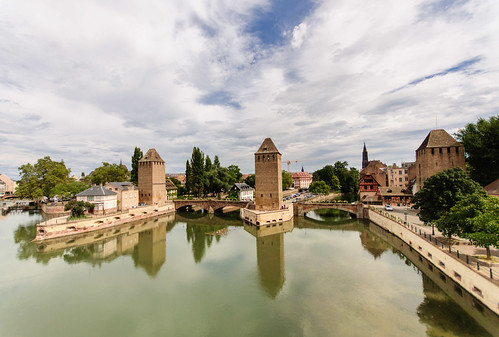
As we wait to see whether Europe can survive in its current form, I thought something from Alsace would be suitable.
The first few hours the atmosphere was hearty
With fireworks, fun, and games of every kind;
All were enjoying it, no one was blind;
Brilliant the speeches improvised, the dances,
And brilliant, too, the technical advances.
Today, alas, that happy crowded floor
Looks very different: many are in tears:
Some have retired to bed and locked the door;
And some swing madly from the chandeliers;
Some have passed out entirely in the rears;
Some have been sick in corners; the sobering few
Are trying hard to think of something new.
(From WH Auden, *A Letter to Lord Byron*)
One of the consequences of the Conservative victory in the recent UK general election was that there will be an in-out referendum of the UK’s membership of the EU at some point in the next couple of years (details yet to be finalized). How should people who think of themselves as being on the left, egalitarian, liberal, progressive vote?
[click to continue…]
One thing about the interwebs is that you sometimes get to find out about someone you’ve been disconnected from for years. It happened to me yesterday, when I discovered that the guy who had been my “handler” in Lutte Ouvière [had died in 2011 aged 62, following a stroke](http://www.lutte-ouvriere-journal.org/2011/10/12/notre-camarade-denis-robin_25765.html). I’d noticed that some prominent French administrator had the same name and googled to see if it was the same guy. It wasn’t, but up came the obituary of Denis Robin, comrade Cerdon, and with it a whole bunch of memories of the nineteen-year-old me from 1978.
Back then I had finished school, having taken the Oxbridge entrance exams before Christmas. I therefore had about nine months on my hands and wanted to spend it in Paris, where I had friends (and still do) through a language exchange with a family there. I landed a job as a courier with an agency called the Banque Centrale de Compensation which recorded transactions on the Paris commodity exchange, the Bourse de Commerce. This meant that I spent my days running from our office to the Bourse and to the HQs of the various coffee, cocoa, soya and sugar companies.
I’d long been interested in the French left and had even done a school project on May 1968, sucking up lots of information on the various groupuscules. This was, I think it fair to say, alternately irritating and amusing to my French friends who were stalwarts of the Socialists, then in electoral alliance with the barely post-Stalinist Parti Communiste. After one dinner-table debate they expressed scepticism about whether my money would ever follow my mouth, and I took this as something of a challenge. The following day, when I was making a delivery to the main offices of the Crédit Lyonnais, I encountered a bunch of militants selling Lutte Ouvrière, a Trotskyist weekly newpaper and engaged them in conversation. One of the people there was comrade Cerdon, and I agreed to meet him on the evening of Mayday for a conversation, ideally having joined up with their contingent on the big demonstration. I never found LO demonstrators that day and ended up marching with UNEF, the Communist student union. But we did meet in a café in the Place de la République that evening and began one of a series of long conversations about politics and related matters, the purpose of which was to recruit me to the organization.
[click to continue…]