I just finished Gregory Gibson’s “Hubert’s Freaks”:http://www.amazon.com/exec/obidos/ASIN/0151012334/junius-20 (subtitle “the rare book dealer, the Times Square talker and the lost photos of Diane Arbus”). It was one of those strange books which sounds interesting but then has you thinking you made a mistake in starting, but suddenly hooks you and has you reading to the end. Gibson tells three intertwined stories: first, that of Bob Langmuir, a neurotic Philadelphia-based antiquarian book-and-miscallaneous-stuff; second, more briefly, that of Diane Arbus, her career, her photographs, suicide and posthumous rise to cult status; and, uniting the other two, Hubert’s Museum, a Times Square freak show (complete with bogus African tribespeople, amputees, tattooed men &c.). Arbus had become involved with the people at Hubert’s in the 1960, and especially with the black couple known as Charlie and Woogie who ran the place, and had taken a whole bunch of pictures there. It is these pictures that Langmuir discovers chez another dealer, amid a pile of other paraphenalia. Part of Gibson’s story is Langmuir coming to terms with what he has, and then struggling to get the difficult (to understate the case considerably) Arbus estate to authenticate the material so that he can bring the pictures to market. But Langmuir is also an archivist of African-American history and he is fascinated by the people at Hubert’s and by the comprehensive phonetically-spelled diaries that Charlie kept for most of his life. Gibson does an excellent job of stitching the various narratives together and using them to evoke a strange and marginal side of America. In passing he gives us some interesting insights into how the market for art photography got started (a combination of scarcity of other art objects giving rise to a need for new outlets for the connoiseur’s passion and institutional hype from curators like John Szarkowski at MoMa and critics like Sontag).
(When I bought the book on a recommendation, I hadn’t realised that it had only recently come out. In fact the story is still short of a denoument as Okie, the Nigerian dealer from whom Langmuir bought the trunk, is suing on the grounds that he was somehow illicitly deprived of valuable items. Since _caveat vendor_ would seem to be to relevant principle for trades between dealers, and since Langmuir did the work of recognising the Arbus material and then establishing authenticity, it is hard to believe the Okie has a case. But where (possibly) millions of dollars are at stake, it is probably worth him trying it on. Pending resolution, the Hubert’s archive can’t be sold.)
On the basis of not paying particularly close attention but listening to what Australian friends had to say, I’d formed a generally positive impression of Australian PM Kevin Rudd. Now I see that Rudd has been stupid enough to “weigh”:http://news.bbc.co.uk/1/hi/world/asia-pacific/7492579.stm into “a controversy”:http://www.theaustralian.news.com.au/story/0,25197,23979363-601,00.html about the artistic depiction of child nudity with the following comment:
bq. “Frankly, I can’t stand this stuff …. We’re talking about the innocence of little children here. A little child cannot answer for themselves about whether they wish to be depicted in this way.”
I can’t wait for the Australian government’s prosposals for banning the appearance of child actors in soap operas and TV advertising on similar “couldn’t consent to thus being depicted” grounds!
The image in question can be seen “here”:http://www.artmonthly.org.au/ . (Perfectly safe for work in my opinion, but what do I know.) Chillingly, “Officials have said they will review the magazine’s public funding.” Of course there may be questions about whether art magazines should be publicly funded at all, but if they are to be, then this seems an crazy reason to withdraw the case.
(Incidentally, a relative of mine works with someone who was on the front cover of Led Zeppelin’s _Houses of the Holy_, no doubt the Australian Childhood Foundation would have been up in arms about that too on the grounds of possible “psychological effects in later years” — there don’t seem to be any.)
I’ve recently had to advise some students who wanted to write papers on the topic of humanitarian intervention. Not for the first time, it brought home to me how strong the disciplinary pressures towards a particular perspective can be. Political philosophy (of the Rawlsian/Kantian variety) isn’t an entirely fact-free zone, but the way we often discuss matters of principle tends to push us towards favouring _policies_ independently of the way things actually are. So we might ask, what should be the foreign policy of a just liberal state and what attitude should such a state have to “outlaw regimes” which are engaged in systematic human rights violations. And, in the light of such thinking, what would the laws of a just international order look like? What rights against interference would states have? When would there be a duty to intervene? And so on.
For Europeans, one of the really disconcerting things about visiting the United States is the size of the meals. Ok, there’s the phenomenon that the restaurant staff will let you take home what you don’t or can’t eat (and that’s an idea that many Europeans feel uncomfortable with), but there’s still the fact of the sheer volume of stuff that gets put on your plate. It seems it wasn’t always this way. Via someone in my del.icio.us network, I came across “this article on how portion sizes have changed”:http://www.divinecaroline.com/article/22178/49492-portion-size–now in the US over the past twenty years. And not only are American meals bulkier, they’ve also increased two or three times in calorific value. That can’t be good.
I blogged this long ago and somewhere else, but the annual chore of assessing exam scripts has brought it back to mind. “Bill Pollard and Soran Reader at Durham devised this ideal exam”:http://listserv.liv.ac.uk/cgi-bin/wa?A3=ind0306&L=philos-l&P=106972&E=1&B=——=_NextPart_000_00C2_01C32DDD.864384A0&T=text/html :
*Philosophy Exam – First Year*
Answer two questions
Two hours
1. Patch together some things you have heard in lectures, in no particular order.
2. Has this question vexed philosophers for centuries?
3. Create an impression of original thought by impassioned scribbling (your answer may be ungrammatical, illegible, or both).
4. Does the answer to this question depend on what you believe?
5. How much irrelevant historical background can you give before addressing this question?
6. Describe two opposing views, then say what you personally feel.
7. Rise above the fumbling efforts of others and speculate freely on an issue of your choice.
8. EITHER
(a) Answer this question by announcing that it really means something different (and much easier to answer).
OR
(b) Write out your answer to last year’s question on this topic.
9. Protest your convictions in the teeth of obvious and overwhelming objections.
10. Keep your reader guessing about what you think until the end. Then don’t tell them.
I first became aware of Dru because she was a member of the Bristol Flickr group, and I was looking to buy a camera. What better way of deciding than to look through other people’s photos, and see what the ones I liked were taken with? So there was Dru, a slightly mumsy, middle-aged woman with a young daughter and a Morris Traveller. In other words, extrapolating from the various signifiers, I’d formed an impression of what Dru must be like. Then I met her, at one of our monthly get-togethers, in the Royal Naval Volunteer. And then she spoke. “Bloodly hell!” I thought to myself, “you’re a bloke … or used to be.” A very quick update of my mental image of Dru took place.
It isn’t very often that people I know have their biography published. In fact, through not paying attention again, I’d failed to notice that Dru’s was coming out. Only when a friend send me “a link to the Guardian”:http://lifeandhealth.guardian.co.uk/relationships/story/0,,2275803,00.html , with the question “Is this Flickr Dru?” did I catch on. Well, “Becoming Drusilla”:http://www.amazon.co.uk/exec/obidos/ASIN/184655067X/junius-21 isn’t so much a biography as the record of a friendship, and what happens to it when one of the parties announces their desire to change sex. [click to continue…]
Cato Unbound is “currently carrying an interesting contribution from Leif Wenar”:http://www.cato-unbound.org/2008/05/12/leif-wenar/we-all-own-stolen-goods/ on how to combat the “resource curse”. Leif proposes a two-stage strategy for attacking the problem of kleptocrats who use the state monopoly of violence to extract resource revenues whilst their population lives in poverty. The first step is to prosecute (in American, and presumably also European courts) traders in goods stolen from peoples by their rulers. The second step is to go after stolen natural resources that get incorporated into manufactured goods elsewhere (say in China) and then imported into the US. Here Wenar advocates a tariff on those goods, the proceeds of which would be paid into a fund to be held for the benefit of the people whose resources have been stolen, with the fund to be disbursed to them when their government meets minimally acceptable standards.
Leiter “has linked already”:http://leiterreports.typepad.com/blog/2008/05/geuss-on-rort-1.html , but I guess that not everyone who reads CT also reads Leiter, and it would be a great pity if anyone were to miss “Raymond Geuss’s reminiscences of Richard Rorty”:http://www.bu.edu/arion/Geuss.htm .
I was pretty much determined to let the question of Ralph Miliband and Pol Pot lie. Blog spats are generally pretty unpleasant and tend to degenerate into a mush of claim, counterclaim and obfuscation. But “along comes Brad DeLong”:http://delong.typepad.com/sdj/2008/05/in-which-we-add.html , of whom I’ve generally had a good opinion in the past. Unfortunately Brad lets his rage and disgust overcome his critical faculties whenever certain key figures come into view (Paul Sweezy, Gunther Grass and Noam Chomsky, to name but three).
I’ve posted “before”:https://crookedtimber.org/2008/02/05/delivering-people-to-the-labour-market/ about the gradgrindesque policy priorities of Britain’s Arts and Humanities Research Council (the main public funding body for the humanities in the UK). My colleague, the philosopher of science James Ladyman, who has been waging something of a campaign on the subject, “has written a piece”:http://stormbreaking.blogspot.com/2008/05/ahrcs-funding-decisions.html for a blog dedicated to resisting the “marketization and instrumentalization of higher education”.
The BBC has a feature on my friend, the philosopher Havi Carel, and the way in which philosophy has helped her come to terms with the diagnosis of an incurable disease. Havi has a book _Illness_ (US, UK) forthcoming in September, in which she draws on her own experience and tries to give a philosophical account of the meaning and significance of illness.
The merchant banker Oliver Kamm has a “vicious little post”:http://oliverkamm.typepad.com/blog/2008/05/miliband-pre-et.html today attacking the memory of the late Ralph Miliband for a paper he published in 1980. Miliband, the father of the current British foreign secretary, was, of course, a Marxist theoretician and a member of the British new left for much of his life. As a member of that left, he authored many papers for journals like the _New Left Review_ and _Socialist Register_. And again, as a member of that new left, he had an ambivalent relationship to the Soviet bloc. On the one hand he lamented the lack of democracy in those countries; on the other he thought they had achieved various social gains. Well he was (largely) wrong about the latter, but 1980 is a long time ago, and, back then he wasn’t alone in that false belief. In fact, he shared it with people for whom Kamm now declares his admiration and support and who then wrote for those same journals. The difference is, of course, that they are alive and he is dead. Miliband cannot reconsider.
Kamm’s post attacks Miliband’s paper “Military Intervention and Socialist Internationalism” (“Socialist Register, 1980”:http://socialistregister.com/node/22 ) on the grounds that he doesn’t think the crimes of Pol Pot were sufficient to justify the Vietnamese invasion. Reading the paper today, it has an odd and stilted feel: Miliband is wrestling with a set of issues and problems that seem deeply alien today. I think Miliband was wrong about that case, and badly so. But I presume (and hope) that he didn’t appreciate how horrific the Pol Pot regime had been, or didn’t believe all the reports. What the casual reader wouldn’t glean from reading Kamm’s nasty little post, though, is that the substance of Miliband’s article was an attack on the idea that the socialist ideal should be advanced by “socialist” states invading other countries. In other words, it was principally _an attack on the idea_ that socialists should support the Soviet invasions of Hungary, Czechoslovakia and Afghanistan. Miliband argues, correctly, that all that resulted from such interventions was alienation from the socialist cause, and the installation of weak puppet regimes without popular legitimacy. You’d never gather that from reading Kamm’s blog, though. He presents Miliband’s attack on Soviet tankism as an apologia for massacre. That wasn’t how it would have been read at the time. In fact, it isn’t how a fair-minded person would read it now.
Surfing over to Charles Dodgson‘s site yesterday, I happened upon Elizabeth Warren’s lecture on the squeeze on the American middle class since the 1970s. Then you could bring up a family on one income; now you can’t. Then non-discretionary spending made up a smaller proportion of household spending; now, it dominates. Result: if a parent loses their job or gets sick, bankruptcy looms. I didn’t expect to sit watching a YouTube video for whole hour but I was riveted by the story Warren tells with the consumption statistics.
I was kind of reluctant to blog this too. After all, there are others at CT who do sociology or economics or family policy and I don’t do those things. And I’m not an American resident either. Still, it struck me as pretty compelling. I wonder how similar the change has been in the other OECD countries?
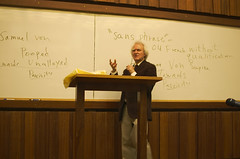
Many of his friends. colleagues and former students were present at a wonderful performance from Jerry Cohen (G.A. Cohen) yesterday. Jerry is retiring as Chichele Professor and gave his valedictory lecture. Here Jerry recreates Isaiah Berlin explaining the influence of the altogether neglected Samuel von Pooped on the totally forgotten Herman von Supine.
I gave a couple of lectures on Hobbes last week, having volunteered a long time ago when doing so seemed like a breeze, then remembering rather late in the day that I hadn’t taught Hobbes for a while. Anyway, it all seemed to go pretty well but then a smart first-year student asked me a question that I’ve been puzzling about ever since. No doubt *real* Hobbes scholars have the answer all sorted (and if so, please tell me) but I wasn’t quite sure what to say. The problem is below the fold.