Posts by author:

John Holbo

Hey Kids! Epistemology!

by John Holbo on April 14, 2007

If you, like me, are a professional philosopher, sometimes it seems like you have to talk about the whole Descartes thing … well, sometimes it seems like you couldn’t swing a dead cat without hitting yourself giving a lecture about how maybe there’s an Deceiving Demon messing with you to a considerable extent.

Now: probably you don’t have good art skills, so you just draw a circle on the board and announce to the students, with confidence that brooks no demurral, ‘this is YOU’. (Or, rather, your MIND.)

Students [collective Troy McClure imitation]: It’s like he’s known me all my life!

You [blushing modestly]: Well, I do have a Ph.D.

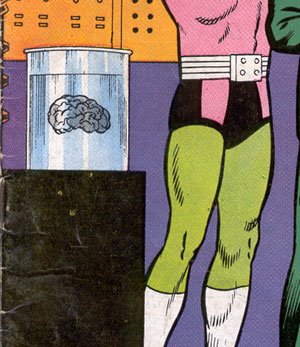
But suppose your students still insist that they don’t get it about the whole Deceiving Demon thing. Well, with this one-size fits-all graphic, you can explain 53% of all known epistemological problems. I give you: Superman’s Pal Jimmy Olsen’s Brain In A Jar!

olsenbrain.jpg

hat tip: ISB

Those are some clear and distinct shorts he’s wearing, if I do say so myself.

TOMORROW: Hawkman explains the Treaty of Versailles.

When I hear the word culture … aw, hell with it

by John Holbo on April 11, 2007

Jonah Goldberg is now grumbling that people are calling him stupid. But, to be fair, the upshot of Goldberg’s indignant response to Henry’s post would seem to be that Henry was actually too charitable to Goldberg’s original post. But I’m getting ahead of my story. Goldberg complains: “Any fair reader of my post (hint, that excludes Henry) would see that I was criticizing liberals and conservatives for not taking culture into account enough.” Now what would that too low accounting value be? “My point was not that culture is everything, but that government isn’t everything.” That is, Goldberg is claiming that the assignment of a non-zero significance to culture is bold contrarianism that places him at odds with both left and right. Of course, far from being a bold position, the claim that culture is not nothing is something everyone would grant freely, if it seemed to anyone worth mentioning.

To put it another way, Goldberg is making a standard rhetorical move which has no accepted name, but which really needs one. I call it ‘the two-step of terrific triviality’. Say something that is ambiguous between something so strong it is absurd and so weak that it would be absurd even to mention it. When attacked, hop from foot to foot as necessary, keeping a serious expression on your face. With luck, you will be able to generate the mistaken impression that you haven’t been knocked flat, by rights. As a result, the thing that you said which was absurdly strong will appear to have some obscure grain of truth in it. Even though you have provided no reason to think so.

Goodling Friday

by John Holbo on April 7, 2007

Over at TPM, much bemused shaking of heads at Monica Goodling’s Friday resignation, and possible Easter symbolism accruing thereto. From her letter to Gonzales: “May God bless you richly as you continue your service to America.”

And suddenly it hits me. In 2008 the seemingly moribund Republican party needs to look, for inspiration, to Corinthians, chapter 15, for spiritual mediation of the apparent contradiction between Christianist principle and cronyist practice. The GOP: “It is sown in corruption; it is raised in incorruption.” (Of course, reading on from 42 to 50 complicates interpretation. Still … )

UPDATE: Oh, I just can’t resist (click for larger version)

Bumperstickerbig

24

by John Holbo on March 26, 2007

Kevin Drum asks why, if it’s so conservative, 24 is so liberal. I’ve only watched 96 hours worth, but here goes. Yes, the CTU action is, at bottom, a kind of Dirty Harry dirty bomb fantasy. But, since this is partly a fantasy of (justified) moral transgression, the show needs to telegraph awareness that ‘this is all very complicated and fraught with moral peril – yet we are doing it with clear eyes.’ So you need to spend some time gesturing in that direction, but it would be annoying if these gestures slowed down the action. So those bits get outsourced to the political side of the narrative. So a subdued sense of how the game actually ought to be played, cleanly, gets played as a sort of steady accompaniment, with the left hand, while the right is banging out a rousing, martial tune. It would be a good bargain, if the reality-based liberal community could strike it: in exchange for liberal control of actually existing institutions and policy-making, conservatives could be ceded total control of a network of powerful but strictly mythical agencies, headed by omnicompetent, albeit non-existent agents.

Rudy as World-Spirit

by John Holbo on March 22, 2007

Matthew Yglesias pens a partial defense of Giuliani’s statement that “freedom is about the willingness of every single human being to cede to lawful authority a great deal of discretion about what you do.” Matt: “The cause of political liberty is not, in fact, served by living in an underpoliced city. Generally speaking, while freedom does require that authority not overstep its proper bounds, it also very much requires that properly constituted authorities be reasonably strong and effective.” But this isn’t what Giuliani said. A point Isaiah Berlin makes very well in “Two Concepts of Liberty”: it is one thing to give up liberty for some greater good – possibly even an increase in freedom along some other axis. (Giving up the freedom to murder in order to secure freedom from murder seems like a good deal.) It is quite another thing to call the sacrifice of liberty ‘liberty’.

This paradox has been often exposed. It is one thing to say that I know what is good for X, while he himself does not; and even to ignore his wishes for its – and his – sake; and a very different one to say that he has eo ipso chosen it, not indeed consciously, not as he seems in everyday life, but in his role as a rational self which his empirical self may not know – the ‘real’ self which discerns the good, and cannot help choosing it once it is revealed. This monstrous impersonation, which consists in equating what X would choose if he were something he is not, or at least not yet, with what X actually seeks and chooses, is at the heart of all political theories of self-realization. It is one thing to say that I may be coerced for my own good, which I am too blind to see: this may, on occasion, be for my benefit; indeed it may enlarge the scope of my liberty. It is another to say that if it is my good, then I am not being coerced, for I have willed it, whether I know this or not, and am free (or ‘truly’ free) even while my poor earthly body and foolish mind bitterly reject it, and struggle with the greatest desperation against those who seek, however benevolently, to impose it.

As Matt says: “He’s still, I think, a pretty creepy authoritarian but the idea he’s expressing has a reasonably distinguished lineage and isn’t just some madness he dreamed up on his couch one afternoon.” Yes, it’s some madness that Hegel dreamed up on his couch one afternoon.

In other news, I’m in the market for a new scanner. It has to work well with mac and have the best OCR capability I can buy for under $200. Googling around, it seems that the most of the stand-alone software packages (OmniPage) are not getting rave reviews from consumers, and are rather expensive. If I have to choose between paying $400 for semi-functionality and just using whatever semi-functionality is bundled with a cheap scanner, I guess I’d go with the latter. I have Adobe Acrobat, which has some ok – not great, I think – OCR capability. What do you think?

Han Shot First

by John Holbo on March 11, 2007

Crooks & Liars links to that fine old Smashing Pumpkins video, “Tonight, Tonight”: the George Méliès, “Le Voyage Dans La Lune” homage.

Anyway, if you’ve never seen the Méliès original, you should be aware YouTube has got it, too (part 1; part 2) – the 14 minute epic; the first science fiction film.

Purists take note. What we’ve got here is a hybrid version: round about minute 11, when the the first selenite appears, the voice-over indicates that “the fantastical being rushes at the astronomer, who defends himself”. Obviously this is from the digitally remastered Lucas edition of 1904. In the film itself – unremastered, 1902 material – it is clear the astronomer strikes first, aggressively exploding the alien with his umbrella.

Oh, hey! The Internet Archive has a free, downloadable, higher quality version. If you’ve never seen this landmark of cinema, check it out.

Pains-taking Plus Metropolis

by John Holbo on February 24, 2007

A bemused follow-up to my Frankenstein post. Here’s what you get tangled in, trying to edit this stuff into shape (plus YouTube goodies!). [click to continue…]

It’s …. alive!

by John Holbo on February 20, 2007

So it happened like this. I noticed that the Gutenberg Project version of Mary Shelley’s Frankenstein didn’t indicate which edition – 1818 or 1831. The two are rather different, as the author rewrote whole passages. Example: I just read a piece by Brian Aldiss in which he asserts, in passing, that H.G. Wells must have been misremembering when he wrote that “Frankenstein, even, used some jiggery-pokery magic to animate his artificial monster.” But: this would only be clearly wrong concerning the 1818 version, which is actually more ‘scientific’. An appendix to a recent edition of the 1818 edition notes: “the 1831 reader is allowed to think that the faculty at Ingolstadt [where young Victor gets his schooling] in the 1790s, even the previously sympathetic Waldman … were indeed teaching arcane magic under the name of natural science.” That’s sort of debatable, as a reading of the 1831 edition, seems to me. But it probably explains Wells’ impression.

Anyhoo. The Gutenberg version is definitely 1831. But, since Gutenberg editions are – Frankenstein-fashion – cobbled from the corpses of works passed into the public domain – it seemed possible that it was maybe a bit of both. Also, there are lots of typos (you get what you pay for.) Mostly just misplaced commas, colons and semicolons, but hundreds of those. (I’m convinced that the main export of Victorian England was the overused semicolon. Seriously, Shelley’s punctuation is bizarre. What’s with all the colons followed by dashes? Is that really necessary? Oh well.) So for the last few weeks I’ve been working through it, a chapter a night, with a public domain (1912 Everyman) edition of the 1831 edition in hand. I’m up to chapter 18. When I’m done I’m going to make a nice public domain edition. (Maybe do a book event.)

So here’s my question. When I’m done, I’d like to double-check it against an appendix to a still-in-copyright 1818 edition, which gives all the differences between the 1818 and 1831 editions. On the one hand, I really ought to be working from public domain material. On the other hand, I’m not exactly copying this appendix; merely verifying the correctness of text I’ve independently produced. Suppose I end up adding, subtracting or shifting 100 characters worth of punctuation, thanks to consultation of this appendix? Would that be a violation of copyright? Seems a bit weird if it is. 100 character total ought to be fair use, right? There must be copyright traditions concerning editorial questions like this, yes? Am I allowed to treat the appendix as containing information I am allowed to use freely?

UPDATE: Ben Wolfson has related, deep thoughts: “Punctuation marks can be very expressive, especially em dashes (my favorites!—maybe tied with semicola), so why ought one restrict their use to single isolated occurences? Surely in combination they can achieve heretofore undreamt-of degrees of subtlety in expression. (My gloss on the comash was that it implies a degree of reticence or hesitancy, and then:—suddenly elsewhere, or the dam is burst.)”

Is it … atomic? Very atomic, sir.

by John Holbo on February 8, 2007

My archiving post got good results. If you want to cite a webpage (in an academic paper, say) and you want to do your best to ensure that the URL you provide will live – even if the page you link goes away – best practices would seem to be: submit the page to WebCite. It’s easy! I tried it. Also, if the Wayback Machine at the Internet Archive knows about your page, that’s probably good enough as well. It’s interesting: neither of these archives really has extensive search capabilities. You wouldn’t use them to find something. But stuff is kept there. By contrast, google is for finding, but not for keeping.

Also, it turns out the Internet Archive has a great vintage trailer for one of my all time favorite films: The 5,000 Fingers of Dr. T!

Archiving

by John Holbo on February 6, 2007

I have an archiving question. Suppose I wanted to save a link to a page and do my best to ensure that it stays good – for years and years, in principle, even if the page goes away. As long as google shall reign. The obvious answer: just link to a googlecache URL. One thing I’m not clear about is google’s policy about these page images. Suppose I record a page as it appeared, say, today. That is: the google page has a little ‘as retrieved on 06 Feb 2007 04:14:38 GMT’ or whatever. Does google only take a new snapshot if something changes on the page (does it have some way of knowing that?) so that, so long as the page isn’t changed, the snapshot stays good forever? Suppose I link to a page and, in two years, the page is modified and google has in the meantime taken any number of fresh cache images. There’s no expiry date on old caches, right? (I’m sure about this. But I want to be really sure. Has google made any explicit commitments, archiving-wise? I’m thinking about the long haul here.) Also, googlecache URL’s are a bit unwieldy. Tinyurl promises to offer more convenient handles that ‘never expire’. But what if tinyurl dies? Would it be bad archiving policy to tiny-fy a googlecache link, for convenience (so someone could type it in, more easily than those long monsters?) What would you say are best practices, short of doing the old fashioned thing and hitting ‘print’ and locking the results in a fireproof safe?

Harry Potter and the Deathly Hallows

by John Holbo on February 2, 2007

So now you only have to wait until July 21 to read it [amazon]. In the meantime, you can contribute to this truly epic predictions thread Russell Fox started back in October. My money is on: Harry is a horcrux.

The criminal as artist

by John Holbo on February 1, 2007

So I skimmed the whole Biden gaffe story. “I mean, you got the first mainstream African-American, who is articulate and bright and clean and a nice-looking guy.” But then, forsaking the news for the sake of the news that stays news – great literature! – I ran into this sinister speech by Mr. Big, from Ian Fleming’s Live and Let Die:

In the history of negro emancipation,’ Mr. Big continued in an easy conversational tone, ‘there have already appeared great athletes, great musicians, great writers, great doctors and scientists. In due course, as in the developing history of other races, there will appear negroes great and famous in every other walk of life.’ He paused. ‘It is unfortunate for you, Mister Bond, and for this girl, that you have encountered the first of the great negro criminals.’

Mr. Big blathers on about Trotter’s Instincts of the Herd in War and Peace, etc. “I am by nature and predilection a wolf and I live by a wolf’s laws. Naturally the sheep describe such a person as a ‘criminal’.” Then things about taking, “not dull, plodding pains, but artistic, subtle pains.” Then he explains how he will kill Bond – but it’s not even sharks with head-mounted lasers. Mere keel-hauling. (Yawn.)

Auric Goldfinger, in his parallel ‘but before I kill you’ scene, manages to be a bit more romantically high-flown:

Man has climbed Everest and he has scraped the depths of the ocean. He has fired rockets into outer space and split the atom. He has invented, devised, created in every realm of human endeavour, and everywhere he has triumphed, broken records, achieved miracles. I said in every realm, but there is one that he has neglected, Mr. Bond. That one is the human activity loosely known as crime. The so-called criminal exploits committed by individual humans – I do not of course refer to their idiotic wars, their clumsy destruction of each other – are of miserable dimensions: little bank robberies, tiny swindles, picayune forgeries. And yet, ready to hand, a few hundred miles from here, opportunity for the greatest crime is offered. Only the actors are missing. But the producer is at last here, Mr. Bond, and he has chosen his cast. This very afternoon the script will be read to the leading actors. Then rehearsals will begin and, in one week the curtain will go up for this single, the unique performance. And then will come the applause, the applause for the greatest single extra-legal coup of all time. And, Mr. Bond, the world will rock with that applause for centuries.

So here’s my question for you. Obviously Mr. Big is straight out of book I of Republic – Thrasymachus and the wolves and sheep and so forth. But when did the romantic notion of the artist-criminal first appear in literature? By the time we get to Goldfinger supervillain soliloquies are hardly cutting edge, I appreciate. But before it became a cliche it had to have a first occurrence. What would you say? (Not villain monologuing, per se: monologuing about how they are artists.)
Last night Belle and I watched a classic war flick – 12 O’Clock High [wikipedia], with Gregory Peck as the stoical General Savage. It contains extensive and rather impressive real combat footage: formations of flying fortresses vs. German fighters with lots of planes going down in smoke and flames and frantic little stick figures trying to bail out safely, with apparently mixed results. Then dropping of bombs and large explosions. It suddenly struck me that it’s sort of weird to use real war footage in Hollywood entertainments.

the new iMonolith mini

by John Holbo on January 10, 2007

Kieran’s quip that “They look like the apes in 2001 gazing at the monolith” becomes YouTube reality. And it’s rather brilliant that the device is showing Zoolander.

[click to continue…]

Poetry and Powers

by John Holbo on December 21, 2006

Our Scott has unleashed impressive versificational forces (here and here). In comments, Adam Roberts suggests we try to get The Crooked Timber Littel Booke of Political, Philosophical and Scientifik Limerics out by X-Mas. I am duty-bound to report that I have already written A Philosophical Abecedarium, if somehow you managed to miss it back in 2002. I invite new contributions. (I’ve got two ‘k’s, so I might as well have dupes for the others.)

And let me take this opportunity to continue my occasional series of comics recommendations. In this thread, everyone piped up with faves, but no one mentioned Powers, by Bendis and Oeming. It’s more or less a cop procedural, with the protagonists as ordinary human officers responsible for investigating ‘Powers’-related crimes. You can imagine how that might get amusing. The hard-boiled dialogue is just great. And, in fact, you can read the entire first story arc – Who Killed Retro Girl? – here. (The navigation is a bit confusing. Most of the apparent links are just for jokey decoration. Click on the little ‘click here’ button in the Retro Girl box at the top. That takes you here. Then click the small, ochre ‘full daily page archive’ button on the left. Then pull down the little pull-down thingy to start at the beginning, rather than with today’s offering – which is p. 110. Whew! Now you just keep clicking ‘next’ through all 110 pages. You probably would have figured that out yourself.) Some of the pages are more full-featured, with links to pages of the original script, sketches and such. For fanboys.

The first year of the series – a whopping 450 pages worth – is available very cheaply: Powers, vol. 1 [amazon]. Good deal.