From the category archives:

Academia

Just off the presses: a new book I have edited with Michael McPherson on philosophical problems in higher education, The Aims of Higher Education: Problems of Morality and Justice (amazon)

aims

Here’s the blurb:

In this book, philosopher Harry Brighouse and Spencer Foundation president Michael McPherson bring together leading philosophers to think about some of the most fundamental questions that higher education faces. Looking beyond the din of arguments over how universities should be financed, how they should be run, and what their contributions to the economy are, the contributors to this volume set their sights on higher issues: ones of moral and political value. The result is an accessible clarification of the crucial concepts and goals we so often skip over—even as they underlie our educational policies and practices.

The contributors tackle the biggest questions in higher education: What are the proper aims of the university? What role do the liberal arts play in fulfilling those aims? What is the justification for the humanities? How should we conceive of critical reflection, and how should we teach it to our students? How should professors approach their intellectual relationship with students, both in social interaction and through curriculum? What obligations do elite institutions have to correct for their historical role in racial and social inequality? And, perhaps most important of all: How can the university serve as a model of justice? The result is a refreshingly thoughtful approach to higher education and what it can, and should, be doing.

The contributors are Amy Gutmann, Kyla Ebels-Duggan, Paul Weithman, Allen Buchanan, Erin Kelly, Lionel McPherson (no relation to my co-editor) and our own Chris Bertram.

I imagine CT readers will be particularly interested in CB’s excellent chapter on philosophical defenses of the humanities, and, I hope, in my and McPherson’s concluding chapter which outlines a series of philosophical problems in higher education that are not discussed in the book, but we think merit further discussion. A version of Amy Gutmann’s excellent chapter is online here.

I should say that we encouraged authors to concentrate on problems arising in selective settings, not because we think they are more important (we don’t) but because we thought that we would get better essays if people reflected on what they knew best. The essays are all written in a style accessible to undergraduates, and in my experience undergraduates find them very engaging, and are troubled by the questions they raise. We are hoping that others will take up some of the problems addressed and some of the suggestions we make in the conclusion and do further work on them.


Pulleys ... and davits

David Runciman wrote a brief essay http://www.lrb.co.uk/v37/n10/david-runciman/notes-on-the-election in the LRB about the results of the British election. I want to focus on one peculiar passage. Runciman observes:

The two countries that have seen the greatest rise in inequality over the past couple of decades are Britain and the United States. Both have a first-past-the-post system designed to offer a clear choice between two main parties. Yet whichever of the two parties wins, the drift towards inequality has been inexorable.

This is, well, nuts or maybe just inexplicable coming from a political thinker of Runciman’s reputation. It tells us nothing about why inequality has accelerated or what might be done to mitigate it. Runciman conflates the British and US political systems because they both have “first past the post” voting–but he somehow neglects to then distinguish them because the US has a presidential model with separation of powers across three branches of government and a widely dispersed federalism, and the UK has a parliamentary model. Which means, of course, as nearly every knowledgable political writer has been screaming during the this time of divided US government, that the US system does not at all offer a “clear choice between two main parties.” In fact, as Juan Linz famously pointed out, in a presidential system two major parties or coalitions can both claim legitimacy by controlling a respective branch of government. (And thus the US can have, simultaneously, two warring “Prime Ministers”, eg, President Obama and Speaker Boehner.)

The American system offers a decidedly murky choice; Because the congressional party (whose election is spread over three cycles) does not merely oppose, but also obstructs the presidential party, the US way of democracy provides the electorate with no logical party accountability–presidential “failures” can be caused by minority legislative parties because the presidential party only appears to voters–and to Runciman, apparently–to be the governing party, but is not. The US system is really enormously different from the UK system. If Runciman had wished to argue that the Congress, whether controlled by Republicans or Democrats, has, in recent decades, abdicated the making and execution of foreign policy to the president, he’d have a point. But he writes as if clear party control of the levers of American politics was built into the system.

And there’s no need for the whole history lesson here, but that’s exactly how it wasn’t designed in the first place. It was, in fact, designed by people who did not anticipate the development of coherent political parties at all and, in fact, loathed the very idea (even if many of them then proceeded to become rather shrewd party politicians in the next phase of their careers). The whole point, as imagined by men who, with certain important exceptions, were very much determined not to replicate the powers of a monarchy in their fledgling nation, was to create conditions that would force elites to compromise and to limit the power of the propertyless (let alone the slaves) to even enter into the discussion. Compromise between powerful interests, not the clarity of unitary authority, was supposed to occur not only between the branches of government, but also between the national government and those of the states (and between the North and the slaveholding sub-nation of the South). There is absolutely nothing structurally about the American system of government, either in its inception or in its current dissipated condition, that offers voters a “clear choice” regarding domestic politics. (Even the rare historical circumstances that have seemingly given one party or the other effective control, eg, FDR’s already balkanized Democrats for, at most four years in the mid 1930s, in fact allowed a cross-party coalition of reactionaries to make the New Deal for “whites only.” http://www.amazon.com/When-Affirmative-Action-White-Twentieth-Century/dp/0393328511)

Later in the essay, Runciman expresses shock that the purportedly smooth running American political structure has crashed into a ditch like the regional trains that its warring parties of equal legitimacy refuse to fund. He writes contemptuously, comparing the squalid Brits with the squalid Yanks, “It is blackmail and veto power, with small groups clamouring to get what they want from the people in charge. This is the current model of American politics, which for all its premium on clarity and executive power is also extremely messy, with all sorts of minor players holding the big boys to ransom.”

But writers and scholars like Norm Ornstein, Thomas Mann, Jacob Hacker and Paul Pierson (and many many others) have written copiously about how and why divided government does not engender clarity in the current iteration of the American presidential system. Runciman seems wholly unaware of this literature.

Sorry to be so sour, but has Runciman ever read The Federalist? Or Madison, in particular? Or just a good history about the ratification of the American constitution http://www.amazon.com/Plain-Honest-Men-American-Constitution/dp/0812976843? To frame his essay with this spurious comparison made it impossible for me to take the rest of his argument seriously.

LIBOR for the universities?

by Daniel on May 26, 2015

This is a post I’ve been planning to write for a while, with various other CT members alternately encouraging me to do so, and sternly reminding me that the consequences will be entirely on my own head ;-). It’s based on a point I’ve been making over the last few years to all sorts of friends when they’ve been trying to bait me on the subject of LIBOR, forex and the various scandals of the financial profession.

The point is quite simple. Bankers have had their day under scrutiny. But so have Members of Parliament (expenses scandal). So have journalists (phone hacking). So has the Church (paedophilia cover-ups). So has the BBC (ditto). This isn’t a specific issue about financial sector corruption. It’s a general trend, one of gradual social re-assessment of whether the fiddles and skeletons of the past are going to be tolerated in the future. It’s not that these sectors are especially dirty and the rest are especially clean – it’s just that politics, finance, religion, journalism and broadcasting have, so far, had their day under the microscope. One day, it’s going to point somewhere else. Particularly (because a lot of my friends are academics), one day it’s going to point at the universities. How confident are we that when it does, that they’ll be found pure?

At this point I tend to get either nervous laughter or outrage. Comments boxes don’t do nervous laughter very well, so readers of a ragey disposition might as well skip the details…
[click to continue…]

Fight Racism. Confirm Clarence Thomas. (Updated)

by Corey Robin on May 25, 2015

I’ve been reading Jill Abramson’s and Jane Mayer’s Strange Justice: The Selling of Clarence Thomas, the definitive account of Thomas’s confirmation battle, which came out in 1994. Here are eight things I’ve learned from it. Among the many surprises of the book is how men and women who were connected to the confirmation battle, or to Thomas and/or Anita Hill, and who were little known at the time, would go on to become fixtures of and issues in our contemporary politics and culture.

1. Edward P. Jones, author of The Known World, which won the Pulitzer Prize in 2004, was Clarence Thomas’s classmate at Holy Cross. They had long conversations.

2. Clarence Thomas was head of the Equal Employment Opportunity Commission for eight years. When Bush nominated him to the Supreme Court, Strom Thurmond proudly declared, “I’ve known Clarence since he was head of the Unemployment Commission.”

3. Gary Bauer and Bill Kristol vacationed together at the beach each summer, along with their families. In the summer of 1991, at the Delaware shore, they planned the Christian right’s campaign to get Thomas confirmed to the Supreme Court.

4. Citizens United was formed by Floyd Brown in 1988 in the wake of the failed effort to get Robert Bork onto the Supreme Court. Brown helped make the Willie Horton ad. Getting Clarence Thomas confirmed by the Senate was one of the organization’s first missions. In 2010, Thomas was part of the slim majority that ruled in favor of Citizens United in Citizens United v. FEC. Though several arguments for his recusal in the case were brought up at the time, no one mentioned Citizens United’s contributions to his confirmation.

5. One of the ads pushing for Thomas’s Senate confirmation to the Court featured a photo of Thomas with the headline “To the Back of the Bus!” The copy read:

As the left strives to keep Judge Clarence Thomas from his seat on the U.S. Supreme Court, it’s like forcing blacks to take a seat in the back of the bus. Fight racism. Call your U.S. Senators and urge them to confirm Judge Clarence Thomas.

6. Angela Wright, one of Thomas’s accusers whose testimony was buried by the Senate Judiciary Committee, worked for Charlie Rose when he was a Democratic congressman from North Carolina. [Update: Actually, the congressman Charlie Rose whom Right worked for was not the Charlie Rose of TV fame. My mistake! Thanks to Steve Hageman and Rick Perlstein for the correction.]

7. Kimberlé Crenshaw was part of the legal team advising Anita Hill.

8. Thomas liked to say that his favorite character in Star Wars was Darth Vader.

Updated (May 26)

9. One of the charges levied against Thomas in the hearings was that he had once spoken favorably about the views of Steve Macedo, the Princeton political theorist, who was at the time a conservative (and a professor at Harvard). There was an extended colloquy during the hearings between then Senator Joseph Biden, Chairman of the Judiciary Committee, and Thomas—Utah Republican Orrin Hatch also got in on it at one point—about whether and why Thomas was attracted to Macedo’s views on natural law and property rights.

10. Along with Kimberlé Crenshaw, Janet Napolitano, Obama’s former Homeland Security Secretary, was also part of the legal team advising Anita Hill. Now she is the President of the University of California, where Crenshaw is a professor.

11. One of the leitmotifs of Mayer’s and Abramson’s book is how much Biden botched the Thomas/Hill hearings. From beginning—when Hill’s allegations first came to light—to end, when the Senate voted to approve Thomas, Biden got played, was cowed, caved into pressure from the White House and the Republicans, or simply didn’t care or understand enough of the issue to push for a fuller and fairer investigation of the facts.

12. When Howard Metzenbaum, also on the Judiciary Committee, found out the specifics of Anita Hill’s allegations about Thomas, the Ohio senator said, “If that’s sexual harassment, half the senators on Capitol Hill could be accused.”

Sunday photoblogging: Florence scooters

by Chris Bertram on May 24, 2015

Florence scooters

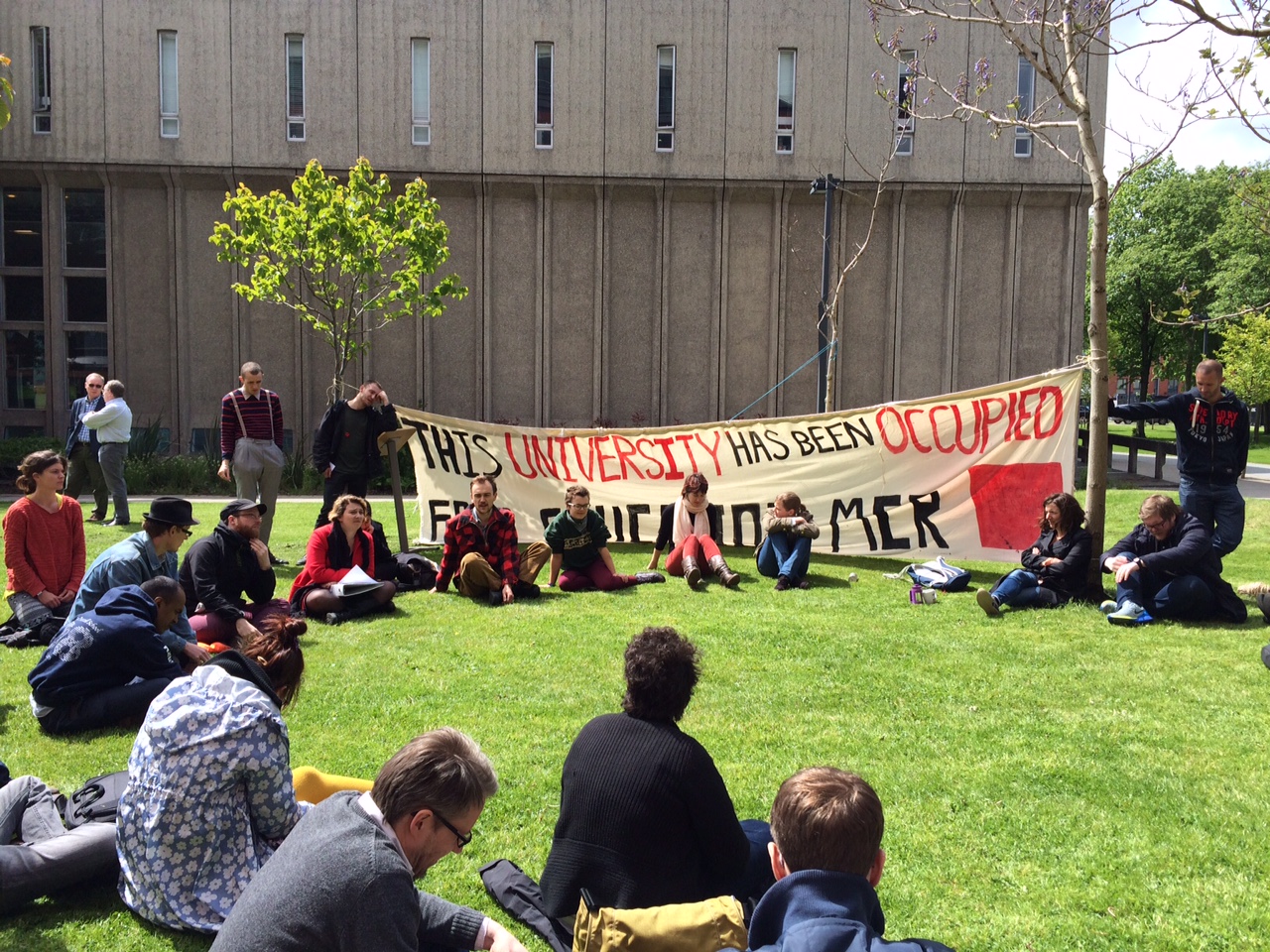
Sharing information on student protests

by Ingrid Robeyns on May 21, 2015

Manchester

Students and staff who are occupying and protesting: share information!
[click to continue…]

Response

by Ken MacLeod on May 19, 2015

Thanks, everyone, for all this. It’s gratifying and somewhat bemusing to have my work given so much thought, and such warm appreciation, from contributors like these, and on a site like this. I’m particularly grateful to those who’ve given my books the great and welcome benefit of their critical attention and/or enthusiasm over many years.

I’ve decided to respond to each in turn, in an order that follows the order of the books referred to: Farrell and Shalizi focus mostly on the Fall Revolution books, Walton takes in the Engines of Light trilogy, Harihareswara deals with The Restoration Game and The Human Front, and Mendlesohn covers everything up to Intrusion. There will be references back and forward — some points raised by Farrell and Shalizi, for example, are better answered in relation to later stories. And in my own life, some events that shaped my early books are only explored (and then obliquely, with much misdirection) in later ones. [click to continue…]

Sunday photoblogging: Pantheon

by Chris Bertram on May 17, 2015

Possibly the greatest building in the history of the world ….

Rome: The Pantheon

Is the UK benefits system a CDO?

by Daniel on May 16, 2015

Almost as an illustration of the sort of thing John’s looking at in terms of misplaced opportunity costs, I have a piece up at medium.com on forthcoming changes to the UK benefit cap system, and how they could have fairly serious consequences for housing benefit tenants. I probably don’t emphasise it enough in the piece, but these knock on effects destroy the cost economics of the policy – once tenants are evicted because they can’t pay the rent, they become emergency cases and have to be accomodated by the council in short-term accomodation, which is one of the most wasteful and expensive things you can do in housing policy. As I said in discussion of the piece, if you don’t like subsidising these guys as buy-to-let landlords, you’re unlikely to love them when they come back as bed-and-breakfast proprietors, at twice the price.

Panel on Education in the Digital Age

by Eszter Hargittai on May 15, 2015

In DC this coming Tue May 19th? If you’re interested in education and technology issues then please come hear our panel on the topic organized by Northwestern’s Institute for Policy Research.

I had, frankly, been afraid of trying to read Ken MacLeod, because I wasn’t sure I had the prerequisite domain knowledge. I studied Russian and majored in Political Science at UC Berkeley,[^fn0] and wasn’t sure that this had given me enough expertise on the history of Communism to jump into his work. Now that I’ve overcome this fear, I should check whether there’s a market for a MOOC, “Remedial Ken MacLeod Prerequisites,” in which I discuss leftism in the twentieth century, MacLeod’s crony and [former Big Pharma dispenser][1] Charles Stross, and the landscape of rural Scotland, or, “Reds, meds, and sheds.”

Then again, perhaps that’s unnecessary; even if you think a Mexican icepick is a margarita with extra salt, you can still enjoy *The Restoration Game* (novel, 2010) and, to a lesser extent, *The Human Front* (novella, 2001). Spoilers commence here!
[click to continue…]

Arendt, Israel, and Why Jews Have So Many Rules

by Corey Robin on May 13, 2015

For more than five decades, readers of Eichmann in Jerusalem have accused Hannah Arendt of being a self-hating Jew. In the current issue of The Nation, I turn that accusation on its head. Eichmann in Jerusalem, I argue, “is a Jewish text filled not only with a modernist sense of Jewish irony…but also with an implicit Decalogue, a Law and the Prophets, animating every moment of its critique.” The reaction against Eichmann in Jerusalem, on the other hand, often coming from Jews, “has something about it that, while not driven by Jew-haters or Jew-hatred, nevertheless draws deeply, if unwittingly, from that well.” What explains this reaction from Jews? Perhaps, I go onto write, it has something to do with the jump, within a relatively short period of time, “from the abject powerlessness of the Holocaust to the mega-power of the modern state” of Israel. That jump “not only liberated the Jew from his Judaism but also allowed him to indulge the classic canards against it.” Arendt was one of the earliest to spot that jump; the half-century-long campaign against her, which shows no signs of abating, is but one register of its consequences.

Along the way, I talk in my piece about the banality of evil, that moment in the 1960s when Norman Podhoretz wasn’t a fool, negative liberalism, the argument last fall between Seyla Benhabib and Richard Wolin, why Jews have so many rules, Matthew Arnold, and what the wrongness of Eichmann‘s readers reveals about the rightness of its arguments.

Read it here.

And This, Too, Is a Romance

by Farah Mendlesohn on May 11, 2015

NB: All page references are to the UK first editions.

Ken MacLeod is an intensely *romantic* writer. His work is engaged with the intensity of feeling between people and landscape, people and people, and people and ideology. The majesty and humour of his writing is, I think, a function of this romance: love after all is both obsessive and mocking. In *Dark Light,* part two of the Engines of Light Trilogy, Matt Cairns is caught up in yet another revolutionary situation in his extended life, “What he doesn’t expect is the acute pang of nostalgia that the smallest hints of a revolutionary situation bring. (244)” Reading a MacLeod novel—even reading the names of characters, Jonathan Wilde, Myra Godwin, or of chapters, *Bright Star Cultures,* *The Queen of Heaven’s Daughters,* *The Sickle’s Sang* and *The Hammer’s Harvest*–can be a little like that for the politically attuned reader, acute pangs of nostalgia sweeping the reader into the moment.
[click to continue…]

Sunday photoblogging: Hotwells and Cliftonwood

by Chris Bertram on May 10, 2015

Hotwells and Cliftonwood