Third and last part of an article discussing Imperia, the large concrete statue of a semi-fictional medieval sex worker. Part 1 is here and Part 2 is here.
A Clandestine Erection
Imperia went up in April 1993, and I won’t even try to explain the insane backstory.
Short version: some people in Constance wanted a cool statue to add luster to the waterfront. Most of them were thinking of something like a Statue of Liberty. A minority, however, had a more subversive idea. And those guys picked Peter Lenk, a sculptor with a reputation. But when the City Council of this fairly conservative small German city saw the plans… you can probably guess how that went over. There was, let us say, some pushback.
But Lenk and his allies went ahead and put up Imperia anyway. The statue was prefabricated and shipped to the harbor in pieces. Most of the construction happened in a single night, between midnight and dawn.
So Constance woke up to Imperia, and… honestly, it wasn’t love at first sight. “Bemusement” was one common reaction. “Disgust” and “outrage” were up there too.
Part of it was, of course, that she’s a gigantic sex worker. Another part is that she was satirizing something that happened almost six hundred years previous, which even in Germany is not exactly front page news. And of course, there were her let’s say attributes,
[there are a lot of photos of her from this angle for some reason]
plus the fact that she was holding a naked Pope in one hand. Constance is a pretty Catholic town, and the whole “naked Pope” thing didn’t really go over well.
Sculptor Lenk eventually addressed this point, saying:
“The figures in the Imperia are not the Pope or the Emperor, but rather jesters who have appropriated the insignia of secular and spiritual power. And to what extent the real Popes and Emperors were also jesters, I leave to the historical knowledge of the viewers.”
— which pretty obviously Lenk was lying through his teeth, and grinning while doing it.
Eventual Respectability
But naked Popes notwithstanding, over years and decades people gradually got used to Imperia. I wouldn’t say she ever became a beloved mascot. You won’t be greeted by posters of her when you pick up your checked bag at the local airport. But the cries to take her down gradually dwindled away, and a modest cottage industry grew up selling Imperia-themed tourist tat.


It was during COVID that Imperia really made the final step to respectability. She wore a (very large) mask for several months, and was used as a symbol in the city’s public health campaign.
[she’s literally a role model]
So she’s part of the community now, and will be adorning Constance’s modest skyline for a long time to come.
While Richard Nixon, Karl Popper, and Jerry Garcia were still alive
Another thing that happened in 1993: Bill Clinton was inaugurated as US President.
MTV — remember MTV? — held its own “Inaugural Ball”, a celebratory concert that was, briefly, the must-have ticket. It was hip and cool! It was a coming-out party for the twentysomething Generation X, which had turned out for Bill Clinton in force! Don Henley performed, and so did Boyz II Men! Dennis Miller was the host!
And then there was a bit where Michael Stipe (R.E.M.) and Natalie Merchant (10,000 Maniacs) did a duet of “Candy Everybody Wants”. I watched it at the time, and I remember being struck by the sense of joy and optimism coming off that stage. Stipe is a guy whose default affect is somewhere between stoic and gloomy, but he’s actually showing signs of mild enthusiasm here. Merchant is practically bouncing off the stage.
And why not? The Soviet Union was gone, and now the Reagan-Bush years were over. Ding dong, the witch is dead! We had a charming new President, who was going to use American power to push for peace in Northern Ireland, the Balkans, and the Middle East. The economy was picking up. A bunch of promising new drugs were about to start pushing back the AIDS epidemic. Nirvana was working on a new album. People were talking about this new thing called the Internet, and it sounded pretty cool.
That said, “Candy Everybody Wants” was a distinctly odd choice. Because there’s a huge disjunct between the music — which is a big cheerful aural hug, all happy brasses and soaring major chords — and the dark and cynical lyrics. The music is fist-pumping inspiration. The lyrics are about how our choices in media consumption are making us cruel and stupid. Presumably they chose it because it works well as a duet — 10,000 Maniacs’ other big hit, “These Are Days”, was very much a delivery system for Merchant’s distinctive voice — but still: 0dd.
Over in Germany, Peter Lenk was finalizing his designs for Imperia. She’d go up a few months later. I very much doubt he watched or listened to “MTV’s Inaugural Ball”. But I definitely think he was picking up on that early-1990s, post-Cold War swell of optimism.
That zeitgeist was particularly strong in Germany, where the dust was still settling from the fall of the Wall. 
[no lie, that was a moment]
Re-unification! All those Soviet armored divisions just across the border suddenly just… going home! The looming threat of nuclear war dwindling to almost nothing! And — wildest and most surprising — the sudden disappearance of a corrupt and oppressive system that had seemed invulnerable, immovable. If Soviet Communism could suddenly just vanish, what might not be possible?
So I think Lenk was definitely feeling that surge of national optimism. And I think he was reacting against it. You might say that while the rest of us were dancing to the music of “Candy”, Lenk was listening carefully to the words.
And I think — whether deliberately or not — he set up Imperia as a critique of that historical moment. As a counterpoint. Imperia may be about the Council of Constance, but she’s also about 1993. If she’d gone up five years earlier, or five years later, I think she would have been something very different.
Give ’em What They Want
Okay, so through the last two and a half posts we’ve zigged and zagged through a bunch of European history and culture: Botticelli, Balzac, the Emperor Constantine, bad Popes, Expressionism, Renaissance bankers, Nazis. But none of this answers the question: is Imperia (the statue) a serious work of art?
I think yes, she is. And part of the reason is this: she rotates. She makes a complete turn every four minutes.
Yes, rotating sculptures are generally dopey. But here I think it works. Because Imperia means “empire”, and empires don’t look one way. Empires have broad horizons. Imperia turns because her claim to authority is very great. Universal, perhaps. Hegemonic.
You can see her as a straightforward comment on hypocrisy and that works. You can see her as powerful men baffled by female sexuality and charisma — reduced, as we noted, to impotence or frustration. You can see her as the patriarchy turned inside out. And those things work, sure. But I think Imperia is most interesting and alarming when we see her as a system.
Remember, the members of the Council of Constance came together to reform the most important institution in their world. They had the tools to do so. They had the brainpower, they had the time, there was broad popular support. But the Council failed because the Council members chose, collectively, to not solve the problem. And they made that collective choice because they were themselves part of the corrupt system. Everybody took bribes. Everybody was profiting. Everybody was complicit. A clean and honest Church would have been better, everybody knew that, but they simply couldn’t get there from here.
[nobody ever got fired for buying Microsoft]
In 1993, the Germans were still basking in the afterglow of the end of Communism. Communism was corrupt, oppressive, and claimed to be universal. But — in Eastern Europe, at least — Communism was imposed at gunpoint, from outside. And I think, whether deliberately or not, Lenk was saying: all right, the bad system imposed upon us is gone. Does that mean we’re done with bad systems? Or will we, collectively, choose something that’s every bit as bad?
And that’s what I think we’re looking at here. Imperia is a system, and she’s a bad system, and she’s the system that we create for ourselves by our collective choices.
Imperia is a bad Nash equilibrium. She’s that corner of the Prisoner’s Dilemma where we all choose to send each other to jail forever.
Imperia is the house always wins. Imperia is a gacha game. Imperia is vendor lock-in. Imperia is our fossil fuel addiction. Imperia is the algorithm that, based on our choices, limits our choices. She’s the Love Island franchise. She lifts us up — and leaves us impotent or frustrated. Imperia is closing down all the newspapers and killing the high streets. She’s all of us knowing what we want, and getting it, good and hard. If you’re workin’ for the Man every night and day, it’s probably Imperia you’re working for. When all that is solid melts into air, all that is holy is profaned, and man is at last compelled to face with sober senses his real conditions of life? He’ll look upwards to meet Imperia’s concrete smile.
Every four minutes, she turns. She looks out over the river that the Romans bridged, and the lake where the Hapsburgs fought the Swiss, and the city that the Allies could have bombed but didn’t. She looks north to Berlin where the Nazis burned Lovis Corinth’s paintings, and east to where Jan Hus came to be burned by the Church. She looks south to the Rome where Raphael immortalized her namesake, who died young, and then died young himself, and she looks west to Paris where Balzac wrote a story about her and then killed himself through overwork and coffee. She looks beyond that to the New World that Prince Henry started the search for, all unknowing, back when the Council of Constance was closing up shop, and where Lovis Corinth’s painting of her rests in a private collection. And in one hand she holds the limp and depressed Emperor, who claims secular power over the bodies of mankind, and in the other she holds the petulant and helpless Pope, who claims spiritual power over the souls.
And oceans rise, and empires fall, and the tourists come and gawk and snap selfies and maybe buy a keychain. And she smiles her small cruel smile, and she turns, and she turns, and all the horizon comes under her stony gaze.
And that’s all.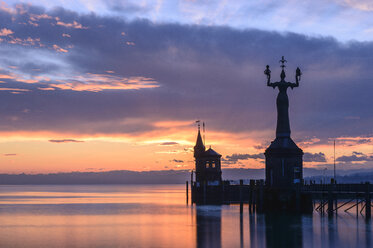
{ 14 comments }
Mark 03.14.26 at 7:10 am
Loved this tripartite tale but oh, my, describing the optimism of the nineties… that really hit me in the feels. How it all changed! But back to the tale. I might never see Constance, but you’ve made her very real to me, thank you.
Phil 03.14.26 at 11:01 am
The last graf reminds me irresistibly of Bowie’s “<a href="https://bowiesongs.wordpress.com/2012/08/28/goodbye-mr-ed/Goodbye Mr Ed”, written in the same period. “Someone sees it all” – Imperia, maybe.
I’m also imagining an audience that would see an event like MTV celebrating Clinton as them talking to them and slapping one another’s backs, and would trace a line from “So their minds are soft and lazy, give ’em what they want” to “they cling to guns or religion or antipathy toward people who aren’t like them”. In other words, seeing the corporations’ disrespect for consumers and educated liberals’ condescension towards the
workingmiddle class as part of one big othering, to be countered by a leader who would stand up for the real people of America. (Admittedly, “cling to guns” etc was 15 years later – a different Democratic President in a different world – but this was a slow-burning process, a smouldering fire under the turf.) There’s something of the early-C20 political divide here, perhaps, albeit with the labels switched – bankers and pencil-necked liberals with the Democrats while Republicans evoke log-cabin populism.Phil 03.14.26 at 11:01 am
Ugh – fix my html, someone!
Alan White 03.15.26 at 2:13 am
Wonderful. Please keep these up!
My last surge of optimism was Obama’s 2012 win, which I’d hoped was a rebuke to the conservative landslide in 2010. 2016 put out that last light with my reaction to the election–my first hospitalization for a panic attack.
And so it goes.
PatinIowa 03.15.26 at 4:46 pm
My last surge of optimism was when LBJ announced he was quitting.
Now, Kali help us all, I miss him.
D. S. Battistoli 03.15.26 at 9:28 pm
It does seem that the decision to label the Council of Constance a failure without engaging the literature does come back to bite this conclusion.
The Council put an end to the Western Schism, which was the second-deepest schism that Western Christianity had faced to that point. As of 2026, no one has figured out how to resolve the only deeper one, the Great Schism. Now, in your first post, you class the Council as a failure in part saying it had nebulous goals (“deal with heresy,” “reform the church”) and not mentioning the schism it ended.
It is true that none of the clerics at the Council listened to Marty McFly’s big speech as he stepped out of the DeLorean (or was it the Terminator stepping from a burst of steam?), saying they better wake up because sixty-six years in the future, when most of them would be dead, a man named Martin Luther would be born, and they needed to take decisive action today and so on. But I don’t think we can fault them for that.
I think your story holds together if we read Lenk not as a person who is telling us anything about what the discipline of history has to offer, but rather as a person who collages shocking images redolent of the past (a woman from Rome named Imperia, the city in which the Western Schism was brought to an end) that really have very little to do with one another outside of the collage. That’s not to deny that reading a riff on the statue is fun; it’s like a square-by-square analysis of the cover Robert Frank made for the Rolling Stones album Exile on Main Street.
If I recall, you wrote another post about art that lasts for a really long time. Thinking of that made me wonder: what powers Imperia’s rotation? Does she stop during power cuts? Is she going to break down one day? If you had to choose the direction she would face when she came to rest, what would it be?
Finally, I liked the retro thought of Natalie Merchant being the lead singer of 10,000 Maniacs, rather than 10,000 Maniacs being the band Natalie Merchant quit before quickly taking her first two solo albums multiplatinum. I remember those times—alt rock on the eve of the second Woodstock festival. I could imagine a different person riffing on the same weirdly Joe-Eszterhas-y statue, and using it as an excuse to talk about Rebecca Walker’s 1992 essay “Becoming the Third Wave.” And who said you couldn’t do lots of things in Central Europe?
J-D 03.16.26 at 1:55 am
Arthur Hugh Clough
Tm 03.16.26 at 9:21 am
“Constance is a pretty Catholic town, and the whole “naked Pope” thing didn’t really go over well.”
Constance claimed the status of an Imperial City and like many other cities in the region enacted the reformation and expelled the Prince Bishop. But after a war the city fell to Austria, lost its independence and was recatholized by force. Constance had wanted to join the Swiss Confederation but the rural estates had objected, fearing city dominance. This is essentially why the city remained an exclave South of the Rhine almost surrounded by Swiss territory.
Today, the majority of residents are not religiously affiliated. In 1993 there still may have been a Catholic majority.
Doug Merrill 03.16.26 at 10:53 am
Michael Stipe was one of the speakers at the Clinton rally I attended in Atlanta in 1992. Clinton was as good at firing up the crowd as Stipe, a genuine rock star.
“use American power to push for peace in Northern Ireland, the Balkans, and the Middle East”
The Good Friday Agreement has held; Bismarck would be pleased that there has not been some damn thing in the Balkans since the end of Clinton’s second term. The Middle East … is a challenging problem.
“a huge disjunct between the music — which is a big cheerful aural hug, all happy brasses and soaring major chords — and the dark and cynical lyrics”
Nods along in “Born in the USA.”
Tm 03.16.26 at 1:14 pm
6: “they better wake up because sixty-six years in the future, when most of them would be dead, a man named Martin Luther would be born, and they needed to take decisive action”
They didn’t need visionary power to know that Jan Hus was alive and something needed to be done. They did take action, and that action was probably not the smartest.
Doug Muir 03.16.26 at 2:42 pm
Phil @2, “Goodbye, Mr. Ed” has come to mind more than once in the last little while.
DS @6, pretty sure I discussed the resolution of the schism in the election of the mild-mannered Martin V?
The Council fixed the schism — in the sense of getting rid of the three Popes — in its first 90 days. But then it hung around for almost three more years, because it was supposed to deal with the other stuff (heresy, conciliar supremacy, Church reform). That’s the stuff it failed at. In particular, it failed at establishing regular Councils as superior in authority to the Papacy (and capable of choosing, restraining, and potentially dethroning Popes), and it utterly failed at reforming the many, many abuses of the late medieval Church — concubinage, simony, graft, multiple benefices, absentee priests and bishops, you name it.
It’s not so much that this would eventually lead to the Reformation (though it absolutely would, and pretty directly). It’s that they couldn’t solve these large, bad, obvious problems because they were, for the most part, complicit. The strongest voices for reform mostly came from academics — the guys with no skin in the game. The bishops, archbishops and abbots were much less inclined to support changes that would undercut their own authority and/or cash flow. And the cardinals — as I noted — quietly but firmly opposed anything that would interfere with their highly lucrative power of electing Popes.
Doug @9, Clinton got some things done! It wasn’t all disappointment.
Doug M.
D. S. Battistoli 03.18.26 at 6:12 pm
Doug @11,
The Western Schism began in 1378. What you call “the whole three-pope thing” began in 1409.
It would have been possible to resolve the latter (indeed, it was the first matter resolved, as you mentioned) without resolving the former. The schism arose not because there were multiple competing “heads” of the church (that had happened before and would happen again, almost always without constituting schism), but because the episcopal body of the church had become multiply cleft. What was needed was a re-constituting of the senior episcopate as a single body. Hence why it was useful to keep all those bishops and cardinals together for several years after they named a pope, a period during which they developed lasting relationships and commitments that they would prove unable to release themselves from upon their return to their various seats.
It seems to me that you are treating “the cardinals” of the Council as a group with a unitary set of interests, which is super cool and, if valid, might get at least halfway toward your conclusion—could you point to research that backs this claim?
In the end, I’m trying to keep the bar against which I read your claims low. As a guided tour to the cultural highlights of the waterfront in Konstanz, it works. You’ve already said in your defense in response to other comments that you’re not a historian. There’s a version of responding to your post that ticks you for every time you seem to slide across the historical record. There’s the fact that you didn’t name the Western Schism until the 12th comment to your third post, after having been prompted. There’s the fact that it does not seem to be the case that you know who the Catholic Church recognized as Martin V’s legitimate predecessor prior to 1958. These things might count against your credibility if you were writing about history in these posts, but not if you’re filling time between views of tourist attractions.
Ultimately, though, we’re on your pitch. You talk about things that strike you as highly relevant (Nazis and MTV) and not about things that don’t (like historical consensus about the crises that preceded the Council of Constance and the political stances of the attendees). And I, as a commenter, stop by from time to time and try to understand what you’re doing. If I fail to understand, that doesn’t mean you fail to prove your thesis statement. I think if I had been better at identifying how all the pointing at the Council of Constance related to your thesis statement, I would have been less likely to flop about here in the comments. I am sorry.
Doug Muir 03.20.26 at 8:29 am
DS @ 12, “slide across the historical record” — okay, couple of points here.
One, IANA professional historian; I’m an interested amateur, full stop. I do try to do my homework, and I do try to acknowledge what I don’t know.
Two, I’m writing for a general audience. A well-read, well educated general audience, to be sure. But I don’t expect that a lot of my readers will already know in detail what the Council of Constance was about, or Balzac’s life story, or who was Pope when Raphael was painting.
Three, I have some format constraints. Three-sub-A, The Crooked Timber team has traditionally given its members a long leash to write about what interests them. That said, I don’t think it would really be appropriate for me to write a lot of blog posts nerding out on my particular obsessions. (Occasional blog posts on my particular obsessions, okay.) So I deliberately wrote this series of posts as a ramble through history, literature, and art, rather than drilling down on the history of Haec Sancta. I think the history of Haec Sancta is damn interesting, and have spent a surprising amount of time contemplating the alternate universe where it was actually enforced, but this is not really the venue. Also, if I were going to write a deep cut nerd obsession post on religious history, I’d probably go with the Sacramental Test Act of 1828, because it had massive consequences for the political evolution of liberal democracy which are largely unrecognized yet still very relevant.
Sorry, where was I… constraints, yes. Three-sub-B, I want to keep it lively and interesting. This means striking a balance between a light tone and a fast pace (on one hand) while (on the other) providing enough accurate technical and academic detail to give the piece some meat. Tasty, but not entirely empty calories, is what I’m aiming for.
Three-sub-C, there are length constraints. That may seem odd given that I just wrote three posts on one statue, but believe it or not I could have written more. Much more. I mention avoiding rabbit holes. I avoided a bunch of rabbit holes with this one. Like, I started to write a sidebar on Henry VII and the alum trade, got a couple of paragraphs in, realized it would add around 1000 words to the post, and reluctantly deleted it. That happened a number of times. If I’m going to ramble, then I also will have to prune, compress, and sometimes skim over stuff.
So there’s a glimpse of how the sausage is made. If it leaves you wrinkling your nose, well, chaque a son gout. All I can do is try.
Doug M.
Massilian 04.07.26 at 2:57 pm
Guy de Balzac ! ? ! ?
Honoré… Sir, Honoré de Balzac.
That’s a shame, because your contribution to Imperia’s glory is a monument.
But nothing is perfect.
Thanks anyway.
Comments on this entry are closed.