This should be enough to get you through the next couple of days.
From the category archives:
Arts
There’s been a marked increase in the harassment of photographers by the police, quasi-police, security guards and suchlike since 9/11, and the UK is no exception. Photographers have been (illegally) forced to delete pictures by officious police and have been told plain untruths about what the law says on the matter. A recent anti-terrorism campaign even has posters with the legend “Thousands of People Take Photos Every Day. What if One of Them Seems Odd?”, and invites the public to involve the constabulary. Since photography is a hobby that disproportionately attracts slightly nerdy loners, lots of photographers “seem odd”, but they ought to be spared this sort of attention!
Now Austin Mitchell MP, himself a keen photographer (and a past victim of such behaviour), is taking a stand, and has introduced an early day motion in the House of Commons
bq. That this House is concerned to encourage the spread and enjoyment of photography as the most genuine and accessible people’s art; deplores the apparent increase in the number of reported incidents in which the police, police community support officers (PCSOs) or wardens attempt to stop street photography and order the deletion of photographs or the confiscation of cards, cameras or film on various specious ground such as claims that some public buildings are strategic or sensitive, that children and adults can only be photographed with their written permission, that photographs of police and PCSOs are illegal, or that photographs may be used by terrorists; points out that photography in public places and streets is not only enjoyable but perfectly legal; regrets all such efforts to stop, discourage or inhibit amateur photographers taking pictures in public places, many of which are in any case festooned with closed circuit television cameras; and urges the Home Office and the Association of Chief Police Officers to agree on a photography code for the information of officers on the ground, setting out the public’s right to photograph public places thus allowing photographers to enjoy their hobby without officious interference or unjustified suspicion.
Readers in the UK could email their MPs and express their support for Mitchell’s stand, they could also email Mitchell himself. Since it seems to be the trendy thing to do, I’ve also set up a Facebook group in support .
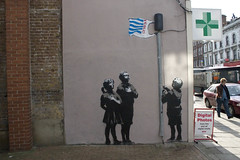
I’m not normally a big fan of Banksy, but this one (photo by Ben Bell) strikes me as quite brilliant.
Ever since I read Stewart Brand’s _How Buildings Learn_ I’ve been a sucker for then-and-now pictures of cities and buildings. Via The Online Photographer , I stumbled on a slideshow of work by Christopher Rauschenberg at The Morning News consisting of Rauschenberg’s captures of Paris scenes taken by Atget. (I’m also a big Atget fan – so this was doubly great.) There’s also a link to an earlier then-and-now series at TMN of New York.

I’ve made you some free X-Mas cards and gift tags!
Printables!
Just like the ones your kids alway waste the good paper on! So there’s never any when you need it! But before I give you the download links, I have some explaining to do.
The world is filthy with X-Mas cards, says you. Well, I think mine are rather special and nice. They are based on visual elements extracted from Ernst Haeckel’s Kunstformen der Natur (1904). A very famous and beautiful work. Wikicommons has some lovely pictures. You know what I like best about that cover? (Thanks for asking, and feel free to click for larger.)
I like the fact that ‘Leipzig und Wien’ is in a sans serif font. Somehow that makes it perfect.
This is awesome.
For a year from September 2005, under the nose of the Panthéon’s unsuspecting security officials, a group of intrepid “illegal restorers” set up a secret workshop and lounge in a cavity under the building’s famous dome. Under the supervision of group member Jean-Baptiste Viot, a professional clockmaker, they pieced apart and repaired the antique clock that had been left to rust in the building since the 1960s. Only when their clandestine revamp of the elaborate timepiece had been completed did they reveal themselves. “When we had finished the repairs, we had a big debate on whether we should let the Panthéon’s officials know or not,” said Lazar Klausmann, a spokesperson for the Untergunther. “We decided to tell them in the end so that they would know to wind the clock up so it would still work.
“The Panthéon’s administrator thought it was a hoax at first, but when we showed him the clock, and then took him up to our workshop, he had to take a deep breath and sit down.”
There have been quite a few blogospheric discussions about staged war photographs (Iraq, Lebanon) and whether it matters whether they were staged if they reveal the truth. Here’s something to check out when you have a bit of time …. Errol Morris has a blog, Zoom at the New York Times devoted to photography. He has now published two parts of a three- (or four-) part essay concerning whether Roger Fenton, one of the earliest war photographers, staged a famous picture of cannonballs on a road in the Crimea, as alleged by Susan Sontag. In part one , Morris gets the opinion of the curators and art historians on which of two Fenton pictures was taken first; in part two he gets his compass out and his feet dirty by going to the Crimea and finding the exact stretch of road. In comments to part one, his own readers offer their solutions to the photographic puzzle. (via FineBooks thanks to PdB.)
I just finished The Professor’s Daughter
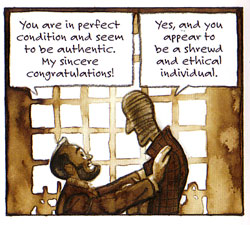
Imhotep IV takes refuge in the shop of an antiquarian, before resuming pursuit of his beloved – Lillian, daughter of renowned Egyptologist, Professor Bowell, who is owner of Imhotep IV. As the defense attorney sincerely declaims, a few pages on: “It was love that caused Pharaoh Imhotep IV to cross the centuries and attempt to breach the west wall of the central police station, and it was hastiness that caused Miss Bowell to confuse arsenic and chamomile.” Further complications ensue upon arrival of Imhotep III, who kidnaps Queen Victoria. Love conquers all, the watercolors are lovely.
You can read the first dozen pages at First Second books – purveyors of fine comic product all-around. (But Amazon will give you a better price. But maybe it’s better to buy from the publishers.)
In other art news, I just noticed that Hirst sold the skull:
Damien Hirst’s diamond-encrusted cast of a human skull has been bought by a group of anonymous investors for its asking price of £50 million, the artist’s representatives claimed yesterday.
It is, by a huge margin, the most paid for a work by a living artist.
Entitled For the Love of God, the skull was first displayed at the White Cube Gallery in Mayfair, Central London, in June where thousands queued for a two-minute viewing in a high-security darkened chamber.
Studded with more than 8,500 ethically sourced diamonds, it has been variously described as “an anthropomorphised disco ball”, “the first 21st-century work of art”, “a cosmic wonder”, “the vulgar embodiment of modern materialism” and, by Hirst himself, as “quite bling”.
And Texas can’t decide whether the grammar/penmanship is wrong enough for it to be $550,000 worth of right.
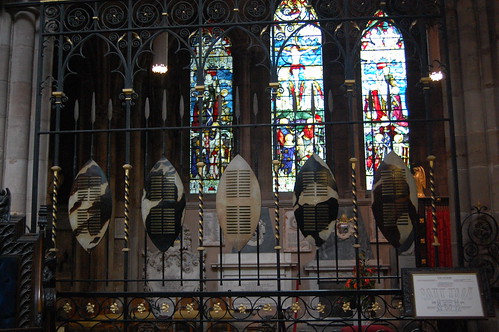
On the whole, ethnic stuff in English churches tends to consist of displays celebrating multiculturalism and interfaith understanding etc. So it was with some surprise that, when visiting Lichfield’s magnificent medieval cathedral I stumbled on this war memorial in the south transept. This in-your-face bit of Africa dates from just after the Anglo-Zulu War of 1879 (think Rorke’s Drift, think Michael Caine) and is just a teeny bit incongruous amidst the gothic widows and vaulted ceilings.
The whole Cathedral is magnificent by the way — there are other photos in my Flickr stream — and this isn’t the only cultural surprise. A memorial to Erasmus Darwin has the words:
“His speculations were directed towards problems which were afterwards more successfully solved by his Grandson, Charles Darwin, an inheritor of many of his characteristics.”
We had an interesting discussion the other day after Harry’s post about Show of Hands and their song “Roots”. That argument was partly about the possible recuperation of song by the radical right despite the inclusivist politics of the songwriter. Yesterday’s Guardian had an interesting piece attacking the the politics at the origin of folksong as a distinct genre, and especially the politics of the folksong collectors Sharpe and Lomax. Hugh Barker and Yuval Taylor argue that the search for authenticity and the untainted roots of distinct national tradition as embodied in besmocked peasants (and so on) is imbued with ghastly racist assumptions of various kinds and that we should simply reject the idea of a distinction between folk and popular song.
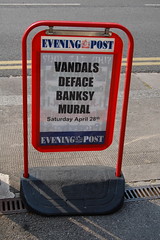
(Those who don’t know about Bristol’s most famous “artist” can google for “Banksy” or check the Wikipedia.)
.
Via 3QD, a nice profile of the great Don Knuth who — amongst many other things — gave the world TeX, which, together with its various descendants, helps make technical writing beautiful and encourages amateur typophiles to waste their time formatting their work.
 Few people with an interest in space travel have the resources to make that dream a reality. In a few minutes, Charles Simonyi will be one of those people. He’s among the few space tourists who’ve paid the $20-$25 million for the experience. He has been chronicling his adventures at charlesinspace.com, an interesting and informative Web site where users can get answers about the various aspects of his preparation and travel. (You can watch the launch live here or click on the link above to choose your preferred player.)
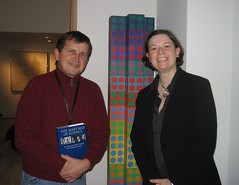
I had the opportunity to meet Charles Simonyi last October when I was in the Seattle area giving a talk at Microsoft Research. I consider my experience a classic case of cultural capital at work. Both of us having grown up in Budapest – and it turns out just a few blocks from each other, although a few decades apart – likely was not enough of a reason for him to bother responding to my email. Rather, I suspect it was our shared interest in the Hungarian artist Victor Vasarely that prompted him to invite me for a tour of his house. It was super fun, Charles Simonyi has some wonderful works by Vasarely and others, and I very much enjoyed the opportunity to see his collection.
We also took a brief tour of his library in which he has some interesting original documents related to space travel. His passion for the topic is obvious and contagious. I look forward to the updates on his site about this amazing adventure.
In the above picture, I stand next to Charles Simonyi (he’s holding my father’s book The Martians of Science) with a Vasarely sculpture behind us. Photo credit goes to Marc Smith who kindly invited and hosted me on this visit to MSR.
A photograph of family members, every June 17th, since 1976.