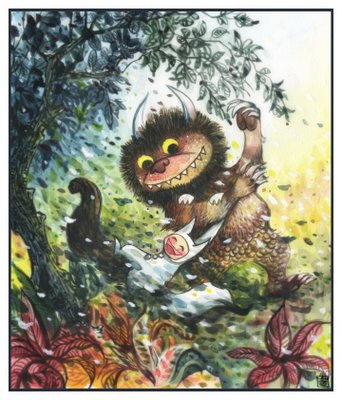
Have you seen this yet? Terrible yellow eyes. It’s an art project with various folks contributing Where The Wild Things Are -inspired works. It’s a lot of fun. This one, for example, by Alina Chau (whose blog is here):
I think this one might be my favorite, however. (By Adam Volker.) Which do you like best?
This Andrew Sullivan link to a Hexstatic song reminded me that Hexstatic and Coldcut’s Timber is surely the best video of all time, and that I should look for it again online (the last time I looked was a couple of years ago, before YouTube really got going). Found sounds meets mid-1990s-vintage video-editing tools and it’s awesome! Fools who disagree with this claim can of course nominate their preferred alternative in comments (and should even be able to embed YouTube links, I think) …
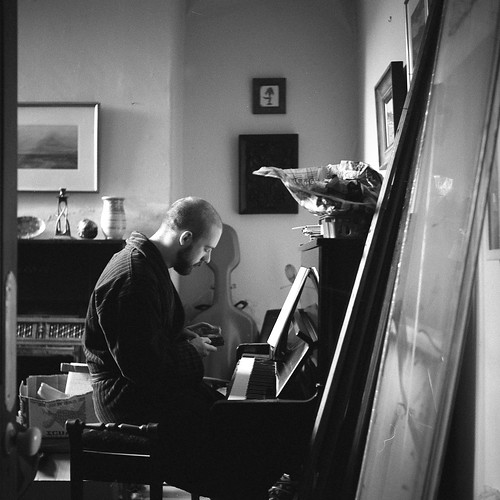
The Online Photographer reports that the firm of Franke and Heidecke is going out of business – perhaps permanently. That’s very sad news, for they are the firm that launched the famous Rolleiflex brand in 1929. As it happens, I bought a 1932 Rolleiflex Standard that I bought in a junk shop in Wales last year. I’d actually seen it a year before. The owner had spotted me with a camera and asked me whether I was interested in the Rollei. At the time I declined, but regretted it as I thought back to the beauty of the image in its ground-glass screen. So I was amazed, when I went back, to find it still unsold and snapped it up. I keep meaning to write a post about what you could, pretentiously, call the “phenomenology of technology”. The Rollei feels so different to a modern digital camera: since it is a twin-lens reflex, you hold it at waist level and look downwards; like other film cameras you don’t get the instant satisfaction of digital – you have to wait and see what came out; and since you have a mere 12 shots on 120 medium format film, you can’t just snap away and select for the best. There’s also the fact that is is a superbly made object. How many other machines made in 1932 still work, and work pretty well. Vorsprung durch Technik, I suppose. Here’s a photograph I made with it:
Nearly every corridor in every building of the Commission, Council and Parliament has two or three examples [of EU official art] along its walls – spectacularly bland and uninteresting prints and photographs, always with the twelve stars on a blue flag in there somewhere. The art is contentless and affectless because any strong statement, or even conveyed sense of geographic location, would probably offend somebody in one or another of the member states. There’s something about the EU that seems completely inimical to lively cultural expression.
Now a Czech art-prankster has put this theory to its test, and found that member states are indeed liable to get offended.
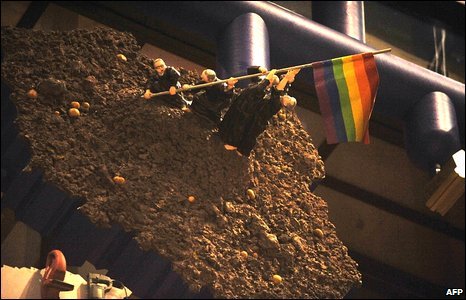
Sited prominently in the headquarters of the EU Council in Brussels, a flagship work of art – which was designed to demolish national stereotypes by mocking them – has caused diplomatic outrage. Not only that, the piece turns out to be the work of a single Czech artist despite having been billed as the collaborative effort of all 27 member states. … As countries digested depictions of their character, such as a Dracula-inspired theme park (Romania), a rudimentary lavatory (Bulgaria) and a flooded land with minarets poking through (the Netherlands), the Czech presidency was forced into a public apology. … Other national depictions in the artwork include: Luxembourg as a lump of gold on sale to the highest bidder; France emblazoned with the word grève , or strike; Denmark made of Lego; and Sweden lying within an Ikea flatpack. Britain is simply missing – supposedly a reference to its euro-scepticism. But some diplomats appear in little doubt of what action they would like to see, namely the removal of the eight-tonne “modern art installation” from the bleak and lofty but all-too prominent atrium of the council’s main building.
In fairness, the artist seems to have gone out of his way to prod national sore spots – other depictions include Germany (autobahns making up a rather thinly disguised swastika) and Poland (a group of monks erecting the Rainbow flag). Pictures below.
Miriam Burstein provides an annotated and hyperlinked list of the murderers modelled in the Victorian version of Madame Tussaud’s Chamber of Horrors, taken from the 1886 Tussaud’s guidebook.
No, I’m not going to make fun of the small handful of right-wing blogs that got fake-alarmist about it, hinting that it kinda sorta looked Fascist. My question is related, however. Being a sensible and knowledgeable sort of person, as opposed to some sort of crazed wingnut, when I look at the poster I see not Fascist art but an homage to German modernist styles of the 1910’s and 20’s. Being the sort of person who futzes with fonts, I also see an example of art that would have been actually illegal under the Nazis. Quoting from German Modern, by Steven Heller and Louise Fili [amazon]: [click to continue…]
David Byrne – you might have heard of his oldband – has an installation at the Battery Maritime Building in New York called Playing the Building. Basically, he placed an old organ keyboard in the middle of a big room and rigged it up so that each key makes noise by banging, blowing, or grinding some part of the building. It’s a great effect and a lot of fun to play. When I was there, Saturday afternoon, there was only a 15 minute or so wait to play it, and everyone was in good spirits and having fun. The building itself is in poor shape and you need to sign a release form to enter. Probably not worth a trip to NY by itself, but if you’re already there, stop by and have some fun making noise.
I’ve seen various textcloud applications before, but Wordle (via Steve Poole) is the first one that I’ve seen that makes it easy to produce aesthetically attractive pictures of the information. Below is the textcloud of my book, “The Political Economy of Trust: Institutions, Interests and Inter-Firm Cooperation” which I’m preparing for publication in Cambridge’s Comparative Politics series (click on the graphic to see the full thing). I want to make a poster of this and frame it for my office.
Huh? It’s a play about “a group of outsourced Japanese Ninjas hired by China to infiltrate the American Psyche by taking on roles in the Media, Pop Culture, and Politics”. Go see it at the Zipper Factory Theater in NYC on Saturday, July 26th at 10:30pm. It’s a fun, fast-paced, multi-media production that will appeal to CT readers. (It’s also directed by one of my oldest and dearest friends.) I thought the actors were great, for example, they were superb with the various accents (from BBC anchor to ninja).
The play also has an improv segment with guests, two this time: Paul Rieckhoff (executive director and founder of Iraq and Afghanistan Veterans of America, and author of Chasing Ghosts, a personal account and critique of America’s war on terror) and Hunter Bell (a writer and performer of the new Broadway show [title of show]).
While you wait to be seated, you can enjoy a drink at the bar or simply engage in some people-watching from one of the comfy/funky seats in the waiting area. Also, the two guests will be around after the play so this is really a play-plus-party event, all for $20.
I just finished Gregory Gibson’s Hubert's Freaks (subtitle “the rare book dealer, the Times Square talker and the lost photos of Diane Arbus”). It was one of those strange books which sounds interesting but then has you thinking you made a mistake in starting, but suddenly hooks you and has you reading to the end. Gibson tells three intertwined stories: first, that of Bob Langmuir, a neurotic Philadelphia-based antiquarian book-and-miscallaneous-stuff; second, more briefly, that of Diane Arbus, her career, her photographs, suicide and posthumous rise to cult status; and, uniting the other two, Hubert’s Museum, a Times Square freak show (complete with bogus African tribespeople, amputees, tattooed men &c.). Arbus had become involved with the people at Hubert’s in the 1960, and especially with the black couple known as Charlie and Woogie who ran the place, and had taken a whole bunch of pictures there. It is these pictures that Langmuir discovers chez another dealer, amid a pile of other paraphenalia. Part of Gibson’s story is Langmuir coming to terms with what he has, and then struggling to get the difficult (to understate the case considerably) Arbus estate to authenticate the material so that he can bring the pictures to market. But Langmuir is also an archivist of African-American history and he is fascinated by the people at Hubert’s and by the comprehensive phonetically-spelled diaries that Charlie kept for most of his life. Gibson does an excellent job of stitching the various narratives together and using them to evoke a strange and marginal side of America. In passing he gives us some interesting insights into how the market for art photography got started (a combination of scarcity of other art objects giving rise to a need for new outlets for the connoiseur’s passion and institutional hype from curators like John Szarkowski at MoMa and critics like Sontag).
(When I bought the book on a recommendation, I hadn’t realised that it had only recently come out. In fact the story is still short of a denoument as Okie, the Nigerian dealer from whom Langmuir bought the trunk, is suing on the grounds that he was somehow illicitly deprived of valuable items. Since _caveat vendor_ would seem to be to relevant principle for trades between dealers, and since Langmuir did the work of recognising the Arbus material and then establishing authenticity, it is hard to believe the Okie has a case. But where (possibly) millions of dollars are at stake, it is probably worth him trying it on. Pending resolution, the Hubert’s archive can’t be sold.)
On the basis of not paying particularly close attention but listening to what Australian friends had to say, I’d formed a generally positive impression of Australian PM Kevin Rudd. Now I see that Rudd has been stupid enough to weigh into a controversy about the artistic depiction of child nudity with the following comment:
bq. “Frankly, I can’t stand this stuff …. We’re talking about the innocence of little children here. A little child cannot answer for themselves about whether they wish to be depicted in this way.”
I can’t wait for the Australian government’s prosposals for banning the appearance of child actors in soap operas and TV advertising on similar “couldn’t consent to thus being depicted” grounds!
The image in question can be seen here . (Perfectly safe for work in my opinion, but what do I know.) Chillingly, “Officials have said they will review the magazine’s public funding.” Of course there may be questions about whether art magazines should be publicly funded at all, but if they are to be, then this seems an crazy reason to withdraw the case.
(Incidentally, a relative of mine works with someone who was on the front cover of Led Zeppelin’s _Houses of the Holy_, no doubt the Australian Childhood Foundation would have been up in arms about that too on the grounds of possible “psychological effects in later years” — there don’t seem to be any.)
In Plato’s Symposium, Alcibiades compares Socrates to ‘those busts of Silenus you’ll find in any shop in town’. You ‘split them down the middle’ and figures of gods are inside.
Obviously this is going to be something like a Russian nesting doll. Maybe exactly like one. I have seen a lot of Greek art and artifacts. I’ve seen, for example, drinking cups that are ugly Silenus on one side, beautiful Dionysus on the other. But I’ve never seen an ancient Greek Silenus nesting doll. Have you? What, exactly, were they like? Which gods were inside? Surely just Dionysus. If they were available in every shop, at least a few should have survived. Popular craft forms don’t usually just blink out of existence. They evolve down the centuries So where can I see one?
Anyone reading blogs over the last few years know how obsessive the wingnut element can get over faked, altered and “faked” photographs. Sometimes there’s a case to answer; sometimes there’s a picture that contradicts their narrative and they’re shrilly convinced that “it isn’t trooo!” We saw instances of both in the recent Lebanon war. Now the great-granddaddy of such controversies looks set for reinvestigation : did Robert Capa stage his most famous picture, the “Falling Soldier” from the Spanish Civil War? The International Center of Photography in New York has acquired a suitcase discovered in Mexico last year containing Capa negatives abandoned when he fled from Paris in 1939.


 , by Steven Heller and Louise Fili [amazon]: