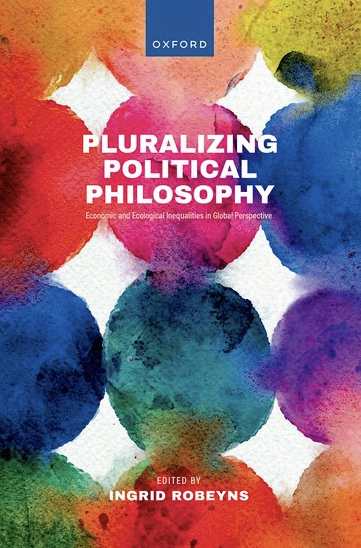
 A couple of years ago, I edited a volume on pluralizing political philosophy, in particular in relation to economic and ecological inequalities. It was put together under the Covid-pandemic, so we had to swap the authors-conference for online meetings, with the authors spread out from China to Argentina. Sometimes the people in the most unfavorable timezones joined us literally in the middle of the night. I have always been very grateful to the contributors for running the extra mile under those circumstances, and some of the contributors gave the book what I am suspecting have been their darlings – papers on which they either had been working for a long time, or else papers that contained really original ideas. The book also includes a separate part with discussions of the main papers.
Against that background, I felt a little sad that (to the extent that I have been able to find out) the book hasn’t been picked up much. The first and so far only book review (in the Erasmus Journal of Economics and Philosophy) came out last week. But now one of the contributors, Krushil Watene, wrote to say that she has been teaching a course on the book, which is wonderful. If her students read this, they are very welcome to let us know their comments and impressions of the various chapters, including whether they think the book works for teaching (my assumption has been that it should be really useful for teaching, since it basically has all these different perspectives and arguments on why to pluralize political philosophy and how to do so, also if one is still on square one. But, as always, the proof of the pudding is in the eating.) And the book can still be downloaded for free.
{ 5 comments }
Matt Lister 09.01.26 at 4:27 pm
The book looks very interesting, Ingrid. (I sympathize with the problem of people trying to do on-line workshops in very different time zones!) What sort of class/level do you think it would work best for, for teaching? (I don’t get to teach political philosophy as such myself at all, so I’m asking out of curiosity more than practically, but maybe the answer can be practical for others.)
As for lack of reviews, my impression is that journals often have a hard time getting people to do reviews, but that at least some are open to people volunteering, and some take suggetions from authors/editors, too. I know that the Journal of Moral Philosophy has been open to people volunteering to do reviews of specific books, so if any readers here (who are qualified) feel inclined, they might reach out to Christian Miller, the book review editor there, and see if he’d be interested in a review.
Ingrid Robeyns 09.01.26 at 5:59 pm
Thank you Matt, that’s a kind suggestion and a useful question. I hope Krushil Watene can weigh in, since she has been teaching from the book (but I don’t know what level). I’d think advanced undergraduate since it presupposes that one knows e.g. Rawls, what is traditionally perceived as the canon, a rough overview of the global justice literature, the debate around perfectionism in theories of justice, etc. But one could of course also pick particular chapters as pieces to be inserted in other courses, e.g. I think any course on global justice should seriously consider Simon Caney’s chapter, and courses on ‘what is philosophy?’ (or epistemology) should consider Krushil Watene’s chapter, to mention just two.
I am actually surprised that, so far, no one has picked a fight with Jo Wolff’s chapter ! :)
Ben Saunders 09.02.26 at 7:41 am
Regarding reviews, most journals are very selective about books that they review, because there’s a lot of competition for limited space. Rightly or wrongly, I think most tend to prioritise (i) sole-authored (or co-authored) monographs over edited collections and (ii) research books over textbooks or similar handbooks.
Ingrid Robeyns 09.02.26 at 9:57 pm
Ben @3, yes, I think that is true (some journals that I contacted a year ago actually just told me your reason #i, they just do not publish any reviews of edited volumes. But there are also unfortunate situations – for example, someone contacted me offline, to say they offered to write a bookreview of this book for the NDPR (which has no space shortage, but might have capacity limits, perhaps) and they didn’t respond. And while there are many good reasons for the difficulty to get book reviews published, it’s frustrating as an editor, because I feel some responsibility (towards the contributors) to bring the book under the attention of possible readers, and my abilities to do so are very limited. But I also accept that these are “luxury-problems” in the grand scheme of things! :)
Bob Michaelson 09.03.26 at 1:24 pm
FYI, according to WorldCat over 375 libraries world-wide have added the online version of this book to their online catalogs – and about 14 libraries world-wide actually have the printed version. So the book has pretty good visibility among major academic and national libraries.
Comments on this entry are closed.