Today’s art post inspiration comes from an unlikely source: JAMA Opthamalogy. The article “Evidence That Leonardo da Vinci Had Strabismus” makes the case that the artist’s exceptional rendering of 3-D in 2-D was in part thanks to his eye condition sometimes referred to as wandering eye. The author, opthomologist Christopher Tyler of City, University of London, examined six pieces thought to be depicting Leonardo da Vinci: “David (Andrea del Verrocchio); Young Warrior (Andrea del Verrocchio); Salvator Mundi (da Vinci); Young John the Baptist (da Vinci); Vitruvian Man (da Vinci) and another possible da Vinci self-portrait.” (quoted from the university’s press release). Ars Technica’s coverage of the piece has helpful visuals. There seems to be disagreement in the art community about whether all of those art pieces depict Leonardo da Vinci, but this is a topic Tyler had already researched earlier. His argument seems convincing to me and is an interesting revelation about the condition under which some artists did that work. Apparently other famous artists also had strabismus (e.g., Rembrandt) or other vision impairments (e.g., Monet, O’Keeffe). I appreciate the angle the Washington Post’s coverage takes on this at the end noting that this should give people with eye-alignment disorders some boost in confidence to counter the discrimination they sometimes face both on the job market and in social situations.
From the category archives:
Arts
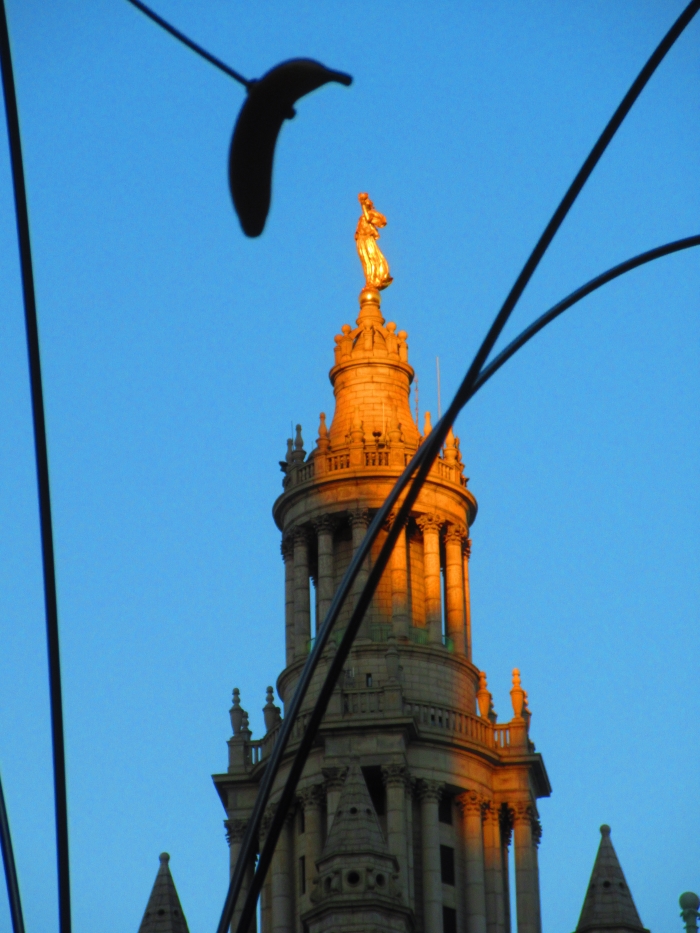 One fun aspect of public art is that you can stumble into it without any planning on your part to have an artistic experience. Such was the case when I found myself staring at columns of colanders and looking up at fruits and vegetables hanging from pots and pans in City Hall Park in New York. The exhibition is by B. Wurtz who likes to draw on everyday objects in his work. Since I am a huge fan of reusing objects, this appeals to me a great deal.
 Another neat aspect of public art in such a location is that by taking a step, you can get an entirely different visual experience. With both trees and scyscrapers in the background, this is not an exaggeration. The pictures on the exhibition site were taken in daylight while mine (see album on Flickr) were taking during dusk so they offer different views from that perspective as well. The trees will be on display in this park through December 7, 2018.
 In a small town in the French-speaking part of Switzerland is a fantastic exhibit dedicated entirely to Star Wars. It showcases several artists using very different media to pay homage to the popular series. From digitally-edited photographs of classical sculptures to various creative 3D-renderings of well-known characters, from photos of lego scenes to drawings in countless styles, the exhibit offers lots of interesting visual stimuli. It’s hard to pick a favorite. I very much appreciated Kyle Hagey’s pieces and can’t believe I had never come across them before. Conveniently, you can view and buy copies of his work on Etsy. There is also a free-to-play Star Wars pinball machine on the top floor of the museum as well as an old-school video game. This is a must-see for any Star Wars fan. The show runs through Oct 14th. That doesn’t leave a lot of time to visit and as far as I can tell, sadly it is not a traveling exhibition. While not the same experience, I did upload some of my photos here for those who are interested, but can’t make it there in person.
 We visited the Cave of Pech Merle yesterday, which is famous for its prehistorical paintings of bisons, mammoths, horses, and other animals. Those paintings have been made by people who, according to our guide, were almost identical to us, except, she said, that they were taller than us – on average 1 meter 85 centimeter. Pech Merle has a website that is a bit slow (at least, given my present internet-conditions), but it has a very interesting part where you can enter the cave virtually.
I’ve visited many caves in my life, but never one with prehistorical paintings, and was very impressed. If you ever get a chance to see them, do go see them! Although the crown piece of the cave are two dotted horses, which are large and in excellent condition and include something of an optical illusion (avant la lettre?) — I was especially touched by the painting of the hands of the people. There are a number of hands, painted in black, close to the dotted horses, presumably by a man (or several men); and then there is this single hand in red, which is presumably from a woman. At first, I was surprised to note that the hands touched me more than the animals (which may be seen as artistically more sophisticated). I guess that seeing a hand brings the presence of the human being closer than seeing a non-human animal. People, almost identical to us, who made paintings in a cave, some 20.000 years ago, that we can still watch today…
I’m writing something introductory (intended for a general audience) about ‘themes’ in literature. Obviously my theme must be that the term is a bit hopeless until you say what you mean by ‘theme’. I’m thinking of introducing it with reference to memories of writing book reports in 6th grade (I think it was.) Mr. Lofton’s (?) class at McCornick Elementary. (Or was he my 5th grade teacher? Can’t remember.)
Anyhoo: it was requisite, on pain of getting no credit for your report, that you correctly check one or more box(es) for ‘theme’. There were exactly four options:
Man vs. Man
Man vs. Nature
Man vs. Society
Man vs. Self
That’s all there is, there ain’t no more!
(Sorry, ladies! It was the 70’s, and Ms. was a magazine, but you got no love when it came time for themes.) [click to continue…]
A couple weeks ago I was, as one does, declaiming selections from Erasmus Darwin’s poetry around the table, for the moral edification of the females present. I was explaining to the young daughters, in particular, how and why people were upset that Darwin poetized plants having sex all the time in The Botanic Garden, volumes 1 and 2. Especially volume 2.
The younger daughter: Oooh, fifty shades of green!
They grow up so fast. [click to continue…]
Adam Roberts has been fighting the good fight, keeping blogging real. He’s been reading his way through H.G. Wells’ collected works so you don’t have to. You can just piggy-back along for the ride. But all good things must end. He just published the post for Wells’ final work, Mind At The End of Its Tether. I’m no Wells scholar but I actually had read that one. It’s astonishingly pessimistic. Nigh-Lovecraftian. And it isn’t even supposed to be fiction. It’s what Wells was feeling in his last days. Here is the book’s opening: [click to continue…]
I’ve been meaning to write something about Philip Nel’s new book, Was the Cat in the Hat Black?: The Hidden Racism of Children’s Literature, and the Need for Diverse Books [amazon]. It’s caused some fuss. But I was already a Nel reader because, as a sometime Seussian myself, I read and enjoyed and learned a lot from his earlier book Dr. Seuss: American Icon.
There is an inherent risk that any degree of analytic subtly and investigative archaeology breeds ethical over-sensitivity, in a case like this. It isn’t scholarship if it doesn’t bring to light something a reasonably intelligent, moderately informed reader might miss. It isn’t dangerous to tender young minds if it sails over their heads. No 5-year old is going to notice the Cat owes a visual debt to minstrelsy, much less that Dr. Seuss apparently took some visual inspiration from a white-gloved African-American elevator operator named Annie Williams. Who knew? If that’s the concern, maybe it’s not much of one. (Not in the same league as giving a slightly older kid an original edition of Charlie and the Chocolate Factory with the original, racist Oompa-Loompa illustrations. Here is Nel on the subject, some years ago.)
Since conservatives are super-hyper-sensitive to the risk that someone besides their snowflake-y selves might be even slightly over-sensitive, it’s pretty much impossible for Nel to broach his whole topic without ‘triggering’ the fainting couch set, be he ever so mild about minatory whispers in your shell-like.
But fair is fair: let me give an example of analysis and plausible harm wires maybe getting crossed. [click to continue…]
Normally I steer clear of Black Friday sordidity, but I’ve been on an art kick here on CT; and, it happens, I need new colored pencils. And the best are Prismacolor. And – lo and behold! – the big box [aw man you missed the sale] is half-price for the next five hours. That’s a good deal if you want to box with shadows in a practical sense. (They aren’t all grey. Just ask Monet.)

After finishing Shadow Of A Mouse, I turned to the next title on the pile: E. H. Gombrich, The Depiction of Cast Shadows In Western Art [amazon].
It comes with its own mouse that comes with a shadow! [click to continue…]
I’m reading a fun book, Shadow of a Mouse: Performance, Belief and World-Making In Animation, by Donald Crafton. The author is an animation historian/film studies scholar. I’m interested in the history but also – as is the author – the theory of animation ‘performance’. I’ll snip a nifty bit from Chapter 4, about the evolution of devices, conventions and styles for handling space. The author uses the evolution of the treatment of shadows as a nice hook, per his book title. [click to continue…]
I am a serious lover of, semi-serious scholar of (hemi-demi-semi-serious practitioner of) caricature. I’m here to deliver the goods.
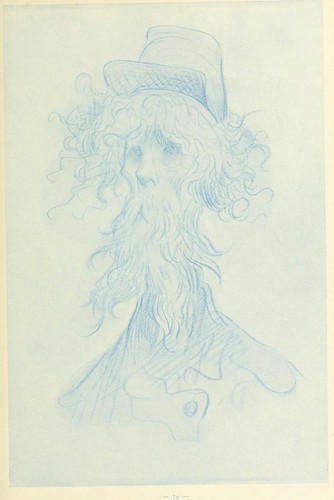
Honoré Daumier is crowned 19th Century French master of this form. For so he is. But Gustave Doré, better known for his Dante, Bible and fairy tale illustrations, is as good, I say. The Internet Archive has a decent copy of Versailles et Paris en 1871, published in 1909. (Oddly, Wikipedia doesn’t even know it exists.) The Archive interface is ok, but this one needs a thumbnail gallery. Also, their PDF is messed up. So I made three Flickr galleries for the three sections of the book. First is “L’ Assemblée Nationale”. Next is: “La Commune”. Last is “Magistrature”. Then I realized I had nowhere to put the artist himself. Here he is. A Crooked Timber exclusive. [click to continue…]
I’m reading Lord Dunsany, The King of Elfland’s Daughter (1924). I’m also preparing to lecture on fantasy and fairy tales in my Science Fiction and Philosophy module (fun!) So I am pleased to find the following passage about the forging of the hero Alveric’s blade. The sword is made from thunderbolts, you see, dug up from a witch’s cabbage patch. (She lives in an especially thunder-prone mountain region. Nothing special about cabbage, apparently.) Thunderbolts are unearthly space metal knocked from the sky in thunderstorms. Science fact.
Nobody can tell you about that sword all that there is to be told of it; for those that know of those paths of Space on which its metals once floated, till earth caught them one by one as she sailed past on her orbit, have little time to waste on such things as magic, and so cannot tell you how the sword was made, and those who know whence poetry is, and the need that man has for song, or know any one of the fifty branches of magic, have little time to waste on such things as science, and so cannot tell you whence its ingredients came. Enough that it was once beyond our Earth and was now here amongst our mundane stones; that it was once but as those stones, and now had something in it such as soft music has; let those that can define it.
So there’s my epigraph for the chapter about the relationship between science fiction and fantasy, when finally I get around to writinbg it. Science fiction is like that sword.
Jack Kirby was born on August 28, 1917.
I celebrated his birthday by rereading a bunch of old Jack Kirby comics. [click to continue…]
The recurring series that’s actually pretty popular, dammit. Also I get sweet music recs every time. Otpup pointed out that the new LCD Soundsystem is great, and although they have only released three of the songs off the new album, I have been listening to them on repeat as I do my morning 1-hour hike that I do before the sun comes up because I am a person of unusual virtue and my life has changed and now I am up from the front end instead of from the other end if you see what I mean. Also it’s really hot when the sun comes up in Singapore. Of course, it’s so muggy before the sun comes up that I come home in a lather of sweat anyway, but hey. I see lots of old people doing tai chi in the park, and occasionally monkeys. Not doing tai chi, as far as I can tell. Otpup posted “Call The Police”, so here’s “Tonite.”
I’m not 1000% sold on The War on Drugs, but I’m warming up to it. And this song is great. Damn this dude must do a good Dylan cover though.
This is one of my favorite songs from The Clash’s Sandinista:
It’s strange in a way how like this the towers of Singapores HDB blocks look, in huge clusters, but neatly painted with graded hues on the brick ends, some blues, some reds, some yellows, all planted around with tidy gardens, all surrounded with new cars.

Sorry, there were much better photos but they maxed out the side of the blog. Anyway, this is in my neighborhood, so there’s that.
I have the Dukes of Hazzard lunchbox that appears in the video at 4:17 and carried it as a purse for a number of years, a choice I now regard as dubious.
Is there a name for the songwriting device of setting up an obvious rhyme and then not using it? Pavement is particularly inclined to this but there’s an example in LCD Soundsystem’s “Tonite” also:
Sure enemies haunt you with spit and derision
But friends are the ones who can put you in exile
You are expecting “prison” at that point, oder?