by Harry on January 7, 2007
Imagine, 45 years after Britney Spears dies, some young kid mimicking her on Stars in Their Eyes. You can’t. Madonna? I’d be surprised. Jagger, Springsteen, Dylan? Ephemera. Hendrix and Presley? Perhaps they are as great as George Formby. Perhaps.
So a treat for the fans amongst our readers (and I know there are some). Scroll down toward the bottom of this page and click “Watch in real media”, and about 3 minutes in you’ll find a lovely little lad playing “My Little Stick of Blackpool Rock”. He doesn’t quite get how dirty it is (thank goodness) and he’s not yet got quite the presence of the master, but it is wonderful. And heart warming. The curious can see the master himself here, here and here (is that the marvelous Beryl there with him?).
by Scott McLemee on January 4, 2007
 This YouTube video of our calico cat and a wind-up toy bird has had just over 9,000 hits. My wife initially put it up expecting that just a few friends would take a look. At some point, it went from a few dozen hits to several thousand. For the past couple of months, it has been poised to break the 10k barrier, but lost a lot of momentum somewhere along the way.
This is where you can help.
Besides, it seems like time finally to do my first CT post of 2007, and it was either this or something about the late Seymour Martin Lipset‘s place in the history of the Shermanite faction following its departure from the Workers Party. A tough decision. But I find that the video does not actually decrease my will to go on, so here it is.
by Eszter Hargittai on December 6, 2006
Andrew Sullivan posts a copy of this compilation of AT&T ads from 1993 predicting the future. They did a great job predicting what is today available to many. And remember, 1993 was the year when the first Windows-based browser was released helping along wide public access to the Web. But at that point little of this was obvious.
I wanted to find the video on YouTube directly. I didn’t realize you could just get to the specific YouTube page by clicking on the video window anywhere but the play button so I proceeded by searching for it on YouTube. I got one result (not the right one) for at&t 1993. A search for at&t ads didn’t give me this hit either.
At that point, I decided to just click on Share in the YouTube player (which annoyingly resizes my entire browser window) and tweak the URL from share to view to get to the page. That’s one way to do it (but again, clicking anywhere but the play button is probably the easiest if you already have the video of interest:). If you don’t have the specific video then it seems best to do a site-specific search for the video on Google as such: site:youtube.com at&t 1993. I wonder when YouTube search will be powered by Google given the acquisition.
UPDATE: I’m told by someone who seems to be a reliable source (but who wishes to remain anonymous) that this is something that they are, indeed, working on and it will be one of the first integrations as part of the acquisition.
by Eszter Hargittai on December 4, 2006
I don’t know anything about the Dutch show “Kinderen voor Kinderen”, but it seems like it could be fairly mainstream and have a sizeable audience. I also don’t know what, if any, reactions this video received, but it’s a good example of how you can socialize kids to be inclusive and understanding of diverse family arrangements. It’s interesting (and sad) to ponder how differently people would react in various places.
by Eszter Hargittai on December 1, 2006
An important aspect of scientific research is that others should be able to reproduce the work. This is significant partly, because it serves as a check on the system, but also, because it allows others to build on previous achievements. Replication is not trivial to achieve, however, given that studies often rely on complex methodologies. There is rarely enough room in journal articles or books to devote sufficiently detailed descriptions of how data were collected and procedures administered. Moreover, even with adequate space for text, many actions are hard to explain without visuals.
This is where recently launched JoVE comes to the rescue. The Journal of Visual Experiments publishes short videos of procedures used in biology labs. Former Princeton graduate student Moshe Pritsker created the peer-reviewed online journal with Nikita Bernstein. The inspiration came back in his graduate school days when he had often been frustrated in the lab while trying to conduct experiments based on others’ descriptions of the necessary methods. The goal of the journal is to assist others with such tasks. The publication has an editorial board and submissions are reviewed before a decision is made about publication.
What a great use of the Web for dissemination of material that would otherwise be difficult to get to relevant parties.
[Thanks to Mark Brady for pointing me to the Nature article – that is now behind subscription wall – about JoVE. That piece served as the source for some of the above.]
by Henry Farrell on November 28, 2006
I’m up on Bloggingheads again, “this time”:http://bloggingheads.tv/video.php?id=163 with Dan Drezner, for those as wants to watch.
by Eszter Hargittai on November 25, 2006
Here are some interesting video finds:
Also, as proof that YouTube has grown up, I am now receiving spam through it:
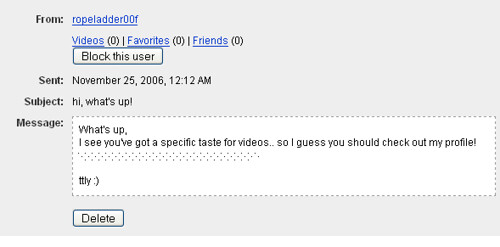
Since the sender’s ID wasn’t created until five days before sending this note and the account has no bookmarked or submitted videos, it’s a safe bet (beyond the content of the message) that its sole function is to generate spam. (I have purposefully removed the URL the user is trying to advertise from the above image.)
by Harry on November 15, 2006
A tribute to the wonderful, wonderful Linda Smith, by her friends. Here till Friday.
by Chris Bertram on November 9, 2006
Though you can sometimes get the same effect by neurotically pressing “refresh” on Soccernet or similar, I know all about “this phenomenon”:http://www.wsc.co.uk/articles/229cfax.html :
bq. Everyone who watches football on Ceefax will have a favourite text moment, even if it’s just the thrill of seeing the screen refresh to reveal, with great dramatic timing, that in fact it’s still 0-0 and you’re staring intently at a black rectangle with some numbers on it. Occasionally I’ve watched the last 20 minutes of a cup tie, or sat through a penalty shoot-out. Sad, perhaps, but surprisingly engrossing. It’s not just football, either. With my four housemates I watched the last 200 runs of Brian Lara’s record-breaking 501 not out for Warwickshire in 1994 on Ceefax. And it was great.
Apparently, Ceefax and Teletext will be phased out from 2008. Life will not be the same.
by Kieran Healy on November 8, 2006
“Calvin from the outside.”:http://www.youtube.com/watch?v=zA64g3pi97M It ain’t pretty.
by Kieran Healy on October 18, 2006
“A new Bravia Ad”:http://www.bravia-advert.com/paint/thead/. No, not the bouncy balls one. A new one. Via “Alan”:http://www.schussman.com.
by Henry Farrell on October 10, 2006
Unless something changes, I’ll be on the Al Franken show on Air America tomorrow, sometime around 1.30 ET, talking about blogs and politics.
by Jon Mandle on July 27, 2006
Colbert returns to the amazing interviews he did with Rep. Lynn Westmoreland and Rep. Robert Wexler. Only this time, it is to skewer the allegedly serious television shows that mock his.
Colbert: “But the Today Show and Good Morning America could be right. I could be asking the wrong questions. For instance, I asked U.S. Congressman Lynn Westmoreland, who proposed requiring the display of the Ten Commandments in the House and Senate chambers if he could name the Ten Commandments. What I should have asked him was this …”
Clips from other shows:
“Is it possible that tanning is addictive?”
“How long does it take you to grow that thing [a long beard]?”
“Do you really need to wait a half-hour after you eat before you go swimming?”
It’s much funnier to watch the whole thing.
Tip: Atrios
by Henry Farrell on July 8, 2006
I’ve been listening a lot to Si Schroeder’s _Coping Mechanisms_ over the last couple of weeks, and wanted to recommend it, although I can’t really describe it very well. My Bloody Valentine is the closest comparison, but it’s still not very close. There’s a free MP3 “here”:http://www.trustmeimathief.com/gallery/sounds/schroedersound/02%20Si%20Schroeder%20-%20Lavendermist.mp3, and you can buy the album as a CD, MP3s, Ogg Vorbis or whatever you like “here”:http://www.trustmeimathief.com/. Full disclosure: I used to know Simon in Dublin, but I haven’t seen him in over six years.
by Eszter Hargittai on June 28, 2006
Via Jim Gibbon I’ve discovered Gapminder. Wow! It’s a wonderful visualization tool for data. The focus is on world development statistics from the UN. The tool is incredibly user-friendly and let’s you play around with what variables you want to see, what you want highlighted in color, whether you want to log the data, what year you want to display, and whether you want to animate the time progression (oh, and how quickly).
I’ve made an example available on YouTube. (I used Gapminder to create the visualization and Hypercam to capture it.)
Here is some context for that particular graph. My first interests in research on Internet and social inequality concerned the unequal global diffusion of the medium. I wrote my senior thesis in college on this topic and then pursued it further – and thankfully in a more sophisticated manner – in graduate school. So this is a topic that has been of interest to me for a while and it’s great to be able to play with some visual representations of the data.
So what you have on the video graph is a look at Internet diffusion by income (logged) from 1990-2004. I picked color coding by income category, which is somewhat superfluous given that the horizontal access already has that information, but I thought it added a little something. (For example, to summarize the puzzle of my 1999 paper – the first to run more than bivariate analyses on these data -, it focused on explaining why all the red dots are so widely dispersed on the graph despite all representing rich long-term democratic countries.)
Thanks to the tool’s flexibility, you can change it so that the color coding signifies geographical region and could then tell immediately that what continent you are on – an argument some people in the literature tried to make – has little to do with the level of Internet diffusion.
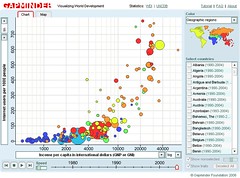
Imagine the possibilities of all this in, say, classroom presentations. Jim links to a great presentation using this tool. (Although I disagree with the presenter’s conclusion at the end about the leveling of differences regarding Internet diffusion.)
I recommend checking out the tool on your own for maximum appreciation of its capabilities.
UPDATE: There is more! Conrad – Jim’s source on this – tells me that the tool on the Trendalyzer site has even more option. Moreover, you can download a beta version of the software that even lets you import your own data.