by Henry Farrell on December 17, 2008
Ari, over at _Edge of the American West_, comes across a site saying that the Wild Things were Jewish.
The original concept for the book featured horses instead of monsters. Sendak said he switched when he discovered that he could not draw horses. The Wild Things (except “Goat Boy”, of course) were named after (and are presumably caricatures of) Maurice’s aunts and uncles: Aaron, Bernard, Emil, Moishe and Tzippy.

Maybe this is common knowledge to lots of folks; I did know the story about the horses. But it reminds me that when I was reading _Where the Wild Things Are_ to my son two nights ago, I spotted that the moon in Max’s bedroom is three quarters full in the early illustrations, changes to a full moon when he begins his travels, and remains full when he returns to his bedroom, and (presumably) normality, linear time, and all that good stuff. Suggestions about what this is supposed to mean (and other _WTWTA_ trivia) welcome in comments.
by Kieran Healy on July 23, 2008
Via Jim Lindgren at Volokh, some article from the Rocky Mountain News about Al Gore’s recent call for the U.S. to be fully running on renewable energy within a decade. The piece itself is hackery (though it does deftly compare Gore to Chairman Mao) but contains the following gem:
Stanley Lewandowski, the general manager of the Intermountain Rural Electric Association, is one of the few utility officials willing to suggest that the prophet of global warming is strutting about like an emperor without his clothes. “Al Gore’s statement of obtaining 100 percent of our power from renewables in 10 years has as much a chance of happening as the sun shining 24 hours a day,” Lewandowski quipped. “It’s nonsense.”
Excellent.
by John Q on July 3, 2008
For a long time, I’ve used the term “delusionist” rather than “sceptic” to describe those who reject mainstream science on global warming. In general, the term “sceptic” is inappropriate for members of this group, since their position is hardly ever based on a willingness to look sceptically at evidence without reliance on a preconceived views. Rather the dominant characteristic is wishful thinking based on perceived political implications. The gullibility with which so many delusionists parrot the latest talking points (“Hockey stick broken!”, “Global warming on Mars”, Warming stopped in 1998″ and so on) is clearly incompatible with any kind of scepticism.
Given the volume of evidence that has accumulated on the issue, only an adherent of some very strong form of scepticism could reasonably remain undecided. Such a sceptic has now appeared in the form of Adam Shand, an Australian program on global warming “it’s only an assumption” that summer is warmer than winter. I imagine he gets great prices on ski holidays, by going in January.*
Of course, once you’ve gone this far in scepticism, why not go the whole hog? Radical scepticism provides the perfect argument for rejecting action to mitigate global warming – if we have no reason to believe in the existence of the external world, then trashing it can’t be a problem, can it?
* Northern hemisphere readers can make the necessary adjustments.
by Kieran Healy on May 29, 2008
In a classic discussion of scientists sampling the ground in the Amazon rainforest, Bruno Latour details the process through which physical bits of soil are turned into recorded measurements and data points for comparison and analysis. He remarks,
Stage by stage, we lost locality, particularity, materiality, multiplicity, and continuity, such that, in the end, there was scarcely anything left but a few leaves of paper. … But at each stage we have not only reduced, we have also gained or regained, since, with the same work of representation, we have been able to obtain much greater compatibility, standardization, text, calculation, circulation, and relative universality, such that by the end, inside the field report, we hold not only all of Boa Vista (to which we can return), but also the explanation of its dynamic.
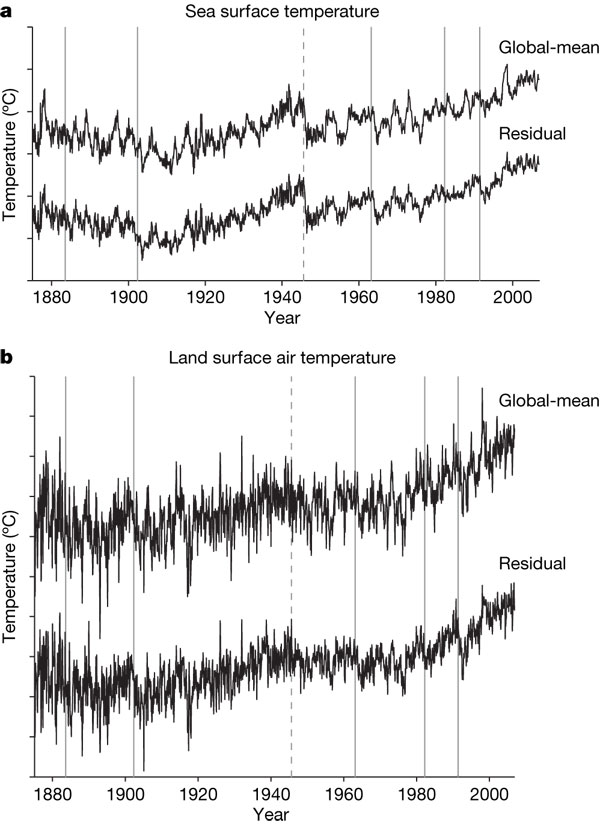
Now, via Andrew Gelman, a fascinating story from Quirin Schiermeier at Nature about the social production of data.
[click to continue…]
by Chris Bertram on April 5, 2008
Jeremy Waldron has a great piece in the latest LRB reviewing a recent book by Cass Sunstein. He has a nice discussion of the Cheney doctrine that even a one-percent probability of a catastrophic event should be treated as a certainty for policy purposes, where the class of catastrophic events is limited to those with a military, security or terrorist dimension. Reasoning like this interacts neatly with “ticking-bomb” scenarios: now a 1 per cent chance that the there’s a ticking bomb the terrorist knows about is sufficient in to justify waterboarding or worse. Of course other potentially catastrophic developments — such as climate change — haven’t generated a “treat as if certain” policy response from the US government, even thought even the most determined denialists must evaluate the probability that anthropogenic global warming is happening at greater than one in a hundred.
Waldron is also pretty acid about Sunstein’s treatment of global warming and distributive justice, noting some of the shortcomings of the idea that poor people’s lives should be valued according to what they’re prepared to pay to avoid the risk of death. But read the whole thing, as they say.
by Kieran Healy on July 23, 2007

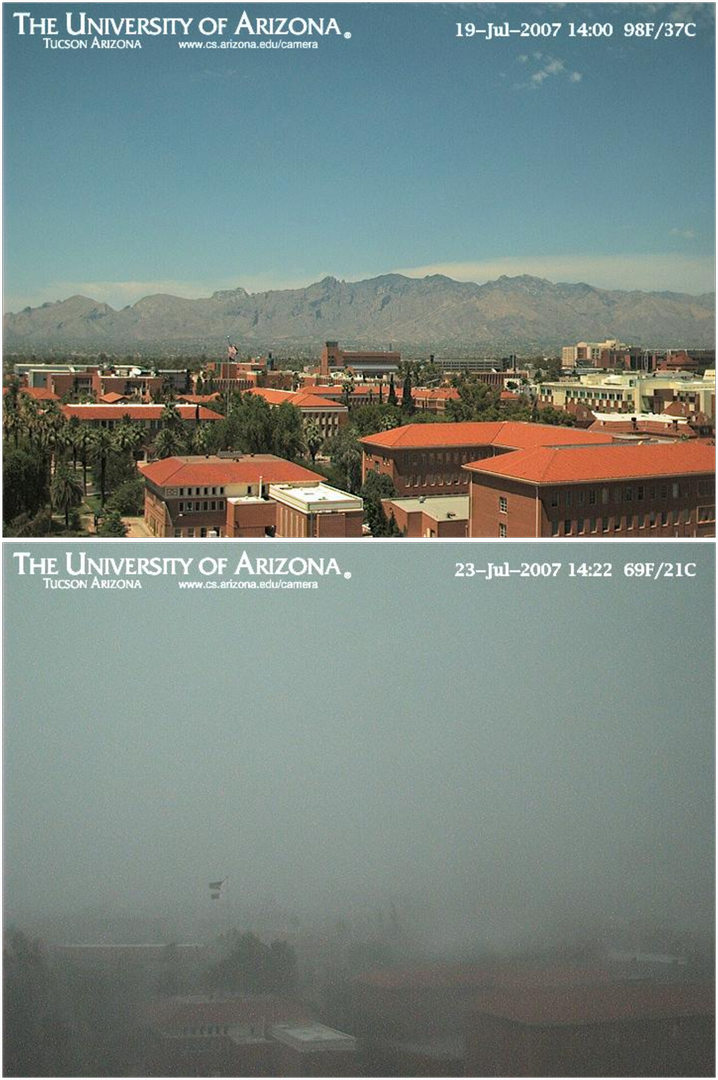
Top: View of the University of Arizona and the Santa Catalina mountains, summer day. (My office is on the top floor of the building in the lower right foreground.) Bottom: View of the University of Arizona and the Santa Catalina mountains, summer monsoon. It’s just finishing up now.
by Chris Bertram on March 15, 2007
UK viewers were treated the other night to a superficially impressive global-warming denialist documentary: The Great Global Warming Swindle . The programme was the work of Martin Durkin who has previous form for dodgy science documentaries. Medialens has a reasonably comprehensive account of the film’s reception and also gives an idea of the contents. See also George Monbiot in the Guardian and Steve Connor in the Independent. Central to the film was the testimony of the MIT oceanographer Carl Wunsch. Wunsch’s own account of how his material was edited and presented so as to give a misleading account of his actual views is here .