The term “globalization” came into widespread use in the 1990s, about the same time as Fukuyama’s End of History. As that timing suggests, globalization was presented as an unstoppable force, which would break down borders of all kinds allowing goods, ideas, people and especially capital to move freely around the world. The main focus was on financial markets, and the assumption was that only market liberal institutions would survive.
The first explicit reaction against globalization to gain popular attention in the developed world[1] was the Battle of Seattle in 1999, but the process, and the neoliberal ideology on which it rested, didn’t face any serious challenge until the Global Financial Crisis of 2008. The Crisis destroyed Neoliberalism as a political project with positive appeal, but its institutions have remained in place through inertia.
Now, however, globalization is finally facing serious threats, most immediately from the nationalist[2] right, seeking to restrict movement of people and goods across national borders. There hasn’t yet been any serious challenge to financial globalization, but faith in the wisdom and beneficence of financial markets has disappeared.
An obvious question here is: can globalization be reversed? My short answer is: within current political limits globalization can be reversed least partially in the case of trade, but can only be slowed in the case of movements of people. I’m still thinking about financial flows.
Daron Acemoglu has a piece at Project Syndicate arguing that basic income is a bad policy. His argument, in a nutshell, is that a truly universal basic income (UBI) would be prohibitively expensive, and that raising additional taxes to pay it “would impose massive distortionary costs on the economy”. The alternative, to cut all existing social programs for the sake of UBI, would be “a terrible idea”, since these programs are targeting those that are particularly vulnerable or needy. He argues that the political effects of a UBI would be bad – a UBI would “keep people at home, distracted, and otherwise pacified”, whereas “we need to rejuvenate democratic politics, boost civic involvement, and seek collective solutions”. For Acemoglu, the top priorities in the USA should be “universal health care, more generous unemployment benefits, better-designed retraining programs, and an expanded earned income tax credit (EITC)”, as well as higher minimum wages.
I share Acemoglu’s view that “One should always be wary of simple solutions to complex problems, and universal basic income is no exception.” In a paper I wrote last year (alas, in Dutch, and I haven’t had the time to translate it, but perhaps google translate can help us a little), I’ve argued that the debate on universal basic income is confused and confusing, and will not be getting us far, because too many papers/interventions are not clear about their assumptions, are not spelling out the goals (e.g. is the primary aim poverty reduction or creating freedom from the need to submit to the labour market for survival or something else), and are not giving the details of the package deal. [click to continue…]
Two hundred years after the birth of Karl Marx and fifty years after the last Western upsurge of revolutionary ferment in 1968, the term “monopoly capitalism” might seem like a relic of outmoded enthusiasms. But economists are increasingly coming to the view that monopolies, and associated market failures, have never been a bigger problem.
and the conclusion
The problems of monopoly and inequality may seem so large as to defy any response. But we faced similar problems when capitalism first emerged, and Western countries came up with the responses that created the broad-based prosperity of the mid twentieth century. The internet, in particular, has the potential to enhance freedom and equality rather than facilitate corporate exploitation. The missing ingredient, so far, has been the political will.
The central idea of Modern Monetary Theory (MMT), as I understand it, is that, rather than worrying about budget balances, governments and monetary authority should set taxation levels, for a given level of public expenditure, so that the amount of money issued is consistent with low and stable inflation. In this context, the value of the net increase in money issue is referred to as seigniorage. To the extent that seigniorage is consistent with stable inflation, it is achieved by mobilising previously unemployed resources.
A crucial question is: what is the scope for seigniorage? In particular (expressing things in MMT terms), is the scope for seigniorage sufficient to permit the introduction of ambitious programs like a Green New Deal without the need for higher taxes to prevent inflation.
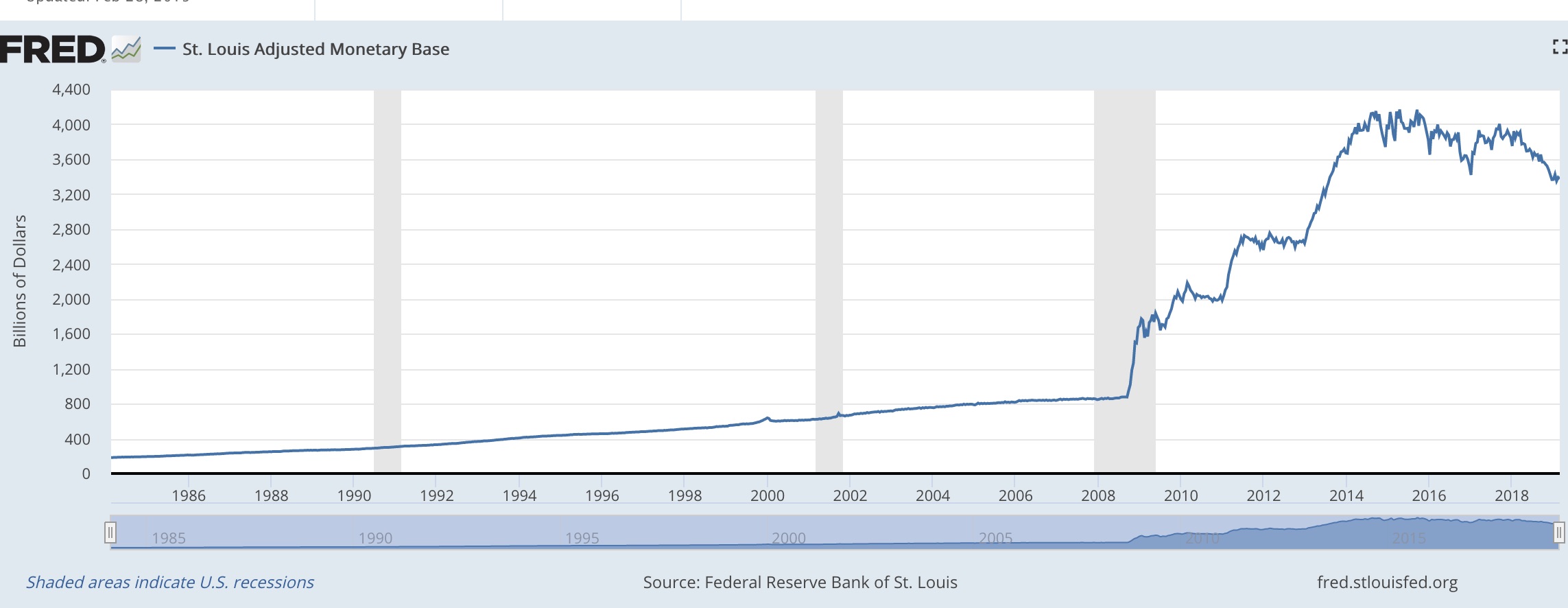
The recent episode of Quantitative Expansion in the US provides some evidence here. Contrary to the dire predictions of some critics, QE did not lead to runaway inflation. This is consistent with the view, shared by MMT advocates and mainstream Keynesians, that, in the context of a liquidity trap and zero interest rates, there is substantial scope for monetary expansion.
How much is “substantial”?
According to the St Louis Fed,
the monetary base grew from around $800 billion to just over $4
trillion between 2008 and 2016. That’s an increase of $3.2 trillion,
which is a lot of money. Expressed in terms of GDP, though, it doesn’t
seem quite as large. Over eight years, $3.2 trillion is $400 billion a
year or around 2 per cent of US GDP ($20 trillion).
It’s been quite a big week in cryptocurrency markets. The price of Bitcoin has fallen close to $4000, down from a peak of nearly $20 000.
As a longstanding sceptic of cryptocurrencies, it might be thought that I would be taking a victory lap. After all, I have previously written that “Bitcoins will attain their true value of zero sooner or later, but it is impossible to say when.” With the Bitcoin price having fallen by 75 per cent, it might seem that my prediction is well on the way to being justified.
Unfortunately, the second part of my statement, about the impossibility of predicting timing has been proved definitively correct.. I wrote this in 2013 when Bitcoins were valued at around $100, and the total market capitalization was a mere billion dollars. A single wealthy individual could have driven the price to zero by short-selling.
Five years later, and despite the price collapse of the past few months, Bitcoins are selling at nearly 50 times the price I criticized as excessive. Moreover, as cryptocurrencies have proliferated, Bitcoin now constitutes only a fraction of the total market. The capitalization of the cryptocurrency market as a whole is fluctuating still close to $100 billion.
Yet this massive valuation is built on nothing. The idea that Bitcoin, or any of its competitors will provide a new and superior means for buying and selling goods and services has been tested to destruction. Nearly a decade after the currency was launched, the use of Bitcoin in purchases is modest, and rapidly declining.
It’s obvious enough by now that support for Trumpism in the US and elsewhere is motivated primarily by racial and cultural animus, and not (or at least not in any direct way) by economic concerns. Still, to the extent that Trumpism has any economic policy content it’s the idea that a package of immigration restrictions and corporate tax cuts[1] will make workers better off by reducing competition from migrants and increasing labor demand from corporations. The second part of this claim has been pretty thoroughly demolished, so I want to look mainly at the first. However, as we will see, the corporate tax cuts remain central to the argument.
A quick rule of thumb is that when someone seems to be acting like a jerk, an economist will defend the behavior as being the essence of morality, but when someone seems to be doing something nice, an economist will raise the bar and argue that he’s not being nice at all.
I’ve spotted two instances already on Twitter since seeing this post this morning. See how many you can find!
I’ve been arguing for a while that a Guarantee Minimum Income (or Universal Basic Income) ought to be combined with a Jobs Guarantee to would make paid work a genuine choice for everyone. To spell this out, the GMI/UBI would make it possible to live decently without paid work, while a Jobs Guarantee would ensure that paid work was available to everyone. As a medium term policy, the best form of GMI would, I think, be the participation income advocated by the late Tony Atkinson. That is, a payment conditional on some form of social contribution, including voluntary work, study and childcare. Support for such a policy entails a direct confrontation with the punitive attitudes behind policies like Work for the Dole, while still maintaining the widely-held principle of reciprocity.
I was going to write more about this, but I just received an article by Felix FitzRoy and Jim Jin, in the Journal of Poverty and Social Justice which presents the argument very well. So, I’ll just recommend that to anyone interested in the issue.
Conservative reform of the Republican party is a project that has already failed. The only question is whether the remaining participants will choose hackery or heresy.
Overwhelmingly, the choice has been hackery (or, a little more honorably, silence).
The case for hackery is put most clearly by Henry Olsen. Starting from the evident fact that most Republican voters are white nationalists who don’t care about small government, Olsen considers the options available to small government conservatives. He rapidly dismisses the ideas of challenging Trump or forming a third party, and concludes that the only option is to capitulate. Strikingly, the option of withdrawing from party politics, and arguing for small government positions as an independent critic isn’t even considered.
As Paul Krugman has observed recently, conservative economists (at least, those who comment publicly). are a striking example for the choice of hackery over heresy. Krugman, along with Brad DeLong, has been particularly critical of a group of economists (Robert Barro, Michael Boskin, John Cogan, Douglas Holtz-Eakin, Glenn Hubbard, Lawrence Lindsey, Harvey Rosen, George Shultz and John. Taylor) who’ve made dishonest arguments in favor of corporate tax cuts.
Recently, an overlapping group (Boskin, John Cochrane, Cogan, Shultz and Taylor) have taken the hackery a significant step further.
My latest Guardian article is headlined https://www.theguardian.com/commentisfree/2018/jan/29/privatisation-is-deeply-unpopular-with-voters-heres-how-to-end-it. The core of the argument is that, to make a success of renationalisation, we need to do more than buy back privatised enterprises, and run them as publicly owned corporations. We need a different model. A starting point would be the statutory authority model used in Australia with great success, before the Hawke-Keating government adopted the corporatised model as a step towards privatisation.
That’s the title of my latest piece in Inside Story. Nothing that will surprise anyone who’s been paying attention to what I’ve written on this, so I’ll just cite the conclusion
Since bitcoins are not useful as a medium of exchange, or desirable in themselves, their true value is zero. The highest price at which bitcoins have traded is around $20,000. At the time of writing, the market price is halfway between that level and zero. Pay your money (or not) and take your chances.
International Studies Quarterly has just published a symposium responding to a paper by Henry and me, which has been released from behind the paywall for the occasion. Our paper has the fairly self-explanatory title “Consensus, Dissensus, and Economic Ideas: Economic Crisis and the Rise and Fall of Keynesianism ” In our paper we looked at the resurgence of fiscal Keynesianism in the immediate aftermath of the Global Financial Crisis and of the successful counterthrust leading to the adoption of austerity policies in the US and Europe.
The symposium has comments from a multidisciplinary group of political scientists, sociologists and economists: Abraham Newman, Andrew Baker, Elizabeth Popp Berman, Paul Krugman, Stephen K. Nelson along with a response from us. It’s great to get these different disciplinary perspectives all in one place, since they all have key pieces of the puzzle, and we are very happy they have chosen to engage with us.
I’ve written here before about the research I’ve been developing on ‘limitarianism’ – the view that we put upper limits or caps on how much of some valuable resource people can have or use. One thing that struck me when giving talks about limitarianism of financial resources/wealth, is that there’s always someone in the audience shouting: “Give me a number!” If the claim is that there should be an upper limit to how much income and wealth someone can have, people want to know what those limits are. Also, I’ve noted that whether or not someone finds the financial limitarian view plausible depends, among other things, on where exactly that ceiling would be put.
One question one could ask, is whether within a political community, there is something of a shared view (or dominant view), of where that ceiling should be (assuming people hold that there should be such a ceiling in the first place, obviously). So I decided to team up with a colleague from economic sociology who has ample experience with conducting surveys, and try to measure, among the Dutch population, whether they hold the view that there should be an upper limit to wealth, and if so, where they would put the cut-off line between ‘rich’ and ‘extremely rich’. Is there a level of material affluence at which we find that people are having not just a lot, but too much? [click to continue…]
I’m working with Troy Henderson from the University of Sydney on a book chapter looking at union responses to the idea of a universal basic income (UBI),which have covered a range from supportive to strongly hostile, with the latter view predominant in Australia. Here’s a draft of my section of the chapter. Comments much appreciated.
With the huge upsurge in the price of Bitcoin recently, I’ve been getting a lot of demand for articles putting forward my point of view: Shorter JQ: It’s an environmentally destructive Ponzi scheme that isn’t usable as a currency even for believers.
Meanwhile, I had another piece in the Guardian, this time looking at the fact that, despite being called a “cryptocurrency”, Bitcoin is used even less as a currency now than it was several years ago. The core problem is that the system is so overloaded by miners creating new coins that processing transactions is slow, costly or both I mentioned the fact that game company Steam had stopped accepting coins and that the list of merchants accepting Bitcoin is small enough to fit on one page. Checking further I concluded that this list is out of date, but not in a good way. Lots of those included, such as Expedia, no longer accept Bitcoin, if indeed they ever did. Here’s one person’s experience. Bitcoin is now a “crypto asset” which is even more obviously a Ponzi fantasy than the original currency story.
One response I got was that transaction speed would soon be greatly improved by something called Lightning. Checking on this it appears that this is software in an alpha (very early) stage of development, which would allow any two parties to set up a transactions account separate from the main Bitcoin blockchain, and only occasionally update the main account. An analogy, for readers of a certain age, is the era before Bankcard, when, if you wanted to do something other than paying cash, you maintained a separate credit and debit account with every store you dealt with. This does not seem like the dawn of a new era to me.