There’s been a fair amount of “debate”:http://www.google.com/search?q=manzi+european+economic+model&ie=utf-8&oe=utf-8&aq=t&rls=org.mozilla:en-US:official&client=firefox-a around “Jim Manzi’s recent piece”:http://nationalaffairs.com/publications/detail/keeping-americas-edge on the differences between Europe and the US. I contributed a bit myself in the Bloggingheads with Dan Drezner linked above (with discussion of Iceland, Stephen Cohen and Brad DeLong’s recent book, and other stuff too). In this wrap-up reply to his critics, Manzi maintains that some of the criticisms that have been made by e.g. Paul Krugman are flat out wrong (Paul seems to have misattributed the data series that he was using), while saying that he was not in fact setting out to prove empirically that European style welfare redistribution systems limit innovation and growth (if I understand him correctly, he still believes this to be true, but doesn’t claim that the figures he adduces show it). As he notes, he is actively advocating that the US turn to redistribution – but is also claiming that there are trade-offs involved. I should also note that I’ve met him a few times, and always found him to be a straightforward, decent and, fwiw, mildly Europhilic guy (with whom I disagree, obviously, on multitudes of things). But as per my original Bloggingheads, I am dissatisfied with one of the most basic claims of the argument – that there is a distinct “European model,” followed by all states within Europe, which can readily be distinguished from the American approach. This is a claim that you sometimes see on “both left and right”:https://crookedtimber.org/2007/10/08/alesina-and-giavazzi-have-a-point/#more-6279 – but it is one that I think is very wrong indeed.
[click to continue…]
From the category archives:
European Politics
Iceland has a population of about 300,000 , about 140,000 taxpayers and pre-crisis GDP of about $12bn. The Royal Bank of Scotland has about 140,000 employees and pre-crisis net profit of about £8.5bn – they’re about the same size as entities. Iceland, like RBS, did very well out of the debt bubble and picked up assets all over the world in an impressive but ultimately unsustainable spending spree. And in a final point of similarity, Iceland, like RBS, owes the British government a hell of a lot of money as a result of the bursting of the bubble.
[click to continue…]
As “Clive Davis”:http://www.clivedavisconfab.com/2010/01/how-some-people-see-europe/ notes, “Charles Murray”:http://blog.american.com/?p=8616 “is disconcerted by the number of black and brown faces he sees around him” during three days that he recently spent stranded in Paris.
I collected data as I walked along, counting people who looked like native French (which probably added in a few Brits and other Europeans) versus everyone else. I can’t vouch for the representativeness of the sample, but at about eight o’clock last night in the St. Denis area of Paris, it worked out to about 50-50, with the non-native French half consisting, in order of proportion, of African blacks, Middle-Eastern types, and East Asians. And on December 22, I don’t think a lot of them were tourists. Mark Steyn and Christopher Caldwell have already explained this to the rest of the world—Europe as we have known it is about to disappear—but it was still a shock to see how rapid the change has been in just the last half-dozen years.
The term “looked like native French” is an interesting euphemism, given that a quite substantial percentage (and, I suspect, a large majority) of the people whom Murray worried about during his peregrinations were citizens of France. I rather think that the word that Murray was looking for here is “white.” Meanwhile, Clive also links to this “very good Foreign Policy article”:http://www.foreignpolicy.com/articles/2010/01/04/eurabian_follies?print=yes&hidecomments=yes&page=full on the whole disgraceful Eurabia genre. Strongly recommended.
Brian Lenihan (Ireland’s finance minister) puts the best face he can on the external limits constraining Ireland’s economic decision making in his “budget speech today:”:http://www.budget.gov.ie/Budgets/2010/FinancialStatement.aspx
In the recent Lisbon referendum the Irish people reaffirmed our place at the heart of Europe. This was the right decision for our economy, for our future and for our children. The single currency has provided huge protection and support to Ireland in the current crisis. It has prevented speculative attacks on our currency and provided funding to the banking system. But, membership of monetary union also means devaluation is not an option. Therefore the adjustment process must be made by way of reductions in wages, prices, profits and rents.
As a small open economy, Ireland would probably have devalued to help cushion the shock, if it had not been an EMU member with no effective control over its currency. Given EMU membership, devaluation (and exit from the system) would probably have been a “very bad idea”:http://www.independent.ie/business/irish/currency-devaluation-may-look-an-easy-option-but-its-a-trick-on-workers-1653712.html. Ireland is hoping to make the best of a bad job, adding levies, increasing taxes and making swingeing cuts to public sector pay so as to shore up its fiscal position.
The problem is that all the fiscal rectitude in the world cannot protect you from “contagious crises of confidence”:http://www.irisheconomy.ie/index.php/2009/12/08/who-blinks-first-ireland-greece-the-ecb-and-the-bank-guarantee/.
One of the “signals” that could instigate a sudden stop in Ireland is a sudden stop somewhere else, particularly somewhere with regional or trade connections. This is why bad news for Greece is bad news for Ireland. If Greece hits a sudden stop, Ireland will wobble, and will be the next in line for a sudden stop in Europe. There is another simultaneous game being played: the ECB and its bailout policies playing a reputation game against member sovereign governments and their fiscal discipline. Again, the Greek situation is bad for Ireland. … Ireland has done everything (so far) that the ECB could reasonably ask of her to impose fiscal discipline and restore competitiveness. If it were only Ireland at risk of a sudden stop, the ECB could be very accommodating about bailout assistance. The ECB would not let a well-behaved minnow like Ireland cause market turmoil. If a sudden stop was brewing and Irish bond yields rocketed up, the ECB could easily mop up any excess of Irish sovereign bonds, killing the run, and later tell some convenient story about why this did not violate EMU no-bailout guidelines. On the other hand, we now know that the Greek government has deliberately and substantially falsified its national accounts over recent years. … no political will to impose any meaningful discipline on tax and spending … adherence to the Growth and Stability Pact is a charade. If the ECB bails out Greece, all semblance of future fiscal discipline throughout the Euro zone is lost. … How can the ECB bail out Ireland if it refuses to bail out Greece?
Greek government bonds “tumbled”:http://www.ft.com/cms/s/0/7e219354-e48b-11de-96a2-00144feab49a.html today. It may very possibly be that Ireland is in the worst of both worlds – suffering the unmitigated agonies of fiscal rectitude imposed by the EMU’s straitjacket, but with at best highly uncertain prospects of support in the event of a new crisis of confidence. Brian Lenihan won’t be sleeping well the next couple of weeks.
 I hadn’t been following the story of Switzerland’s efforts to ban the construction of minarets. Switzerland has about 400,000 muslims and — though there are many mosques — precisely four minarets. The referendum succeeded by a comfortable majority. As you can see from the poster, the rights of women under Islam were pointed to as a reason to support the ban. The Guardian reports that the pro-ban SPP
said that going to the European court would breach the popular sovereignty that underpins the Swiss democratic model and tradition … It dismissed the arguments about freedom or religion, asserting that minarets were not a religious but a political symbol, and the thin end of a wedge that would bring sharia law to the country, with forced marriages, “honour” killings, female genital mutilation and oppression of women … The prohibition also found substantial support on the left and among secularists worried about the status of women in Islamic cultures. Prominent feminists attacked minarets as male power symbols, deplored the oppression of Muslim women, and urged a vote for the ban.
The Times reports that there’s some evidence that more women were in favor of the ban than men, too. One can only suppose that, having waited until 1971 to give women the vote in Federal elections, and in some parts of the country until 1990 in Cantonal elections, the Swiss are now making up for lost time making good on their commitment to feminism.
So as “Ingrid notes”:https://crookedtimber.org/2009/11/19/whether-or-not-it-is-good-for-europe-it-is-very-bad-for-belgium/, EU member states have chosen Von Rompuy as the new President of the European Council. To use the terms that Euro-politicians have themselves been using (which were nicked, presumably by Brian Cowen, from the title of a political science text on Irish Taoisigh), they have decided to go for a chairman – someone with a low international profile who is good at conciliating warring factions – rather than a chief. I have no doubt that Von Rompuy will do very good work, but he surely will not be a colossus bestriding the world stage, banging the heads of Sarkozy, Merkel and Brown together to force them to agree common European policy and so on. This means, I think, that the interesting stuff will be happening at the level of the foreign policy representative, Baroness Ashton. This too is unlikely to be a high profile post in the short term – but unlike Von Rompuy, Ashton will have a very substantial set of bureaucratic resources to draw upon, with links both to the Council and Commission, as well as her own European External Action Service, which will have an independent budget line. This could add up to something pretty interesting in a few years time. (Update: via Matt Y. “Annie Lowrey”:http://blog.foreignpolicy.com/posts/2009/11/19/eu_spots_close_to_filled makes more or less the same point).
Turning to _real_ European politics, “the”:http://www.irishtimes.com/newspaper/breaking/2009/1120/breaking16.htm “crisis”:http://www.irishtimes.com/newspaper/breaking/2009/1120/breaking66.htm “continues”:http://www.irishtimes.com/sports/soccer/2009/1120/1224259191991.html but looks set to come to no good outcome. FIFA shows no interest in scheduling a rematch, despite Thierry Henry’s statement that a rematch would be the fairest option. Those involved seem determined to do a _reductio ad absurdum_ on Richard Posner’s “arguments about responsibility”:https://crookedtimber.org/2009/11/19/risk-pollution-market-failure-social-justice/. French footballers (and – judging from Trappatoni’s discreet circumlocutions – perhaps Irish footballers too) clearly feel that it is their obligation to push the rules as far as they can go and further – and if the referee doesn’t spot the odd match-and-qualifying-round-determining handball here or there; well, the culprit has no obligation to seek anything but his own advantage, and anyway, it all balances out in the end, doesn’t it? “Incompetent”:http://www.irishtimes.com/sports/soccer/2009/1120/1224259204440.html “regulators”:http://www.guardian.co.uk/football/2009/nov/19/thierry-henry-fifa-rematch-ireland-france shrug their shoulders and refuse to take any responsibility for the mess. And Irish and French politicians deplore the outcome – but declare themselves powerless to do anything about it. Whether this spells out a possible case for world government to prevent such atrocities occurring in the future, I leave to the theorists. However, I don’t think anyone can deny that the end result is manifestly contrary to even the most minimal principles of justice, fairness and efficiency, completely exploding Posner’s arguments in the eyes of all fairminded individuals.
So the news is spreading that the Belgian PM, Herman Van Rompuy, would be the first president of the EU. I am not going to comment on what that means for the EU now. It’s after nine in the evening here, and I’m preparing my teaching for tomorrow morning (and for reasons I need not disclose in this post, I need my time to prepare).
But despite time shortage, one thing I am happy to throw in cyberspace is a prediction that this will not be good for Belgium. Not a very hard-to-make prediction indeed. In the last years I’ve blogged here, once in a while, on the political instability of Belgian politics, indeed perhaps even the instability of the very future of Belgium; and Van Rompuy seemed to have been the only one able to bring calm back, and at least lead a more-or-less functioning government. His professional skills and talents in making compromises in extremely difficult situations will certainly be very useful in Babylonian Europe; but who will rescue Belgium? How long will it take for the Belgian government to have a new PM, and is there anyone to be found with the same authority that Van Rompuy has been able to command? Tonight Belgium will celebrate that this little country has been able to achieve something powerful, but tomorrow it will wake up with headackes…
I wrote a couple of “blog”:https://crookedtimber.org/2008/06/24/annals-of-stupid-lawmaking/ “posts”:https://crookedtimber.org/2008/06/30/taking-the-mickey/ last year on the Mickey Tax, or, as its promoters would prefer to describe it, the ‘Travel Promotion Act’ bill, which would seek to ‘promote’ travel to the US by imposing a fee on anyone entering the country which would in turn be handed over (after costs were deducted) to an advertising slush-fund. Now the “FT is reporting”:http://www.ft.com/cms/s/0/1fa32e7e-ce05-11de-95e7-00144feabdc0.html that the European Union is threatening to retaliate against it by imposing visas on US visitors.
bq. US plans to levy fees on European Union tourists and business travellers visiting the US have come under fire in Brussels and could prompt the EU to enact its own visa-like system for US travellers, according to diplomats. … In the past, most Europeans visiting the US for less than 90 days have not had to make pre-departure arrangements. The same applies to US visitors to the EU under visa-reciprocity guidelines. “If this tax is indeed introduced, the Commission will have to re-evaluate once again whether it is tantamount to a visa,” said a spokesman for Jacques Barrot, the commissioner for justice and home affairs, on Tuesday.
If the EU carries through on this threat, American tourists to Europe who have to pay visa fees, wait in queues at overworked consulates etc, should know who is responsible – the “Walt Disney Corporation of America”:http://www.washingtonpost.com/wp-dyn/content/article/2008/02/13/AR2008021302837_pf.html.
bq. JAY RASULO STOOD IN FRONT OF TWO MASSIVE SCREENS, each projecting his balding visage, and did what he loves to do: sell a big idea. The dapper, diminutive chairman of Walt Disney Parks and Resorts implored 500 tourist industry executives to ask the federal government for an expensive favor. … Executives from tourism giants such as Marriott, American Express and Hertz buzzed with excitement — and skepticism. Getting taxpayers to underwrite overseas commercials had been the travel industry’s Holy Grail for decades. But the idea had never gotten very far in the councils of government. … A big lobbying push was needed for a big Ask — the term lobbyists use to describe what they are pleading for from Congress.
It’s an interesting story. When it became clear that the travel industry was unlikely to get US taxpayers to pay for a $200 million travel promotion campaign, lobbyists started looking for alternative ways of raising money – and the most obvious was to top up the industry’s own efforts with the Mickey Tax. Hence the bill, and hence the possible retaliatory measures from Europe. All thanks to Jay Rasulo and his balding visage.
I watched Paolo Sorrentino’s quite extraordinary film Il Divo last night. It is remarkable in so many ways, but especially, as a portrait of evil in the form for Giulo Andreotti (as depicted by Toni Servillo) and also, in terms of the most marvelous cinematography. In a recent post I attracted hostility from some by doubting the West’s commitment to individual rights. No doubt I overgeneralized a little, but post-war Italy would be a part of any case for the prosecution. Andreotti as portrayed in the film, is prepared to go to almost any lengths, to inflict evil in pursuit of what he takes to be the good, to deal with the Mafia, to sacrifice his colleagues (I’d say his friends, but it isn’t clear that he had any). I wonder if it isn’t possible that Italy between some date in the 1970s and the fall of the Berlin Wall, wasn’t the European state where a person was most likely to be the victim of political murder? (Actually, I’m guessing that Romania might take that prize.) Not to be missed.
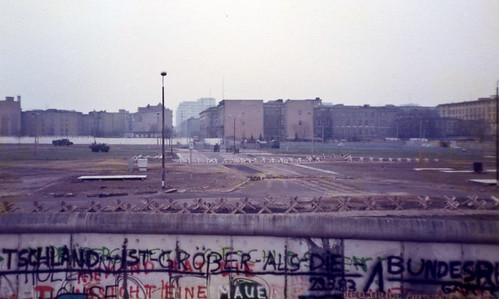
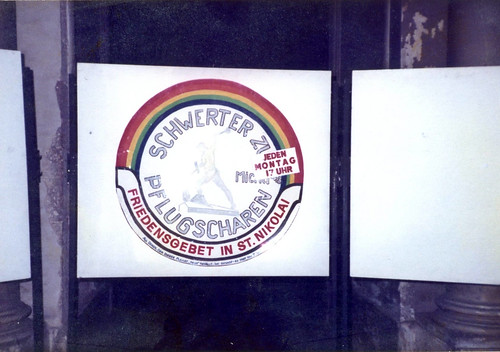
Two photos today. My partner, Pauline Powell and I visited East Germany and West Berlin in 1984. The first picture is a shot of the Berlin Wall from the western side, and seems appropriate as tomorrow is the 20th anniversary of its fall. The second shot, taken inside the Nikolaikirche in Leipzig, announces one of the prayers for peace meetings that helped to build the popular movement that would eventually contribute to the fall of the regime. (Some details of this are on the St. Nikolai Church website.)Both pictures are Pauline’s, not mine (all rights reserved etc). We believe the swords into ploughshares picture is unique on the web, though perhaps others exist as prints. As such, it is something of a historic document.
Just after Mary Robinson announced that she was not interested in the EU Presidency, former Irish Taoiseach and outgoing EU ambassador to Washington “John Bruton has put his hat in the ring”:http://www.irishtimes.com/newspaper/frontpage/2009/1029/1224257604883.html. I know him and like him enormously (he’s a very decent right winger), so I won’t speak to the merits of his candidacy on grounds of manifest personal bias. But if I was a betting man (and there were a contract at Intrade), I’d think him well worth a considerable flutter. He fulfils the informal desiderata (Christian Democrat from a small state), but even more importantly seems like a very plausible compromise candidate. The Germans are likely to veto Blair, while the UK is almost certain to want to veto overly enthusiastic federalists like Jean-Claude “‘I am not a dwarf'”:http://www.google.com/url?sa=t&source=web&oi=news_result&ct=res&cd=2&ved=0CAwQqQIwAQ&url=http%3A%2F%2Fwww.ft.com%2Fcms%2Fs%2F55d05d12-c362-11de-8eca-00144feab49a.html&ei=ifnoSuC5L8HElAeg1YjBDQ&usg=AFQjCNHvNraUGoaaoyb7mPQ920MIXSVYmg Juncker and Guy Verhofstadt. Bruton is plausibly acceptable to both sides – he is pro-European enough to keep the mainlanders happy, but very well liked in the UK. At the moment, I’m not seeing any other declared candidate who could plausibly get a consensus behind him or her. I’ll try to write more on the candidates as the politicking continues …
The _Financial Times_ has an “excellent article”:http://www.ft.com/cms/s/0/0abb8eca-b45b-11de-bec8-00144feab49a.html summarizing the institutional issues facing the EU if, as expected, Lisbon passes. Read it for the substance. But enjoy it for this suggestion, which I haven’t seen floated before:
However, as became clear this week, many smaller EU member states do not want a high-profile president. Belgium, Luxembourg and the Netherlands circulated a document contending that the first president should be “someone who has demonstrated his commitment to the European project and has developed a global vision of the Union’s policies, who listens to the member states and the institutions, and who is sensitive to the institutional balance that corresponds to the Community method”. Translated from Eurospeak, this means a person with a lower profile than Mr Blair and from a country more deeply committed than the UK to the European ideal. Across Europe there is a recognition that the EU would do its image a favour if it awarded the job to a woman, one possibility being Mary Robinson, Ireland’s former head of state.
Depending on how Vaclav Klaus’s “brinkmanship”:http://www.ft.com/cms/s/0/f5193342-b4eb-11de-8b17-00144feab49a.html plays out, the new president will have to be chosen pretty soon. It would be very, _very_ sad to see wingnuts’ heads exploding again in just a few weeks time …
So the polls are open in Ireland for the Lisbon Treaty Mulligan referendum. Early reports suggest that “more people are voting than the last time”:http://www.irishtimes.com/newspaper/breaking/2009/1002/breaking1.htm in Dublin, but that turnout elsewhere in the country is very low. I’m predicting a win by somewhere in the 6%-8% range (more predicated on ‘No’ voters being discouraged and not voting, than on any great sense of positive enthusiasm for the referendum). Also worth noting in passing that Wolfgang Munchau “who suggested last year”:https://crookedtimber.org/2008/07/02/kicking-the-irish-out/ that the Irish could (and perhaps should) be kicked out of the EU for their impertinence in voting No the first time around now seems to “have gone quite cold”:http://www.ft.com/cms/s/0/9fb71816-a095-11de-b9ef-00144feabdc0.html?catid=131&SID=google on the Treaty himself. He fails to tell us whether major European member states are monitoring his shifting beliefs against the likelihood that they might soon have to pull out of the EU and reconstitute themselves in a new organization that would specifically exclude Wolfgang Munchau. Perhaps his column next week will reveal more – in the meantime, feel free to speculate about the vote, provide updated information, opinions etc in comments.
Update: Looks as though I seriously underestimated the swing – the Treaty passed by a 17% margin.
Speaking of how the world needs many more assertive humanists to counter the seemingly irresistible forces of wingnuts and indifference, Chris Patten’s name is in the ring for Europe’s first proper foreign minister. The FT reports that Lord Patten is ‘not campaigning for the job, but would be very positive about it if approached’. Patten would do a superb job.
Patten’s thankless work on policing in Northern Ireland brought about a huge leap forward and must have required no small physical courage on his part. His stint as the last governor of Hong Kong got valuable concessions from the Chinese that someone more worried about their ego and reputation couldn’t have delivered. And Patten’s and Javier Solana’s outwardly amicable and respectful managing of their conflicting EU foreign policy roles in the early 2000’s is a credit to both. Patten is uniquely qualified to be the face (and the brains) of Europe’s foreign policy.
There are other good reasons, too. The FT points out David Cameron’s likely discomfort with a fellow Tory being in such a prominent EU role. Also, putting Patten in as Number 2 may make it all that much easier to refuse Tony Blair the top job. And Patten has proven he can actually do all the deal-making and consensus-building the job requires (even more reason why the member states should think of Patten for President of the union, not least to preserve their own sovereignty).
But here’s my reason. Sometimes the good guys should win. I want someone in the foreign policy job whose judgment, experience and, above all, integrity I respect. Someone who may disappoint in the particulars, but who is sound on the fundamentals. In both organizational and political life, I don’t want to believe that only the cynics and brown-nosers, the bullies and yes-men will come out on top. Patten is living proof that successful leaders can be deeply moral and highly effective. That’s something we can all aspire to.
And think about the book he would write afterward…
Full disclosure: I’ve met Lord Patten a few times at the 21st Century Trust, an organisation of which I’m a fellow and he is the Chair.
Judging by a review I read in the New York Times, there is some danger of Christopher Caldwell’s _Reflections on the Revolution in Europe_ being taken more seriously by some Americans than earlier examples of the Europe-about-to-become-Muslim genre. Matt Carr, writing for the Institute of Race Relations, “provides some detailed rebuttal”:http://www.irr.org.uk/2009/july/ha000011.html .