by Eszter Hargittai on November 3, 2006
by Eszter Hargittai on October 20, 2006
Earlier this year, Brad DeLong suggested that he should get rich and then give a large grant to me to do a study. I’m all for Brad getting rich and I happily await the day including the check he’ll send my way as a result. However, in the meantime, it’s good to know that there are some other sources of potential funding for work on information technologies.
Yesterday, the MacArthur Foundation announced a new initiative in Digital Media and Learning. They have committed $50 million dollars over five years to this. I was fortunate to be one of the recipients of a research grant. My project will be a look at young people’s uses of the Internet with particular focus on their skills and participation. I will also be conducting a training intervention (on participants randomly assigned to the control versus the experimental group) to see if we can create a program that helps people improve their online abilities (in such domains as efficiency in content navigation and evaluating the credibility of information).
Generally speaking, the goal of this initiative is to gain a better understanding of how young people are using digital media in their everyday lives and how various types of learning are taking place outside of the classroom through the use of such media. MacArthur has also launched a blog to discuss related projects.
The press conference was simulcast in Second Life and some participants captured a few screenshots, including ones from Teen Second Life.
As you can imagine, I’m super excited about all this and so will likely be blogging about related issues in the future (hah, not that I haven’t already).
by Kieran Healy on October 9, 2006
Just “listen to at least the first few minutes of this radio show”:http://www.wnyc.org/stream/ram?file=/radiolab/radiolab042106a.mp3 (“or via links here”:http://www.wnyc.org/shows/radiolab/episodes/2006/04/21), which begins with the work of “Diana Deutsch”:http://psy.ucsd.edu/~ddeutsch/, a psychologist who studies the psychology of music. The opening segment demonstrates a remarkable phenomenon, whereby a looped segment of ordinary speech appears — after a few repetitions — to become musical. Moreover, once you’ve perceived it as music, listening to the segment in context makes it sound like the speaker is in a Busby Berkeley musical and has just begun to segue into a solo number. The general musicality of speech is obvious, I suppose, especially when you listen to certain accents, or hear “uptalk”:http://itre.cis.upenn.edu/~myl/languagelog/archives/002967.html. But this is a very nice sort of case.
Via Clifford at “Cosmic Variance”:http://cosmicvariance.com/2006/10/09/music-and-language/
by Belle Waring on August 22, 2006
This post from the Freakonomics blog on why beautiful women sometimes marry unattractive men seems somewhat incomprehensible to me. Maybe you all can help:
…a new study by Satoshi Kanazawa, an evolutionary psychologist at the London School of Economics, suggests it may be a simple supply-and-demand issue: there are more beautiful women in the world than there are handsome men.
Why? Kanazawa argues it’s because good-looking parents are 36% more likely to have a baby daughter as their first child than a baby son—which suggests, evolutionarily speaking, that beauty is a trait more valuable for women than for men. The study was conducted with data from 3,000 Americans, derived from the National Longitudinal Study of Adolescent Health, and was published in The Journal of Theoretical Biology.
According to this news article, “Selection pressure means when parents have traits they can pass on that are better for boys than for girls, they are more likely to have boys. Such traits include large size, strength and aggression, which might help a man compete for mates. On the other hand, parents with heritable traits that are more advantageous to girls are more likely to have daughters.”
[click to continue…]
by Henry Farrell on August 21, 2006
Sean Carroll has a “post”:http://cosmicvariance.com/2006/08/21/dark-matter-exists/ at _Cosmic Variance_ on some fascinating cosmological observations which seem (Sean’s take is obviously rather more authoritative than mine) to demonstrate the existence of dark matter as comprehensively as one could reasonably hope for.
by Eszter Hargittai on August 17, 2006
First, Stephen Colbert commented on a funny Hungarian story the other day. The entire clip is worth watching, but if you want to jump straight to that segment then forward to 3.44 (or 3.37 if YouTube won’t let you do that). Love the way he pronounces the URL. *
Second, Mark Liberman of LanguageLog has decided to do a speech speed experiment on native Hungarian speakers as a follow-up to this matter (his observations here and here). If you are a native speaker of Hungarian, please send him a note and participate. The original peer-reviewed journal publication’s findings were based on just ten participants. Let’s see if he can get at least as many.
[*] Not as funny, but part of the real story is that the vote is only for recommendations that a committee will then consider when making the final decision.
by Eszter Hargittai on August 16, 2006
The NYTimes decided to report on the extent to which Hungarians are better than Americans at recalling store prices. Given that most blogging I do about Hungary seems to result in a discussion of the Hungarian language and given that the authors explain the findings based on language differences, I thought I’d take this opportunity to address the issue head on.
Let’s start with the findings:
Hungarians are far better than Americans at recalling long prices; on average, they can recall 19 to 24 syllables with decent accuracy, while Americans can recall only 13. The authors suggested that this was because Hungarians speak 41 percent faster, both out loud and when repeating sounds to themselves “subvocally.”
The NYTimes piece ends right there. That’s not fair, the author left out the most interesting part: how do we know how fast Hungarians speak in comparison to Americans?
[click to continue…]
by Eszter Hargittai on August 16, 2006
Behind the hustle and bustle of the book exhibit at the recent annual meetings of the American Sociological Association was an exhibit of various data sources. That area of the room is usually very quiet. As a break from everything else, I decided to take a little tour. The posters and flyers are actually quite informative despite being abandoned and looking somewhat pathetic from afar. It seems to me that this is an underappreciated part of the meetings and could be especially helpful for graduate students. Of course, it should hold value to many others as well.
In addition to data sources, there are pointers to various tools and also reports that may be of interest. Much of the material on these Web sites is presented in a way that it should be accessible and interesting to many non-specialists, too. The teaching potential of some of these sources is considerable as well.
Below the fold I list some of the resources I saw.
[click to continue…]
by Eszter Hargittai on August 8, 2006
I’m looking to outsource some work and could use some advice on:
1. what to call the work I need done
2. what service to use
3. what pitfalls to avoid
[click to continue…]
by Eszter Hargittai on July 3, 2006
An image of a man who is definitely not a college student (certainly not traditionally aged) accompanies an article called “Men Assume Sexual Interest When There May Be None” in a recent piece by a HealthDay reporter, a piece that’s been published on various Web sites. (In case of link rot, I’ve placed a screen shot here.)
In the sixth paragraph of the piece we find out that the study is based on 43 male and 43 female college students aged 18-22. That is the only part of the article where the participants are referred to as college students. Otherwise, the entire piece is about the behavior of men and women generally speaking.
There are several fields that base a good chunk of their empirical research on studies of students.* This is usually done due to convenience. And perhaps regarding some questions, age and educational level do not matter. But the issue is rarely addressed directly. In many instances it seems problematic to assume that a bunch of 20-year-olds in college are representative of the entire rest of the population. So why write it up that way then? At best, in the conclusion of a paper the authors may mention that future studies should/will (?) expand the study to a more representative sample, but these studies rarely seem to materialize.
This is one of my biggest pet peeves when it comes to certain types of scholarship. And I do mean scholarship. Because it is not just the journalistic reports that make the leap. The academic articles themselves use that kind of language. It is part of a larger question that’s been of interest to me for a while now: Historically, how have various fields settled on what is acceptable empirical evidence in their domain and what are the appropriate modes of analysis? Papers that get into top journals in one field wouldn’t even make it off the editor’s desk for review in another field due to the data and methods used. But then when it comes to reporting findings to the public, it all becomes one big general pool of work where the methods and the validity of the findings don’t seem to matter anymore.
[*] Note that recently I have been doing studies on college students myself. First, I have a concrete substantive reason for doing so (they are the most highly network-connected age group, which helps to control for regular use). Second, when I write up the work, I never draw huge generalizations about all users. I always report on “college students” or “study participants”. I do not simply conclude that whatever I find about college students is representative of all Internet users. It would be wrong to do so.
by Eszter Hargittai on June 28, 2006
Via Jim Gibbon I’ve discovered Gapminder. Wow! It’s a wonderful visualization tool for data. The focus is on world development statistics from the UN. The tool is incredibly user-friendly and let’s you play around with what variables you want to see, what you want highlighted in color, whether you want to log the data, what year you want to display, and whether you want to animate the time progression (oh, and how quickly).
I’ve made an example available on YouTube. (I used Gapminder to create the visualization and Hypercam to capture it.)
Here is some context for that particular graph. My first interests in research on Internet and social inequality concerned the unequal global diffusion of the medium. I wrote my senior thesis in college on this topic and then pursued it further – and thankfully in a more sophisticated manner – in graduate school. So this is a topic that has been of interest to me for a while and it’s great to be able to play with some visual representations of the data.
So what you have on the video graph is a look at Internet diffusion by income (logged) from 1990-2004. I picked color coding by income category, which is somewhat superfluous given that the horizontal access already has that information, but I thought it added a little something. (For example, to summarize the puzzle of my 1999 paper – the first to run more than bivariate analyses on these data -, it focused on explaining why all the red dots are so widely dispersed on the graph despite all representing rich long-term democratic countries.)
Thanks to the tool’s flexibility, you can change it so that the color coding signifies geographical region and could then tell immediately that what continent you are on – an argument some people in the literature tried to make – has little to do with the level of Internet diffusion.
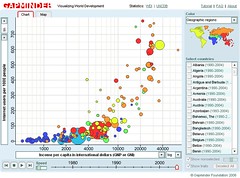
Imagine the possibilities of all this in, say, classroom presentations. Jim links to a great presentation using this tool. (Although I disagree with the presenter’s conclusion at the end about the leveling of differences regarding Internet diffusion.)
I recommend checking out the tool on your own for maximum appreciation of its capabilities.
UPDATE: There is more! Conrad – Jim’s source on this – tells me that the tool on the Trendalyzer site has even more option. Moreover, you can download a beta version of the software that even lets you import your own data.
by Eszter Hargittai on June 16, 2006
Rob Capriccioso of Inside Higher Ed reports on what Glenn Reynolds of InstaPundit, Markos Moulitsas Zúniga of Daily Kos and Jessica Coen of Gawker think about college students’ lack of interest in political blogs and Beltway gossip.
While I appreciate that they are happy with students spending their time on things other than politics, their responses ignore the fact that students do follow news, they just don’t do so on political blogs. All of the responses present time spent on these blogs as competition for time spent having fun with friends. However, findings from the survey suggest that students do follow current events (59% look up local or national news daily or weekly; 44% look up international news that frequently) so it’s not as though students only care about sex and beer. Granted, the survey doesn’t ask about the specific type of news they follow, but chances are that some of the material overlaps with topics covered on these blogs.
Additional info in the article includes my response to the inevitable question: “What about porn?”.
by Eszter Hargittai on June 14, 2006
How does the popularity of Facebook compare to MySpace among a diverse group of college students? What types of blogs are students most likely to read? How many have ever visited Instapundit or Daily Kos?
As mentioned earlier, last month I gave a talk at the Beyond Broadcast conference hosted at Harvard Law School. The conference folks have now made the presentations available in both audio and video format. You can listen to or watch my talk misleadingly titled “Just a Pretty Face(book)? What College Students Actually Do Online”. (The title is misleading, because the talk is not about Facebook or even social-networking sites more generally speaking. Rather, it’s about what young people do online and how it differs by type of background.) I have put the presentation slides online in case you are curious to see the specifics (those are hard to follow on the video and there wasn’t enough time for me to mention stats in the presentation).
I should note that these are all still preliminary findings as I need to do more data cleaning and there’s tons more to do on the analysis front. But I don’t anticipate major changes in the findings presented given the size of the sample.
If you prefer text over these various other options I will be writing up the findings this summer and will post a link once it’s done. But if you can’t wait to find out the answers to the above questions then I recommend clicking on one of the above links. (All this information is toward the end of the presentation.)
Okay, fine, I won’t make it that difficult. The quick answers to the above questions are (again, for this group of college students):
1. Facebook is more popular (Facebook 78%, MySpace 51%)
2. Political blogs are the least popular type of blogs (from among the ones asked, which included personal journals, arts/culture/music, technology, sports)
3. 1% have ever visited each, Instapundit and Daily Kos that is (as per the third question above)
There’s lots more info in the presentation.
Recall that many of you took a survey back in January here on CT about your use of various sites and services. I haven’t forgotten that I still owe you a summary of the responses and that is forthcoming as I analyze the college student Internet use data. I thought reporting the former may be more interesting in the context of the latter thus the delay.
by Henry Farrell on April 24, 2006
Two opinions on wikis last weekend.
From the former editor of _Encyclopedia Britannica_, quoted in the “Economist”:http://www.economist.com/surveys/displaystory.cfm?story_id=6794228 (sub required).
bq. Contrast that with the joyful reaction of Wikipedia’s detractors to Brian Chase, the dodgy biographer (whose article was literally one in a million). Somebody who reads Wikipedia is “rather in the position of a visitor to a public restroom,” says Mr McHenry, Britannica’s former editor. “It may be obviously dirty, so that he knows to exercise great care, or it may seem fairly clean, so that he may be lulled into a false sense of security. What he certainly does not know is who has used the facilities before him.”
From an aside in “John Clute’s review”:http://www.scifi.com/sfw/books/column/sfw12574.html of Theodora Goss’s new book of short stories.
bq. It is something that may derive from the tendency of mutants to emit blog gas, for the net culture they live in has no internal or external censors, no _captaining_ of the unsorted untested wikipedian utterances of the gawping soul, no place for the buck to stop.
[click to continue…]
by Jon Mandle on March 30, 2006
AP:
NEW YORK – In the largest study of its kind, researchers found that having people pray for heart bypass surgery patients had no effect on their recovery. In fact, patients who knew they were being prayed for had a slightly higher rate of complications.
The study looked at complication rates within 30 days of heart bypass surgery and compared three groups of about 600 each: “those who knew they were being prayed for, those who were prayed for but only knew it was a possibility, and those who weren’t prayed for but were told it was a possibility.”
Results showed no effect of prayer on complication-free recovery. But 59 percent of the patients who knew they were being prayed for developed a complication, versus 52 percent of those who were told it was just a possibility.
A kind of reverse placebo, I guess.
Dr. Harold G. Koenig, director of the Center for Spirituality, Theology and Health at the Duke University Medical Center, who didn’t take part in the study, said the results didn’t surprise him….
Science, he said, “is not designed to study the supernatural.”
No, it’s designed to study the natural. Like, for example, whether prayer can help recovery from bypass surgery.
UPDATE: Here’s a link to the abstract in the American Heart Journal. The full text is behind a pay wall.
