From the category archives:

Sociology

The Sociology of Jack Vance

by Henry Farrell on May 28, 2013

[A few years ago](https://crookedtimber.org/2009/07/17/vance-in-the-nyt/) I suggested that I wanted some day to write a longform piece on the sociology of [Jack Vance](http://www.nytimes.com/2009/07/19/magazine/19Vance-t.html?_r=0). Unless I get funding from some unexpected source (e.g. some [Vanceophile billionaire](http://www.paulallen.com/)) to take time out from my more traditional academic responsibilities, that probably isn’t going to happen. However, I have drafted a few short blog posts (a couple of which are yet to be completed), primarily for my own entertainment over the last few years. I’ll be publishing them over the summer lull, for the edification of those four or five of you who share my paired interests in f/sf fantasy writers with baroque prose styles and social science theory. A final post, “The Feminist Jack Vance” (consisting of 20 lines of carriage returns, followed by a note in eight-point type explaining “This page intentionally left blank”) is probably better described than written. Vance has few female characters indeed who cannot immediately be categorized as waifish love-pixies, self-centered sexual manipulators or plain-faced man-hating harridans (there are women such as Paula Volsky who clearly like Vance’s work and are influenced by it, but far fewer, I imagine, than there might be were he even slightly more enlightened).

Forthcoming at Irregular Intervals:

I – The Spirit of Market Capitalism in Master Twango’s Establishment at Flutic.

II – Positional Goods and the Column-Sitters at Tustvold.

III – Robust Action among the Breakness Wizards.

IV – Informal Institutions and the Old Tradition of the Perdusz Region.

V (to be completed) – The Stationary Bandits of the Tschai Steppes

VI (to be completed) – Class, Status, Party, Distinction, Clam Muffins.
[My reflections on Britain since the Seventies](https://crookedtimber.org/2013/04/10/britain-since-the-seventies-impressionistic-thoughts/) the other day partly depended on a narrative about social mobility that has become part of the political culture, repeated by the likes of Tony Blair and Gordon Brown and recycled by journalists and commentators. In brief: it is the conventional wisdom. That story is basically that Britain enjoyed a lot of social mobility between the Second World War and the 1970s, but that this has closed down since. It is an orthodoxy that can, and has, been put in the service of both left and right. The left can claim that neoliberalism results in a less fluid society than the postwar welfare state did; the right can go on about how the left, by abolishing the grammar schools, have locked the talented poor out of the elite. And New Labour, with its mantra of education, education, education, argued that more spending on schools and wider access to higher education could unfreeze the barriers to mobility. (Senior university administrators, hungry for funds, have also been keen to promote the notion that higher education is a social solvent.)
[click to continue…]

More on The Org

by Henry Farrell on April 11, 2013

Tim Sullivan responds to my post at _OrgTheory._

bq. The point of the AA story, though, was not that organizations are perfectly efficient but that organizations face tradeoffs, and it can be useful to acknowledge those tradeoffs explicitly and to understand the economic architecture of organizations because it makes the situation of the average employee, manager, executive more comprehensible. In the AA case, they had a terrible website (which reflected plenty of other dysfunction within the company), and yet to do the job that AA aspired to (that is, flying people and stuff all over the world), you have to build a big, complicated organization that does lots of things all at once – managing fuel contracts, negotiating with pilots and flight attendants, setting prices, and so on. And organizing all of this involves a lot of tradeoffs. … Ray and I aren’t suggesting that orgs can’t be full of politics, power plays, bad managers, ridiculous HR departments, and so forth. They clearly are — but you have to accept these realities when you decide that there’s something that you want to do that will be best accomplished as a group of bosses and employees. The trick is not to ignore them or pretend they don’t exist, but to understand how and why they are produced, to recognize that sometimes apparent inefficiencies are the result of being organized, and understand the difference between tradeoffs and the _truly_ ridiculous and pointless aspects of organizational life.

I think that the nub of the disagreement is best summed up in one half-sentence here, where Tim suggests that “you have to accept these realities when you decide that there’s something that you want to do that will be best accomplished as a group of bosses and employees.” The point of the alternative perspective I set out is that there _isn’t_ any moment when a collective ‘you’ of bosses and employees, with a common interest in getting something done, decides this. The actual ‘you’ who makes the decisions is a very specific ‘you’ with a very specific set of interests. It is the ‘you’ who is in charge (or, if you want to get all old-style, the ‘you’ who is a capitalist). There is a literature of course in organizational economics, which talks about ‘team production functions,’ and how teams might rationally, if they wanted to get stuff done and minimize shirking, assign oversight to a hierarchically empowered actor. But in an economy which is not organized around cooperatives, very few private enterprises will originate in this way. Instead, they will originate with decisions by owners of capital, who will empower managers (a group which may, or may not, overlap with the owners of capital) to hire workers. The logic will be different, obviously, in non-profits and the government sector, but less different than you might imagine, as both these sectors become more and more like private enterprise.
[click to continue…]

Britain since the seventies, impressionistic thoughts

by Chris Bertram on April 10, 2013

The 1970s have been in my mind over the past few days, not only for the obvious reason, but also because I visited the Glam exhibition at Tate Liverpool last weekend. Not only were the seventies the final decade of an electrical-chemical epoch that stretched back to the late nineteenth-century, they were also the time when the sexual and political experimentation of the 1960s and a sense of being part of a cosmopolitan world order became something for the masses, for the working class, and when the old social order started to dissolve. In the experience of many people, the sixties happened in the seventies, as it were.

But my main thoughts, concerning Britain at any rate, have been about social division, and about some oddly paradoxical features of British life before Thatcher. There’s a very real sense in which postwar British society was very sharply divided. On the one hand, it was possible to be born in an NHS hospital, to grow up on a council estate, to attend a state school, to work in a nationalised industry and, eventually (people hoped), to retire on a decent state pension, living entirely within a socialised system co-managed by the state and a powerful Labour movement. On the other, there were people who shared the experience of the NHS but with whom the commonality stopped there: they were privately educated, lived in an owner-occupied house and worked in the private sector. These were two alternate moral universes governed by their own sets of assumptions and inhabited by people with quite different outlooks. Both were powerful disciplinary orders. The working class society had one set of assumptions – welfarist, communitarian, but strongly gendered and somewhat intolerant of sexual “deviance”; middle-class society had another, expressed at public (that is, private) schools through institutions like compulsory Anglican chapel. Inside the private-sector world, at least, there was a powerful sense of resentment towards Labour, expressed in slogans about “managers right to manage” and so on that later found expression in some of the sadism of the Thatcher era towards the working-class communities that were being destroyed. Present too, at least in the more paranoid ramblings of those who contemplated coups against Labour, was the idea that that the parallel socialised order represented a kind of incipient Soviet alternative-in-waiting that might one day swallow them up.
[click to continue…]

The Org

by Henry Farrell on April 5, 2013

Ray Fisman and Tim Sullivan (who I know a little and like) are blogging about their recent book on organization management, _The Org_ (Powells, Amazon) over at OrgTheory.net at the moment. It’s both a very good book and an excellent introduction to a particular style of thinking about organizations. The book starts with Ronald Coase’s insights about the relative benefits of contract and hierarchy, and goes from there. Much of the book is devoted to showing how these insights travel across a wide variety of different contexts – Baltimore policing (building on Peter Moskos' sociology), Christian preaching and the like. Much of the book is also devoted to explaining why apparently frustrating aspects of organizations have a rationale, and may even be the best way of accomplishing something or somethings, given the complex and multiple needs, internal incentive problems and so on. More succinctly, the book sets out to show how the world that Dilbert inhabits may not be the best of all possible worlds, but is better than we realize at first glance, and actually less dysfunctional than the obvious alternatives. It provides a lot of detail and case study to back up this basic claim. And it is in an entirely different league of intelligent argument from other books aimed at business readers.

All this said, I tend to view organizations from a different perspective than the authors, one which didn’t really get any sustained attention in the book. Fisman and Sullivan build on two major traditions in organization and management – one stemming from Frederick Taylor, and the other from Chester Barnard. Taylor emphasized the value of overt incentives, monitoring and information in achieving organizational efficiencies. Barnard emphasized the benefits of fuzzier notions of corporate culture, in creating a more diffuse, but likely valuable set of benefits in interactions between workers and management. Fisman and Sullivan start off with a Coaseian version of Taylor’s arguments, but weave in some Barnardian arguments about the benefits of corporate culture as the book progresses. A good organization is one with clear, well designed incentives, _and_ with a culture of trust.

[click to continue…]

Invisible Men

by Kieran Healy on January 11, 2013

Over the years I’ve [written](http://kieranhealy.org/blog/archives/2004/07/16/a-new-analysis-of-incarceration-and-inequality/) [about](http://kieranhealy.org/blog/archives/2006/05/23/incarceration-rates/) the work of [Bruce Western](http://www.wjh.harvard.edu/soc/faculty/western/), [Becky Pettit](http://faculty.washington.edu/bpettit/), [Chris Uggen](http://chrisuggen.blogspot.com), and other scholars who study mass incarceration in the United States. By now, the basic outlines of the phenomenon are pretty well established and, I hope, widely known. Two features stand out: its [sheer scale](http://kieranhealy.org/blog/archives/2006/05/23/incarceration-rates/), and its [disproportionate concentration](http://kieranhealy.org/blog/archives/2004/07/16/a-new-analysis-of-incarceration-and-inequality/) amongst young, unskilled black men. It should be astonishing to say that more than one percent of all American adults are incarcerated, and that this rate is without equal in the country’s history and without peer internationally. Similarly, it may seem hard to believe that “five percent of white men and 28 percent of black men born between 1975 and 1979 spent at least a year in prison before reaching age thirty five”, or that “28 percent of white and 68 percent of black high-school dropouts had spent at least a year in prison by 2009”.
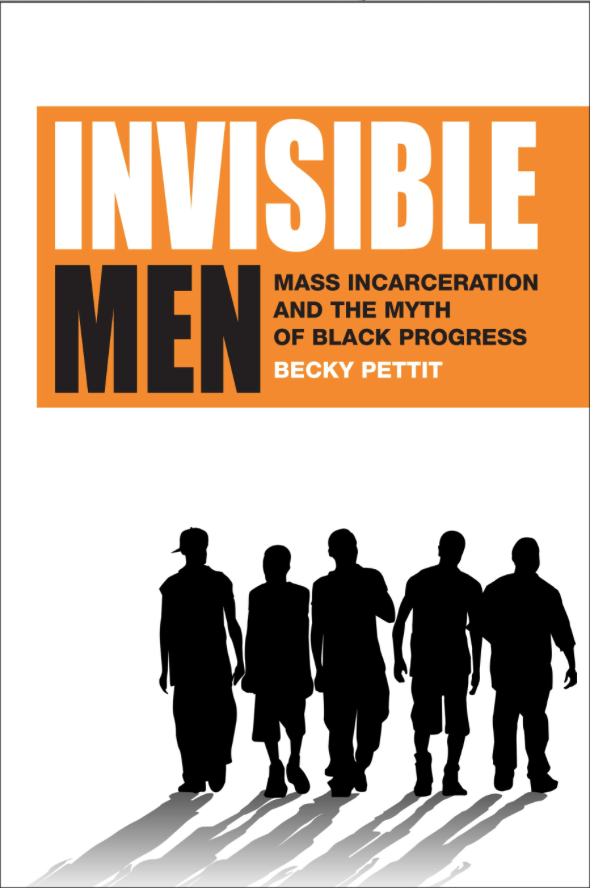
Those numbers come from the first chapter of Becky Pettit’s new book, [*Invisible Men: Mass Incarceration and the Myth of Black Progress*](http://www.amazon.com/Invisible-Men-Incarceration-Black-Progress/dp/0871546671). You can read [the first chapter](https://www.russellsage.org/sites/all/files/Pettit_Chap1.pdf) for free, but I recommend you [buy the book](http://www.amazon.com/Invisible-Men-Incarceration-Black-Progress/dp/0871546671). Pettit’s argument is that mass incarceration is such a large and intensive phenomenon that it distorts our understanding of many other social processes.

[click to continue…]

SASE Conference: States in Crisis

by Henry Farrell on January 2, 2013

I’m on the executive committee of SASE, the Society for the Advancement of Socio-Economics, which means that I plug their annual conference every year around this time. This year, the conference theme is States in Crisis, and is taking place from June 27-June 29 in Milan, Italy. The conference’s main target group is economic sociologists, but there’s a good mix of people from other social science disciplines, including political science. If you’re interested, you have two weeks to submit paper or panel proposals …

Max Weber’s Newcomb problem

by Chris Bertram on October 25, 2012

I was reading a postgraduate dissertation on decision theory today (a field where I’m very far from expert) and it suddenly occurred to me that Max Weber’s Protestant Ethic has exactly the structure of a Newcomb problem.

Consider: in the classic Newcomb problem a being, which always guesses right, offers you a choice involving either taking a box (A) containing $1,000,000 or nothing OR taking that box plus another one (B) which certainly contains $1000. The being guesses what you will do and, if you are disposed to take both boxes (A+B) always puts nothing in A, but if you are disposed to leave B alone and just open A, puts the million dollars in A. But by the time you make the choice, the money is there or it is not.

One apparently compelling argument says you should open both boxes (since A+B > A), another persuasive argument says that you want to be in a state of the world such that the being has put the million in box A. A sign that you are in that state of the world is that you are disposed to open just the one box, so this is what you should in fact do. You thereby maximize the expected payoff.
[click to continue…]

Alex Gourevitch on environmentalism: some pushback

by Chris Bertram on October 10, 2012

Alex Gourevitch, with whom I’m collaborated in the past, has [a piece at Jacobin](http://jacobinmag.com/2012/10/two-hurricanes-2/) that’s somewhat hostile to environmentalism. The piece is written as a provocation, and, indeed, it has successfully provoked at least one person: me. Alex argues that greens substitute science for politics, neglect the social determinants of well-being, would deprive the global poor of technological benefits that could protect them from natural disasters and risk condemning people to lives wasted in drudgery.

No doubt Alex can find plenty of instances of people mouthing the sentiments and opinions he condemns. But the trouble with this sort of writing is exemplified by the endless right-wing blogs that go on about “the left” and then attribute to everyone from Alinsky to the Zapatistas a sympathy for Stalinist labour camps. Just like “the left”, people who care about the environment and consider themselves greens come in a variety of shapes, sizes and flavours. Taking as typical what some random said at some meeting about the virtues of Palestinians generating electricity with bicycles is inherently problematic.
[click to continue…]

SASE Mini-Conferences

by Henry Farrell on September 7, 2012

SASE, the Society for the Advancement of Socio-Economics (the academic association for economic sociology), is hosting its annual conference in Milan next year, and calling for proposals for mini-conferences as part of the main event.

bq. Up to eight mini-conference themes will be selected for inclusion in the Call for Papers by the program committee, which may also propose themes of its own. Preference will be given to proposals linked to the overarching conference theme, “States in Crisis,” but mini-conferences on other SASE-related themes will also be considered. Proposals for mini-conference themes must be submitted electronically to the members of the program committee by October 1, 2012. All mini-conference proposals should include the name(s) and email addresses of the organizer(s), together with a brief description. As in previous years, each mini-conference will consist of 2 to 6 panels, which will be featured as a separate stream in the program. Each panel will have a discussant, meaning that selected participants must submit a completed paper in advance, by June 1, 2013.

I have a vested interest here – I’m a member of SASE’s executive board – but it is a pretty good way of getting serious discussion going on a topic or linked set of topics that are too big to deal with in a single panel.

Some things people are Bringing Back In at ASA 2012 later this week: Animals, Hegel, Gender, Migration, Utopia, Materiality, the Generalized Other, Theory. Some things we are going Beyond at ASA 2012 later this week: the Glass Ceiling, Geneticization, the Individual, Growth and Neoliberalism, the Normal v Deviant, the Cost Structure, the Fact/Value antagonism, the Black/White divide. Some things we are After at ASA 2012 later this week: Globalization, 9/11, Gouldner, the Flood, the Afterschool Special, Socialism, Retirement, Occupy. Some things that are a Paradox at ASA 2012 later this week: Public Space, Empowerment, Suicide, Internet Privacy, Fictive Kinship, Carbon, Authenticity, Global Schizophrenia, Mexican Developmental Institutions, Food Stamps and Obesity. Some things being Revisited at ASA 2012 later this week: Embedded Autonomy, Trivers-Willard, Becoming White, Secularism, Gender Violence, Marginal Man. Things that will be found to be Relational at ASA 2012 later this week: Mechanisms, Ontologies of Individuality, Ethnic Identity, Carework, Dynamics, Events, Political Culture, Signaling, Perspectives, Understanding, Process, and Models.

To my surprise, however, only one thing is being Reconsidered, and we are not Taking anything Seriously.

Olympics Trolling

by Kieran Healy on July 29, 2012

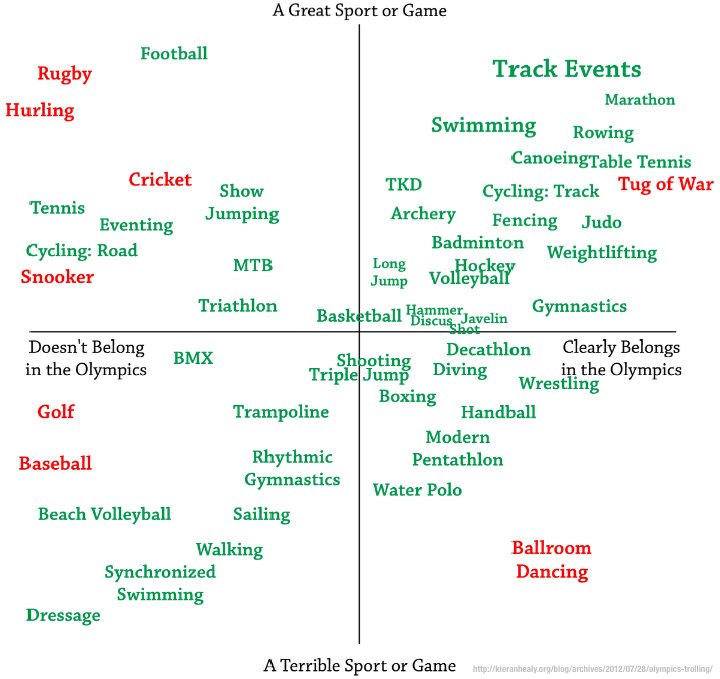
It’s that happy time when I whine about American television coverage of the Olympics. This year’s whining has a new twist—beyond the usual complaints about sentimental crap and tape-delay—given the lack of decent streaming options absent a pre-existing subscription to some cable channels. But it’s also the time when I’m reminded of my existing personal prejudices about sports, when I may discover new ones (as new events are added), and when I try to figure out whether there’s any defensible rationale to my preferences. Reflecting on my sports bigotry, I think the simplest model is a two-dimensional space that, I think you will agree, is both easy to understand and wholly objective.

[click to continue…]

Assault Deaths within the United States

by Kieran Healy on July 22, 2012

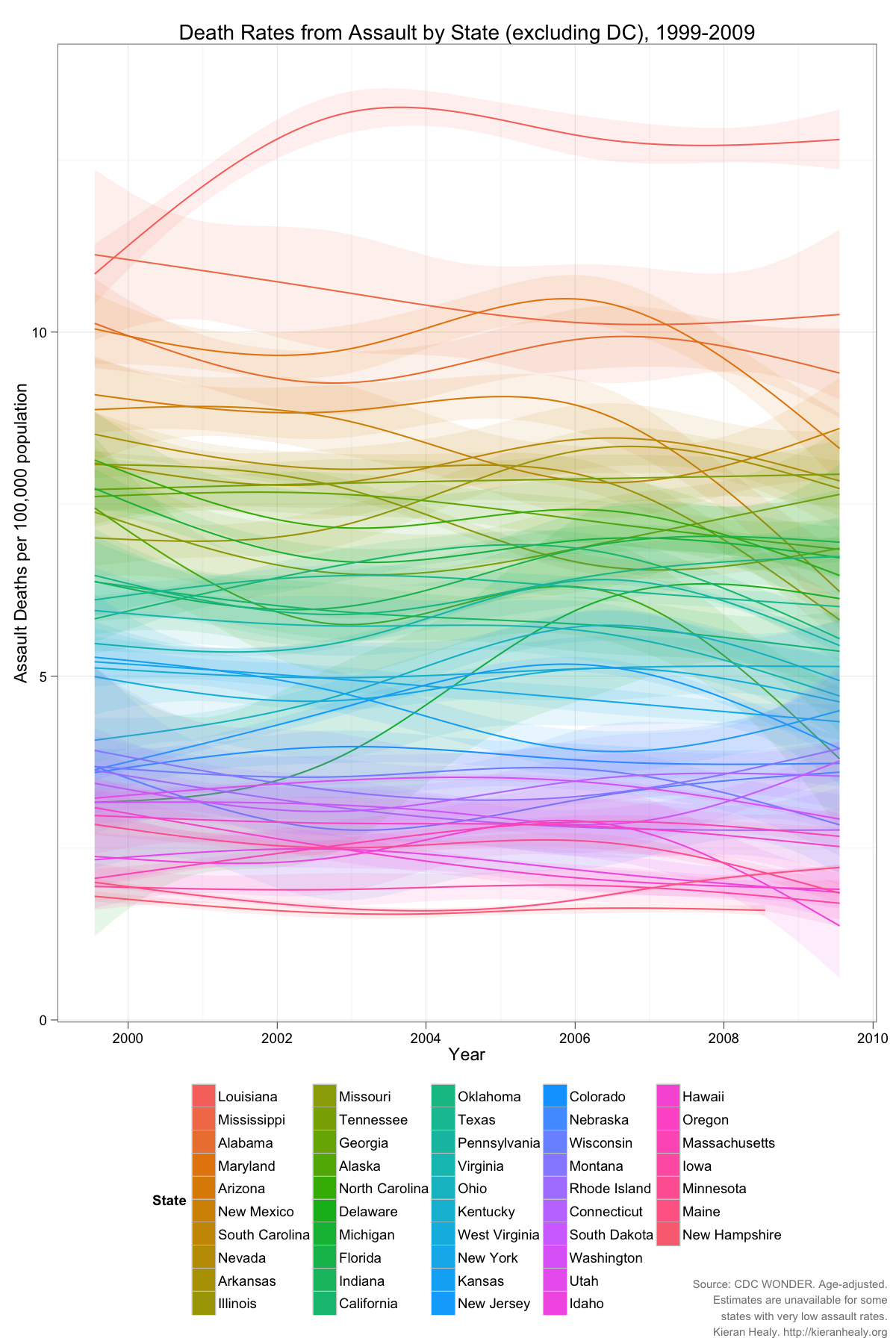
The chart in “America is a Violent Country” has been getting a lot of circulation. Time to follow up with some more data. As several commentators at CT noted, the death rate from assault in the U.S. is not uniform within the country. Unfortunately, state-level and county-level mortality data are not easily available for the time period covered by the previous post—though they do exist, going back to the 1940s. What I have to hand is a decade’s worth of US mortality data courtesy of CDC WONDER covering 1999 to 2009. I extracted the assault deaths according to the same criteria the OECD uses (for the time period in question, ICD-10 codes X85-Y09 and Y87.1). The estimates are adjusted to the 2000 U.S. population, which isn’t identical to the standard OECD adjustment. But the basic comparability should be OK, for our purposes.

First, it’s well-known that there are strong regional differences in the assault death rate in the U.S. by state and region. Here’s what the patterns look like by state from 1999 to 2009.

Assault death rates by State

Trends in the Death Rate from Assault, 1999–2009, by State. Click for a larger PNG or PDF.
[click to continue…]

America is a Violent Country

by Kieran Healy on July 20, 2012

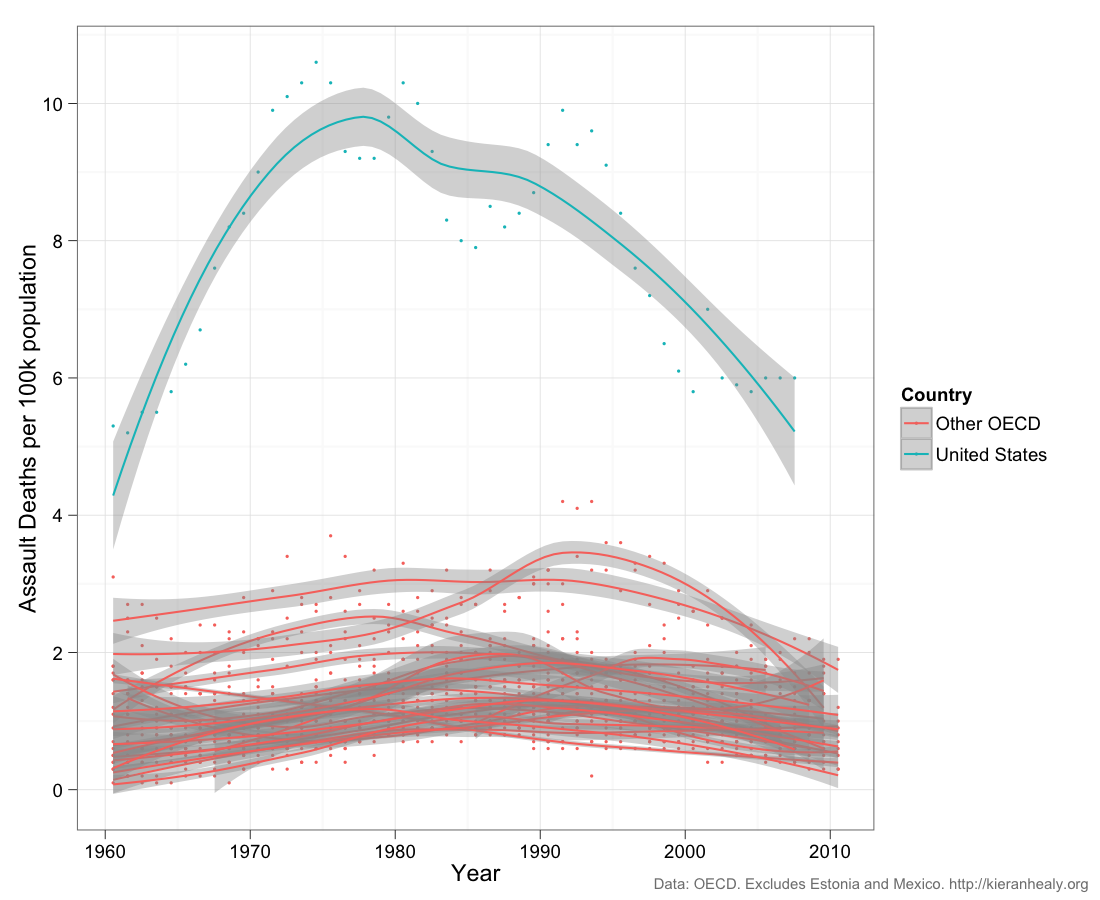
The terrible events in Colorado this morning prompted me to update an old post about comparative death rates from assault across different societies. The following figures are from the OECD for deaths due to assault per 100,000 population from 1960 to the present. As before, the most striking features of the data are (1) how much more violent the U.S. is than other OECD countries (except possibly Estonia and Mexico, not shown here), and (2) the degree of change—and recently, decline—there has been in the U.S. time series considered by itself. Note that “assault” as a cause of death does not distinguish the mechanism of death (gunshot, stabbing, etc). If anyone knows of a similar time series for homicides specifically, let me know.

Click for a larger version.

Here are the individual time series.

[click to continue…]

The Neighborhood in your People

by Kieran Healy on July 13, 2012

Via John Siracusa, a really nice exercise in crowdsourcing and data visualization on Bostonography.

… we’re running an ongoing project soliciting opinions on Boston’s neighborhood boundaries via an interactive map. We want to keep collecting data, but we’ve already received excellent responses that we’re itching to start mapping, and when we hit 300 submissions recently it seemed like a good enough milestone to take a crack at it. (That’s actually 300 minus some junk data. If you offer the ability to draw freeform shapes, some people draw random rectangles and triangles, and some people draw… er, other long, tipped objects.) There are many questions to be asked here. Where are the areas of consensus? Where are the disputed zones? Where are the no-man’s lands, etc

Crowdsourced Brighton

Boundaries are fuzzy, but not uniformly so, the consensus center of a neighborhood need not be its geometric center, and so on. Lots of interesting stuff. It’d be great if they could collect data on the social distribution of this knowledge, too. It’s like an updated version of Kevin Lynch’s The Image of the City, with shades of Rick Grannis’s classic paper The Importance of Trivial Streets. Very nice work. Check out the full discussion.