Heinrich Kley on Politics and Metaphysics

by John Holbo on April 10, 2013

I was going to review a couple of new books I picked up – The Lost Art of Heinrich Kley, Volume 1: Drawings & Volume 2: Paintings & Sketches. (Those are Amazon links. You can get it a bit cheaper from the publisher. And see a nifty little video while you’re there.) But now I seem to have lost vol. 1 of Lost Art. Turned the house over, top to bottom. Can’t find it anywhere! Oh, well. Bottom line: I’ve been collecting old Kley books for a while. It’s fantastic stuff – if you like this kind of stuff – and these new books contain a wealth of material I had never seen. I wish, I wish the print quality in vol. 1 were higher because the linework really needs to pop. The color stuff in volume 2 is better, and harder to come by before now. One editorial slip. Kley’s Virgil illustrations come from a ‘travestiert’ Aeneid, by Alois Blumauer, not a ‘translated’ one. Parody stuff. (There, I just had to get my drop of picky, picky pedantry in there.) That said, the editorial matter in both volumes is extremely interesting. Volume 2 has a great Intro by Alexander Kunkel and a very discerning little Appreciation by Jesse Hamm, full of shrewd speculations about Kley’s methods. He’s a bit of a mystery, Kley is.

The books are in a Lost Art series that is clearly a labor of love for Joseph Procopio, the editor.

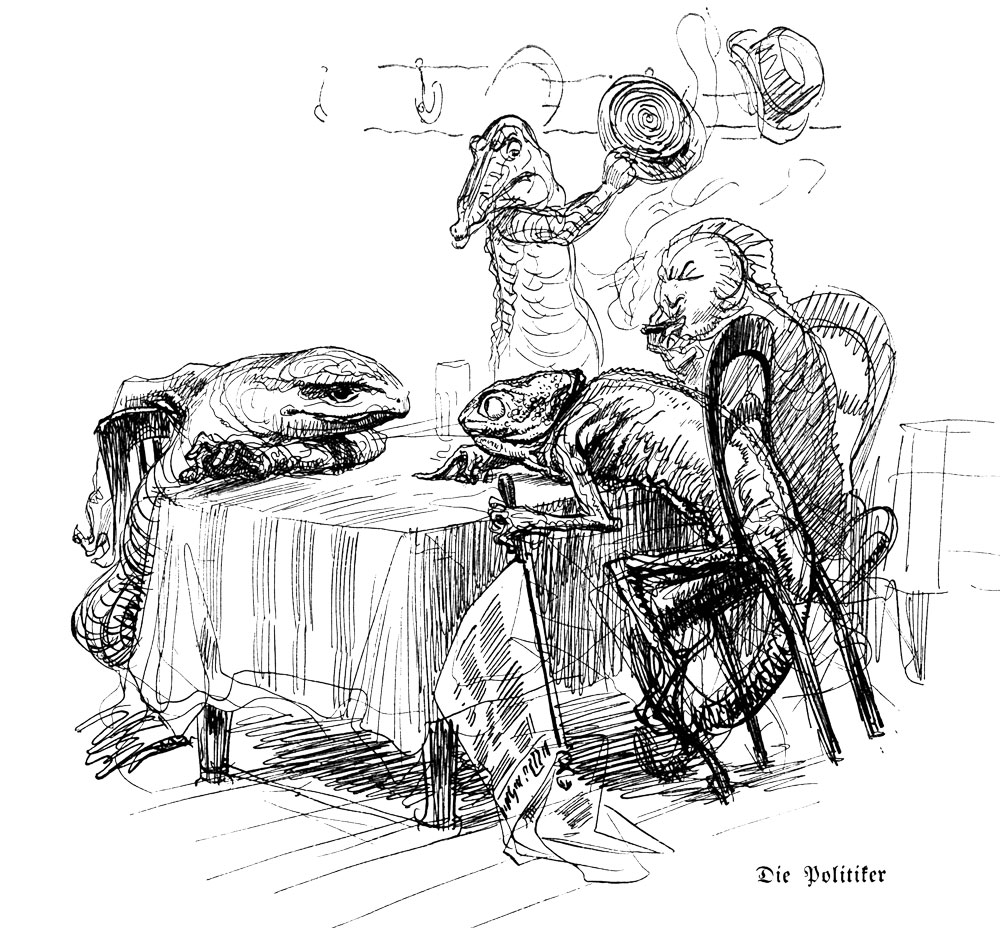
In honor of our Real Utopias event, I’ll just give you Kley on politics and metaphysics. (These particular images aren’t from these new volumes, but they’re nice, aren’t they?)

politiker

metaphysiker

Click for larger.

{ 4 comments }

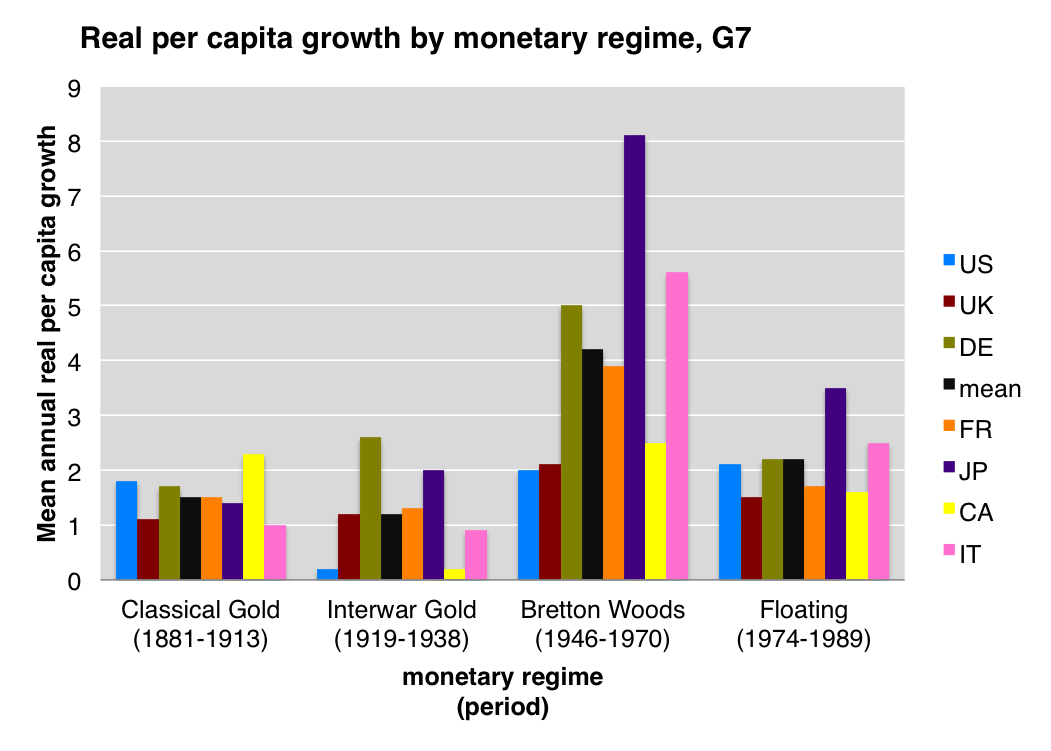
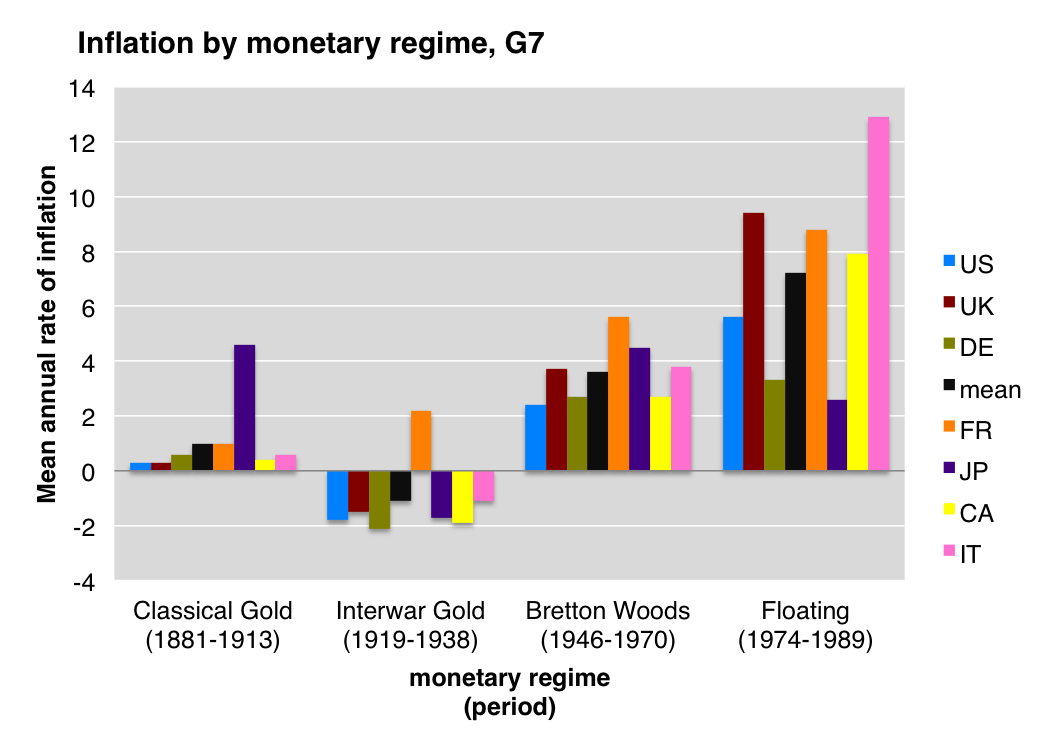
Was the gold standard a golden age, or a gilded one? How does it compare to later monetary regimes? I mean, we know the gold standard was terrible for the US, but what about other countries? I know you want to know, without having to dig in data appendices, so I made you some charts. Because I love you that much. (But not enough to extend the floating exchange rate regime data down to the present; that’s actual work.)

growth

inflation

Data from table 1, Michael Bordo, “The Gold Standard, Bretton Woods and other Monetary Regimes: An Historical Appraisal,” NBER working paper no. 4310.

{ 36 comments }

In The Reactionary Mind, I wrote:

One of the reasons the subordinate’s exercise of agency so agitates the conservative imagination is that it takes place in an intimate setting. Every great blast—the storming of the Bastille, the taking of the Winter Palace, the March on Washington—is set off by a private fuse: the contest for rights and standing in the family, the factory, and the field. Politicians and parties talk of constitution and amendment, natural rights and inherited privileges. But the real subject of their deliberations is the private life of power: “Here is the opposition to woman’s equality in the state,” Elizabeth Cady Stanton wrote. “Men are not ready to recognize it in the home.” Behind the riot in the street or debate in Parliament is the maid talking back to her mistress, the worker disobeying her boss. That is why our political arguments—not only about the family but also the welfare state, civil rights, and much else—can be so explosive: they touch upon the most personal relations of power.

Feminism—and the backlash against it—is the paradigm case of the battle over the private life of power. As historians have shown, the attack on Women’s Lib gave the modern conservative movement what it needed to achieve its counterrevolution in 1980. But to understand why that was the case, we have to recall just how radical feminism truly was: it sought to disrupt concrete and tangible relationships in the most private relations of power. [click to continue…]

{ 123 comments }

1975 and 2013

by John Q on April 9, 2013

There’s already plenty of commentary, here and elsewhere on Margaret Thatcher. Rather than add to it, I’d like to compare the situation when she assumed the leadership of the Conservative Party with the one we face now. As Corey points out in his post

In the early 1970s, Tory MP Edward Heath was facing high unemployment and massive trade union unrest. Despite having come into office on a vague promise to contest some elements of the postwar Keynesian consensus, he was forced to reverse course. Instead of austerity, he pumped money into the economy via increases in pensions and benefits and tax cuts. That shift in policy came to be called the “U-Turn.”

Crucially, Heath was defeated mainly as a result of strikes by the coal miners union.[1]

From the viewpoint of conservatives, the postwar Keynesian/social democratic consensus had failed, producing chronic stagflation, but the system could not be changed because of the entrenched power of the trade unions, and particularly the National Union of Miners. In addition, the established structures of the state such as the civil service and the BBC were saturated with social democratic thinking.[2]

Thatcher reversed all of these conditions, smashing the miners union and greatly weakening the movement in general, and promoting and implementing market liberal ideology as a response to the (actual and perceived) failures of social democracy. Her policies accelerated the decline of the manufacturing sector, and its replacement by an economy reliant mainly on the financial sector, exploiting the international role of the City of London.

Our current situation seems to me to be a mirror image of 1975. Once again the dominant ideology has led to economic crisis, but attempts to break away from it (such as the initial swing to Keynesian stimulus) have been rolled back in favour of even more vigorous pursuit of the policies that created the crisis. The financial sector now plays the role of the miners’ union (as seen in Thatcherite mythology) as the unelected and unaccountable power that prevents any positive change.

Is our own version of Thatcher waiting somewhere in the wings to take on the banks and mount an ideological counter-offensive against market liberalism? If so, it’s not obvious to me, but then, there wasn’t much in Thatcher’s pre-1975 career that would have led anyone to predict the character of her Prime Ministership.

fn1. I was too far from the scene to be able to assess the rights and wrongs of these strikes or the failed strike of the early 1980. It’s obvious that the final outcome was disastrous both for coal miners and for British workers in general, but not that there was a better alternative on offer at the time.

fn2. The popular series, Yes Minister, was essentially a full-length elaboration of this belief, informed by public choice theory

{ 33 comments }

From the Mixed-Up Files of Mr. Jon Lee Anderson

by Corey Robin on April 9, 2013

Last month, New Yorker reporter Jon Lee Anderson turned twelve shades of red when he was challenged on Twitter about his claim in The New Yorker that Venezuela was “one of the world’s most oil-rich but socially unequal countries.” A lowly rube named Mitch Lake had tweeted, “Venezuela is 2nd least unequal country in the Americas, I don’t know wtf @jonleeanderson is talking about.” Anderson tweeted back: “You, little twerp, are someone who has sent 25,700 Tweets for a grand total of 169 followers. Get a life.” Gawker was all over it.

What got lost in the story though is just how wrong  Anderson’s claim is. In fact, just how wrong many of his claims about Venezuela are. [click to continue…]

{ 90 comments }

On Harry Dexter White and Pearl Harbor

by Eric on April 8, 2013

In the recent TLS I have an essay on Benn Steil’s new book on Bretton Woods. Unlike some notices, mine is critical. You can read mine here. If you’re interested in the theory, put forward in Steil’s book, that Harry Dexter White caused US intervention in World War II, read below the fold. If you’re more interested in the late Baroness Thatcher, please carry on down to the other posts for today.

[click to continue…]

{ 26 comments }

The Lady’s Not for Turning

by Corey Robin on April 8, 2013

To get a sense of why conservatives in Britain of a certain age revere Margaret Thatcher, check out this clip of her “You turn if you want to, the lady’s not for turning” speech at the Conservative Party Conference in October 1980.

The context (my apologies to the Brits in the audience; this stuff can be like ancient Greek to us Yanks): In the early 1970s, Tory MP Edward Heath was facing high unemployment and massive trade union unrest. Despite having come into office on a vague promise to contest some elements of the postwar Keynesian consensus, he was forced to reverse course. Instead of austerity, he pumped money into the economy via increases in pensions and benefits and tax cuts. That shift in policy came to be called the “U-Turn.”

Fast forward to 1980: Thatcher had been in power for a year, and the numbers of unemployed were almost double that of the Heath years. Thatcher faced a similar call from the Tory “Wets” in her own party—conservatives who weren’t keen on her aggressive free-market counterrevolution—to do a U-Turn, and many expected she would. This was her response. [click to continue…]

{ 26 comments }

Baroness Thatcher is dead.

by Harry on April 8, 2013

I presume it is a bit silly to point to any obituaries. So, instead, a heartwarming story. A few weeks before he died Eric Heffer, in one of his last interviews, Eric Heffer told a story against Neil Kinnock. (If you are too young to remember Heffer, well, here’s wikipedia). He, Heffer, was dying, and one evening, walking down a corridor in the Commons, he got to the point that he couldn’t walk any further. He thought he was alone but Mrs Thatcher was several feet behind him. Seeing his distress she made him put his arm round her, and walked him to a nearby office, made him a cup of tea, and sat with him while they waited for a nurse. His observation, about Neil Kinnock, was that he would have walked straight by.

It turns out that Heffer and Thatcher were friends of sorts; similarly Thatcher and Allan Adams. (See Frank Field on Thatcher’s liking for socialist company). The first 6 years of my political life was devoted to opposing nearly everything Thatcher did (including the Falklands War, about which I have changed my mind; the exception: sale of council houses), and that only ended because I moved somewhere that I could oppose what Reagan was doing instead. But there’s plenty of space on the internet for people who want to speak ill of the dead — I just thought I would tell a story I heard about 22 years ago and is not, as far as I can find, recorded elsewhere.

{ 70 comments }

Being or Nothingness redux

by Eric on April 6, 2013

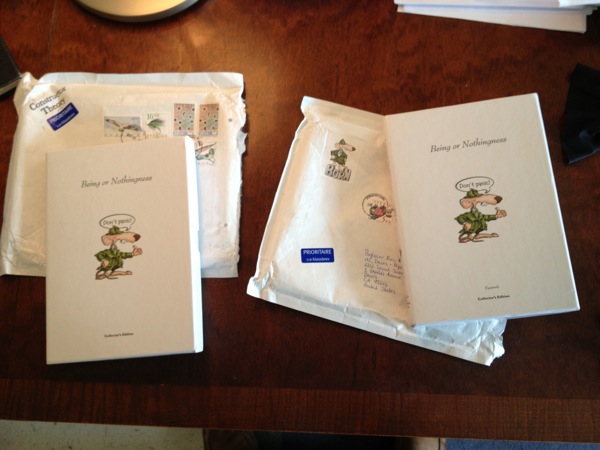
IMG 2730

So, I got these two packages from Sweden today. Obviously, this is part two of this episode. Which Jon Ronson wrote about here.

I’m not going to try to analyze the books I received yet, except to note that yes, that’s clearly the Giant Rat of Sumatra speaking the slogan from The Hitchhiker’s Guide to the Galaxy, “BORN” as a reference to the original Being or Nothingness and, uh, probably some other stuff. One of the books says “Facsimile” and the other doesn’t. I already confirmed with Jon Ronson that he got one too.

I won’t attempt any further analysis for now. But if anyone else got one (or two) please write in to say…

{ 14 comments }

The Org

by Henry Farrell on April 5, 2013

Ray Fisman and Tim Sullivan (who I know a little and like) are blogging about their recent book on organization management, _The Org_ (“Powells”:http://www.powells.com/partner/29956/biblio/9780446571593?p_ti, “Amazon”:http://www.amazon.com/gp/product/0446571598/ref=as_li_ss_tl?ie=UTF8&camp=1789&creative=390957&creativeASIN=0446571598&linkCode=as2&tag=henryfarrell-20) over at “OrgTheory.net”:http://www.orgtheory.net at the moment. It’s both a very good book and an excellent introduction to a particular style of thinking about organizations. The book starts with Ronald Coase’s insights about the relative benefits of contract and hierarchy, and goes from there. Much of the book is devoted to showing how these insights travel across a wide variety of different contexts – Baltimore policing (building on “Peter Moskos’ sociology”:https://crookedtimber.org/2009/07/21/discretion-and-arrest-power/), Christian preaching and the like. Much of the book is also devoted to explaining why apparently frustrating aspects of organizations have a rationale, and may even be the best way of accomplishing something or somethings, given the complex and multiple needs, internal incentive problems and so on. More succinctly, the book sets out to show how the world that Dilbert inhabits may not be the best of all possible worlds, but is better than we realize at first glance, and actually less dysfunctional than the obvious alternatives. It provides a lot of detail and case study to back up this basic claim. And it is in an entirely different league of intelligent argument from other books aimed at business readers.

All this said, I tend to view organizations from a different perspective than the authors, one which didn’t really get any sustained attention in the book. Fisman and Sullivan build on two major traditions in organization and management – one stemming from Frederick Taylor, and the other from Chester Barnard. Taylor emphasized the value of overt incentives, monitoring and information in achieving organizational efficiencies. Barnard emphasized the benefits of fuzzier notions of corporate culture, in creating a more diffuse, but likely valuable set of benefits in interactions between workers and management. Fisman and Sullivan start off with a Coaseian version of Taylor’s arguments, but weave in some Barnardian arguments about the benefits of corporate culture as the book progresses. A good organization is one with clear, well designed incentives, _and_ with a culture of trust.

[click to continue…]

{ 25 comments }

Reflections on Real Utopias

by Erik Olin Wright on April 3, 2013

A very wide range of issues have been raised in the many interesting postings and comments during the Crooked Timber seminar about my book Envisioning Real Utopias which ran from March 18-28. In what follows I will give at least a brief response to the core themes of each of the eight contributions to the seminar. I will organize my reflections in the order of the contributions in the symposium.

“[PDF version here]”:https://crookedtimber.org/wp-content/uploads/2013/04/Erik-Olin-Wright-Reflections-on-Real-Utopias-Crooked-Timber-symposium.pdf
[click to continue…]

{ 10 comments }

Iain Banks is dying of cancer

by Henry Farrell on April 3, 2013

“Story at the Guardian”:http://www.guardian.co.uk/books/2013/apr/03/iain-banks-gall-bladder-cancer?INTCMP=SRCH, thanks to people in comments below. This is very sad news. He has been a wonderful and prolific writer, whose intelligence and considerable grasp of politics were often concealed by the lightness of his touch. I would have loved it had he written more in the experimental vein of some of his earlier fiction – _Walking on Glass_ is just a lovely book – but am grateful for what he has written. He never got the reception in the US that he deserved – some CT readers may not know his work. Readers interested in his literary side should perhaps start with _Walking on Glass_ or _The Wasp Factory_ (“It is a sick, sick world when the confidence and investment of an astute firm of publishers is justified by a work of unparalleled depravity. There is no denying the bizarre fertility of the author’s imagination: his brilliant dialogue, his cruel humour, his repellent inventiveness. The majority of the literate public, however, will be relieved that only reviewers are obliged to look at any of it.” – _The Irish Times_), and those more interested in sf should begin with _Consider Phlebas_ or perhaps _The Use of Weapons._ They’re all wonderful novels, in very different ways.

{ 49 comments }

Some objective moral truths?

by Harry on April 3, 2013

Matthew Hutson’s interesting article in yesterday’s Times has, in the print edition, the unfortunate tag “How much does psychology determine moral principles?: a lot”, which led me to think it was going to be about whether ought implies can. In fact it is about research showing what anyone who teaches moral philosophy already knows, which is that people get confused the first time they encounter trolley-type problems:

For a recent paper to be published in the Journal of Experimental Social Psychology, subjects were made to think either abstractly or concretely — say, by writing about the distant or near future. Those who were primed to think abstractly were more accepting of a hypothetical surgery that would kill a man so that one of his glands could be used to save thousands of others from a deadly disease. In other words, a very simple manipulation of mind-set that did not change the specifics of the case led to very different responses…..

Other recent research shows similar results: stressing subjects, rushing them or reminding them of their mortality all reduce utilitarian responses, most likely by preventing them from controlling their emotions.

Even the way a scenario is worded can influence our judgments, as lawyers and politicians well know. In one study, subjects read a number of variations of the classic trolley dilemma: should you turn a runaway trolley away from five people and onto a track with only one? When flipping the switch was described as saving the people on the first track, subjects tended to support it. When it was described as killing someone on the second, they did not. Same situation, different answers.

I haven’t read the papers he refers to, but I’d be impressed if it established either of the claims he asserts toward the end of the article:

Objective moral truth doesn’t exist, and these studies show that even if it did, our grasp of it would be tenuous.

[click to continue…]

{ 348 comments }

Good Reads for #WAAD 2013

by Ingrid Robeyns on April 2, 2013

It’s the annual World Autism Awareness Day. Last year, Twitter provided an excellent source of links and information through #WAAD – so check out Twitter later today if you are interested. I’d like to use the occasion to put in a plug for an old book, a classic indeed, that I only read last Summer, but that should be on anyone’s reading list who wants to enter the world of people with autism:
[click to continue…]

{ 15 comments }

Alternative Hugo Ballot

by Henry Farrell on April 1, 2013

So the Hugo nominees are “here”:http://www.thehugoawards.org/hugo-history/2013-hugo-awards/. Outside of the novels, the only nominated work I’ve read is Edward James and Farah Mendlesohn’s _Cambridge Companion to Fantasy Literature_ which I am entirely happy to recommend you go vote for, or, better still, buy. As for the novels, they’re:

* 2312, Kim Stanley Robinson (Orbit)
* Blackout, Mira Grant (Orbit)
* Captain Vorpatril’s Alliance, Lois McMaster Bujold (Baen)
* Redshirts: A Novel with Three Codas, John Scalzi (Tor)
* Throne of the Crescent Moon, Saladin Ahmed (DAW)

I’ve read five of the six (and I got halfway through the first book in the series which Mira Grant’s _Blackout_ ends), and I’ve got a serious case of the mehs. _2312_ is the only one that I would recommend as doing something interesting. The other five seem to me solid, but not wildly exciting. Ahmed’s _Throne of the Crescent Moon_ is a lot of fun – good sword and sorcery from a non-Christian Europe-centric perspective. _Captain Vorpatril’s Alliance_ is perfectly fine, but while it isn’t the worst of Bujold’s books, it’s not close to being the best either. John Scalzi’s _Redshirts_ didn’t grab me, perhaps because I never particularly liked _Star Trek_, and so was underwhelmed by the pathos.

But in the end, the Hugo nominees are no more and no less than a prestigious crowdsourced recommendation list. Which means that if your taste doesn’t gel with that of the Hugos crowd, you shouldn’t get bent out of shape about it, but also you shouldn’t take it as gospel. CT readers are a different crowd than Worldcon attendees/supporters, and I imagine would generate a different list. If people want to namecheck the books they liked in comments, I’ll undertake to write a follow up post next week that tries to pull these recommendations together in a more useful form. I’ve already listed “some of my favorites here”:https://crookedtimber.org/2013/02/27/hugo-nominations-2/ but take that as a conversation starter, not ender.

{ 34 comments }