by Chris Bertram on July 17, 2009
The latest “episode”:http://www.guardian.co.uk/commentisfree/henryporter/2009/jul/16/photography-police-view-delete-images of police harassment of street photographers is recounted by Henry Porter in the Guardian. There just seems to be an endless loop around this stuff: police officers stop/arrest/intimidate photographer, fuss in the press, lobbying of politicians, earnest denials and issuings of revised guidance by senior police, continued botherings despite guidance. Do, repeat.
What really astonishes me about this is that the alleged terrorism link is based on what seems to be a law-enforcement myth about the bad guys scoping out their targets using DSLRs and that the police are actually missing a major intelligence opportunity. Anyone who mixed with enthusiastic photographers knows that there is a bunch of people in every town and city who wander around looking at things, noticing the unusual, exploring side-streets and back alleys, and so forth. Even when we haven’t got cameras on us we’re looking, noticing, framing, making a mental note. You’d think that a smart police officer somewhere might have cottoned on to this and had the idea that cultivating good relations with such people, not acting so as to piss them off, might actually be a good idea. But no. The police mentality is to see such people as suspicious and possibly criminal and to intimidate them off the streets. Stupid, stupid, stupid.
by Michael Bérubé on July 16, 2009
A moment of silence for <a href=”http://obsidianwings.blogs.com/obsidian_wings/2009/07/barefaced-goaway-bird.html”>Hilzoy</a>, who’s retiring from blogging this week.
[click to continue…]
by Henry Farrell on July 16, 2009
So is Tony Blair officially in the running to become President of the Council of member states of the European Union (a new job, that might or might not be quite powerful, depending on who gets it, that will come into being if the Lisbon Treaty passes)? The Financial Times “says yes”:http://www.ft.com/cms/s/0/d5313c12-7145-11de-877c-00144feabdc0,dwp_uuid=70662e7c-3027-11da-ba9f-00000e2511c8.html [click to continue…]
by John Q on July 15, 2009
Discussion on the first post in this series went really well, so I’m carrying on. Here’s the proposed introduction.1 Again, comments, both favorable and critical are very welcome and the best will be rewarded with a copy of Dead Ideas from New Economists (I’m back with the original title at present).
Updated As Chris Bertram points out, my second (or higher-order) hand attribution of the “Thesis, antithesis, synthesis” triad to Hegel was incorrect. As with Mundell’s impossible trinity, these terms weren’t used by Hegel (apparently they were borrowed from Fichte by Hegel’s popularisers). I’ve changed the text a bit and added a bit more about Marx and idealism/materialism, still trying to keep it at a level that will be good for a broad audience and avoid the risk of bringing in yet more errors. There’s lots more in the thread I will take into account in later parts of the book, coming soon. Thanks everyone, and keep the comments coming,
[click to continue…]
by John Q on July 15, 2009
A DC-based friend wrote today to say that he had finally abandoned the Washington Post, a paper he used to really like. The final straw was this piece allegedly written by Sarah Palin, a substance-free rant claiming that a cap-and-trade scheme for CO2 emissions would be economically ruinous. But much more damaging is the observation that, if this piece had come out (with the obvious stylistic variations) under the byline of George Will, Robert Samuelson, David Broder or any of the other rightwing/Villager hacks on the Post op-ed page, it would have slipped by without any real notice. The sooner this insult to the memory of Katherine Graham and Ben Bradlee1 goes out of business, the better.
1 Yes, I know Ben Bradlee is still alive, and even still associated with the paper. But his memory will be forever associated with the Post in its glory days, and not with the travesty produced by Fred Hiatt and Katharine Weymouth.
by Kieran Healy on July 14, 2009
by John Q on July 13, 2009
This is the first in what I hope will be an extensive series of extracts from my forthcoming bestseller Dead Ideas from Live Economists 1. I’m inviting comments and suggestions from readers, with free copies of the book for the ten best. To avoid cluttering the home page, the substance will be over the fold, with only a short intro like this for each post.
Update The discussion has been very helpful, though a lot has more to do with what will come later. In this section, I’ve changed the para about Keynes speculative career a little.
[click to continue…]
by Chris Bertram on July 13, 2009
That’s “a headline”:http://news.bbc.co.uk/1/hi/uk/8147890.stm at the BBC. So it would seem that they do rather less damage to the UK economy tham the various banking groups that needed rescuing ….
by Chris Bertram on July 12, 2009
Phew! England (and Wales) “just about got away with it”:http://news.bbc.co.uk/sport1/hi/cricket/england/8146497.stm despite Pietersen’s stupidity and arrogance. The really big difference from 2005 (so far) is the change in feel caused by Warne’s retirement. Four years ago, Warne was a feral presence, spooking the England batsmen with his cunning and aggression. Of course, Ponting was captain back then too, but this series has seen him come to the fore: planning, homework, probing the England weaknesses. Collingwood was terrific today, but, generally England were brainless. Still, no harm done yet and four tests to play to win back the Ashes.
by Ingrid Robeyns on July 12, 2009
I haven’t blogged much in the last months — I had too much on my plate and blogging is an easy thing to drop if there’s much more work than can be squeezed into 24 hours a day. A few times something came on my path that I felt I had to blog about, and now, in this academic-off-season with more time (or rather: fewer urgent deadlines) the challenge will be to remember all those things that I felt were worthwhile throwing into the Blogosphere.
Here’s one. A few weeks back I joined “the Friends of the Stanford Encyclopedia of Philosophy”:https://leibniz.stanford.edu/friends/ (SEP). For philosophers, but also for other academics or thinkers/writers/readers who sometimes want to check out a philosophical theory, term, subfield or canonical thinker, this is a true gift. I use it in my teaching and have so far only had positive remarks from students. The SEP contains high quality refereed entries, generally well-written and enlightening, and always freely available to anybody on Earth with access to the internet. Anybody supporting the Open Access movement, or anybody seriously concerned about educational equality of opportunity on a global level, should therefore support the SEP if they can (the membership fees are $5 for students and $10 or 25 for professionals – much less than the fees of most academic associations). So now there is an easy way to support the SEP, and you’ll get something in return for your membership – nicely formatted PDFs of the entries. I hope many thousands worldwide will join, and that the people working hard at creating and maintaining the SEP will take it as a big ‘thank you’ for their work.
by Henry Farrell on July 9, 2009
We’ll soon be having a Crooked Timber seminar on George Scialabba’s wonderful book, “What Are Intellectuals Good For?” (“Powells”:http://www.powells.com/s?kw=Scialabba%20intellectuals%20good%20for&PID=29956, “Amazon”:http://www.amazon.com/gp/product/0978515668?ie=UTF8&tag=henryfarrell-20&linkCode=xm2&camp=1789&creativeASIN=0978515668). I really commend this book to CT readers – if you like the kinds of things that we talk about, you will almost certainly like this book. And if you read it, you will be You can also hear George “in conversation”:http://www.radioopensource.org/george-scialabba-the-untethered-untenured-mind/ on Chris Lydon’s Radio Open Source – his ability to speak in clear, beautifully articulated paragraphs is both frightening and awe-inspiring to the likes of myself (whose ability to respond to questions on the fly is … not quite as impressive).
by John Q on July 8, 2009
My Icerocket self-search (admit it, we all do it), led me to this marvellous project. The Invisible Library is a collection of books that don’t exist, except in the pages of other books. It is physically manifesting at the Tenderpixel Library in London, but will resume invisibility after 12 July.
The connection?
[click to continue…]
by Eszter Hargittai on July 8, 2009
Two years ago, as part of a collection of articles researching social network site uses, I published a piece (blog post here) about the different predictors of Facebook and MySpace use among a diverse group of first-year college students. Some of the reactions to that paper suggested that the the differences by race/ethnicity and socioeconomic status identified in the data were only temporary and would soon change.
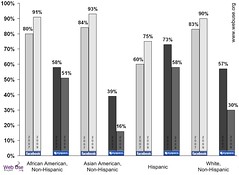 I now have some new data to consider possible changes over the past two years. I haven’t written this up in any formal way yet (nor do I have more elaborate statistical analyses to share right now), but I do have some figures suggesting that the differences I identified two years ago persist today.
Note that this is a new cohort of first-year students (i.e., not the same students resurveyed two years later) at the same universitywhere I conducted the study in 2007. (See details about the data collection and sample descriptives at the end of this post.)
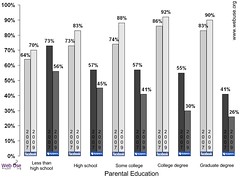 There are two main findings here. (Click on the images for larger versions or see the table below.) First, there is a general increase in use of Facebook and a general decline in use of MySpace across the board. In 2007, 79% of the study participants were using Facebook while in 2009, 87% of the sample reports doing so. In contrast, while in 2007, 55% of the group reported using MySpace, in 2009, only 36% do so. [click to continue…]
by Henry Farrell on July 7, 2009
It sounds as though the putative efforts to remove Mary Dietz as editor have failed, and Sage has backed down. “Inside Higher Ed”:http://www.insidehighered.com/news/2009/07/07/sage has the details (along with some discussion of the comment thread on this blog, and the recent decision of the American Sociological Association to farm out its journals to Sage.
At the same time Sage was landing a prestigious batch of journals, it was trying to reassure political scientists who have been trying to figure out what was going on with the leadership of _Political Theory,_ a key journal in the discipline and one published by Sage. … unconfirmed reports … coup … While Sage officials insist nothing of the kind happened, and the original editor is in place, another political scientist has confirmed that he was offered and accepted the editorship, then withdrew when he learned of the controversy. While Sage officials will acknowledge only some sort of “misunderstanding,” they admit that whatever it was they were were trying to do was done without consulting the scholars on the editorial board of the journal, and they are apologizing for that. …
Jayne Marks, vice president and editorial director of Sage, said in an interview that there had been “a misunderstanding,” but that Dietz had never stopped being editor of the journal. … declined repeatedly to explain what took place, or to acknowledge that anything had happened. … Asked explicitly about how another political scientist said he signed a contract for an editorship that wasn’t apparently open, and that many political scientists were expressing concern about the lack of information, Marks repeated that everything has been “sorted out” and that she wouldn’t say more.
by Henry Farrell on July 7, 2009
Daniel Davies will be moderating a salon with George Soros at “FireDogLake’s Book Salon”:http://firedoglake.com/booksalon/ tomorrow – should be fun …