Could the Queen sack Johnson? Would she?

by John Q on September 2, 2019

Having vague ideas of Parliamentary supremacy, I’m struck by reports that Boris Johnson could simply ignore a vote of no-confidence, and remain office to push through a No Deal Brexit, even in the face of legislation prohibiting such a course of action. As far as I can tell, these arguments are based on the premise that Parliament must nominate an alternative, and the assumption that neither Corbyn nor anyone else would prove acceptable to a majority. (Update: On more careful reading of the linked article I see that the new boss, Cummings, saying that Johnson could, for which I read would, ignore a vote for a new PM).

That might be true, and then again it might not. The question that occurs to me is whether Johnson could also ignore a vote in favour of a new PM, and if so, what could be done about it? One possibility is that the Queen could dismiss him, and invite the new PM to form a government, which would presumably hold immediate elections.

That, pretty much, is what happened in Australia in 1975, though the government’s position was far more tenable than in the hypothetical that I’ve outlined above. The government had a majority in the House of Representatives (our equivalent of the Commons). However, the government was unpopular and the Senate (similar to the US Senate in most respects) refused Supply, creating a financial crisis. The Governor-General (representing the Queen) sacked the PM (Whitlam) and installed the Leader of the Opposition (Fraser) in his place. Fraser called an election and won.

I honestly have no idea whether if Johnston refused to go, he could be removed, by the monarch or otherwise. For that matter, could he get the Queen to prorogue Parliament indefinitely, and govern by decree? That sounds inconceivable, but maybe only in the sense of Vizzini in the Princess Bride.

It’s worth noting that the absence of a written constitution isn’t the critical issue here, or at least not to the extent often claimed. Australia has a constitution, but it’s silent on all the relevant issues (it doesn’t even mention the office of a PM).

That’s enough from me. Useful links and informed comments much appreciated.

{ 59 comments }

Sunday photoblogging: Alte Pinakothek, Munich

by Chris Bertram on September 1, 2019

Munich: Alte Pinakothek

{ 6 comments }

The missing question

by Harry on August 30, 2019

Yesterday’s All Things Considered story about Brexit was a remarkably insidious piece of journalism. Their man in Albion visited the town with the highest Brexit vote in Britain (a ‘namesake’ of Boston Mass: the fact that they have the same name is, no doubt, a remarkable accident), managed to find a woman who voted for Brexit, and asked her what she thought of the Prime Minister’s decision to restrict the sovereignty of the elected parliament (not the way he put it). She was enthused “If that’s what it takes…then so be it”: Brexit has to be done and dusted because we’ve got to ‘slow and control” immigration. She freely admitted that Brexit would be bad for the economy, and he asked if she cared that it will be bad for her business. It as already been bad for her business, which relies on EU migrant labor, but that is something she was, nobly, willing to put up with. But what she was willing to put up with in order to slow and control immigration is entirely uninteresting. The question he didn’t ask was how she justified wrecking other people’s businesses and the businesses that other people who are worse off than she is work for. Next time, please present her with some remainers who are going to lose their livelihoods because of Brexit, or the non-trivial number of remainers who will lose their lives because the health service is understaffed (or just badly staffed) and ask her to justify the costs she is trying to impose on them. (Brilliantly, when I looked for the story to link to, I got an ad for an interview with the repulsive James Dyson).

{ 93 comments }

Johnson’s putsch

by Chris Bertram on August 29, 2019

I’ve refrained from blogging much about Brexit and the political situation in the UK because, to be honest, I find it all too painful. But the latest move by British PM Boris Johnson seems worthy of comment. Johnson has “prorogued” (translation: suspended) Parliament in order to make it as hard as possible for MPs to shape the Brexit process and to prevent the extremely damaging disorderly crash-out from EU that he seems determined to impose on us on the 31st October. It is worth remembering that Johnson has no mandate of his own, commands the loyalty of less than half the MPs in the Commons, and was selected by the Tory Party membership alone (a tiny group in which elderly racists are more common than they are even in the average golf-club bar). Prorogation has been saluted by the Telegraph with the headline: “The Prime Minister must give effect to the will of the people.” Thus does the Caudillo claim to incarnate the people’s will more than their Parliamentary representatives do. This is not a move that was unforeseen. It was much-discussed during that Tory leadership contest. Johnson said he did not find it attractive. Others who now sit in his Cabinet, unresigned, such as Morgan, Rudd, Hancock, even Javid and Gove, rejected it as an odious attack on democracy only weeks ago. Yet now is is both a brilliant tactical masterstroke but simultaneously “nothing to see here” business as usual.
[click to continue…]

{ 140 comments }

A tie would have been good enough

by Harry on August 27, 2019

When Leach was facing, with 2 to win, the tie was gone. If he was out, Australia would win. If he scored 2, England would win. And if he scored 1, Stokes would score the winning runs. But, from the point of view of the Ashes, a tie was as good as a win: either way England has to win more of the subsequent 2 matches than Australia: if Australia win one, or both are drawn, Australia keep the Ashes.

I tried to describe the scale of Stokes’s feat to someone who had no knowledge of cricket. Unfortunately, she proved to be completely ignorant of all sports, a remarkable accomplishment, but one that left me at a complete loss for analogies (I was going to reach for tennis, but even then — winning from 2 sets down and 5 games down in the third set doesn’t really capture it).

Lots of young people have said that this was the greatest innings ever, better even than Jessop at the Oval, or Botham at Headingley, and that this was a greater victory than Headingley 1981. But they weren’t born at the time and have only seen highlights of 1981, so what do they know? Even those of us who are old didn’t see Jessop in 1903, but we did watch Headingley ’81 with the same stunned disbelief as we watched Headingley ’19. Maybe, just maybe, Jessop’s innings matched this one. But those of us who saw Headingley ’81 and Headingley ’19, albeit on telly, surely agree that the youngsters are right.

What nobody has talked about is Watson and Bailey’s draw. If any of our readers witnessed Sunday’s game, and Watson and Bailey, please let us know how they compare. If you google “Watson and Bailey” from my location, you get a hairstylist in California.

On twitter, in response to a request from Ben Stokes, specsavers agreed to provide Jack Leach with a lifetime supply of eyeglasses.

{ 43 comments }

Jimmy Carter gets advice about global warming

by John Q on August 22, 2019

In the course of attempting to threadjack Harry’s post on advice to new students, a commenter made the often-repeated claim ““Forty years ago (1970’s) global cooling was all the rage!””. As it happens, just before reading this comment, I received a link to some files from the Jimmy Carter Presidential Library and Museum. It’s a daily log or similar, and starts with a response to someone named Frank Press who had written to Carter raising concerns about CO2 emissions and global warming. The advice given to Carter was as follows:

The issue raised by Press is not new. The experts all agree that more infor­mation is needed. The energy plan indicates that nearly $3 million was being requested for ERDA to study the long-term effects of co2. (James) Schlesinger feels that the policy implications of the issue are still too uncertain to warrant presidential involvement or poli­cy initiatives. Schlesinger is examining the issue in the preparation of the FY 79 budget, and will, at that time, have the full report of the NAS study and further results from ERDA.

That accords with my memory, but not, apparently that of numerous others. Both warming and cooling were discussed in the 1970s, but there wasn’t clear evidence either way. By the 1980s, it became clear that the trend was towards warming, though it took another decade or so to produce broad scientific agreement that greenhouse gas emissions were the most likely cause and another decade for this agreement to reach near-certainty.

[click to continue…]

{ 94 comments }

Giovanni Buttarelli

by Maria on August 22, 2019

A few years ago I was on a panel about the Internet of Things. There were five of us, plus the moderator, sitting in a line across the stage of the Brussels convention centre; reps from Google and, I think, a big Korean chaebol, Giovanni Buttarelli, the European Data Protection Supervisor, Wojciech Wiewiórowski the Assistant European Data Protection Supervisor (though he might have still been the Polish DPC at that point), and me. I was there – I think – because the moderator knew me and I can usually be relied upon in these situations to stir a little, but not too much.

It all took a while to get going because Google, a major sponsor, took some of the allotted time to screen a video about how the Internet of Things would also include the Internet of Clothes, and how this would be great for Europeans because the ‘smart’ fabrics in question were hand-woven French jacquard. The infomercial was followed by a lengthy and remarkably self-serving presentation from the Google executive, and we all had to sit up on the stage looking interested for a good fifteen or twenty minutes. Finally, the panel-proper began and our moderator lobbed a softball for each of us to answer in turn.

Everyone was quite measured and politely took their cue from the Google framing, which was that Europe needed to ‘focus on innovation’, ‘provide an enabling regulatory environment’, and basically make the Single Market safe for surveillance capitalism. What none of us realised was that once the video had finished screening behind us, it had been replaced by a live Twitter feed which the now quite grumpy audience was quickly populating with dissent. We on the stage couldn’t read the sarcasm and frustration that had filled up the hashtag, so when it came to my turn and I let rip a quick but genuinely exasperated little monologue that ended with a rhetorical question about how we data-subjects would even afford to buy smart things after we’d all been automated out of existence, the applause and even a few whoops took us all by surprise.

Giovanni caught my eye and grinned. Anyone, and I mean anyone, in receipt of a smile like that – loaded as it was with canniness, grace, deep and multiply enfolded intelligence, and sheer downright mirth – would walk a long way to see it again.

[click to continue…]

{ 5 comments }

David and Eric Schwitzgebel have made a list of the 295 most cited philosophers in the Stanford Encyclopedia of Philosophy. On Facebook, Harry commented:

Nussbaum is #10 on this list — not especially surprising. The next woman on the list is Anscombe, at #48. Then Korsgaard at #57, Anderson at #63. Foot comes in at #139 (after Millikan, Cartwright, Thomson, Young and Annas). 10 women in the top 139 is a bit shocking, but the low ranking of Anscombe and Foot is more than a bit shocking. Some of it can be explained away — the list favors the present over the past (and especially, I would guess, the teachers of the people who write for SEP), it favors people who’ve written many somewhat influential pieces over people who have written a few very influential pieces, and it favors people who write about many things over those who write about few things. But add all of those factors together and you don’t come close to explaining why there are so few women in the top #139, and you come even less close to explaining the rankings of Anscombe and Foot in particular.

It is quite depressing indeed, but not at all surprising. There are enough research papers showing that, trying to keep all other factors constant (e.g. by conducting audit studies), women receive less recognition in academia than men. No need to review that literature here again. Not only the women who would be candidates for “top 295” lists, but across the full spectrum of degrees of seniority. But there is more to be said. [click to continue…]

{ 27 comments }

Advice for new college students

by Harry on August 20, 2019

A couple of years ago the Midwest conference of the Junior State of America asked me to be their keynote speaker. I still have no idea at all why they invited me – it seemed and still seems rather unlikely. I stupidly agreed, and then agonized about what to talk about. The organizers suggested talking about how I got to where I am, but, although there are parts of how I got to where I am that are quite interesting, where I am is not interesting at all. Then, mercifully, the Thursday before the talk two of my students brought one of their friends to meet me in my office. (You can tell how exciting their lives must be!) And they told me to tell her my tips for how to get the most out of college. I was put on the spot and tried, desperately, to remember what my tips are. Fortunately, I did remember. And then I thought, oh, actually, I could talk on Saturday about how to get the most out of college. It’s something I know something about, and that would actually be useful to audience!

Since it is the time of year that some of our readers in the northern hemisphere are getting ready to welcome students to college (I am teaching a small first-year class, which I only do once every three years), and other readers are getting ready to send their kids off to college and, conceivably, one or two readers are getting ready to go off to college themselves, I thought I’d excerpt the part of the talk where I actually give the advice. About 2/3rds of the talk was about what the point of going to college is and I’ll skip most of that, but just say that the point that I gave them was to learn knowledge, skills, attitudes and dispositions that will enable them to make a better contribution to the good of all of us; and to enjoy that learning itself. I know going to college has other purposes, but these are the ones that get neglected by the college recruiters, and school counsellors, and movies, that shape their ambitions about college.

Here goes with the concrete advice:
[click to continue…]

{ 64 comments }

Best moment of the academic year

by Harry on August 19, 2019

I invite other teachers or students to submit their own best moment of the academic year past. Mine was this.

A small class — just 17 students. They had read Amia Srinivasan’s “Does anyone have the right to sex?”. Some of them hated it, because they thought (wrongly) that it expressed sympathy with incels. Others were more intrigued. During the discussion I made reference, as she does, to political lesbians, and as I was saying the word it occurred to me that they might not know what it meant. So I asked them what it meant. The blank faces indicated that none of them had looked it up, which I pointed out (I knew they’d all read the piece). So I asked them to guess, and several made wild guesses. The one who got closest was very uneasy in saying it, I think because he worried that he was being politically incorrect. I finally told them what it meant. Several of them looked concerned, wondering what they ought to think about this. A few knew that I am perfectly capable of making things up to bamboozle them. After an interminable 2 seconds of silence, though, one young woman hit the table, and cried, very loudly: “That’s AWESOME! Good for THEM!”. Her face had that look that a baby’s face gets when it has its first taste of chocolate.

{ 25 comments }

Cutting the financial sector down to size

by John Q on August 18, 2019

That’s the provisional title I used for my latest piece in Inside Story. Peter Browne, the editor, gave it the longer and clearer title “Want to reduce the power of the finance sector? Start by looking at climate change”.

The central idea is a comparison between the process of decarbonizing the world economy and that of definancialising it, by reducing the power and influence of the financial sector. Both seemed almomst impossible only a decade ago, but the first is now well under way.

There’s also an analogy between the favored economists’ approach in both cases: reliance on price based measures such as carbon taxes and Tobin taxes. Despite the theoretical appeal of such measures, it looks as if regulation will end up doing much of the heavy work.

{ 29 comments }

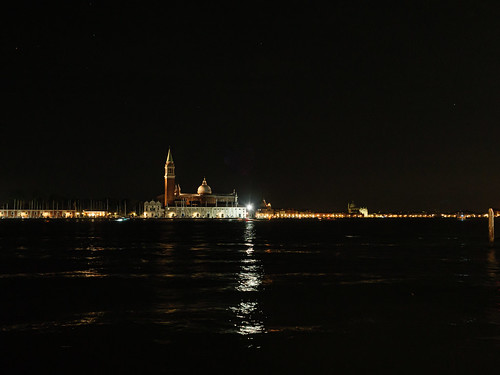
Sunday photoblogging: Venice: San Giorgio Maggiore

by Chris Bertram on August 18, 2019

Venice: San Giorgio Maggiore

{ 3 comments }

Give children the vote

by John Q on August 17, 2019

Looking at the array of ignorant and vindictive old men attacking Greta Thunberg and other young climate activists, the case for lowering the voting age is just about unanswerable. Anything that could be urged in justification of stopping 16 year olds, as a group, from voting, is equally applicable to those over 60 (a group to which I belong). Over 60 voters are, on average, poorly educated (the school leaving age in Australia was 15 when they went through and I assume similar in most places), and more likely to hold a wide range of false beliefs (notably in relation to climate change).
[click to continue…]

{ 79 comments }

Ossian’s Ride

by Henry Farrell on August 14, 2019

Caragh Lake, the epicenter of the future


[Caragh Lake: the epicenter of the future]

In 1959 the famous British astronomer Fred Hoyle published his novel, Ossian’s Ride. It was the wildest science fiction, depicting a future Ireland miraculously transformed into a technological superpower. Vast highways crisscrossed the Irish countryside. The discovery of cheap contraception (manufactured from turf) broke the control of the Catholic church. A shining new city, organized around the principles of scientific discovery, was constructed on the shores of Caragh Lake in County Kerry. Britain was left on the sidelines, wondering what had happened.
[click to continue…]

{ 30 comments }

The Incarcerating Power of Stereotypical Beliefs

by Scott Page on August 14, 2019

Freeman testified at trial that Abrahams was trying to stop him and Willingham from fighting, and that she hit Willingham in the face. Willingham, Freeman testified, then raised his hand as if he was going to hit Abrahams, but then lowered it to his waist, which prompted Freeman to believe he had a gun. Freeman shot Willingham three times, according to police.

-Detroit Free Press June 20, 2019

America is very good at some things and very bad at others.  We produce a steady flow of scientific, cultural, and engineering successes– in the past five years we can lay claim to a drug that cures hepatitis C, Hamilton: The Musical, and self-driving cars.  And yet, we perform just this side of miserable at addressing core social and economic challenges.  We are among the world’s leaders in income inequality, obesity rates, drug overdose deaths, and per capita greenhouse gas emissions.  And, we rank first, that is worst, in the proportion of citizens in jail at about seven people per thousand.  Even more troubling, blacks are six times as likely as whites to be behind bars. [click to continue…]

{ 18 comments }