It took me so long to find this quote. I remembered that it was Solovki, yes! And that Maxim Gorky was the visitor! And the tortures with the logs, and being staked out for the mosquitoes, and rolling the prisoners down the stairs, and the brave boy who told all, all! to Gorky and was left behind to be shot the moment Gorky’s ship left the horizon empty and barren! And the tarps. But could I find the quote? I damn sure could not. I was in the position of Edward Gorey’s Mr. Earbrass who starts up in the night having thought of the perfect lines for an epigraph: “His mind’s eye sees them quoted on the bottom third of a right-hand page in a (possibly) olive-bound book he read at least five years ago. When he does find them, it will be a great nuisance if no clue is given to their authorship.”
I had to read before and after many instances of the mention of Gorky I will tell you what. But virtue prevailed! The Solovetsky Archipelago is almost certainly what the name of the Gulag Archipelago comes from, as Solzhenitsyn considered it the mother of the Gulag, and the primary site before the cancer metastasized. The Soviets, eager to show that the camps are actually rather nice if you think about it sent Maxim Gorky to investigate. He was newly-returned to the Soviet Union and probably disinclined to rock the boat which currently supplied him with some vast apartment and a dacha (irrelevantly, haven’t we all sort of wanted a dacha? They sound great. Perhaps Trump will get one eventually.)
The NYT today has an article about how the Dutch, with their long experience of holding back the sea, plan to advise other nations about utilizing children’s pudgy fingers to avert devastating floods. At least, I assume that’s what it’s about; I didn’t RTWT yet. More interesting and pertinent to me was this article from some weeks ago about how Singapore is constructing new land, both to increase the city state’s area on general principles and to deal with rising sea levels. Singapore is in a difficult position as a low-lying polis with no higher ground or inetrior countryside to relocate to. In addition, it is forested with high-rise apartment blocks that can hardly be moved. Bukit Timah hill, which I can see from my window, is only about 400 ft above sea level and is the highest point on the island. Singapore imports tons of sand from neighboring countries and uses it to create new islands offshore or infill and extend the current island.
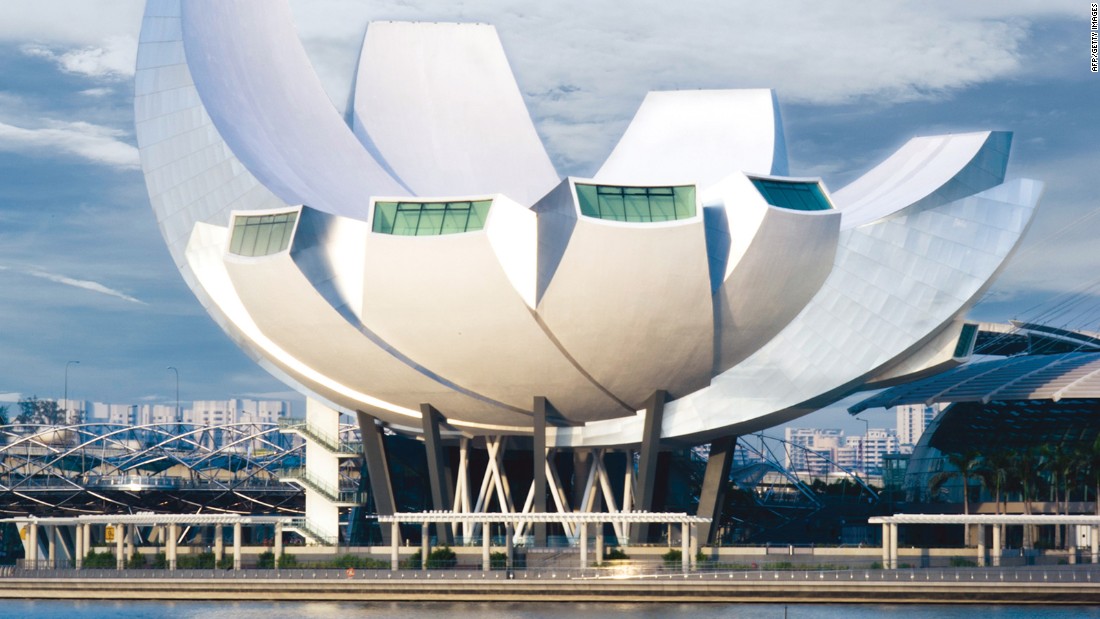
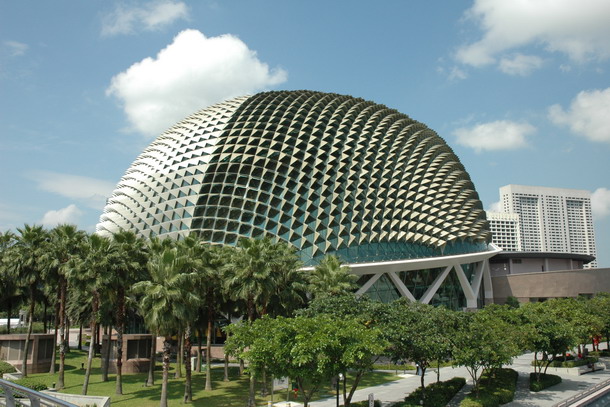
The area where the Marina Bay Sands hotel and casino is located is on infill. It’s the one that looks like a cruise ship plonked on top of three curving towers. Next to it are these fabulous tree-like structures filled with plants and a stylized lotus building, and the huge ferris wheel, currently the biggest in the world, is nearby. With this and the durian-shaped Esplanade theatre Singapore has methodically achieved its goal of having a recognizable skyline. It is just like the government to plan the whole thing out like in this way after, one assumes, envious comparisons to the spontaneous towers of Hong Kong, and build it up in a slow plodding way–but then have it actually work!
From what I have seen in staying here so long, after the sand is put in, the ground is usually firmed up by being planted with trees for a while, though apparently they also build concrete honeycombs to support it from beneath. Both Indonesia and Malaysia have become irritated by the expansion and have begun to withhold exports of sand, so that Singapore has to look further afield. Myanmar has no compunction about selling something that’s worthless to them. Singapore has created something I didn’t know about, namely a strategic sand reserve in Bedok. This is also the most Singapore thing ever. Looking ahead! 10-year plans for new public housing and new MRT lines to service them! It is a curious place. I recommend you do read the whole article though it is long. The stories of a man who has viewed all the changes from the water are very interesting for a different perspective than the one I see. It is a fascinating look at what a truly endangered nation will do when it takes the Anthropocene seriously.
One of the reasons I like blogging and opinion writing is that I’m better at thinking up ideas than at the hard work needed to turn them into properly researched journal articles, which is the core business of being an academic. So, it’s great when an idea I’ve floated in a fairly half-baked form in a blog or magazine article gets cited in a real journal article. Even better when it’s a colleague or, in this case, former colleague who cites me.
James Laurenceson, formerly of UQ and now Deputy Director of the Australia-China Relations Institute at UTS, has an article just out in the Australian Journal of International Affairs (paywalled, unfortunately, but well reading if you can get access), on Economics and freedom of navigation in East Asia, which cites a short piece I wrote last year and reproduced here. My key points were
* Contrary to many claims, China has no interest in blocking trade in the South China Sea, since most of it goes to and from China
* For the smaller volume of trade between other countries, the cost of taking a more roundabout route is so small that China could not exert any significant leverage by restricting access to the South China Sea
* There’s nothing special about this case. The whole idea that navies are vitally needed to keep sea lanes open is nonsense
Where I based the first two claims on a bit of Google searching and a couple of academic papers, James has developed the argument in convincing detail, addressing a wide range of possible counterarguments. If I could find someone to do the same thing for my third claim, I’d be very happy.
Would you like to watch a pro-natalist video from Singapore…and Mentos or something? The answer is sort of that you wouldn’t because it is the single most embarrassing thing in the world. It’s waaaaay more like the Lonely Island’s (awesome) song “I Just Had Sex” than it is like anything remotely appropriate as a domestic policy, er, proposal. But it is real. (Congratulations on the 50 years, Singapore!) I mean, you can see that it’s intended to be funny, yet…
“Aw yeah baby, I want to hang out in your void deck.” THIS WAS A REAL THING. There is a moment where you think, someone had to actively approve of this idea.
Lifted from YouTube comments (!) “Response by my London friends: ‘LOL That’s hilarious!’ Response by Singaporean viewers: ‘HAH? WHAT STROLLER? LIAK BO KIEW!’ It’s terrible when foreigners get the song more than locals. We have a terrible sense of humour.” This is not evidence of a lack of humour per se or anything other than being price-conscious IMO. Relatedly, I saw an ad for OCBC or something on Singapore Airlines: father and young son approach huge carousel and ticket booth manned by improbable moustachioed Irish fellow. “How much?” “One dollar and children under five are free.” “I’d like two tickets then.” Irish guy: “how old is your son?” “Six” Leaning in close, the Irish guy, “you know, you didn’t have to buy him a ticket. I never would have known.” “No,” says the dad looking down at his son’s gleaming, parted hair, “but he would.” I was kind of moved by this commitment to Asian values (I am a soft touch generally) until I realized the ad was ostensibly about a Singaporean refusing a free ticket. Just, no.
ETA: how exactly did they Iggy Azalea that accent up?
Important developments in Hong Kong, where students and citizens are protesting to get more democratic reforms. According to various internet reports (various posts at the BBC-website, Hufftington, Bloomberg), college and university students went on strike last Monday to protest Beijing’s decision to not allow open nominations for candidates for the 2017 elections in which the leader of Hong Kong would get elected. Protesters are worried that the closed nominations will mainly draw candidates who follow the Beijing line. From the perspective of an outsider, this seems like a textbook case of elections which will not be democratic if nominations themselves are not democratic.
The civil disobedience movement demanding more democracy is known as Occupy Central: the BBC has a short piece on the movement that helpfully explains their demands and gives some background information. Occupy Central is planning a multiple-day sit-in at Hong-Kong’s financial district starting October 1st.
According to the BBC, “most of China’s state-run media outlets have not commented directly on the student-led protests.” Which makes it all the more urgent and important that people-controled media, such as independent blogs like ours, share the news and talk about it. Consider this an open thread, for sharing views, information, insights and updates.
A story that has gotten weirdly little play in the US (I can’t speak for the UK press or the press in other countries) is the pushback by the ‘Big Four’ accountancy firms against the democracy movement in Hong Kong. On July 1, over 100,000 people marched in protest against Chinese plans to curtail democracy in Hong Kong. But the Big Four had not only made it clear that they didn’t like the protests – they had threatened that business would pull out of Hong Kong if the protests continued.
bq. The big four global accounting companies have taken out press advertisements in Hong Kong stating they are “opposed” to the territory’s democracy movement, warning that their multinational clients may quit the city if activists carry out threats to disrupt business with street protests. In an unusual joint statement published in three Chinese-language newspapers on Friday, the Hong Kong entities of EY, KPMG, Deloitte and PwC said the Occupy Central movement, which is calling for electoral reform in the former British colony, posed a threat to the territory’s rule of law.The group of pro-democracy activists is calling for 10,000 people to block traffic in the central business district as part of a campaign to put pressure on the Hong Kong government, although if and when this will happen is still under discussion. In the advert, the big four firms warned that protests would disrupt the Hong Kong stock exchange, banks and the headquarters of financial and professional services firms causing “inestimable losses in the economy”. It added that clients of the four firms had reflected further concerns about the wider impact of the protests: “We are worried that multinational companies and investors would consider moving their regional headquarters from Hong Kong, or indeed leave the city entirely. This would have a long-term impact on Hong Kong’s status as a global financial centre,” the joint statement said.
This is a quite remarkable initiative. It was published in Chinese rather than English – presumably both to speak more directly to potential protesters, and to make it less likely that it would seep into the English speaking press. According to one of the firms, it was pushed by local branches rather than the accountancy groups’ international management. Even if this is true, the statement is signed in the names of the firms and have not been publicly repudiated.
Of course, this isn’t the first shameful decision made by Western companies looking to build business in China – see Bloomberg’s squashing of a story on corruption among family members of senior Chinese leaders, or, for that matter, Rupert Murdoch’s instruction to Harper-Collins not to publish Chris Patten’s memoirs. But this goes substantially further than quiet acquiescence, to public and active opposition to the pro-democracy movement, and the issuing of threats intended to stifle it. It would be nice to see Ernst-Young, KPMG, Deloitte and Price-Waterhouse Cooper put on the spot by US politicians and journalists about their Hong Kong offices’ unrepudiated public statements opposing pro-democracy protestors.
The foreign workers in Singapore are divided by gender into two tasks and two entirely different ways of life. I talked below about the men, who do mainly construction, but also work on the oil refineries off the south coast. Women who are guest workers almost all work as domestic helpers, who live with the family for whom they work, and do a variety of tasks: cleaning house, cooking, taking care of children, taking care of elderly or disabled family members, washing cars, shopping at the wet market for fresh food like fish and tofu and eggs and fruit and vegetables, shopping at the grocery store for rice and noodles and frozen chapati and Marshmallow Fluff, etc. etc. Most are from the Philippines, but many are from Indonesia and some from Myanmar or Thailand–some must be from mainland China but I feel I never hear of them. Expats like me would hire them if they were from Beijing and spoke even rudimentary English, because then they could help our children better their Mandarin. Women from the Philippines are paid more, because they are likelier to speak better English and be better educated (not so uncommonly with a post high-school degree, like our first helper, who worked for us for nine years.) They are also paid more because the government of the Philippines has negotiated a minimum wage for them, as I understand it. Indonesian helpers are sometimes 18-year-old girls who have literally come straight from a village where they lived in a house with a packed earth floor, and then they are screamed at because they didn’t use the right setting on the washing machine. They go through training courses paid for by the maid agency, allegedly. I think this is more a spurious reason for the agency to make the fee paid by the workers higher (as in many places, the women often pay a multiple of their eventual monthly salary to the Indonesian agency that gets them a job in Singapore.) The government of Singapore requires employers of helpers to pay a levy of–mmm–$380? (One of those convenient internet banking things). Domestic helpers are now guaranteed one day off a week but only if contracts were signed in 2013; previously Filipina workers were guaranteed one day off a month–oooh, lavish innit–and workers from Indonesia and Myanmar…none. [click to continue…]
There was a truly unprecedented riot in Singapore’s Little India neighborhood last night. (Video report from the BBC, Channel News Asia, Al Jazeera’s good report.) Our family just moved house, out to the wilds of Bukit Batok (a lovely apartment, actually, next to the Bukit Gombak MRT). Up till October, though, we were living right up the road from the spot where it took place, like 700m away; we would have been able to hear the yelling no question, and the bus exploding with what I imagine would have been rather startling ease. The riot started when a private bus, driven by a Singaporean, struck and killed an Indian worker while backing up. The bus driver was injured in the riot, and the bus itself destroyed completely. There is video of the windshield being smashed, and later footage of the bus completely aflame, suddenly punctuated by the gas tank bursting. Ambulances and, later, police cars (?!?!?! there aren’t enough interrobangs to express my feelings about typing this sentence) were also turned over and torched. A number of policemen were injured in the riot, as were some rioters, but the police never fired on the crowd, and got things under control within two hours, and happily no one else died. The cops were able to get there in a hurry because the Tanglin Police Post (bigger than a station, and more important) is about 500m away. They’ve had a big photo on one of their recruiting ads for ages, on a banner on the side of the building, that shows a bunch of ethnically diverse police officers armed with riot gear and huge plastic shields. I used to think, whenever I rode past in the taxi, so exhausted from work and in terrible pain, at the end of a thirty minute drive, with my head fallen to one side and my cheekbone pressed flat on the glass like skinless chicken breast against the cold plastic in the butcher’s section, “well, they ain’t never going to get the chance to do that.” [click to continue…]
The NY Times has an interesting, but unsatisfactory, article, on government attempts to promote urbanization in China, with a target of 70 per cent by 2025. The story is mostly about farmers whose land has been acquired by fiat, which fits into well-established journalistic frames. The bigger issue, buried right near the end, is the fact that, under the hukou system of registration, people classed as rural can’t legally live in the city. So, while about 35 per cent of the population is legally urban, the true figure is more like 53 per cent. That makes nonsense of the figures quoted at the beginning of the article, and the suggestion of forced urbanization on a historically unparalleled scale. In reality, the announced target implies a modest slowdown in rural-urban migration, which occurred despite official disapproval.
The big question, at least from the viewpoint of rural Chinese, is whether China can shift to a universal social welfare and retirement income system to replace the workplace-based system of social welfare, of which hukou was part, and which made sense with comprehensive state ownership. This topic is touched on in the NYT article, but in a fragmentary and confusing way, and it’s one about which I know little. I’d be grateful if anyone could point to a more comprehensive treatment.
From an Australian point of view, the continued construction of high-rise apartment buildings, highlighted in the article, is a big deal, since it drives much of the demand for steel, and therefore iron ore and coking coal, that has underpinned our amazing run of good economic fortune, along with the willingness of both Australian and Chinese governments to implement large-scale fiscal stimulus at the time of the global financial crisis.
I’m in Madrid at the moment for the annual meeting of SASE, the “Society for the Advancement of Socio-Economics ” (the main organization for economic sociologists). One of the panels tomorrow is an author-meets-critics session on Gary Herrigel’s recent book, _Manufacturing Possibilities._ While I won’t be on the panel, I have written a review of the book, which Gary has in turn responded to – both are below the fold. The review and response are also available in PDF form if you prefer to read it that way.
I’ve written a long review essay looking at Benedict Anderson’s _Under Three Flags_ and James Scott’s _The Art of Not Being Governed_ which has just gone up at _The American Interest._ In an ideal world, I’d have preferred to have written a bit more on Scott (whose book is a classic, and beautifully written to boot), and a bit less on Anderson (whose book has much of interest, but is not a new Imagined Communities), but the Anderson book fit better with the purpose of the review, which was to think about the prospects for anarchism in the modern world. I’m grateful to Scott McLemee for reading an early draft, and rescuing me from error on a few key points (Scott is absolved from any further responsibility though, and likely does not agree with everything I have to say).
bq. On August 8, 1897, Michele Angiolillo, an Italian anarchist, shot Antonio Cánovas del Castillo, the Prime Minister of Spain. Cánovas had dominated Spanish politics for decades, even during periods when he was nominally out of office, helping shore up Spain’s tottering monarchy and its possession of Cuba and the Philippines through torture and wide-scale military repression. Spanish imperialism in the Americas died with him: Cuba and the Philippines soon drifted out of Spain’s sphere of control and into that of the United States. A bullet from an anarchist’s pistol had changed global politics.
This Financial Times story on how petitioners to the Chinese government are treated is extraordinary.
Those gathered there are from the country’s downtrodden, people with grievances against the government who have made their way to the capital to petition China’s modern-day mandarins. When the crowd spots a foreign journalist, many rush forward waving their petition documents and shouting their grievances: “My daughter was murdered and the police did nothing,” says Yan Zizhan, a petitioner from Henan province. “I was beaten up by officials from the family planning department because I wouldn’t have sex with one of them,” says Liu Zhongwei, from Shandong province.
… in the absence of democracy or an independent legal system, the Communist party relies on a 3,000-year-old pressure release valve known as the “petitioning system” to deal with dissatisfaction among the masses. … There is no substantial difference between today’s petitioning system and the system in place 1,000 years ago,” according to Xu Zhiyong, a Beijing-based lawyer and human rights activist who, like many in China today, say the petitioning system is broken and needs to be abolished. “The three essential elements – the emperor, the officials and the injured citizens – have the same relationship. The emperor wants to resolve a portion of the people’s grievances so as to maintain the stability of his regime but the officials have their own interests to think about.”
… Visitors to this office soon notice the heavy-set men in civilian clothes watching the crowds of disgruntled petitioners. Known as jiefangren, or petition interceptors, they are government officials, police officers or sometimes just hired thugs sent by regional and provincial governments to repatriate petitioners before they cause a fuss in the capital. … Over months of interviews, the Financial Times heard numerous accounts and witnessed several examples of officials from the Offices of Letters and Calls or Beijing police working in collusion with interceptors to help detain and abduct petitioners. When interceptors identify people from their region outside the petition office, they approach them and try to get them to return home quietly, ostensibly so their grievances can be “resolved” locally.
ome petitioners are promised quick fixes to their problems; others go willingly in the hope of a free trip home or a place to stay while in Beijing. Those who refuse to accompany these men are usually taken by force. Often they are taken to detention centres operating like private prisons and known as “black jails”. Mr Xu says: “Black jails are places used by provincial governments to illegally imprison petitioners; we call them black jails because, first, they are just like prisons – established by the government to restrict people’s freedom – and, second, they are ‘black’ because they have no basis in any laws or regulations and are totally illegal.” Such facilities exist all over China but especially in Beijing, where they are often no more than a few rooms in a hostel or an unused warehouse. Once detained, petitioners can be subjected to “thought reform” and “re-education” techniques that range from cajoling and threats to extortion, beatings and outright torture.
I have a Bloggingheads on the Mumbai attacks with Sumit Ganguly, an expert on Indian politics at University of Indiana. Since Sumit, unlike me, knows a whole lot about the background and likely consequences, the format is more like an interview than a dialogue. Click below to see it (or here for the home site).
The _New York Times_ has a story suggesting that Bill Clinton cozied up to Kazakhstan president Nursultan A. Nazarbayev in order to help out a big donor to the Clinton Foundation.
Unlike more established competitors, Mr. Giustra was a newcomer to uranium mining in Kazakhstan, a former Soviet republic. But what his fledgling company lacked in experience, it made up for in connections. Accompanying Mr. Giustra on his luxuriously appointed MD-87 jet that day was a former president of the United States, Bill Clinton. … the two men were whisked off to share a sumptuous midnight banquet with Kazakhstan’s president, Nursultan A. Nazarbayev, whose 19-year stranglehold on the country has all but quashed political dissent. … Mr. Nazarbayev walked away from the table with a propaganda coup, after Mr. Clinton expressed enthusiastic support for the Kazakh leader’s bid to head an international organization that monitors elections and supports democracy. Mr. Clinton’s public declaration undercut both American foreign policy and sharp criticism of Kazakhstan’s poor human rights record by, among others, Mr. Clinton’s wife, Senator Hillary Rodham Clinton of New York.
… Mr. Giustra also came up a winner when his company signed preliminary agreements giving it the right to buy into three uranium projects … monster deal stunned the mining industry, turning an unknown shell company into one of the world’s largest uranium producers …In a statement Kazakhstan would highlight in news releases, Mr. Clinton declared that he hoped it would achieve a top objective: leading the Organization for Security and Cooperation in Europe, which would confer legitimacy on Mr. Nazarbayev’s government. “I think it’s time for that to happen, it’s an important step, and I’m glad you’re willing to undertake it,” Mr. Clinton said.
I don’t imagine many readers will be shedding tears at the death of former Indonesian dictator Suharto, and certainly I won’t be. The bloody massacres in which he rode to power amid the collapse of the Sukarno regime, and the brutal invasion and occupation of East Timor, not to mention his spectacular corruption, mark him down among the worst political criminals of a terrible century. Like some other dictators, he managed some significant successes in economic management, but overreached himself in the period leading up to the Asian economic crisis if 1997, which brought his downfall from power. Unfortunately, hostility to the Suharto regime has coloured attitudes to Indonesia in the decade since his fall from power, certainly in Australia and I suspect elsewhere.
In fact, Indonesia has been remarkably successful in dealing with what was, in many respects, a poisonous legacy from the Suharto era. [click to continue…]