Bit of a joke there. What the paper is about is, we found a new planet, about 18.2 light years away. That means that we’re seeing the planet as it appeared 18.2 years ago, in the summer of 2007.
Summer 2007: the first iPhone had just hit the market, the last Harry Potter book was fresh on the bookshops, Rihanna’s “Umbrella” was all over the radio, and “The Big Bang Theory” was about to premiere on TV. Britain’s Tony Blair had just handed off to Gordon Brown, while in the US a freshman Senator named Barack Obama was quietly preparing his Presidential bid. And the world economy was sliding inexorably towards the Great Recession.
Anyway, the planet. The planet is a “Super-Earth“. That means it’s basically the same sort of planet as Earth: a ball of rock, probably with an iron core, possibly with an atmosphere. But it’s bigger than Earth, hence the “Super”. Like, if the Earth was a golf ball, this planet would be more like a cricket ball or a baseball. Definitely bigger, but not so much bigger that it’s a different sort of thing.
Okay, so we’ve found lots of planets around other stars. Like, literally thousands of them. And we’re finding more new planets every day. So what’s interesting about this one?
[this shows something like one quarter of the currently known planets. and yes, that lower right one is not a proper sphere.]
Well… maybe a couple of things. But first, a brief digression!
[click to continue…]
From the category archives:
History of Ideas
A few weeks ago the historian Perry Anderson published an essay “Regime Change in the West?” in the London Review of Books. Like many of Anderson’s essays this is a wide-ranging splurge full of bon mots and *apercus” delivered from some quasi-Olympian height. My attention was caught, though, by the following couple of sentences which both expressed a widely-held belief, even a cliché, but one which I knew to be false despite the lazy “of course” which Anderson interjects:
Historically too, of course, the US is an immigrant society, as no European country has ever been [emphasis added]. That means there is a tradition of selective welcome and solidarity for newcomers that doesn’t exist at anything like the same emotional pitch in Europe.
The reason I knew this to be false is that, unlike Anderson, I had taken the trouble in my own (non-historical) work on immigration to read the work of France’s foremost historian of the phenomenon, Gérard Noiriel in his now-classic work, Le creuset francais: histoire de l’immigration (XIXe-XXe siècle) (Seuil, 1988). In his opening chapter “The dismissal of memory”, Noiriel addresses both the facts and the myth, pointing out that while in the US immigration is understood as an “internal” part of the constitutive history of the nation, in France it has been treated as something episodic and external. But when you look at the facts, immigration has played as much of a role, and perhaps more, in French society as American.
Political philosophers are criticised for their idealism, but when it comes to immigration they try to be ‘realistic’. Their aspiration to ‘realism’ often leads to nationalism (which I have analysed elsewhere as an implicit but heavy bias), but I still don’t understand why they aspire to realism on this issue. Philosophers have neither voters to attract, like the politicians, nor believers to bring to church, like the Popes.
Why are Popes far more progressive than philosophers on the issue of migration?
[click to continue…]
Here are two groups of Western philosophers. We’ll call them Group A and Group B. Here’s Group A:
Plato, Epicurus, Plotinus, Aquinas, Duns Scotus, Francis Bacon, Hobbes, Locke, Spinoza, Newton, Leibniz, David Hume, Herbert Spencer, John Stuart Mill, Schopenhauer, Kant, Kierkegaard, Nietzsche, Wittgenstein, Jean-Paul Sartre, Kurt Gödel, Karl Popper, Jeremy Bentham, Alan Turing, Saul Kripke.
And here’s Group B:
Aristotle, Socrates, Descartes, Bishop George Berkeley, Rousseau, Heidegger, Hegel, Marx, Frege, Bertrand Russell, John Dewey, Albert Camus, Frantz Fanon, John Rawls, Willard Quine.
Okay, so: what distinguishes these two groups?
Answer under the cut, but… stare at those two lists. Take a moment; give it a try. Do you see it?
Hints: It’s something pretty straightforward. Frege is an edge case. And while Rousseau is formally part of Group B, he really belongs with Group A.
If you have a guess, put it in a comment, then come and look. [click to continue…]
Within pretty broad limits[1], I’m an advocate of historical ‘presentism’, that is, assessing past events and actions in the same way as those in the present, and considering history in relation to our present concerns. In particular, that implies viewing enslavers, racists and warmongers in the same light, whether they are active today or died hundreds of years ago.
A common objection to this position runs along the lines:
Suppose that at some point in the future, the vast majority of people are vegans. They will judge you in the same way as you judge past enslavers, racists and warmongers. In anticipation of this, you should suspend judgement on people in the past.
I don’t buy this.
[click to continue…]
I’ve just finished Erin Pineda’s Seeing Like an Activist: Civil Disobedience and the Civil Rights Movement (Oxford University Press, 2021), and it is a very welcome addition to the literature on both civil disobedience and the history of the US civil rights movement that anyone interested in either topic should read. Pineda is keen to push back against a particular liberal constitutionalist theory of civil disobedience, associated with Bedau and Rawls that purports to draw on the US civil rights movement but which, according to her, ends up both falsifying the history and provides succour to a narrative about civil rights that is used to discipline subsequent movements (such as Black Lives Matter) as failing to live up to the standards set by the activists of the 1960s. That narrative and theory also supports what we might call a form of soft white supremacy, according to which a nearly-just republic composed largely of white citizens was already in place and the task of civil disobedience was to communicate the anomalous exclusion of black Americans from the polity, so that white citizens, apprised of this injustice and stricken by conscience, would act to rectify things.
This standard liberal narrative around civil disobedience has fidelity to law and an acknowledgement of the basic justice and legitimacy of the established order at its heart. The task of civil disobedients on this view is to act non-coercively and non-violently but to break the law (a bit) only to raise the awareness of citizens considered as fellows who are thought of not as themselves implicated in the injustice but as basically good people who would act if only they knew. The civil disobedient on this view submits willingly, even eagerly, to punishment in order to testify to injustice whilst also accepting the shared framework of law. The tacit framework here is also a nationalist one (or at least a statist one) of shared co-operation among fellows who want to establish a just order on national territory together.
[click to continue…]
I was reading a book on migration ethics recently – I may write a review later 1 — and it reminded me how a certain picture of the normal liberal state and its place in the world figures in a lot of political philosophy. Although the normative arguments are supposedly independent of historical facts, history is to be found everywhere, but only in a highly selective version that reflects the dominance of the United States within the discipline and the prominence of prosperous white liberals as both the writers of the important texts and as the readers and gatekeepers. 2 Their assumptions about the world and the US place in it shine through and form a "common ground" that is presupposed in much of this writing.3
In this vision, all the world is America 4 — though not one that corresponds to the actual history of the US — and the rest of the world mostly consists of little proto-Americas that will or should get there in the end (thereby echoing Marx’s dictum that the more developed country shows the less developed one a picture of its own future). This imaginary, but also not-imaginary, state is a sort-of cleaned-up and aspirational version of the actual one, cleansed of embarrassing details that are mere contingencies that detract or distract from what US liberals suppose to be its real essence or telos. Crucially, it is also considered as a basically self-contained entity, where all the important relationships are ones among people on the territory.5 It is an association of free and equal persons that has simply arisen on virgin soil. Both the actual United States and other countries fall short of this model, of course, but with time and good will wrinkles and carbuncles will be removed. 6
It took me so long to find this quote. I remembered that it was Solovki, yes! And that Maxim Gorky was the visitor! And the tortures with the logs, and being staked out for the mosquitoes, and rolling the prisoners down the stairs, and the brave boy who told all, all! to Gorky and was left behind to be shot the moment Gorky’s ship left the horizon empty and barren! And the tarps. But could I find the quote? I damn sure could not. I was in the position of Edward Gorey’s Mr. Earbrass who starts up in the night having thought of the perfect lines for an epigraph: “His mind’s eye sees them quoted on the bottom third of a right-hand page in a (possibly) olive-bound book he read at least five years ago. When he does find them, it will be a great nuisance if no clue is given to their authorship.”
I had to read before and after many instances of the mention of Gorky I will tell you what. But virtue prevailed! The Solovetsky Archipelago is almost certainly what the name of the Gulag Archipelago comes from, as Solzhenitsyn considered it the mother of the Gulag, and the primary site before the cancer metastasized. The Soviets, eager to show that the camps are actually rather nice if you think about it sent Maxim Gorky to investigate. He was newly-returned to the Soviet Union and probably disinclined to rock the boat which currently supplied him with some vast apartment and a dacha (irrelevantly, haven’t we all sort of wanted a dacha? They sound great. Perhaps Trump will get one eventually.)
Attention conservation notice: long (nearly 5,000 words long) essay on the economic power of ideas. To its credit, the questions discussed are plausibly important. To its detriment, the arguments are less arguments than gestures, and the structure is decidedly baggy.
For the last couple of weeks, I’ve been wanting to write a response to Aaron Major’s (paywalled) article on ideas and economic power for _Catalyst._Â Now there’s a second piece by Jeremy Adelman in _Aeon_ on Thomas Piketty and Adam Tooze. I think they’re both wrong, but in different ways. Major’s piece suggests that economic ideas don’t really matter very much – it’s the economic base, not the superstructure that’s doing the work. Adelman, in contrast, think that ideas are super important – he just thinks that Piketty and Tooze have ones that are leading us in the wrong direction.
These arguments come from radically different places, but they have one thing in common. They both substantially underestimate the role that ideas have played in getting us to where we are on the left, and what they they’re likely to do for us in the near future. [click to continue…]
Jacob Hamburger has an article in the LA Review of Books on the “Intellectual Dark Web” which is really very sharp, but ends up in the wrong place. [click to continue…]
This New York Times profile of Jordan Peterson is a masterful exercise in giving the subject sufficient hemp to twine into rope and then loop around his neck. This bit provides a nice excuse to talk about one of my favorite books in the social sciences.
Mr. Peterson illustrates his arguments with copious references to ancient myths — bringing up stories of witches, biblical allegories and ancient traditions. I ask why these old stories should guide us today.
“It makes sense that a witch lives in a swamp. Yeah,” he says. “Why?”
It’s a hard one.
“Right. That’s right. You don’t know. It’s because those things hang together at a very deep level. Right. Yeah. And it makes sense that an old king lives in a desiccated tower.”
But witches don’t exist, and they don’t live in swamps, I say.
“Yeah, they do. They do exist. They just don’t exist the way you think they exist. They certainly exist. You may say well dragons don’t exist. It’s, like, yes they do — the category predator and the category dragon are the same category. It absolutely exists. It’s a superordinate category. It exists absolutely more than anything else. In fact, it really exists. What exists is not obvious. You say, ‘Well, there’s no such thing as witches.’ Yeah, I know what you mean, but that isn’t what you think when you go see a movie about them. You can’t help but fall into these categories. There’s no escape from them.”
It was the 200th anniversary of the birth of Karl Marx a couple of days ago. I planned to repost my series from 2011 on “Marxism without Revolution”, but didn’t get to it. I was reminded when Matt Yglesias mentioned it on Twitter, so here it is, in three parts.
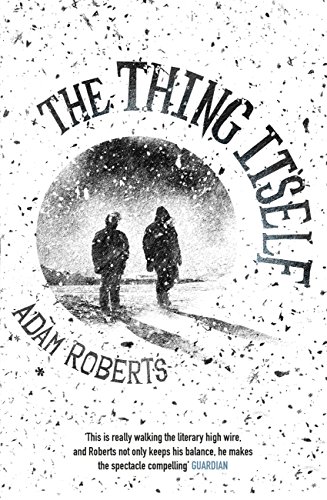 Last week I finished Adam Roberts SF novel, The Thing Itself [amazon]. (Adam is, you may have noticed, a regular commenter here. I’ve been friendly with the dear fellow for years.)
The mash-up joke at its heart: it’s The Thing (you know: the John Carpenter film, remake of the 1950’s film, adaptation of the John W. Campbell, Jr. novella, “Who Goes There?“) meets Kant’s Ding An Sich!
That’s a good joke! I like jokes like that. Adam likes jokes like that. I haven’t read as many of Adam’s novels as a good friend should, but the author of a humorous sequel to The Brick Moon, and a little thing called Twenty Trillion Leagues Under The Sea, likes to take an idea, give it a spin. Just drop it. See how low it can go.
Back to The Thing Itself. What if Kant were on to something? Some Thing. What would the possibilities be, for space travel, for sanity, for commerce, for common-sense, if we could sidestep, as it were, space and time? (I don’t think this is going to satisfy sticklers for Kant scholarship, but attempts are made to keep up the conceit. Fiction often involves implausible leaps, as many important writers have noted.) [click to continue…]
I’m writing something introductory (intended for a general audience) about ‘themes’ in literature. Obviously my theme must be that the term is a bit hopeless until you say what you mean by ‘theme’. I’m thinking of introducing it with reference to memories of writing book reports in 6th grade (I think it was.) Mr. Lofton’s (?) class at McCornick Elementary. (Or was he my 5th grade teacher? Can’t remember.)
Anyhoo: it was requisite, on pain of getting no credit for your report, that you correctly check one or more box(es) for ‘theme’. There were exactly four options:
Man vs. Man
Man vs. Nature
Man vs. Society
Man vs. Self
That’s all there is, there ain’t no more!
(Sorry, ladies! It was the 70’s, and Ms. was a magazine, but you got no love when it came time for themes.) [click to continue…]
Last night I watched Citizen Jane, a recent biopic about Jane Jacobs and her long fight against Robert Moses’s plans for New York. Of course, Jacobs was largely correct: Moses’s grand utopian schemes wrecked the ecologies of street and community and eventually produced neighbourhoods worse than the ones they replaced, whilst failing to solve even the problems, like traffic congestion, they seemed best suited to. But being already familiar with the substance of the dispute, and with Jacobs’s great work, *The Death and Life of Great American Cities*, what struck me most forcefully was the rhetoric. On the one hand, there were the self-proclaimed “experts”, on the other, ordinary people with their lived experience, sceptical about whether the “experts” had their best interests at heart (or if they did, whether they shared the same conception of their interests). A great irony of the Jacobs case is that though she was right about Moses and his plans, the net result of her activism has not been, in the end, to preserve those neighbourhoods for the kinds of people who lived there then, but rather to give them an afterlife to be enjoyed by the people who can now afford to live in them.