I’m sure I’m not capable of putting the point better than Flying Rodent:
bq. Let’s say you were a cartoonish, Ahmadinejadesque lunatic fixated on destroying Israel. How would you go about achieving your goal?
Read the rest.
From the category archives:
I’m sure I’m not capable of putting the point better than Flying Rodent:
bq. Let’s say you were a cartoonish, Ahmadinejadesque lunatic fixated on destroying Israel. How would you go about achieving your goal?
Read the rest.
I’ve seen The Hurt Locker and Green Zone within a few days of one another. Purely as a piece of cinema, The Hurt Locker is probably the better film, but politically it is nowhere, and indeed it suffers from the same syndrome as many Hollywood Vietnam pictures – they are all about Americans and how they feel, and the poor natives appear as mere ciphers. Not so Green Zone, where the Iraqis appear as persons in their own right, with interests, feelings, grudges, agendas. Green Zone is, in some ways, a pretty crude film, and there’s a striking disconnect between the late-Bourneish style and the anti-war substance. Still, if that gets a broader audience remembering and thinking about what happened, and what went wrong, and why, that’s no bad thing. In the credits at the end, I was surprised to see “Based on _Imperial Life in the Emerald City_ by Rajiv Chandrasekaran”. I’m not sure what the necessary and sufficient conditions for the “based on” relation are, but this is not that distant from saying that the latest Bond movie is “based on” the official history of MI5 (although to be fair, the account of the pathologies of the CPA is recognizably, though distortedly from _Emerald City_). One thing that both book and movie reminded me of is this: that the cheerleaders for the war (be they neocon or “decent left”) didn’t just applaud the invasion. The awfulness of Saddam was such that being pro-war in 2003 was wrong but perhaps forgiveable and — as some of the barely repentant cheerleaders keep reminding us — was sometimes motivated by moral motives. They also applauded or excused the really bad post-invasion fuck-ups: the failure to control looting, deBaathification, the dissolution of the Iraqi army, etc. So thanks to Rajiv Chandrasekaran, Paul Greengrass and Matt Damon for keeping a light shining on that.
The blogosphere was very exercised about the arguments for and against war in Afghanistan and Iraq, but as both conflicts have dragged on there has been less sustained attention given to the developments within those countries. Still, a trip over to Amazon presented me with a list of possible books to read about Iraq, the invasion, the occupation, the current situation, etc. Not so for Afghanistan where the top choice was an updated edition of a book first published in 1981 ( _Afghanistan: Land of Conflict and Beauty: A History of Conflict_ by John C. Griffiths). So is there anything? (And if not, why not?)
From the New York Times:
bq. The alliance of Interior Minister Jawad al-Bolani held the largest rally in Baghdad to date, with hundreds filling a large outdoor soccer stadium on Saturday. But it was not exactly a show of overwhelming public support. Many in the crowd were police officers employed by Mr. Bolani’s ministry. One officer, speaking on the condition of anonymity, said his battalion had been ordered to attend. The event was as notable for security as it was for political theater. Iraq Army helicopters circled low overhead, American Apaches higher in the sky. Streets were closed in all directions, snipers lined rooftops and each candidate had his own security detail, forming a phalanx around Mr. Bolani’s tent, a sea of machine guns and stony stairs. At the end of the rally, doves were released as a symbol of peace. Unfortunately, they were set free just as fireworks burst in the sky, catching many birds in the cross-fire.
Sometimes a thought occurs about something that might make for an interesting blog post, but I realise that whilst I know enough to have the thought, I’d have to do a great deal of research to write something that would survive the scrutiny of people who know their stuff. Still, it may be that commenters who know more than me can say something of value, and that I could at least serve as a prompt. So here goes. An article on the BBC website discusses the recommendations of a French parliamentary committee which described the veil as :
bq. “contrary to the values of the republic” and called on parliament to adopt a formal resolution proclaiming “all of France is saying ‘no’ to the full veil”.
Hmm, I thought. It wasn’t so long ago that “all of France”, at least for some values of “all of France” had a more divided view about the veil. Roughly at this time, in fact:
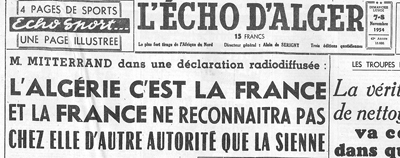
(Picture nicked from the very excellent Images of France and Algeria blog, which has, incidentally, lots of interesting stuff on the 1961 Paris massacres of Algerians.)
But then I also remembered that official France had not, in fact, been very tolerant of the veiling of Algerian women. The photographer Marc Garanger is famous for his many pictures, taken during the war, of Muslim women forcibly unveiled so that they could be photographed for compulsory ID cards. There are some here . So how did that all work out then? A little googling reveals that this very month, historian Neil MacMaster has a new book entitled _Burning the Veil: The Algerian war and the ’emancipation’ of Muslim women, 1954-62_ (Manchester University Press). I couldn’t find any reviews, as yet. The blurb writes about a campaign of forced modernisation followed by a post-revolutionary backlash involving a worsening of the position of women in Algeria.
So two thoughts then: (1) far from being an aberration in France, there was a very recent period when very many French women (or perhaps “French” women) were veiled; (2) attempts by the state to change that didn’t lead to female emancipation and the triumph of Enlightenment values.
When I read the _Financial Times_ review of Joris Luyendijk’s _People Like Us: Misrepresenting the Middle East_ last year, I knew it was a book I wanted and needed to read (Australian title is _Fit to Print_). So I placed an order on amazon.uk that very morning. But it never came and I only just got my hands on a second-hand copy. Amazon (US and UK) are both listing it as out-of-print. Which is a pity, because you need to read it too. Some of it will be familiar to intelligent and well-informed people: of course we _know_ things work like that. But it is hard to keep the knowledge one has of the news process in view, when watching TV, reading the papers, listening to the radio over breakfast. Luyendijk will, at the very least, do the necessary job of keeping us sensitized.
[click to continue…]
In August, the Erasmus University Rotterdam fired Professor Tariq Ramadan. Well, strictly speaking, they didn’t fire him, but rater withdrew the invitation to be a guest professor. Since December 2006 Ramadan had a contract with the City Council of Rotterdam to advise the City Council on civic integration & multicultural policies (about half of the population in Rotterdam is not from Dutch origin and the city has enormous socio-economic-cultural problems). At the same time he was invited as a guestprofessor at the Erasmus University for the same period (allegedly he had asked for this affiliation himself when he was asked to work for the City Council). So legally speaking in August the City Council fired him, and at the very same moment the University withdrew its invitation to be affiliated as a guest professor. Yet for what follows, I don’t think this legal quibble is very relevant. From an ethical-political point of view it remains a dismissal. The question is: was this dismissal justified?
[click to continue…]
Goldstone’s report on Cast Lead is out. Google blog and news searches show that the people who were always going to say “It’s not trooo!” (and worse) have begun to do so in large numbers. So it goes.
I forgot to note a very special anniversary yesterday. April 22nd is the date on which Charles Krauthammer opined:
Hans Blix had five months to find weapons. He found nothing. We’ve had five weeks. Come back to me in five months. If we haven’t found any, we will have a credibility problem.
You’ve now had six years. How’s that credibility looking?
I mentioned last week that I’m reading Nancy Rosenblum’s On the Side of the Angels: An Appreciation of Parties and Partisanship (Powells, Amazon). The final chapter, “Banning Parties,” has a valuable discussion of the normative implications of party bans, which speaks extensively to the Israeli example.
First, contra arguments such as those contained in this typically disingenuous post by Jamie Kirchick, it draws a clear distinction between banning hate parties (which Rosenblum argues is, within certain limits, a reasonable form of democratic self-defence) and banning parties that are threats to national identity (which Rosenblum argues is not a form of democratic self-defense). Rosenblum speaks to the rationale for Israel’s ban on the Kach party, which called for the forced ‘transfer’ of Arab ‘cockroaches’ from Israel, and sought to ban Arab-Jewish intermarriage. [click to continue…]
David Velleman (NYU, Philosophy) observes (in an email to me) that CNN is describing the Israeli killing of civilians in Gaza as “unintentional” (he didn’t give me a link, but I believe him, and no doubt one of you will supply it). He continues:
As a philosopher of action, I say that this description
is false.The Israelis knew that they would would cause civilian casualties vastly
disproportionate to the Israeli civilian casualties that they are trying
to prevent. They have accepted those Palestinian deaths as a cost of
pursuing their ends, and hence as part of a “package deal,” all of which
is intentional on their part.I know that the Catholic doctrine of “double effect” would excuse these
killings as unintentional. But the doctrine of double effect is bad
philosophy.Look at it this way. The Israeli authorities are not trying to get their
own soldiers killed; they are trying to minimize harm to Israeli forces.
But should it turn out (god forbid) that their incursion results in
disproportionate Israeli losses, and that they antecedently knew it
would, they will rightly be held responsible for having struck a bad
bargain, intentionally incurring costs too great for the anticipated
benefits. In such a case, they would not dare to plead “double effect”.So it is with killing of Gazan civilians, which is clearly intentional.
I’m not a philosopher of action, and I’m also not the kind of philosopher that gives common sense much weight in trying to discern the philosophical truth. But the doctrine of double effect has always seemed to me to be one of those things which is deeply counterintuitive to common sense, for reasons illustrated in Velleman’s email, and is a case where philosophers ignore that unease that common sense suggests at their peril.
Much of the blogospheric chatter about “proportionality” in warfare has been characterized by disinformation of a rather systematic kind. That was the case in the recent Lebanon war, and it is happening again during the current Israeli operation in Gaza. At Opinio Juris, Kevin Jon Heller does an excellent job of explaining the legal issues by way of what it would be absurdly ironic (in this context) to call a thorough “Fisking” of Alan Dershowitz. As Brian Leiter (via whom) points out, the moral issues are also significant.
Update: I found this BBC article about who is legally entitled the benefit of the principle of noncombatant immunity quite useful.
It’s quite depressing that 2008 had to end with this kind of violence in Gaza. On the 29th I signed the petition for a ceasefire that Avaaz initiated. I’m glad to see that by now more than 170,000 people worldwide are calling upon all involved parties to agree to a ceasefire. I am enough of a pessimist to seriously doubt that it will make any difference to what happens on the ground, but still. Sometimes one acts even when one finds it hard to believe that it will make a difference.
Luckily 2008 also had some wonderful moments of hope. For many Americans the election of Obama has been such a moment. One of the most touching Obama-related things I saw was when I visited South Africa during the second half of November. I am involved in a research-action project in Capetown in a township called Khayelitsha. My input in that project is merely philosophical/theoretical, and has so far been from a (physical) distance, so one of the main purposes of my visit was to get to know the women in the townships that are part of this project. One of them, Vivian Zilo has founded the Iliso Care Society which serves nutritious soup to the poorest, and especially to those who need to eat so that they can take their TB or HIV medication. Inside the house of Iliso were several newspaper clips on the walls, some about Iliso, some about local events. But in a prominent central place were a few about Obama, taken from South African Newspapers. Editorials in those newspapers wrote optimistic columns about the significance of Obama’s election not just for the US but for the prospect of a better world, and of course also for the position of black people. Parallels were drawn with what South Africans could do to make their country a better place to live.
Enough Bloggers here and elsewhere have warned us to be realistic about what Obama will be able to deliver – still it was really heart-warming to see how people can be inspired by an event that takes place thousands of miles of where they live, and even if they live in a situation in which many of us would have lost all hope for a significantly better life altogether. The strength and energy and optimism of some of these women from Khayelitsha were striking. So I hope 2009 will bring us more of such hopeful events, more than in 2008, and more than those events where many have lost all hope to reach a just and sustainable solution. Happy new year!
From Inside Higher Ed today
The missteps in Iraq are well documented by now. … Among those success stories is the American University of Iraq, a Western-style institution in the war-torn country’s northern region that promises to “lead the transformation of Iraq into a liberal and democratic society. … The university’s lofty aspirations, as espoused on its Web site, make the selection of its first chancellor all the more puzzling. Owen Cargol, who took the helm at AU-Iraq in 2007 and resigned in late April of this year, had a checkered past that could have been revealed to university organizers with a simple Google search.
… Cargol’s 2001 resignation stemmed from allegations made by a Northern Arizona employee who alleged that Cargol, while naked in a locker room, grabbed the employee’s genitals, the Arizona Republic reported. In a subsequent e-mail to the employee, Cargol described himself as “a rub-your-belly, grab-your-balls, give-you-a-hug, slap-your-back, pull-your-dick, squeeze-your-hand, cheek-your-face, and pat-your-thigh kind of guy.” Cargol, who at the time was a married father of two children, went on to say that he was a “sensual kind of guy” who hoped the employee could “feel comfortable enough with me (and others) to reciprocate the same level of playfulness and affection,” the newspaper reported.
I’ve received an email from the political science department at King Saud University about the detention and imprisonment without charge of one of their colleagues, Matrook Al-Faleh, asking “all political science departments and civil society organization to exert all their pressure upon the Saudi government to release” Al-Faleh and other prisoners. The likely reason for the arrest is that Al-Faleh (who has protested in the past against torture and prison conditions in Saudi Arabia) had written a general email criticizing conditions at Buraida General Prison. Human Rights Watch has more here. The letter itself is after the fold.