Today I’d like to talk about that delightful little companion of field and garden: the shrike.

[copyright Rosemary Mosco, 2024, birdandmoon.com]
If you know, you know. And if you don’t know… well, let’s talk about shrikes.
[click to continue…]
From the category archives:
Today I’d like to talk about that delightful little companion of field and garden: the shrike.
[copyright Rosemary Mosco, 2024, birdandmoon.com]
If you know, you know. And if you don’t know… well, let’s talk about shrikes.
[click to continue…]
The blue-ringed octopus! An elegant little creature, native to the southwest Pacific, particularly the waters around Australia. Pretty to look at… but mostly famous for being very, very venomous. The blue-ring’s bite is deadly. A single sharp nip can kill an adult human in minutes.
But why? The blue-ring is a modest little creature that lives in shallow water, preying on small fish and crustaceans. A bite that can paralyze a 10 gram fish or a 20 gram crab, sure. A bite that can kill a 70 kilogram human dead? What’s the point of that?
Well: the good news is, a recent paper has discovered just why the blue-ringed octopus is so deadly. The bad news is… um, it’s kind of disturbing.
Trigger warning for sexual assault, cannibalism, and existential horror. I am not kidding.
[click to continue…]
 We visited the Cave of Pech Merle yesterday, which is famous for its prehistorical paintings of bisons, mammoths, horses, and other animals. Those paintings have been made by people who, according to our guide, were almost identical to us, except, she said, that they were taller than us – on average 1 meter 85 centimeter. Pech Merle has a website that is a bit slow (at least, given my present internet-conditions), but it has a very interesting part where you can enter the cave virtually.
I’ve visited many caves in my life, but never one with prehistorical paintings, and was very impressed. If you ever get a chance to see them, do go see them! Although the crown piece of the cave are two dotted horses, which are large and in excellent condition and include something of an optical illusion (avant la lettre?) — I was especially touched by the painting of the hands of the people. There are a number of hands, painted in black, close to the dotted horses, presumably by a man (or several men); and then there is this single hand in red, which is presumably from a woman. At first, I was surprised to note that the hands touched me more than the animals (which may be seen as artistically more sophisticated). I guess that seeing a hand brings the presence of the human being closer than seeing a non-human animal. People, almost identical to us, who made paintings in a cave, some 20.000 years ago, that we can still watch today…

I hope those of you based in the right places enjoyed the red moon last night. The day before yesterday, we enjoyed a fabulous bright and almost full moon, while sipping some French wine on top of a hill in the Midi-Pyrénées. But alas, yesterday we had only clouds around the time we had hoped to enjoy the red moon. Still, they were pretty spectacular too – at least, a bit earlier in the evening.
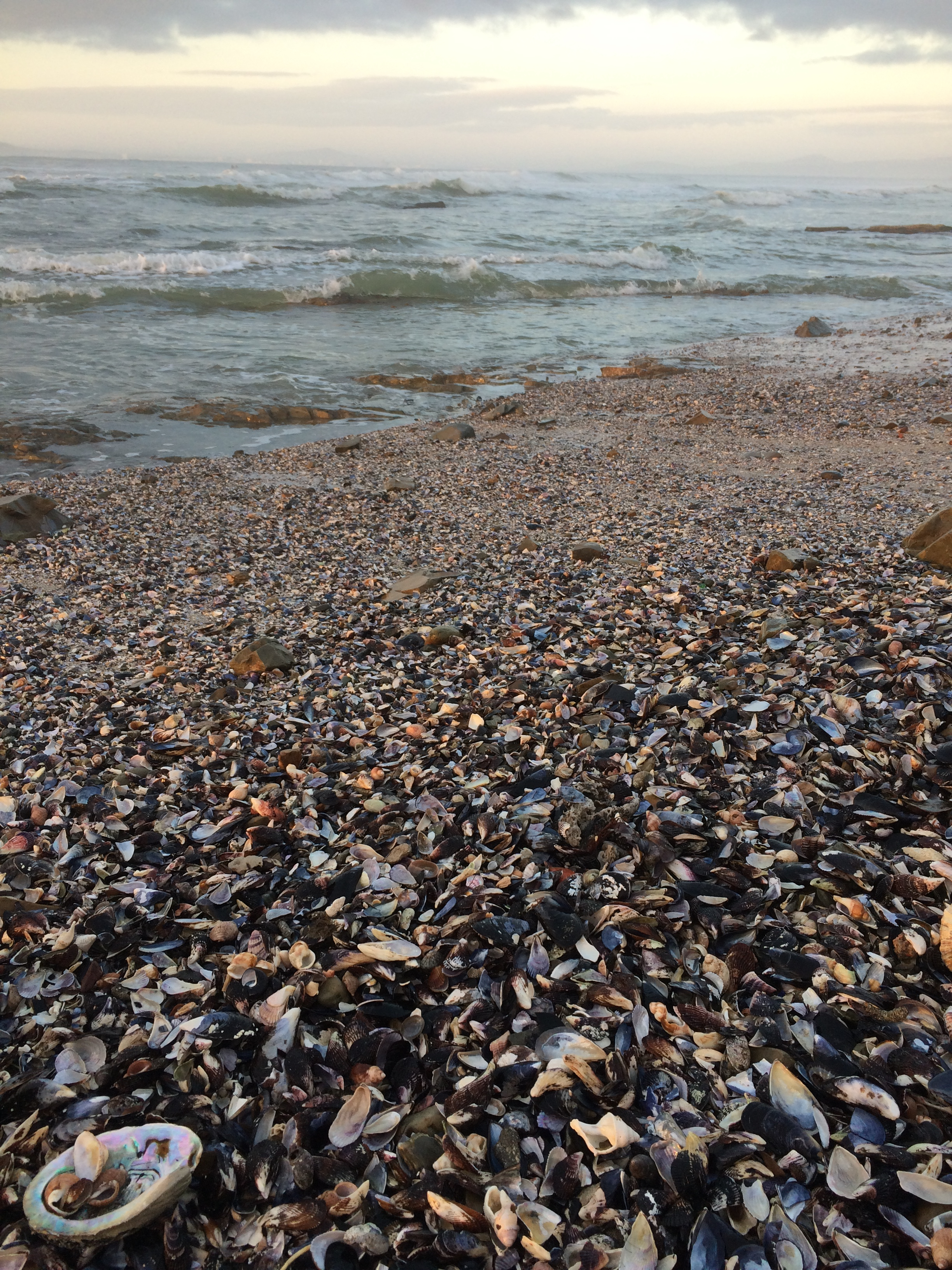
I was in Cape Town this week, for the annual conference of the Human Development and Capability Association (HDCA). Since earlier this year I was elected President-elect of the HDCA, and have also been an associate editor for its journal for a few years, I was occupied with the conference and organisation matters from the moment I arrived till the closing session which I chaired. It is frustrating to be in a building several days non-stop, and not seeing anything of the city, so I was very glad that Ina Conradie, my former PhD Student and a longtime resident of Cape Town took me to Mouille Point Beach, to inhale the smell of the ocean and get some clamshells for my sons. Friends had warned me that Cape Town beaches are white-sanded and may be without shells, but not this one! I’ve never seen so many shells on a single beach, including some very beautiful ones.
I got up at 5 AM to take a hike in the Arizona desert with older daughter. Nothing around me but cactus, rocks, and the sun getting it together to glare over the mountains. (Older daughter was a couple hundred meters away, around the bend. I was alone!) A few bird noises. Ah, nature! How … natural it all seemed. Suddenly – voices! Two hikers, their words carried across an ancient, solemn landscape, although they are invisibly off in the distance. They are arguing, loudly, about Trump and how stupid his tweets are. And yet all I see is primordial desert. Trump has, to all appearances, managed to troll the desert itself – patient floor of a primordial, long-dead sea. That guy is a pro, as trolls go.
But don’t let it get you down! On the way out I remembered to photograph a teensy bit of desert, dawn fireworks. Didn’t come out so well, but you get the idea. [click to continue…]
I just got back so I can tell you. Lombok is the next island over from Bali in the chain and the straits between them form the Wallace Line, which separates Asian from Austronesian flora and fauna. People are coming back from fishing because they went out early, of course. The boats are narrow with two pontoons on either side that are attached to the boat by two struts per side, each an angle of two bits of wood; the effect is of brightly colored water striders. They are all painted in a riot of pink and green and blue and white.
Old ladies and men are sweeping the sidewalks and lanes and parking spaces and packed-earth yards with stiff brooms that are proper besoms of twigs, pushing each leaf and empty Happytos bag into the gutter. This seems a futile gesture towards cleanliness sometimes if the sidewalk is on a busy road and the neighboring empty bale has no one tending it but isn’t, really, and it produces what I consider the most distinctly Southeast Asian morning sound as the thinnest ends of the twigs chuff and scrape against the concrete. Some men are just sitting around in bales (those raised platforms of bamboo that are open on all four sides and have a thatched roof) smoking, because that’s a thing everywhere. Clove cigarettes, mostly, which smell wonderful and taste…also wonderful. I have never been a smoker but occasionally have a few when I am in Indonesia alone. I went with Violet this time so no dice. People are vaguely lining up to buy fried snacks from little carts.
Men with the white caps that indicate they have been on the hajj are strolling towards mosques. Lombok is very poor and I often wonder how they made their way all the way there, dignified in batik shirts and plastic slippers. Tours with their mosques, I guess; there was one in the airport with everyone dressed the same and nametags hanging down and three carts piled so high with matching black luggage it looked like tumbled black bricks. The towns and villages compete with their mosques so they are beautiful: green and gold domes, green-and-white diamond tiles, slender minarets.
There is no other feeling of pleasure and self-satisfied minor vice quite like listening to the first call to prayer before it is light and then promptly going back to sleep. Especially if it is raining. The calls to prayer are long and beautiful, reminding you that god is great five times a day. I wonder if people don’t sometimes think, “I literally just prayed!” Some people clearly do as Lombok has an awesome heretical “Three Prayer” sect in which, as you may guess, you only need to pray three times a day, and just, whenever you’re feeling it. Their Ramadan lasts only one day and I think they might even be able to drink too. I guess by the time the news got to Lombok things were a little muddled.
Lombok is home to Balinese people too (about ten percent, and they used to run the place, which local Sasak people seem still to resent.) There are yellow ribbons around big fig trees to tell you they are sacred, and narrow carved gates opening off the road at high places and descending into temples you cannot see. And so there are festivals almost every day and beautiful young women with baskets of fruit on their heads in the early morning, and gamelan music that has been playing the whole night. There are some Chinese people too, there have to be, running little stores, and so I passed by a Chinese graveyard with its distinctive horseshoe graves and a few people burning grave goods and sweeping the graves clean. (Folk songs always want someone to see that the singers grave is swept clean; I want to go to Bonaventure Cemetary next time I am in Savannah and sweep my grandmother’s grave, and Annie Washington’s.)
Of course, there is rice. Of all the things people grow in the world, rice seems like the most trouble. You do pass the odd field empty but for a feeble scarecrow of a plastic scrap tied to a piece of bamboo, but for the most part there is always someone working in the field, ceaseless toil under a straw conical hat. You would think it would all be growing in tandem but it’s not. I saw the neon green of new rice shoots in the wet paddies, and the golden haze over dry fields ready to harvest, and fields stubbled but for stacks of hay, and people doing the tedious task of pulling up every growing shoot of new rice, arranging them into bundles, and re-planting them in rows, all while ankle-deep in water, and women spreading out harvested rice on tarps laid at the edge of the roads to dry. I see why they do this–the heat on the black tarmac must make quick work of it, but I always worry it will blow away, or someone will drive into it, and I don’t imagine it’s the least polluted rice in the world, but clearly they know better than I.
Lombok has many people living on $2 a day, but has very little malnutrition because the volcanic soil is so rich and the sun and rain so abundant. So I also passed fields of corn and runner beans and tomatoes and rows of papaya plants. It’s funny sometimes to think of food traveling so far, all the way from the Americas. In the evenings people in Lombok drive their scooter up to scenic points along the coast, peaks falling away to perfect palm-fringed beaches on either side, and the sun setting right behind the three mountains of Bali, and they eat grilled corn with lime and chili.
This song has nothing to do with Lombok (or Perth for that matter) but I was listening to day before yesterday. It will help you imagine that you are in a black rental SUV with all these things gilding, pulled past the glass on an infinite string, now a little painted cart drawn by a thin-ribbed pony just near enough to touch, and now a green mountain far away over endless shining paddies.
Being in a multi-bed room overnight, or being in the OR, or even sometimes when the chemotherapy room is crowded over-full and they are putting people in cheap plastic chairs before hooking them up to clear bags of poison–this is the worst. And the worst thing about being in the hospital overnight is that you can’t sleep. I understand intellectually that your doctors need to know what your blood pressure is. I mean, sort of. What if you don’t have any heart problems? Why always with the blood pressure? But between your IV bag running out and beeping and the irrational fear that air bubbles will get inside you and kill you, and the checking of the temperature and blood pressure every four hours, and the breakfast you actively don’t want being slammed down at 6:30, and the cleaning staff, well, you don’t sleep. No knitting up the raveled sleeve of care for you! And this is true even in a private room! This article in the NYT explores a very obvious point, namely that multi-bed wards are a terrible idea all the time. I felt vindicated to read that the decrease in hospital-borne infections outweighs the cost of constructing a hospital with individual rooms.
As a doctor, I’m struck daily by how much better hospitals could be designed. Hospitals are among the most expensive facilities to build, with complex infrastructures, technologies, regulations and safety codes. But evidence suggests we’ve been building them all wrong — and that the deficiencies aren’t simply unaesthetic or inconvenient. All those design flaws may be killing us.
It’s no secret that hospital-acquired infections are an enormous contributor to illness and death, affecting up to 30 percent of intensive care unit patients. But housing patients together very likely exacerbates the problem. Research suggests that private rooms can reduce the risk of both airborne infections and those transmitted by touching contaminated surfaces. One study reported that transitioning from shared to private rooms decreased bacterial infections by half and reduced how long patients were hospitalized by 10 percent. Other work suggests that the increased cost of single-occupancy rooms is more than offset by the money saved because of fewer infections. Installing easier-to-clean surfaces, well-positioned sinks and high-quality air filters can further reduce infection rates.
The whole thing is worth a read. Perhaps unsurprisingly, having a window out of which you can look at trees or nature has a huge impact on recovery time. I personally have always wanted to get the Magic Mountain treatment in which I am bundled in specially folded blankets and put out on a lounger to enjoy a view of the Alps.
The author doesn’t discuss bad fluorescents, though the commenters do. New compact bulbs can mimic the warmer light of incandesents reasonably well now, and that is another terrible hospital thing that could be fixed. I feel I should note two things here. One, the staff at hospitals is almost uniformly composed of kind helpful people who are working very hard. Nurses are great. The sub-nurses who are supposed to be just emptying bedpans or whatever are delightful. But let’s be honest: the actual doctors are the least friendly. Sorry actual doctors. I know you are busy. (But so are the ladies emptying the bedpans, probably?) Two, I am not in the hospital or accompanying anyone to same at the moment and this is just a general complaint so don’t worry about me; more importantly my migraine treatment worked. Since I made it to the first week (at which the Botox takes full effect) I have used my migraine meds only once. John was disappointed that I can have a headache at all but he doesn’t know that not having a real migraine every day after having had that happen for months oh God is a fairy wonderland (I don’t know why I’m not being more sparkly and cheerful all the time; I’m sorry, beloved family. I have terrible jet lag still). I asked my neurologist if there were any side effects and he said, “you’ll be running back here every twelve weeks begging me to do it again, but other than that, no.” OMG Dr. Fineman you are right. Thanks for the Tinkerbell-clapping, everyone! Now tell me of your experiences with flimsy curtains separating you from people with dementia shouting all night. The airing of grievances can be therapeutic; anyway it’s better than reading articles about politics amirite?
Long post. Input welcome on any aspect of what I am discussing but I end the post with a very specific question, to which I would really like an answer: do our esteemed primate cousins ask questions? Yet more specifically: have language-trained non-human primates demonstrated the ability to ask questions? (Communicatively elicit desired information from their fellows or humans?)
But let me first back up and give you my situation and needs. [click to continue…]
Elizabeth Cotten had an unlikely musical career. As a left-handed young girl she taught herself to play her brother’s banjo. Then she bought a guitar from Sears Roebuck at 11 and proceeded to play it Jimi Hendrix-style, upside-down. After getting married at 17 she basically gave up playing guitar for 25 years, except for occasional church performances. Quite at random, she was hired as a maid by part of the Seeger family–working for Pete Seeger’s dad and the children of his second wife. She picked up the guitar again, and blew everybody’s mind. Mike Seeger (Pete’s half-brother) started recording her and the sessions were made into an album from Folkways Records–Folksongs and Instrumentals with Guitar. Her signature tune “Freight Train” became hugely popular among the folk musicians of the revival of the late 50s/early 60s, being covered by Joan Baez and Bob Dylan among many others.
She started to tour and perform with big names, released another influential record in 1967, Shake Sugaree, and kept touring and playing till the end of her life (January 5, 1895 – June 29, 1987). Her unusual picking style was greatly admired, because it’s totally awesome! People have worked out alternate ways to play the songs that don’t involve playing the guitar upside down and backwards. (John spent two weeks learning “Freight Train” when we were on Martha’s Vineyard last year, causing our children to, in extremis, institute a strict “no Freight Train” policy. Happily, though, now it reminds us of my aunt’s house and all being together with my siblings and cousins, and beach plums, and the creek with its perfect flat wet stones, and the cold Atlantic, so grey.) Her music is distinctive because of the bass lines–the strings sounding the lowest notes were at the bottom of the guitar and so she picks out distinctive tunes on them. The highest string being on top, she sometimes treats the guitar like a banjo–since that’s where the high-pitched drone string is. I just learned reading the wikipedia article that she wrote “Freight Train” at 11!
Her voice is wonderful, but many of her best songs are instrumental only:
I’m having trouble choosing here, “In The Sweet By and By” is beautiful…some songs are painfully short, like “Mama, There’s Nobody Here But The Baby” or “Ain’t Got No Honey Baby Now.” [Which I can’t find a working video of :/ ] 56 seconds? NO. Although Harry Taussig plays a killer version on steel guitar. I’ll close with the topical “Take Me Back to Baltimore.”
My dad is an incredible guitarist, and plays steel 12-string bottle-neck slide, though he removes the second string from the highest two strings, making it 10-string. He also picks in this style–and we are big fans of Ry Cooder who is a master at it. When I was a kid we always had music playing. My godfather played the fiddle and we had plenty of other random musicians at parties, which, in South Carolina through to the late 70s were always two- or three-day affairs. We had a whole crew of Hell’s Angels camped out in the back yard one time. My brother and I would sing, folk songs like “Froggy Went a-Courting.” That’s happiness for me, standing on the front porch catching lizards on the screen, listening to live music and the leathery sounds of the palmetto pushed by the wind, live oaks tossing their heads and their festoons of Spanish moss, my feet slowly blackening with the super-fine dust of mildew that settles inevitably on the grey floor of any screen porch, the sky and the hydrangeas planted around the base of the house and the screen porch ceiling all alike powder-blue, the smell of salt water and marsh and endless joints burning mingled into a perfect sweetness. High tide. Got to be high tide at 2 p.m. with a summer thunderstorm blowing up far across the river. Not low tide and with all hanging breathless and hot, and the mud flats on the sandbar across the river stinking in the sun. Eating cold boiled peanuts and watermelon and drinking sweet tea. Perfect. Except now I’m homesick!
OK, my mom texted me earlier that it was snowing in D.C. That is wrecked-up sideways, people. LAND’S SAKES IT IS THE MIDDLE OF APRIL?! In a way I should really post the Weezer song “My Name is Jonas,” because, do you know what else? Guess what I received in a text today–words of deep concern from my little brother. Building’s not going as he planned. The vortex means digging is banned. The dozer will not clear a path; the driver swears he learned his math! The workers are going home–I reckon, because the dirt’s frozen! How’s the man meant to get a cellar dug for his cool 1950s-plan cabin on the lower meadow of his proppity up in West Virginia if it starts snowing and the workers are going home? Now I imagine it’s all going to melt in a trice but this really has been retarding his plans, for real, and not just in a Weezer song (which is an excellent song, but not as good as “Say it Ain’t So,” The Best Weezer Song. Um. OK, no, I’m changing my plea to guilty claim to “The World Has Turned And Left Me Here“). Yep, they have had the stones and the timber and all that, sufficient to build a cabin, and all taken from the woods itself, but they haven’t been able to break ground till last week because they couldn’t break into the damn ground!
And now it’s snowing on all they poor heads, even that of Fatso, the chihuahua-pomeranian mix, who isn’t fat, and was chosen for his mighty endurance and ability to withstand the harsh winters by sitting in a dog bed made of a damn knitting basket or something right up next to the wood stove. I am told that despite being a pom-chi-chi (no, psych, it’s cause he’s 1/4 pom and the rest chi), Fatso has the soul of a black lab, and that I will love him and not think he is a wretched yappy creature whom humans brought into the world only in order to illuminate the First Noble Truth. We’ll see. E’erbody says so, though. Hmmm. OK Fatso, win my heart. He’ll get a chance this summer when I meet him for the first time.
Anyway, for the rest of y’all, here’s DJ Earworm’s Summermash 2013, with the “hey where’s all my ‘Get Lucky’ and ‘Blurred Lines'” you were wondering about I was complaining about with regard to the 2013 mashup (which has grown on me). Watch, listen, and imagine. Summer is coming, sure as anything. If she is delayed in some way I feel certain that small felt and metal figures whose manipulable fingers become dark with smuts over the course of the film will be animated in stop-motion and narrated over by an avuncular zombie Burl Ives in such wise as to overcome any difficulties as may be posed by the Snow Miser or Jim DeMint or whoever.
ETA 24h later: I told my girls that I was wrong and that everyone on the whole internet explained that they could perfectly well go on and win the Fields Medal if they were inclined to be mathematicians, and that being super-fast at mental arithmetic as a child isn’t the same as going on to make interesting discoveries in math as an adult, and that I was a jerk, and also wrong. Additionally, wrong. So if Zoë (12) wants to take time out from her current project of teaching herself Japanese, or Violet (9) wishes to take a break from her 150-page novel about the adventures of apprentice witch Skyla Cartwheel, then, in the hypothetical words of the Funky Four Plus One: “They could be the joint.” [Listen to this song because it’s the joint.]
“Y’all’s fakes!”
If you’re impatient you can skip ahead to 3:20 or so. Tl;dw: the overly scientific Princess Bubblegum, having snuck into Wizard City dressed in wizard gear along with Finn and Jake, is buying a spell from a head shop place that sells potions and spells and all that schwazaa. But she wants to know what the spell’s made of. “Magic?” Then she asks…read the post title. Then they get busted.
“So, kiddos,” I asked my kids in the elevator on the way down to the pools today, “are numbers real, or are they just something people made up?” Violet: “Real.” Zoë: “Real.” “That’s correct! Numbers are real! Like what if there were a sakura with its five petals, and it were pink, but no humans existed. Would it still be pink? Would it still have five petals?” [At approximately floor 14 I decided to bracket color problems.] “Yep.” “And things that are true about the number five, would they still be true too, like would five times five equal twenty-five and stuff?” “Totally.” “Could two plus two ever equal five, if there were no people around to check?” Zoë: “No, obviously not. Even now, people have lots of different languages, but if they have a word for five, then that word is about something that’s not two plus two, and it’s twenty-five if you multiply it by itself, and stuff like that. And people discovered zero two times.” “Correct! Math is real!” Zoë: “Also people discover important things about astrophysics with math, and then the same numbers keep turning up, and why would it be like that if there wasn’t really math?” “OK, so, we can keep discovering new things about math, right?” Girls: “Sure. Mathematicians can.” Me: “Maybe you! No, not you. I’m sorry.” Zoë: “I know.” Violet: “What?!” Me: “No, you’re both very intelligent children, you can learn calculus just as well as anyone, but if you were going to be an incredible math genius or something we’d kind of already know. Sorry.” [John was doing laps at this point. I’m not sure he approves of my negative pedagogical methods.] Zoë: “What’s set theory?” Me: “It’s just what it sounds like. There are sets of numbers, right, like all the prime numbers, all the way to infinity? Theories about that.” Violet: “I’m going swimming with daddy.” Me: “OK, there’s just more math out there, waiting to be discovered–but sometimes mathematicians come up with stuff that’s crazy. Like string theory. Which maybe isn’t a theory?” Zoë: “Why not?” Me: “I think they might not have any tests at all proposed by which to prove their hypotheses.” Zoë was very indignant: “That’s not a theory at all! What is that? Me: “Math that’s really fun and weird and entertaining if you understand it? John, can string theorists not propose any test whatsoever that would prove their hypotheses or is it rather the case that we lack the capacity to perform the tests that would figure it out?” John: “It’s an important distinction and I think it’s the latter. Like, was there an even or an odd number of hairs on Zoë’s head on March 23, 2006? There’s some true fact of the matter, but it’s indeterminable.” Me: “Well they can’t be demanding time travel, Jesus.” Violet: “We should have counted!” BEST. SUGGESTION. ERVER!1
OK, so, I’m a Platonist about math. Like lots of mathematicians I knew in grad school, actually, but not by any means all. In fact, some were a little embarrassed about their Platonism. My algebraic topologist friend was of the ‘numbers are the product of human intelligence’ school (N.B. while I understood vaguely what my HS friend who was also at Berkeley did set theory was writing is his diss on, in a kind of babified ‘along these lines’ way, I genuinely could not understand at all what my algebraic topology friend was doing. What, even?) This reminds me of an idiotic discussion I had in a Classics seminar with me vs. an entire group of people (including my dissertation adviser). They all maintained that there were no structures absent human recognition/simultaneous creation of the structures. As in, absent the evolution of humans on the earth, there would be no regular geometric structures. I was just like:?! Crystals that are even now locked in the earth inside geodes, where they will never be seen? Beehives? Wait, are these all imperfect and gently irregular, and thus unsatisfactory? They shouldn’t be because many of the crystals are perfectly regular. Anyway OH HAI ITS BENZENE? I…was neither presented with any compelling counter-arguments nor was I winning the argument. It was very irritating. Then I brought up my own objection–this is steel-manning, I guess: benzene was created/isolated by humans? Like Faraday even? Fine, NOBLE GASES! NOBLE GAS MATRIXES! I can draw argon on the board! Look at how this shell is so full of electrons mmmmm this probably doesn’t want to react with anything cuz it’s so lazy amirite guys (but we can make it (but also in the Crab Nebula it’s happening naturally!) but that’s irrelevant))! I still…did not win the argument. We were forcibly moved on to another topic.
I know people wanted to discuss the external reality/human-created nature of numbers and math in the earlier thread, but we got trolled by someone who was ‘just askin’ questions’ and said I ‘had to check with each and every commenter about exactly what he/she intended’ before taking offense ever at something, say, sexist that someone said. (HhHHmmmyoursuggestionfascina–NO.) Now’s your chance!
N.B. Long-time CT commenter Z alone is permitted to use humorous quotes from recalled Barbie and Malibu Stacey dolls in his discussion with me. If anyone else does I will smite you. With smiting.
ETA: It has occurred to me only just now that this post would have better had it been titled “America: rRuck Yeah!”
You have probably already read about the horrible chemical spill in West Virginia last Thursday, which the New York Times has a stunner headline: Critics Say Chemical Spill Highlights Lax West Virginia Regulations. Oh, really? (You can read lots of good posts on this and previous environmental and labor disputes at Lawyers, Guns and Money–you can start looking at Erik Loomis’ posts as he also has great series along the lines of ‘this day in labor history’.)
300,000 were left with poisoned drinking water (coming out of the tap!) after specialty chemical-producer Freedom Industries spilled some 5,000 gallons of 4-Methylcyclohexane Methanol into the Kanawha Valley’s water treatment intake near Charleston. The water remains clear although poisonous, but smells helpfully like licorice. Also, boiling it doesn’t help.
Obviously this logo is but a minor blot on the company’s record vs. its actual malfeasance but uh…it’s a crime against good design, since my daughters looked at it and asked, “what’s rReedom Industries?” Also really looks as if it should have the smoking twin towers photoshopped into the background, and perhaps a big glistening tear into the eagle’s eye, and it would be a good blog header for Pamela Geller. Hey, remember her? (She doesn’t follow good trigger safety at all, I totally just learned this. But she’s a teetotaler also, so.)
What I am curious about in the Singer/infanticide/ending the life of the disabled vein is, what do those who are totally opposed to every form of infanticide think about anencephalic babies (and babies who have similarly non-survivable, severe birth defects)? I don’t think that, as a formerly pregnant person who has given birth to healthy children, my opinions on these questions have any extra merit, but I do think others not so situated may share my opinions without feeling so strongly about them, or in the same way. Perhaps the situation calls for some epistemic humility? The terrifying prospect to me, and to many mothers, of “late-term” abortion bans, is that pregnancies which are terminated after 20 weeks are almost all wanted pregnancies in which something horrible has occurred or been discovered. (And, in those cases where the baby is unwanted, there are almost certainly serious problems in the woman’s life that have led to the delay in getting an abortion sooner.) So, in a situation of supreme horror, the fetus might die, but the mother might be forced to carry the dead fetus inside her and have labor induced, to struggle in pain and blood to bring her dead baby into the world. She would feel the liquid inside her, and the lax ligaments, and all the other things she felt in pregnancy, but she would know the baby was dead. I have heard of mothers knowing right away. So close to you then, infinitely close, but infinitely far, and a rotting thing now, a poison for the rest of your body. So awful.
My first pregnancy was easy and wonderful. I felt and looked glowing, and although I was in labor for more than 40 hours (remind me not to do that again) I gave birth vaginally to a healthy girl who latched onto the breast just a few minutes after she was born, and fed well and naturally. In my second pregnancy I had unexplained bleeding starting at 19 weeks. Bright pink fresh blood in the toilet bowl. I thought my heart would stop. I thought her heart had stopped. They couldn’t figure out what was wrong. I was in terrible pain (I often am; but it seemed like she was tap-dancing on the worst bit of me.) I kept bleeding on and off. I knew how many movements she was supposed to make in an hour and I counted, and counted, and counted, hour after hour, so scared, and then another hour. The doctors were determined to deliver her surgically as soon as they felt she was cooked up right, so, 37 weeks. It turned out to be nothing serious, placenta previa (the organ grew over the cervical os, the opening to the birth canal, blocking the baby’s egress.) She was fine.
But sometimes when the doctors check, they find that the fetus, which has appeared to be developing fine, has no brain at all, that the blackness inside her skull on the scans is only water. This is not even a fetus, really–certainly not a future infant. It will never feel pleasure at a mother’s touch, or pain from being pinched by a crib mattress, or see anything, or hear anything. It is empty. Laws that would force a woman to stay pregnant and nourish and grow that wrongly-made creature inside her, and to suffer the agonies of childbirth, and to bring forth this…not-baby–laws like that are torture. I would go mad. I would try to abort the fetus myself. I would try to kill myself. I would want to be put to sleep then, there, in the doctor’s office, and wake up, not pregnant, and with a little coffin to bury my hope and love inside. With ashes inside, only, because I would want not to look, but I would look, and I would always wish I had not.
But let us say an unjust, oppressive, Christian regime forces me to endure, and to deliver this severely deformed baby. Does anyone think we should use artificial life support to keep the baby alive? Almost all fetuses of this type are stillborn, and those that are not usually die on the first day of ‘life.’ Even the Catholic Church has some hand-waving about letting God’s will take its course. That is, they are not insistent on providing hydration and nutrition–no one even considers artificial respiration. Reading on it, three children have lived a year or so. There are pictures of course, and now I wish I hadn’t looked at them, and I am so sorry, the poor little things, and so sorry for the parents. For the mothers! When I think of those oscillations inside you, feeling movements you didn’t make, the mysterious gliding of blood-wet surfaces over each other in the absolute black, the not-you inside you…what if you knew in the end there was nothing? Some kind of seasickness of death? At the last you would be holding a newly hatched chick, naked and grey and dead, grey and jerking with dying? But back to the matter at hand, we all think a form of infanticide is appropriate here, right? No one’s on team ‘drastic measures for resuscitation?’ Artificial respiration for 80 years, for something that can never feel you hold his hand? A rough golem on whose forehead no glyph has been inscribed? So isn’t there a small number of real-world, continuously-occurring cases in which we are all pro-infanticide?
UPDATE: so misinterpreted! Obviously my fault also. I didn’t jump in to give Singer crucial moral support. I’m not totally sure how I did…I guess I’m implying all his critics are disingenuous and have parked themselves at the top of a slippery slope with some dubious wedge. I apologize to sincere Singer-critics for insulting their position in this way. That wasn’t actually what I was trying to do at all. I was genuinely curious. There was a case maybe eight years ago now, but I can no longer find it in the welter of anti-abortion and pro-abortion articles, in which a woman’s 24 or even 26-week-old fetus died, and the laws of her state required a waiting period before you could get a late term abortion (Texas IIRC?). The removal of a dead fetus is done via dilation and curettage, i.e., via abortion. So she had to go talk to some doctor, and then go stay by herself in a motel with her dead baby inside her for two days. She wrote about her experience and I remember thinking, I don’t know if I could live through two days of that. A responsible, thoughtful doctor would have deemed the dead fetus a threat to her health and her ability to have future children and had it removed on those grounds, but in this particular case, it was a Catholic hospital and none of these things happened. So I did mean to say, I think there are a number of infants born each year whose lives everyone agrees cannot go on in any way. That doesn’t mean that–HAHA! now everyone is obliged to accept all Singer’s positions; I was honestly curious, not mock-curious, and I honestly don’t know what all Singer’s positions are. But I also meant to describe to people who haven’t been pregnant the terror of something going wrong, and how you hope you would be a good enough person to accept your baby any way she came, but you fear you’re not brave enough, not really, not truly brave enough. And that as long as she was inside maybe you could pretend it would be alright somehow? But even then there is only one feeling that is ever like this, of having something inside you that is alive, that isn’t you, that you are waiting for, and how would it be if you were waiting for nothing? That’s all. I really don’t know enough about Singer’s positions to arbitrate on any of these questions; I was just thinking, we need to hear from severely handicapped people who were written off as a total loss before we know whether he can be right. We might also be interested to hear from mothers. And I’m only the mother of perfectly healthy babies! That’s it. I’m not laying down my life for in-group sacrifice.