Now this Seth… did leave children behind him who imitated his virtues…. They also were the inventors of that peculiar sort of wisdom which is concerned with the heavenly bodies, and their order.
And that their inventions might not be lost before they were sufficiently known, upon Adam’s prediction that the world was to be destroyed at one time by the force of fire, and at another time by the violence and quantity of water, they made two pillars; the one of brick, the other of stone: they inscribed their discoveries on them both, that in case the pillar of brick should be destroyed by the flood, the pillar of stone might remain, and exhibit those discoveries to mankind; and also inform them that there was another pillar of brick erected by them. Now this remains in the land of Siriad to this day.
— Antiquities of the Jews, Flavius Josephus, Book 1, Chapter 2, 68-71
So first, a brief digression on Flavius Josephus.
The Turncoat
Ah, Flavius Josephus. Born Joseph ben Matthias, a Jew in Judea, he was a general during the Jewish Revolt against the Romans. But then he switched sides and joined the Romans. He then caught the attention of the Roman general with a flattering prophecy that the general would one day become Emperor. (Which eventually happened. Emperor Vespasian, 69-79 AD.) 
[this guy]
So Josephus became part of the Imperial staff. He changed his name — “Flavius” was the family name of the new Emperor — and led efforts to get other Jews to switch sides. (Mostly unsuccessful efforts. Like, when he approached the walls of besieged Jerusalem, his attempts at persuasion were met with “howls of execration or derision, and sometimes showers of stones.”) After the war was over, with several hundred thousand dead and Judea in ruins, Josephus ditched his Jewish wife and children, followed the new Emperor back to Rome, and wrote a best-selling history. His Jewish War lays great emphasis on the wisdom, strategic brilliance, and noble character of the new Emperor; the invincible might, glory, and greatness of Rome; and Josephus’ own cleverness and correct choices(1). While Judea was crushed under the Roman yoke, Josephus became wealthy and influential, picked up a trophy wife and a villa, and eventually retired to a life of ease.
(1) To be fair, he may have solved the first Josephus Problem. It’s a rare case where mathematical insight was actually life-saving! Well, life-saving for Josephus anyway.
It might be possible to view Josephus as a pragmatic survivor who just joined the winning side. But if you actually read his memoirs, Josephus’ character comes across pretty clearly, and he’s just so immensely pleased with himself.
Anyway:
The Columns
On one hand, Josephus’s quote above is the only mention of the children of Seth being astronomers or inventors, or building brick or stone pillars. There’s nothing else like that in any other ancient source. So that seems a bit sketchy.
But on the other hand, it’s not like our ancient sources are exactly complete and comprehensive. So much stuff got lost over the centuries! An occasional one-off dangling reference is only to be expected. And when Josephus isn’t talking about Rome, or Emperor Vespasian and his family, or his own wonderful self? He’s actually considered a fairly reliable source. He’s consistently more accurate than, say, Herodotus.
So there’s probably something behind the story of the pillars of brick and stone. “The land of Siriad” is tentatively assigned to somewhere in Egypt. (When classical authors wanted to suggest that something was really old, they tended to associate it with Egypt.) One suggestion is that he might have been talking about the twin obelisks of Thutmose III. These were two immense pillars of granite, erected at Karnak around 1450 BC. Nearly two thousand years later the Roman emperor Constantine took one of them and had it transported to Rome. It’s still there in Rome today. It’s called the Lateran Column.(2)
(2) Not to be confused with the Vatican Column, the Solar Column, or like nine other Egyptian columns around Rome. Building a 30 meter, 300 ton stone obelisk was how Egyptian pharaohs flexed. Roman emperors flexed by grabbing one of those columns and moving it to Rome.
[surprising how well it blends actually]
A bit later one of Constantine’s successors decided there was no point in leaving the obelisk’s twin standing lonely in front of Karnak. So he had the second obelisk transported to Emergency Backup Rome, aka Constantinople, modern Istanbul. It’s called the Column of Theodosius. About a third of it got broken off, but the rest is still right there in the middle of downtown.
[it’s 100 tons of granite, it’s not wandering off.]
I’ve seen it. My first reaction was that it had to be a fake. It’s that well preserved. The hieroglyphs look like they were carved… maybe not yesterday, but no more than a few decades ago. Like it might be a 19th century forgery, imitating the original.
But no. Say what you like about Thutmose III, the man did not cut corners on quality control. The red granite of the columns is a really, really hard stone. Carving those hieroglyphs must have been incredibly difficult, thousands of hours of back-breaking yet precise labor. But they’re good for the next ten thousand years.
[built to last, baby]
Mind, we don’t know if these two columns were the source of the Sons of Seth anecdote. They’re a matched pair of pillars, yes. But one isn’t brick, and their inscriptions are not about astronomy.(3) Maybe Josephus was talking about some other pillars or obelisks, now long gone. Or maybe the whole thing was garbled, or entirely mythical. We just don’t know.
(3) They’re about how awesome Thutmose III was, of course.
That said, there are ancient Egyptian monuments that talk about astronomy. They’re just not pillars.
Tear The Roof Off The Sucker
Strictly speaking, tear the ceiling off the sucker. The roof would have been too big.
[a bit much even for 19th century colonialists]
That’s the Temple of Hathor in Egypt, and yeah it really looks like that. By Egyptian standards, it’s pretty new: started in the late Ptolemaic period, finished under Roman rule. It’s not even two thousand years old.
It used to have a big astronomical chart inside. Lots of Egyptian structures did. The Egyptians often decorated their tombs with astronomical / astrological motifs — the two weren’t really separate at this point — and they had a number of temples with bas-reliefs or sculptures that depicted astronomical knowledge.
Probably the most famous of these is the Dendera Zodiac, which used to adorn a ceiling inside that same Temple of Hathor. It looks a bit confusing at first —
[this is a 1-1 reconstruction, paint and plaster on wood]
— but it’s a map of the sky, and if you stare for a bit you may recognize some of the constellations of the Zodiac. There’s Taurus the Bull around four o’clock, yeah? Upside-down around midnight are Capricorn, Sagittarius and Scorpio. Peer for a bit and you’ll see a few more. That thing in the middle that looks like a skull-faced sheep holding a knife? Apparently that’s the Big Dipper, and the little red foxy thing near dead center is the Little Dipper. The North Star would be at the very center, except back then there was no North Star. (More on this shortly.)
Those people walking around the outside, and the larger figures holding the sky? They, and their hieroglyphs, encode a bunch of astronomical information. And those small pale circles with things inside? Apparently they’re giving particular locations of the Sun, Moon, and planets. And if you put this all together, you can get a particular date in ancient times when the planets were in just that alignment: around 50 BC. Whether that was the date the temple was completed, or a date of ritual significance, or just the birthday of someone important, there’s no way to know, but it’s pretty nifty regardless.
Now, I said this “used to adorn” a ceiling within that big temple complex. It doesn’t adorn it any more. That’s because back in the 19th century some French guys went in there with a bunch of workmen and tools, hacked out the ceiling, and shipped it off to France.
[let us in, we’ll tear this mother out]
Note that this is not a small thing. It’s nearly ten feet on each side, and weighs over a ton. Didn’t slow these guys down. They just rocked up to the Temple of Hathor, chiseled out the unique and priceless star chart, and strolled away with it. After various adventures, the ceiling ended up in the Louvre. It’s still there today.
Anyway! Ancient Egypt had a number of bas reliefs and paintings with these sorts of astronomical illustrations. And probably some were on stone, and some were on brick. So if you ignore the whole “pillars” thing, then maybe these were the inspiration for Josephus’s “Sons of Seth” quotation?
[shrug] No way to know.
I Just Like To Say “Nutation”
So originally I was going to use the story of the brick and stone pillars as a springboard for talking about deep time, how human knowledge may last (or not) over thousands of years, yadda yadda. But I got distracted. Let’s talk about the North Star instead.
Right now the North Star — “Polaris” — sits almost directly above the Earth’s North Pole. If you’re at the North Pole, Polaris is at the zenith, directly overhead. If you’re at 45 degrees north, you’ll see Polaris 45 degrees above the horizon. If you’re at the equator, Polaris will sit right on the horizon, and south of the equator you won’t be able to see it at all. But if you can see it, that’s pretty convenient, because then you know which way north is.
[just go towards that one in the middle that’s not moving much]
There’s nothing magical about Polaris. The Earth’s axis of rotation points out into space, and it just happens to point close to a reasonably bright star. As it happens, there is no South Star. In that direction, Earth’s axis points towards dark empty space.
Right, so — next level. The Earth’s axis doesn’t always point in the same direction. For reasons beyond the scope of this blog post, there’s a thing called “precession”. Precession means that as the Earth spins, it also wobbles. Very slowly. 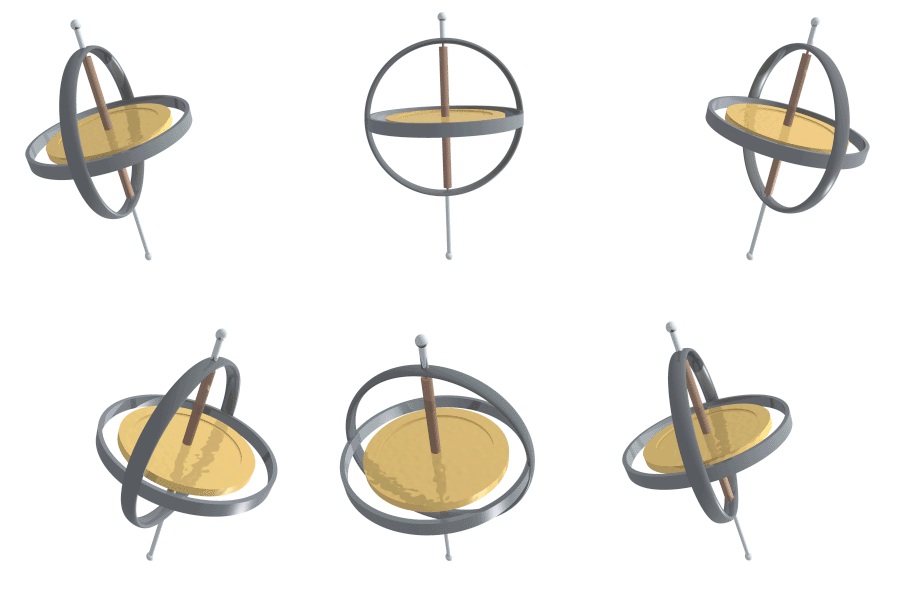
To complete one wobble, for the Earth’s axis to return to its starting point, takes a bit less than 26,000 years.
This means that Polaris wasn’t always the North Star. A thousand years ago, it was several degrees away from the celestial pole. Two thousand years ago, in Roman times, the Earth’s axis pointed towards blank empty space to the north, just like it points towards nothing to the south today. And a couple of thousand years further back — in ancient Egypt of the Old Kingdom — there was indeed a North Star. But it was a completely different North Star, not our Polaris. Oh, and: the name “Polaris”? Only shows up in the 15th century, when the Pole had moved close enough to make this star special.
[chart (c) celestialchimes.com]
Nerd fact: even today, the Pole doesn’t point exactly at Polaris. It’s still about half a degree off. It’ll reach its closest approach around the year 2102, when Pole and Polaris will be almost on top of each other. Then it’ll start to move inexorably away. By 25oo AD Polaris will be the North-ish Star, and by 3000 AD there won’t be any sort of North Star at all.
I first read that fact as a kid around 1979. I remember thinking then that 2102 was ridiculously distant, an unimaginable future time. Now it’s as close to us as we were to 1950. My high school / college aged kids would be in their nineties, but it’s absolutely possible they might live to see it. (Not that there’ll be anything to see. Like I said, it’s a nerd fact.) The kindergarten down the street? Statistically, most of those kids will be around in 2102. It’s within reach.
The last time Polaris was the Pole Star was around 24,000 BC. That was right around the Last Glacial Maximum, the coldest point of the Ice Age. Most of Europe and North America was under a mile of ice. Saber-tooth tigers and mammoths were still a thing.
[don’t worry, we won]
The next time Polaris will be Pole Star will be around 28,000 AD. What will the world be like in 28,000 AD? I got nothing.
[although there are theories]
— Oh, and if you want a really deep cut? On top of the wobble there’s a secondary, much smaller wobble. Like a pie crust, yeah? The big wobble is precession, and the little wobble is called “nutation”, and it has a cycle of eighteen years.
The nutation doesn’t seem to do much of anything. It’s just there.
[this is pretty useless information, honestly]
That Their Inventions Might Not Be Lost
So is there anything like the Pillars of the Sons of Seth today? Oh yeah. Several things, actually. But this post is already long, so I’ll just pick one: Memorial Plaza at Hoover Dam, on the Colorado River in the American Southwest.
Hoover Dam is just awesome and you should absolutely go see it. There have been bigger dams built since — but not many, and none in such a dramatic setting.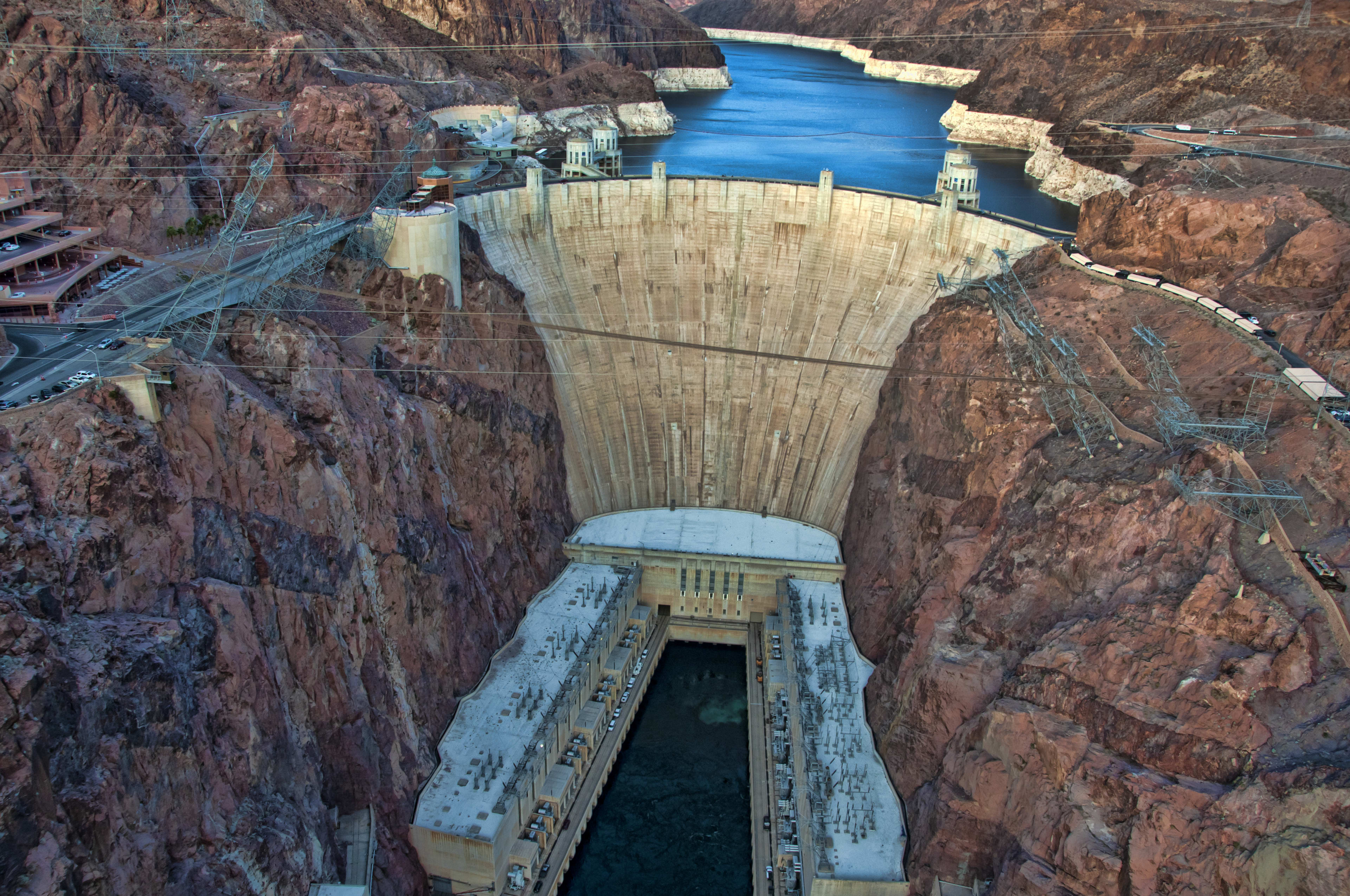
[seriously, just go]
That little round bit off on the left? That’s Memorial Plaza. It has a very Art Deco memorial to the ninety-some guys who perished building the dam (“They died to make this desert bloom”). It has the seals of the 48 states that were part of the US back in 1935. It has some extremely 1930s Winged Figures — they sort of look like the big brothers of the Rolls Royce hood ornament. 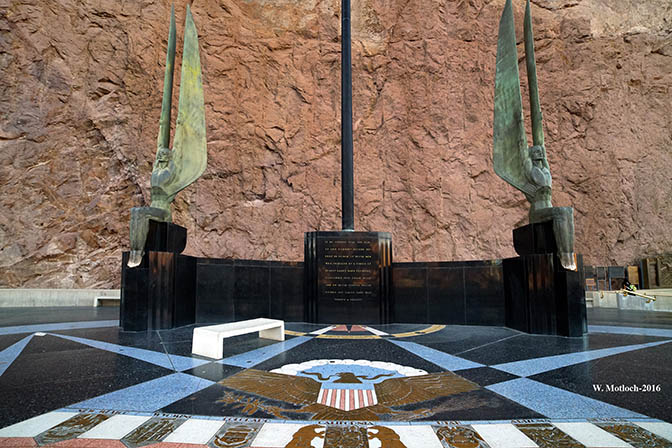
[this and next two images (c) W. Motloch, 2016]
And if you zoom in on that yellow stripe, behind the American Eagle and the white bench? It’s an astronomical diagram.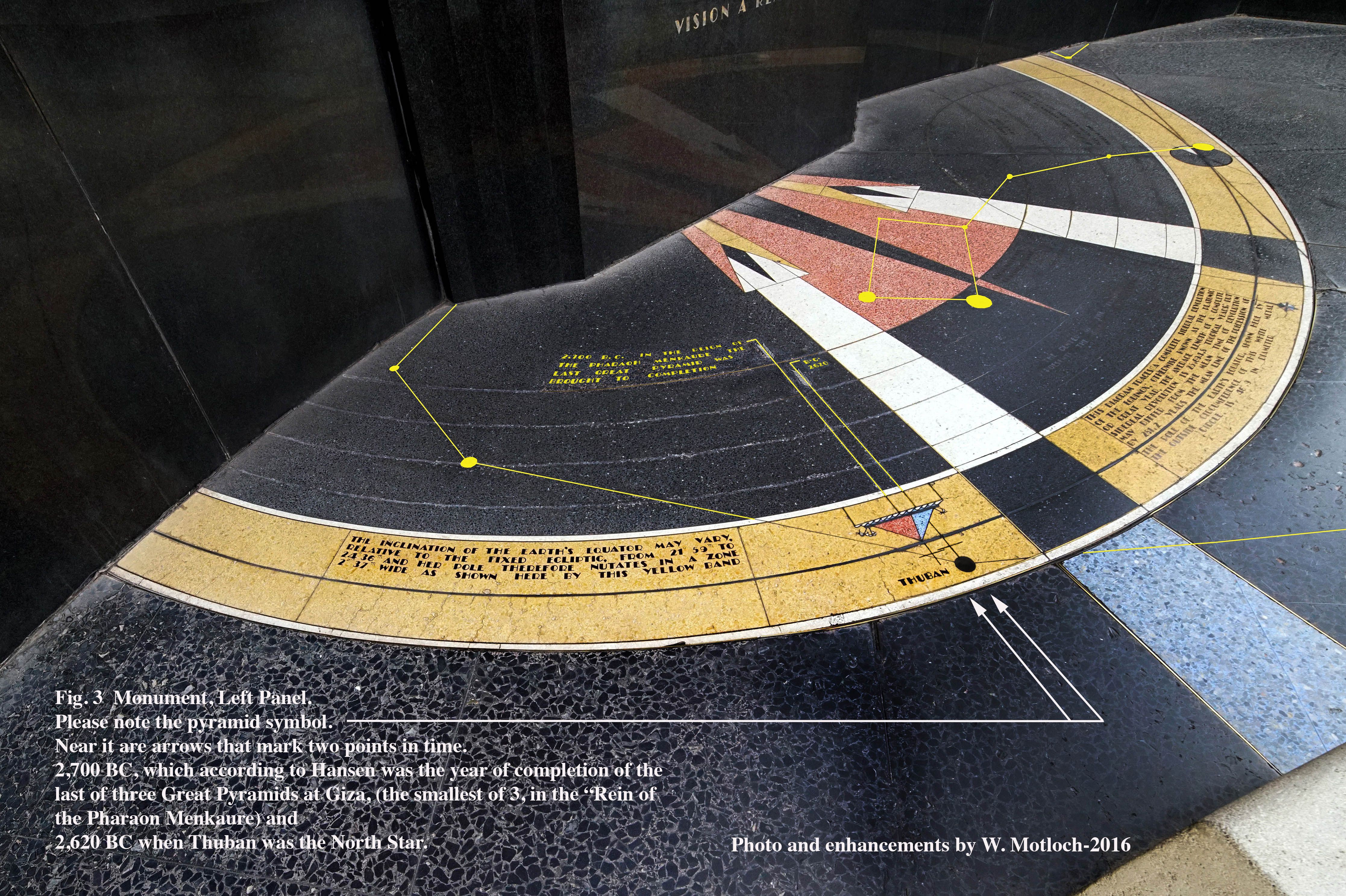
It shows the constellations closest to the North Pole, and describes the precession of the equinoxes. There’s explanatory text, but even without it, a competent astronomer could reverse-engineer the date it describes: September 30, 1935.
That’s right: it’s pretty much doing the same thing as the Dendara Ceiling, just in a cool Art Deco style.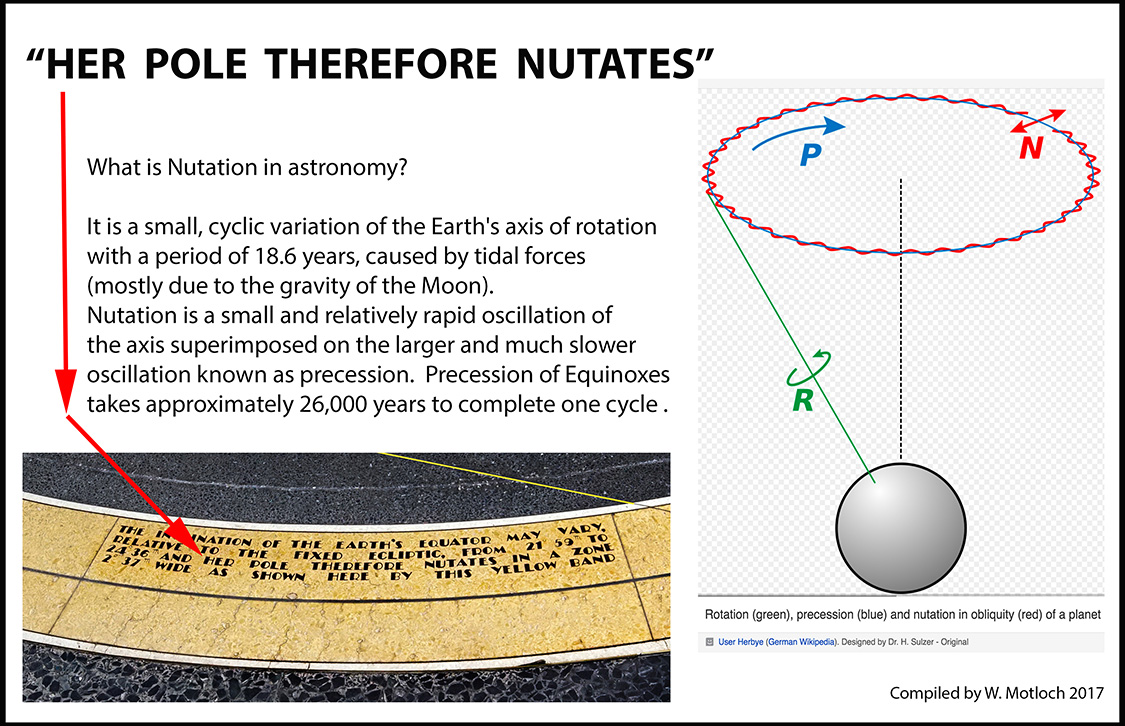
[it even mentions nutation, aaaah]
The creator of the diagram was an eccentric Norwegian-American sculptor named Oskar Hansen. Hansen was difficult, cranky, a serial fabulist, a compulsive womanizer, and a no-kidding polymath who was, among other things, an architect, a sculptor and a self-taught mathematician. I’m not going to chase this particular rabbit today, but if you’re interested, there’s an excellent website; go check him out.
The US Bureau of Reclamation, which built Hoover Dam and still runs it today, turned Hansen loose to decorate the dam (there are some insane bas-reliefs) and build the Memorial Plaza. And apparently he talked the Bureau into paying for an elaborate astronomical diagram, because… I don’t know. The New Deal just did stuff like that. It was the style of the time.
The thinking behind the diagram? Well, Hoover Dam is likely to stick around for a long time. Thousands of years, perhaps. So, why not send a message across those millennia. And what could possibly connect us to that distant future time? Well, at least one thing for sure: precession. Whatever may happen to civilization or the human species, the Earth’s axis will continue that vast slow turn. So whether it’s post-apocalyptic humans or genetically engineered raccoons or Skynet, if there’s any intelligence on Earth, it should be able to read Memorial Plaza’s message. We were here, at this precise time. We watched the stars, just as you do. We were real, we were alive, we built this.
There are other places where moderns have tried to impart scientific or astronomical information to the future. I picked Memorial Plaza because we started with Egypt and, you know, Memorial Plaza is kind of… pharaonic. The Winged Figures, the stone carving, making the desert bloom? The in-your-face hugeness of it all? Thutmose III would have sighed with delight.
Mind, it’s anyone’s guess whether the Plaza will match Thutmose’s current record of 3500 years. It actually had a near-death experience just recently, when it was shut down for renovations in 2022. The renovations went over cost, the contractor was fired, work stopped for years, and there was a real concern that the Bureau of Reclamation would simply get rid of the star chart as too much trouble. Fans mounted a public Save The Star Map campaign, and in the end the chart was fully restored — it opened to the public again in December 2025. But it was a close-run thing.
So maybe Hansen’s message will go through to the 55th century and beyond. Or maybe it will get lost or destroyed along the way. It’s barely survived its first century! Thirty-four more is a big ask.
And in that case, maybe some future human civilization (or the raccoons, or Skynet, or whoever) will find a fragmentary reference to it, and wonder for a while: what is this talking about? And then turn away: shrug! No way to know.
And that’s all.
{ 9 comments… read them below or add one }
Whomever 02.11.26 at 4:34 pm
I visited Hoover Dam a few years ago and the new bridge has plaques that as far as I can tell honors the project manager. It literally includes a GANNT chart.
Austin Loomis 02.11.26 at 9:05 pm
I encountered the word “nutation” as a bit of technobabble on TNG. I have a memory of Geordi saying something about “modulating nutations” which Google confirms is from The Best of Both Worlds (specifically Part I). I was, as the kids say, today years old when I learned it had a Primary World referent and wasn’t just (TECH). And that’s me as one of today’s lucky 10,000.
Which is almost as cool as the content of the article itself.
Michael W 02.11.26 at 11:19 pm
A great book on the history of ideas in ancient egypt is Jan Assman’s “The Mind of Egypt”, or equally his “Moses the monotheist.” The Egyptian script remained readable for more than 2,500 years, and during that time Egypt went through modernising periods, renaissances reviving ancient ideas, centralising bureaucratic priestly class periods and feudal lord periods.
My curiosity about Egpytian ideas was raised by reading Plato’s Timeaus and Critias, in which the ancient history of the Mediterainian is said to have been held by the Egyptian priests, who are supposed to have told it to Solon of Athens who passed it on to one of the participants in the dialogue, Critias. Although Plato’s atlantis myth doesn’t seem to have any Egyptian predecessors, as he suggests in the dialogue, the part about Egypt having it’s own ancient history is quite right- Manetho’s King List seems to have been accurate in suggesting that the Egyptians knew of real kings from 5000 years ago!
Peter T 02.12.26 at 12:40 am
Sadly, the West Country Sethians portrayed in Patrick O’Brien’s Aubrey and Maturin novels seem to be a literary fiction, as the actual Sethians never got too far from the Mediterranean and died out in the 3rd or 4th centuries.
Still, Seth is seen as a key gnostic figure, a fount of knowledge, and one who might well have erected an early stone encyclopedia.
Alan White 02.12.26 at 6:36 am
What an educated ramble through the centuries this is. CT has its champion of educated charm and it is Doug Muir. Please keep posting.
Stephan H 02.13.26 at 2:25 am
Nutation is related to the precession of the lunar nodes – the locations where the moon’s orbit cuts through the ecliptic plane. It changes the angle between the equatorial plane and the lunar orbital plane by about 5 degrees and hence changes the maximum declination the moon experiences during its orbit. This has a small, but significant effect on tides with an approximately 19 year cycle and is taken account in the construction of nautical charts.
Sara 02.13.26 at 6:34 am
I just happened to be thinking of an Arthur C Clarke book today (the songs of distant earth) and happened upon this post in my RSS reader. This was a wonderful read. Thank you.
Lameen 02.13.26 at 10:09 am
Genesis 5, which lists the descendants of Adam through Seth, is an outstandingly boring chapter as it stands – just a formulaic list of people and ages. But the end of the previous chapter doesn’t just list the descendants of Cain in similar fashion, it also throws in comments on their culture-hero roles: Jubal, for instance, is “the father of all who play stringed instruments and pipes”. It’s easy to imagine an alternative ancient version of Genesis 5 where one of Seth’s descendants gets name-checked as the father of astronomy. Maybe Josephus had read one.
oldster 02.13.26 at 7:03 pm
That was great fun, Doug!
My only request is that you not concede too readily to the Herodotus-bashers in declaring him unreliable. A first reading may lead you to think that he is a credulous gossiping fool. But if you spend more time with him, you will come to see that he is a very canny skeptic. He reports what he has heard, but keeps his cards very close to his vest about how much of it he himself believes. He is a good anthropologist: he is interested in what various people’s myths tell us about those people. And like a good anthropologist, he keeps accurate records of what his subjects say, without himself endorsing what they say.
He is, in that sense, a far less interested party than Josephus was. And a far more decent human being.