That’s the actual name of the paper. Isn’t that great?
Here’s a prologue: a post I wrote a while back about the Portuguese Man-o’-War. (It’s kind of long — I was new to CT back then, and still figuring stuff out).
To summarize: the Portuguese Man-o’-War is a large jellyfish-type creature. And when I say “large”, I mean they can grow as big as a large cat, with stinging tentacles dangling for many meters beneath and around them. They’re carnivores, feeding on fish and small invertebrates. Their stings paralyze prey, which is then drawn upward into the main body, digested, and eaten. (In that order.)
In the post I mention that they have a parasitic fish that afflicts them, but I don’t talk about any of their other relationships. So now I’m going to talk about an organism that interacts with the Man-o’-War in a different way: a predator.
Specifically Glaucus Atlanticus, the Blue Dragon Sea Slug.
[yes, they really look like this.]
Also known as the Sea Swallow, or the Blue Angel, or… man, just look at that. Isn’t that just ridiculously gorgeous?
Well, these guys(1) look this way for reasons. Let’s discuss.
(1) English “guy” and “guys” are currently in an awkward blurry space between male-coded and gender-neutral. But these guys are obligate hermaphrodites, so it’s not an issue.
So sea slugs aren’t very closely related to land slugs. They’re marine molluscs that evolved from a shelled, snail-like ancestor way back in the Paleozoic, before the dinosaurs. They’re formally known as nudibranchs — pronounced nooda Bronx, or just “nudies” if you’re a diver. (If you’re being a huge nerd about it, there are some sea slugs that aren’t formally nudibranchs. Never mind that now.)
They’re often some combination of weird and beautiful. A few examples:


[I literally just grabbed some pictures at random]
Giving up their shell freed them of a major metabolic burden and liberated them to swim around. But it also meant they had to evolve new defenses against being eaten. Which they did. Some evolved incredibly good camouflage; some used their flexible bodies to mimic more dangerous creatures; some evolved internal toxins that made them taste nasty. And a bunch of them, including the Blue Dragon, evolved venomous stings.
But in the case of the Blue Angel / Blue Dragon, they evolved stings, but they never evolved venom. Because the Dragons don’t make venom. They steal it. These slugs get their venom from eating venomous prey, particularly and preferentially Portuguese Man-o’-Wars.

[a couple of Blue Dragons closing on a Man-o’-War, like biplanes attacking a zeppelin.
(c) imagequestmarine.com, via Fae Sapsford]
— You might wonder how a slug can bite pieces off something. Well, strictly speaking slugs don’t have jaws. But most molluscs have a hard chewing apparatus called a “radula”. And in the case of the Blue Dragon, the radula has convergently evolved into something that looks and works exactly like a jaw.
[specifically, like the kind of jaw you have nightmares about]
So it has no trouble slicing pieces off the soft-bodied Man-o’-War. And by doing so, it gains a sting powerful enough to cause severe pain, blisters, cramps, nausea and vomiting even in an adult human.
[very bad idea! please do not!]
So all this has been known for a while now — decades. And it’s weird but not unique. There are a number of species that do something similar. There’s even a technical term for it: kleptocnidy. The Dragons eat the Man-o’-War’s stinging tentacles and gain the ability to sting. (They eat the rest of the poor Man-o’-War, too. In fact, despite being around 1/100 of the Man-o’-War’s size, they’re an important and dangerous predator.)
But when you get down to the cell-tissue-organ level? The way this works is pretty crazy.
First, somehow the Dragon’s digestive system sorts out the stinging cells. We know where inside the slug this happens (the liver) but we still don’t know how.
Next, the Dragon has specialized cells that grab and digest the stinging cells, but that keep the stingy bits. The part that stings is called a nematocyst, and it’s an organelle within the cell. The Dragon has cells that use a modified form of phagocytosis to do this. Phagocytosis is what your white blood cells do to invading bacteria — they flow around, engulf, and dissolve. The Dragon’s cells do this, except they don’t digest (or even disturb) the delicate nematocyst.
[How did this evolve? Did the slugs have something like a white blood cell, which was then adapted to this new use? Apparently this is an area of ongoing research right now.]
Okay, now comes the really insane part. You see those long feathery “fingers” on either side of the slug?
[the better to hug you with, my dear]
Those are called “cerrata”. And the slug’s digestive system has specialized ducts that connect to them. You and I have digestive systems that are straightforward tubes, but the slug’s digestive system has branches. And those specialized cells transport the nematocysts out to the ends of those branches, and then stuff them into special stinging organs there.
It’s a bit as if you could eat a plateful of bees, and then your intestines would wrap up the bee stings, and then special branch-intestines would reach into your arms and hands, carrying the stings there. So that you could deliver hundreds of bee stings with the touch of a finger.
Back to the paper, then. All of the above is old knowledge. What wasn’t known was what the slug used the stings for. I mean, yes defense obviously. But do the Dragons / Angels also use the stings for offense? In particular, do they use them to aid in predation?
Turns out: yup, they sure do.
The authors managed to keep a number of Blue Dragons alive in captivity (this is quite difficult, because reasons) and introduced them to various living prey items. And it turns out the slugs are active predators. They don’t just gnaw on defenseless jellyfish. They’ll eat anything they can catch, including other invertebrates — worms, shrimp, whatever — and small fish.
And “anything they can catch” was a broader category than suspected. That’s because, if the slug can get close enough, they’ll whip those long cerrata around to sting their prey. And each one can contain enough nematocysts to instantly paralyze a small animal. So while the slug isn’t fast, it only needs to land a single touch. One flick, just a moment of contact, the lightest caress, and that’s the game.
The paper authors watched this play out in real time, repeatedly. Hence their title: angels with devil hands.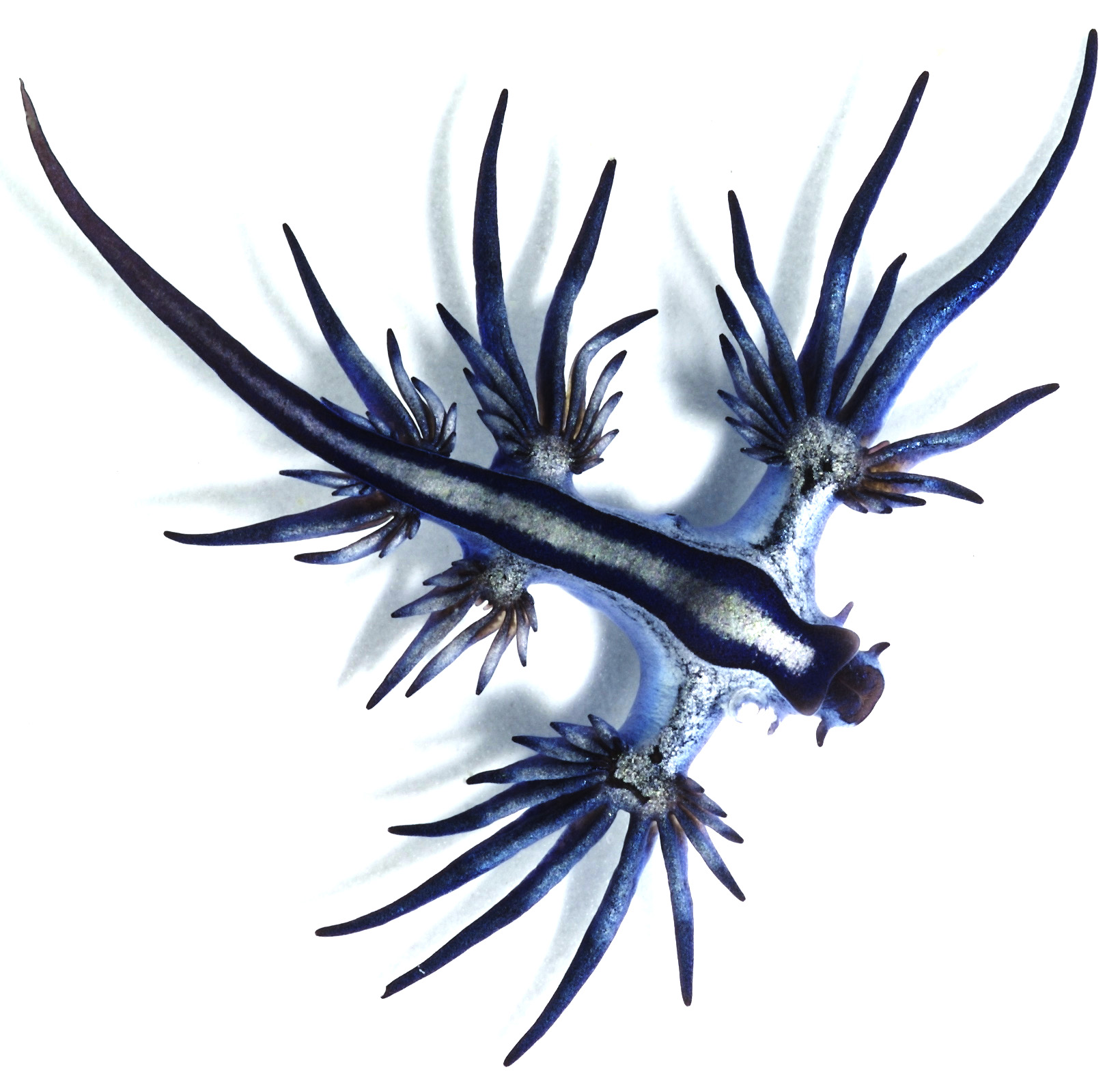
[big hands, I know you’re the one]
— I mentioned that the slugs look this way for a reason. Well, we can now guess why they have those very long cerrata: they’re weapons. Longer cerrata give the slow-moving slug a longer reach for hitting prey.
As to the coloration, they float on the ocean surface most of the time. Hence their pattern of blue, dark blues and whites: they reflect a lot of harmful ultraviolet, and also blend in. From a distance, a Dragon will look like a small clump of seaweed or a streak of light on the water’s surface.
— Did I mention that they habitually float upside down? And that they swallow air bubbles for buoyancy, to float effortlessly, but then cough them back up when they want to swim more actively? Or that they are cheerful and energetic cannibals? Or that they can regenerate?
Well. Obviously I like writing these nerdy science posts! But I do think they connect to the greater CT project: much is known, but there’s so much more yet to know. And sometimes the moving frontier between between the known and the unknown hits something that’s just cool.
And that’s all.
{ 12 comments… read them below or add one }
Jim Harrison 04.29.26 at 1:11 am
Lots of insects get their venom from what they eat, though sequestering a molecule seems a lot simpler than sequestering a nematocyst. Thomas Eisner, the great mavin of chemical defenses in arthropods wrote several books about the phenomenon. I bring him up because I hate to pass up an opportunity to plug his memoir, For the love of Insects, which is a wonderful read.
Bill 04.29.26 at 2:31 am
Doug, these posts are so awesome. I have gently picked up a different nudibranch in a handful of seawater once or twice, but I will refrain with these guys.
krms 04.29.26 at 2:58 am
just a comment that this is great! maybe the type of article you’d prefer to read in a newspaper or magazine, rather than on a blog?
bad Jim 04.29.26 at 5:29 am
… what ingenious deviltry
could frame such fractal symmetry?
Otherwise, wow. Endless forms most beautiful and most wonderful indeed.
Ken_L 04.29.26 at 7:44 am
And all humans got from evolution was an opposable thumb and a predisposition to chronic lower back pain.
oldster 04.29.26 at 8:48 am
I’d love to hear a theory for why these slugs have evolved something like a tetrapodal body-plan. It is surely the resemblance to higher chordate body plans (a lizard, a cat) which makes the larger fronds resemble hands, when in fact they are no more homologous to hands than they are to the man-o-war’s tentacles. These slugs could have wound up hexagonal or heptagonal or anything else — what advantage accrues to them from looking like little lizards?
Jim Harrison remarks on the frequency with which poisons are harvested by a predator from its prey. As I understand it, there are also animals that cultivate onboard colonies of bacteria that function as their toxin-factories (pufferfish, blue-ringed octopi, etc. — did you already write about these?). Given the continuity of bacterial substratum, you could write a life of the bacteria according to which it is just using its host animals to reproduce and spread (pufferfish are just a way for the endosymbiotic bacteria to get around the ocean).
Perhaps a life of the cnidocytes could be written that would push them into the foreground, and make the slugs and man-o-wars just one episode in their picaresque (and piquant!) peregrinations.
Matt 04.29.26 at 11:19 am
These things live around where I do. I don’t think I’ve every seen one in person, but I don’t want to, either. I have seen “blue bottle” jellyfish around, and that’s close enough. Mostly, I just hope I don’t accidentally step on one or have it wash up against me when I’m at the beach or surfing.
Doug Muir 04.29.26 at 2:21 pm
oldster @6, I /think/ that’s purely accidental? If you look at the other slugs, none of them look remotely tetrapodal.
Also, if you look closely, you’ll see there are three pairs of cerrata. The rearmost pair are smaller, but still: it’s more of a hexapod than a tetrapod.
Also-also, while these guys are capable of swimming, my understanding is that they’re pretty slow. I haven’t seen Blue Dragons in the wild, but I’ve seen other sea slugs, and their movements are pretty languid. The cerrata may look like limbs, but I think most of the propulsion is coming from slow undulations of the entire body.
I did write about the blue-ringed octopus a while back — google that phrase on this site and it will pop right up.
Doug M.
Jay Conner 05.01.26 at 3:33 am
I had a Japanese friend who introduced me to Sea Slug Sashimi at a sushi restaurant in Tokyo, in 1958. It was black, slippery, with a slimy coating. I think he was testing me to see if I truly would eat anything Japanese.
I have since described it as having all the texture and flavor of a Goodyear Tire.
After chewing it for several minutes, tasting no discernible flavor, and making no substantial progress toward reducing it in volume, I managed to discard it.
I have never seen it on any Sushi menu since, and I live in California, and eat a lot of Sushi, shop at Asian markets, and I have never seen the Sea Cucumber offered for sale here. It is, however, googleable. Probably I should make inquiries…
JimV 05.01.26 at 3:56 pm
These creatures look very useful for aliens (good or bad) in a movie or video game. I have made small-scaled images from the photos to decorate the seas of some of my hobby games. I am not a good enough video artist to animate them. Thanks for the post.
pouncer 05.04.26 at 4:52 pm
When hunting elusive prey… They cooperate? Pair up?
Two by two, hands of blue…
GeoX 05.04.26 at 10:30 pm
I personally would eat up a post about sea slugs being or not being nudibranches.