I think I sort-of knew many of the facts that Elijah Wald recounts “in this piece in the Financial Times”:http://www.ft.com/cms/s/2/eeca345e-8de1-11de-93df-00144feabdc0.html . Still, knowing and putting-together are two different things. You couldn’t listen to 78s as “background music” because even with an auto-changer, you’d have to get up every 15 minutes – hence the importance of radio if you wanted a soundtrack to other activities. Why did jazz singers such as Billie Holiday record such a wide repertoire of “standards”? They were packaging the hit songs of their day for a particular audience (with other singers styling for other market segments). Wald’s account also makes sense of other matters that seem incomprehensible to modern music fans. Wald doesn’t discuss this, but we are often surprised that great singers of the past died in poverty and obscurity and are buried in unmarked graves (Bessie Smith, for example). But Wald’s emphasis on the contemporary importance of the song rather than the singer helps to explain how this could have happened. We might prize the iconic performances of the time, but back then there were lots of jobbing singers churning out multiple versions. Interesting enough to make me order a copy of Wald’s new book, _How the Beatles Destroyed Rock ’n’ Roll_.
Posts by author:
Chris Bertram
Well with Australia 133 for 8 and 199 behind at tea on the second day, I’m a bit late starting this. If I’d posted last night it would have been to berate a mediocre England – what a difference a day makes. Is Broad the new Flintoff? Can Australia yet pull it back? Comment away.
Sorry, I forgot to get this started. But in truth, it was pretty much over by lunchtime on day one. Should Harmison ever play for England again? I’m certain that Bopara shouldn’t. Comment away!
Quite a few people have now posted about Jerry Cohen on the web. Notable amongst them are “Colin Farrelly”:http://colinfarrelly.blogspot.com/2009/08/ga-cohen-1941-2009.html , “Thom Brooks”:http://the-brooks-blog.blogspot.com/2009/08/obituary-g-cohen-1941-2009.html , “Ben Saunders”:http://bensaunders.blogspot.com/2009/08/death-g-cohen.html, “Chris”:http://virtualstoa.net/2009/08/05/dead-socialist-g-a-cohen-1941-2009/ “Brooke”:http://virtualstoa.net/2009/08/06/jerry-on-jerry/ , “Matthew Kramer”:http://normblog.typepad.com/normblog/2009/08/ga-cohen-a-tribute-by-matthew-kramer.html and “Norman Geras”:http://normblog.typepad.com/normblog/2009/08/ga-cohen-19412009.html . I was also sent, by Maris Kopcke Tinture, a “link to a private recording she made of Jerry’s valedictory lecture from May 2008”:http://rapidshare.com/files/264780177/jerry_valedictory.m4a. The recording is imperfect and there is a chunk missing in the middle, but it is the only such recording to have surfaced.
(I also need to post a short note about use of my photos of the valedictory, since people have been taking them from my Flickr stream and using them without permission: they are not public domain. 1. Seek permission, which I will normally grant to any not-for-profit site unless I find the content objectionable. 2. Please attribute (this can be in as miniscule a text as you like). 3. If you are a commercial organization then we will need to come to an arrangement about a fee, which will be donated to an appropriate charity.)
A few unsystematic thoughts about Jerry Cohen:
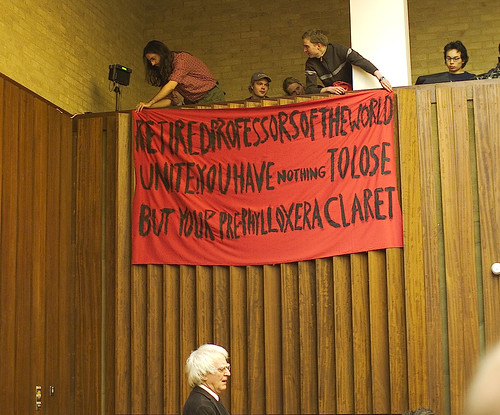
A friend called yesterday to tell me the news about Jerry Cohen and then I spent the day feeling disoriented, sad, confused, not really knowing what to feel or think. For me, and I’m sure, for many friends, colleagues and former students, Jerry was a constant presence. If I’m writing something I often hear Jerry’s voice telling me that I’m being evasive, that I’ve failed to explain a distinction, that such and such is “bullshit”, and so on. At the same time, Jerry was quite brilliant at striking the right balance between the discipline of following the argument where it leads and the importance of hanging onto one’s deepest convictions.
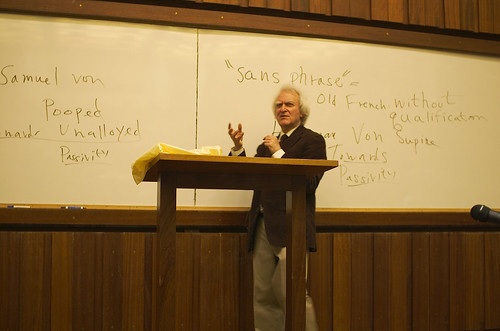
I got a call this morning to tell me that Jerry (G.A.) Cohen has died suddenly and unexpectedly of a massive stroke. I want to write an appreciation of him as a friend, mentor and philosopher in due course, but I’m too numb to do it at the moment. I know that his other friends, colleagues and fellow students of his feel the same acute sense of loss.
My friend Jo Wolff has “a column over at the Guardian’s Comment is Free”:http://www.guardian.co.uk/commentisfree/2009/aug/03/students-university-dumbing-down section taking issue with Phil Willis MP, who chairs the Parliamentary Select Committee on Innovation, Universities, Science and Skills which just issued its report on “Students and Universities” (downloadable “here”:http://www.publications.parliament.uk/pa/cm/cmdius.htm ). Jo is upset with Willis and his committee for two reasons: first, because they suggest that the marked increase in the proportions of First Class and 2.1 degrees is the result of grade inflation; second, because they were sceptical about whether a degree of the same class from different institutions are necessarily of equal value.
Jo’s response to the first “dumbing down” point is to cite the benign influence of the government quango the Quality Assurance Agency on teaching standards in Universities. I can’t actually work out if Jo’s QAA argument is sincere or an attempt at heavy irony. In any case, I wonder if he’s actually read what the report says about the QAA. It argues — surely correctly — that the QAA has been more focused on processes than on what happens in the classroom and that it has been quite easy for universities to tick the quality-assurance boxes whist actual teaching quality goes unexamined. That’s one part of the report that is surely right. At the time of “subject review” I think only about 1/19th of a department’s score was a result of classroom observation and the rest was attributable to a lengthy paper-trail which we all laboured for months to assemble. But whatever, Jo knows as well as I do that the incentive structure that government has put in place for higher education in the UK has not favoured quality of teaching but rather research. Teaching has been seriously underfunded and there has been little to no payoff in terms of career advancement open to good teachers. In the circumstances it really is hard to believe that the across-the-board improvement in student grades is the result of better teaching. (No doubt any increase in performance in the UCL philosophy department is attributable to better teaching, but Jo needs an argument for the sector as a whole!)
Jo’s response to the second point — cross-institution comparability of standards — is to say “so what?”. He may be right. But what infuriated the Select Committee was that they asked the question of university leaders and failed to get a clear answer. Rather they were faced with obfuscation and evasion. Perhaps if Jo had been interviewed he would have given the committee a clear, reasoned and satisfactory answer as to why it doesn’t really matter: the Vice Chancellors of Oxford and Oxford Brookes universities weren’t willing or able to do so.
Someone wanted me to start this thread before the game started. Well I’m a bit late for that, but most of the first day was obliterated by rain. The Aussies are now 126 for 1 after 30 overs …. so unless England’s attack can get it together fast, Australia will be in control.
Judging by a review I read in the New York Times, there is some danger of Christopher Caldwell’s _Reflections on the Revolution in Europe_ being taken more seriously by some Americans than earlier examples of the Europe-about-to-become-Muslim genre. Matt Carr, writing for the Institute of Race Relations, “provides some detailed rebuttal”:http://www.irr.org.uk/2009/july/ha000011.html .
It is disappointing to get what appears to be definitive evidence that Robert Capa’s photograph of the falling soldier was staged. Sadly, too, I’m inclined to agree with the thought that the staging in that case also amounts to fakery. Still, I’m far from certain about my reactions here: staging a photograph is not, in itself, sufficient to make the charge stick. I was thinking last night about the US Civil War photographs where we suspect the photographers rearranged the bodies, and that is one of the examples that Philip Gefter discusses in an essay on the problem at the New York Times. Many of Bill Brandt’s photographs of English upper and working-class lives were staged, but that staging doesn’t make them bogus. Rather Brandt was using artifice to get his subjects to enact a role more general than any particular haphazard moment. That also seems true of the Lewis Hine pictures that Gefter discusses. Capa’s soldier seems altogether more problematic. We _could_ say that he is an icon standing for the many soldiers who did in fact die for the Republic, but that doesn’t feel right since it would be hard for the image to play that role for us if we knew that the man was simply acting. Brandt’s subjects were (barely) acting, but they were at least playing parts that they also played in life. And for reasons Susan Sontag discussed long ago, the fact of photographic _selection_ means that even where a picture appears to have a definite semantic charge, it would be naive to take that as a veridical report, since the image may well have been chosen for that effect from a sequence of which all the rest conveyed a quite different impression.
England “win the second test”:http://news.bbc.co.uk/sport1/hi/cricket/england/8159247.stm (the first time they’ve beaten the Australians at Lords since 1934), thanks to some awesome bowling from Flintoff, and some very dodgy umpiring. Open thread below.
The latest “episode”:http://www.guardian.co.uk/commentisfree/henryporter/2009/jul/16/photography-police-view-delete-images of police harassment of street photographers is recounted by Henry Porter in the Guardian. There just seems to be an endless loop around this stuff: police officers stop/arrest/intimidate photographer, fuss in the press, lobbying of politicians, earnest denials and issuings of revised guidance by senior police, continued botherings despite guidance. Do, repeat.
What really astonishes me about this is that the alleged terrorism link is based on what seems to be a law-enforcement myth about the bad guys scoping out their targets using DSLRs and that the police are actually missing a major intelligence opportunity. Anyone who mixed with enthusiastic photographers knows that there is a bunch of people in every town and city who wander around looking at things, noticing the unusual, exploring side-streets and back alleys, and so forth. Even when we haven’t got cameras on us we’re looking, noticing, framing, making a mental note. You’d think that a smart police officer somewhere might have cottoned on to this and had the idea that cultivating good relations with such people, not acting so as to piss them off, might actually be a good idea. But no. The police mentality is to see such people as suspicious and possibly criminal and to intimidate them off the streets. Stupid, stupid, stupid.
That’s “a headline”:http://news.bbc.co.uk/1/hi/uk/8147890.stm at the BBC. So it would seem that they do rather less damage to the UK economy tham the various banking groups that needed rescuing ….
Phew! England (and Wales) “just about got away with it”:http://news.bbc.co.uk/sport1/hi/cricket/england/8146497.stm despite Pietersen’s stupidity and arrogance. The really big difference from 2005 (so far) is the change in feel caused by Warne’s retirement. Four years ago, Warne was a feral presence, spooking the England batsmen with his cunning and aggression. Of course, Ponting was captain back then too, but this series has seen him come to the fore: planning, homework, probing the England weaknesses. Collingwood was terrific today, but, generally England were brainless. Still, no harm done yet and four tests to play to win back the Ashes.
A couple of weeks ago, I gave a public lecture in Bristol on the subject of Jean-Jacques Rousseau and his continued relevance to modern society and political philosophy. Undoubtedly mileages will vary on that question, but anyone who wants to hear my take on it can “listen to a podcast”:http://www.bris.ac.uk/philosophy/podcasts_html/WhyRousseauMatters.mp3 . (The lecture is included as part of the “Philosophy at Bristol” series which you can access “via its blog”:http://eis.bris.ac.uk/~plajb/blog/ or at “iTunes”:itpc://eis.bris.ac.uk/~plajb/blog/atom.xml .)