by Chris Bertram on June 7, 2007
I try to avoid commenting on the material posted on Norman Geras’s site. But today he posts “a letter from Professor Daniel Statman”:http://normblog.typepad.com/normblog/2007/06/dark_days_for_t.html to “a colleague” in the British Society for Ethical Theory explaining why Statman feels unable to attend the forthcoming “BSET conference”:http://www.bset.org.uk/conference.html at Bristol (my institution). Statman — who specializes in writing on the ethics of war and whose “oeuvre“:http://philo.haifa.ac.il/faculty_pages/statman.htm contains a philosophical defence of targeted killing in the so-called WoT — is clearly a political animal and not just a wounded academic. You can read the whole letter at Normblog, but I thought I’d just comment on this paragraph:
bq. As you surely recall, in the past I used to come regularly to the meetings of BSET, which I always felt were among the highest-quality conferences in ethics worldwide. For the last two years, I haven’t been able to attend the meetings, but I did plan to do so this year and I sent the registration forms to Bristol two weeks ago. But after learning about the UCU resolution to promote an academic boycott of Israel, I have changed my mind. In the present circumstances, I don’t think I’ll feel comfortable at an academic institution or conference in the UK. I don’t feel like sitting down to dinner with people some of whom may have voted to boycott me and my colleagues. Nor do I feel like having dinner with people who, though against the boycott, nevertheless believe the offensive and absurd claim that Israel is an “apartheid state,” which makes all Israelis, academics in particular, morally polluted. And maybe, above all, I’d rather avoid the heightened self-consciousness which I fear will be inevitable in the circumstances. (Which of these folks voted to boycott me? Was that a friendly smile or the opposite? Is he being nice to me in spite of my being Israeli, because of, or regardless of? Was that political comment a provocation or just innocent small talk? And so on and so forth.)
The first thing to say is that Statman is, of course, free to associate or not with whoever he chooses, and thereby to _boycott_ whoever he likes (including people he suspects, without evidence, of beliefs he might find offensive). The second is that just 158 people voted for the motion at the UCU conference, so it is very unlikely that Professor Statman would indeed face the prospect of dinner with anyone who voted to boycott him and his colleagues. In fact, since the motion passed is at best construed as being a vote to “promote” the boycott (that is to require discussion of it in branches), a point he acknowledges in his initial formulation, it seems certain that he won’t have to dine with such a person. The third is that it is hard to imagine why the claim that Israel is an “apartheid state” (absurd or not) is particularly morally polluting for Israeli _academics_ , as Statman states. He worries that even non-boycotters might have beliefs he finds offensive — I wonder if he is so fastidious about avoiding people who might have morally offensive beliefs elsewhere (Haifa, for example?). I suggested in my last post on this issue (to remind people, I was opposing the boycott) that one effect of the proposal is to facilitate we-are-the-victims grandstanding. Statman’s letter, and his use of Geras’s website to publicize it, would seem to be just such an instance.
by Chris Bertram on June 5, 2007
I’m confused. According to the many media reports, the UCU, successor to the AUT and NATFE and the main trade union representing British academics, “has voted to reinstitute the boycott of Israeli universities”:http://education.guardian.co.uk/higher/worldwide/story/0,,2091769,00.html that the AUT finally rejected last year. But in fact, _as far as I can tell_ , the UCU Congress has done no such thing. Rather it has passed some rather wooly pro-Palestinian resolutions and has ordered its executive to promote discussion of the boycott at branches over the next year or so. The practical effect of this in the world is at best close to zero. In fact it is almost certainly negative: no-one actually gets boycotted but the worst elements of the Israeli right (and the likes of Alan Dershowitz) get a renewed opportunity to portray themselves as victims.
Aside from the general stupidity of the boycott campaign (well “summed-up”:http://unspeak.net/exclusion-wall/ by Steven Poole last year), it promises to consume a lot of energy in fruitless arguments that go nowhere. Last time this happened “I stood up on my hind legs at my local AUT branch and opposed the pro-boycott motion”:https://crookedtimber.org/2005/05/03/ariel-sharon-and-the-aut-boycott/ . I’ll vote against it again this time, when the opportunity presents itself. I have to say though, that I’m a lot less motivated to oppose the boycotters than I was. They are just as wrong as they ever were, but I’ve been sufficiently disgusted by Israeli conduct over the past year (especially in Lebanon) not to feel all that much enthusiasm for making a big effort. And then there’s the fact that when I did speak up against the boycott I received a load of offensive email. Normally, you’d expect to get such email from the people on the other side, telling you what a horrible sellout you’ve been. But I didn’t receive a single bit of hostile email from a pro-Palestinian persepective. Rather, I got a good deal from Likudniks and their American friends who mistakenly assumed that if I opposed the boycott I must share their vile perspective on Arabs generally and Palestinians in particular. (No thanks. Go away! I don’t want email from people like you.)
“Martha Nussbaum’s article in Dissent”:http://dissentmagazine.org/article/?article=811 puts the case against the boycott pretty well. However there’s one pro-boycott argument that she doesn’t address and which I’ve not heard a good reply to. It doesn’t, for me, outweigh the arguments against, but I do think it weakens the often-put “double standards” argument that anti-Israel measures unfairly discriminate against Israel since there are far worse countries in the world. (This is often accompanied by the further claim that because Israel is picked out whilst other countries are worse, the motive of the boycotters must be sinister and is probably anti-semitic.) The argument is this: that the Israeli perpetrators of injustice are far more vulnerable to outside pressure than, say, the Chinese or the Russians are. Measures taken against Israel therefore stand a better chance of being effective. The Russian treatment of the Chechens or the Chinese treatment of the Tibetans may indeed be worse than the Israeli treatment of the Palestinians. But we can take action _now_ to force the Israelis to negotiate and to end the injustice of the occupation, whereas we cannot act with similar prospect of success against Russia or China. Obviously that argument depends on a number of facts about the way the world is. And those facts are highly contestable. But it doesn’t depend (to the contrary!) on any claim that Israel is uniquely or even especially evil or unjust.
by Chris Bertram on June 2, 2007
Josh Cherniss, Harvard grad student and an old friend of Crooked Timber, tells me of an interesting sounding initiative at Harvard for a grad student conference in political theory.
Details below the fold.
[click to continue…]
by Chris Bertram on June 1, 2007
Jeff Randall in an article tellingly entitled “It’s not racist to worry about immigration”:http://www.telegraph.co.uk/opinion/main.jhtml;jsessionid=GC4DUTALG01A3QFIQMGSFF4AVCBQWIV0?xml=/opinion/2007/06/01/do0101.xml&posted=true&_requestid=6551 in the Telegraph:
bq. Never mind arguments over race, diversity and multi-culturalism, England (where most immigrants want to settle) is horribly crowded. With 50 million people, it is the fourth-most densely populated country in the world, excluding city states such as Hong Kong and Dubai.
The trouble with this sort of claim is obvious. If England (density: 388.7 /km²) counts as a country then all kinds of other non-sovereign-state units ought to be included in the sample — New Jersey (438/km²) perhaps, or Puerto Rico (434 /km²), or the Palestinian Territories (615 /km²). But if sovereign states (apart from city states) _are_ the relevant unit, then the UK (243 /km²) comes in behind “rather a lot of places”:http://en.wikipedia.org/wiki/List_of_countries_by_population_density .
by Chris Bertram on May 29, 2007
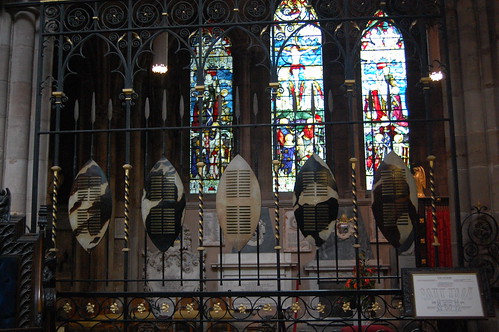
On the whole, ethnic stuff in English churches tends to consist of displays celebrating multiculturalism and interfaith understanding etc. So it was with some surprise that, when visiting Lichfield’s magnificent medieval cathedral I stumbled on this war memorial in the south transept. This in-your-face bit of Africa dates from just after the “Anglo-Zulu War of 1879”:http://en.wikipedia.org/wiki/Anglo-Zulu_War (think Rorke’s Drift, think Michael Caine) and is just a teeny bit incongruous amidst the gothic widows and vaulted ceilings.
The whole Cathedral is magnificent by the way — there are other photos in my Flickr stream — and this isn’t the only cultural surprise. A memorial to Erasmus Darwin has the words:
“His speculations were directed towards problems which were afterwards more successfully solved by his Grandson, Charles Darwin, an inheritor of many of his characteristics.”
by Chris Bertram on May 23, 2007
Well, “here we go”:http://news.bbc.co.uk/sport1/hi/football/europe/6669039.stm . An open thread for pre-match speculation and post-match analysis. Me, I’m feeling confident. Milan are a great side, but they’ve been doing all the talking and I think their desire to avenge 2005 will work against them. They were terrific against Man U, but profited from suicidal defending, and great performances are often followed by average ones. Hold on tight.
by Chris Bertram on May 20, 2007
Went to see Shane Meadows’s much-hyped-by-the-critics “This is England”:http://www.imdb.com/title/tt0480025/ last night. What a piss-poor film it is. Poorly acted, poorly scripted, and hardly redeemed by some really clunking cinematography. The film would be kind of ok as a drama offering on BBC2 (or BBC4) but insightful socio-historical document it isn’t. The action all takes place on a bog-standard depressing-concrete housing estate with the standard row of depressing-concrete shops (plus free-standing Pakistani newsagents) and — for those who don’t know — gravitates around the tensions within early-80s skinhead culture between two-tone ska fans and racist knuckleheads. Young boy with father-killed-in-the-Falklands (Shaun) gravitates to the cool(ish) multiracial ska crowd but then becomes seduced by boastful-but-insecure racist psychopath Combo, the movie then plods along to its predictable violent “climax”. Thatcher and the Falklands lurk predictably in the background. Redeeming features? The National Front meeting in the pub isn’t badly observed, but, in truth, it can’t have been all that hard to set up a little cameo involving dopey skinheads, tatooed bikers and fat Nazis in bad suits. TiE goes a long way to showing that, just so long as you make a film with a certain kind of subject matter, critics will give you a good write-up. Sit at home and watch old episodes of _Shameless_ or rent a copy of _La Haine_ : both are better acted and both offer more insight into their subject-matters than _This is England_.
by Chris Bertram on May 12, 2007
Simon Kuper, in today’s FT, “reviews Anne Goldgar’s _Tulipmania_, “:http://www.ft.com/cms/s/50e2255e-0025-11dc-8c98-000b5df10621.html a new study of the 17th century boom and bust in the Dutch tulip market. Disappointingly, it turns out that most of the stories are false. There was a boom, but it was a fairly marginal phenomenon in the Dutch economy, and people weren’t ruined: the deals were done when the plants were in the ground, but payment was due only when the bulbs were dug up. Most people simply refused to pay, or paid only a small fraction of what they owed.
by Chris Bertram on May 5, 2007
We had an interesting discussion the other day after Harry’s “post”:https://crookedtimber.org/2007/04/25/roots/ about Show of Hands and their song “Roots”. That argument was partly about the possible recuperation of song by the radical right despite the inclusivist politics of the songwriter. Yesterday’s Guardian had “an interesting piece”:http://music.guardian.co.uk/folk/story/0,,2071468,00.html attacking the the politics at the origin of folksong as a distinct genre, and especially the politics of the folksong collectors Sharpe and Lomax. Hugh Barker and Yuval Taylor argue that the search for authenticity and the untainted roots of distinct national tradition as embodied in besmocked peasants (and so on) is imbued with ghastly racist assumptions of various kinds and that we should simply reject the idea of a distinction between folk and popular song.
by Chris Bertram on May 1, 2007
Good 1 Evil 0 (Agg. 1-1) Good wins 4-1 on penalties.
by Chris Bertram on April 29, 2007
(Those who don’t know about Bristol’s most famous “artist” can google for “Banksy” or check the Wikipedia.)
.
by Chris Bertram on April 22, 2007
Just before Christmas, I picked up a copy of _Roseanna_, the first volume of Maj Sjowall and Per Wahloo’s Martin Beck series. I’ve just finished the final volume _The Terrorists_. Having read the first, I had to read them all. Since the reprint schedule wasn’t going to get me them all quickly enough, I scoured Hay-on-Wye for volumes and then the internet. In the 1960s and 1970s Sjowall and Wahloo, husband and wife, collaborated on the sequence of ten detective stories set (mainly) in Sweden. Though we at CT sometimes Scandinavia as some kind of benign alternative to North American capitalism, the far-leftish Sjowall and Wahloo had a much more negative take. The Swedish welfare state that appears in the novels is a grotesque fraud perpetrated on the working class and they use the device of detective fiction to show a reality of desperation, poverty, isolation, alienation, exploitation, and criminality. But the novels are hardly exercises in _agitprop_ . If they were, they’d be a pretty poor read. Instead, their brutally cynical vision of Swedish society simply tinges the whole and emerges through the facts and the occasional acid comment.
[click to continue…]
by Chris Bertram on April 17, 2007
There’s a useful blog covering l’affaire Wolfowitz “here”:http://www.worldbankpresident.org/ . So far as I can see the Wall Street Journal is almost alone in spinning a pro-W line (what a surprise!).
by Chris Bertram on April 2, 2007
Spotted at the “Economist’s Free Exchange blog”:http://www.economist.com/blogs/freeexchange/2007/03/airlines_and_inequality.cfm :
bq. According to the new tax data, the income gap has widened. This has led to more speculation that we will descend into a Dickensian dystopia full of the have and have nots. I recently experienced this type of reality when I had the opportunity to fly business class on a trans-Atlantic flight.
Possibly this is an attempt at irony by La Galt; possibly the gap between first-class and regular transatlantic passengers really does make her think of _Bleak House_ or _Oliver Twist_ . Either way, there’s a kind of disconnect here that I have trouble getting my head around.
by Chris Bertram on March 26, 2007
This is for “Harry”:https://crookedtimber.org/2006/03/22/michael-gove-is-right/ . (And perhaps for Henry, Kieran and Maria too.) A limited edition (300,000 jars). It is already being re-sold on ebay. Not sure what it tastes like, as mine is as yet unopened.