Most of you have probably seen this when it first aired on BBC 4, but just in case anyone mentioned it I thought I’d link to it anyway. Part 1, part 2 and, perhaps best of all, part 3. Unsurprisingly, he is a man of great discernment, listing Stanley Unwin, Georgette Heyer, Delia Smith and Led Zeppelin. And you’ll never feel bad about swearing again (he makes me feel a bit better about the fact that one of the little monster‘s first sentences, when asked to do something, was a very calm and direct, “F**k it, Dadda do it”). Hugh Laurie fans? well, there’s a lot of him in it too.
Posts by author:
Harry
Somewhere back in the mists of time, I seem to remember our own Daniel criticized academics for not taking seriously the fact that management is a job, something that can be done badly or well (the only cite I can find is here, but I’ll link to the long version if someone finds it for me, if, that is, it isn’t something I just dreamed). I suspect that there are two (respectable) reasons for this. One is that academic managers are drawn from the ranks of academics and given little if any training. This narrow pool has already selected out a lot of people who might actually be good at it, and as a result academics rarely get to experience good management directly. Second, management is something that is much easier to recognise as a real and important skill if you have seen some good examples of it than if you have only seen bad or indifferent examples. (I think of it as a bit like my experience with dental work; the first time I had work done with a good anaesthetic it was something I couldn’t possibly have imagined before).
Here’s a long post from aaron swartz which I recommend to all who doubt that management is an important skill, and recommend, even more, to anyone who is being thrown into management tasks without much training or help, especially in an environment with unclear lines of authority and/or an anti-authority culture. If you’re planning to become principal of a school its all useful, but you might especially want to look at Point 2a and Point 9.
Hanna Rosin in the Atlantic.
One day, while nursing my baby in my pediatrician’s office, I noticed a 2001 issue of the Journal of the American Medical Association open to an article about breast-feeding: “Conclusions: There are inconsistent associations among breastfeeding, its duration, and the risk of being overweight in young children.” Inconsistent? There I was, sitting half-naked in public for the tenth time that day, the hundredth time that month, the millionth time in my life—and the associations were inconsistent? The seed was planted. That night, I did what any sleep-deprived, slightly paranoid mother of a newborn would do. I called my doctor friend for her password to an online medical library, and then sat up and read dozens of studies examining breast-feeding’s association with allergies, obesity, leukemia, mother-infant bonding, intelligence, and all the Dr. Sears highlights.
After a couple of hours, the basic pattern became obvious: the medical literature looks nothing like the popular literature. It shows that breast-feeding is probably, maybe, a little better; but it is far from the stampede of evidence that Sears describes. More like tiny, unsure baby steps: two forward, two back, with much meandering and bumping into walls. A couple of studies will show fewer allergies, and then the next one will turn up no difference. Same with mother-infant bonding, IQ, leukemia, cholesterol, diabetes. Even where consensus is mounting, the meta studies—reviews of existing studies—consistently complain about biases, missing evidence, and other major flaws in study design. “The studies do not demonstrate a universal phenomenon, in which one method is superior to another in all instances,” concluded one of the first, and still one of the broadest, meta studies, in a 1984 issue of Pediatrics, “and they do not support making a mother feel that she is doing psychological harm to her child if she is unable or unwilling to breastfeed.” Twenty-five years later, the picture hasn’t changed all that much. So how is it that every mother I know has become a breast-feeding fascist?
At some point, when I was a little bit obsessed with this topic myself, I looked a handful of studies and my experience was like Roisin’s; they all showed very small benefits, but I noticed that none of them tried to control for the socio-economic status of the mothers. Ever since I have been rather skeptical about the benefits, but have dutifully supported the breastfeeding of my kids, despite the difficulties that both they and their mother endured. Breastfeeding meant that for the first several months of each of their lives their primary relationship was with their mother, and everything I did with them had to be scheduled around the need for them to feed. With the first two, both of whom screamed pretty much constantly while awake for 4 months, I — and my wife — frequently went against our instinct that they were hungry, and refrained from giving them any formula (as the books tell you to), causing, I suspect, far more misery for all of us than was necessary.
My favourite La Leche League story (frequently referenced in Rosin’s article) is a from a friend who teaches high school. She asked a La Leche League counsellor how she could pump, given the brief breaks between classes, and the time it takes to let down. “well”, said the counsellor, “that’s easy, you just massage your breasts for 10 minutes before you pump”. “But I’m teaching in front of 30 teenagers in that 10 minutes before I pump, I can’t massage my breasts in front of them”. “Oh yes you can, they’ll soon get used to it”.
Siobahn, to whom I owe the link, says that her favourite line of the article is this:
“This is why, when people say that breast-feeding is “free,” I want to hit them with a two-by-four. It’s only free if a woman’s time is worth nothing.”
Update: see Laura’s excellent follow-up/summary, and ensuing discussion.
Via Leiter I see the very sad news that Brian Barry is dead. As anyone who knew him can tell you Brian was some sort of force of nature; irascible, funny, impatient, kind, clever and subtle, but sometimes obtuse and sledgehammering. A founder of analytical political philosophy, who became irritated by its unworldliness, and who moved, as far as I can tell, from the middle of the political spectrum gradually but relentlessly to the left, while the world determinedly moved the other way. And he was verbose. Polity got me to read an early version of Why Social Justice Matters
The last time I saw him was on a flying visit to Swift, when he and Anni dropped in, almost (but not quite) without warning, for a drink. It was an unexpected pleasure to see them, and Brian dominated the conversation, as he sometimes did. He’d recently been in the States and had visited his ex-wife, to see her for the last time. She had joined a religious community, which was not quite Trappist, but committed to speaking only when necessary. Both Adam and I had to suppress a giggle that someone who must once have been surrounded by words should go to such lengths to turn her back on them.
Many readers will only know him for his public performances, which were often witty, but also usually pugnacious and sometimes ill-tempered. Even I, who knew him not well, but well enough, and was on the receiving end of a great deal of kindness and support from him, found the following story, which I can’t attribute for an obvious reason, surprising. At a post-lecture party, a female graduate student (from whom I heard this) found herself in a corner with a male professor who started making very unwelcome advances that were not obvious from a distance. Brian, from across a crowded room, noticed, and quietly made his way to them, and subtly engaged said professor in conversation. He never spoke to her about the incident, which she interpreted not as him feeling uncomfortable, but as his being sensitive to the fact that she didn’t want to discuss it.
Brian told me once that he planned to stop writing at 70, and I think he more or less kept to that. So it is although a sad loss for philosophy, we probably haven’t lost writings we’d otherwise have seen. But it is a terribly sad loss for Anni, and for his many friends all over the world. And for that matter, for the world that moved right while he moved left. (Text edited in response to kidbitzer’s comment).
(UPDATES — at djw’s request, here’s the link to our post on WSJM, by Tom, not me! See also djw’s posting of a delicious, and unfortunately but typically prescient, passage from Brian’s review of Anarchy, State and Utopia). Further Update: please keep commenting. In a few days I’ll post again with links to the current thread, and to as many of the nice memories gradually emerging on the web as I can manage, and will tell Anni to have a look, because I know that she will be very pleased to see what so many people are saying. In the meantime here are Stuart White’s comments at Next Left).
Another piece by Mary Ann Mason at the Chronicle, this time on the problems academic men (and men generally) have being primary carers for children. Describing a recent book by Andrea Doucet, Do Men Mother?: Fathering, Care, and Domestic Responsibility
it was not easy for those single fathers because, just as in the scientist’s case, American society is not always willing to accept them as the primary caregivers. Particularly tricky is being accepted by other parents in social situations and at schools. As one father commented in the book, “There’s a lot of networks for moms and there isn’t a network for guys, and I think a huge part of that is it isn’t easy for a guy. I’ve been out to the library, and I’ve seen a guy pushing a baby carriage. But it’s just not so easy for a guy to go up to another guy and say, ‘Hey, how old is she? Do you want to be friends?'”
She goes on:
Father as breadwinner is a deeply held cultural stereotype within the society and the university; despite many instances in which women, particularly professional women, earn salaries larger than their husbands’. In Doucet’s study, the married fathers who had chosen to be stay-at-home parents included those whose wives made a much higher salary and those in couples who had decided that the father was the better choice for stay-at-home parent. In virtually all of those cases, the father returned to work within three years. Most of them attributed it to the social stigma they had experienced by not being the breadwinner.
People who liked the John Martyn song I posted, or who are just mourning his loss, might want to listen to this loving tribute to the great man on Mike Harding’s show.[1] So many great songs it seems a shame to pick one out, but listen to the end, and hear him do “Singing in the Rain”. Sorry, I only noticed this today; it’ll go offline in about 24 hours.
[1] One of the great irritations of later life, more confirming evidence in this broadcast, is the dawning realisation that Phil Collins might be a nice chap — and one with real discernment.
Five.
I especially liked this:
A newspaper columnist once told of her shock when, having struck up a rapport with a man over dinner, she was told at the end of the meal he had no vacancies for friends. He was operating a “one-in, one-out” policy. Six months later she received a card stating he was now available for friendship.
There’s a lot of fretting about Facebook in England these days, because it is creating attention-deficient friend-flators. When Henry announced that he had joined and pressed the rest of us to, someone criticized him for assuming that it was reaching a critical mass just because he, and his friends, had joined. I, by contrast, assumed that it was about to go belly-up because I had joined (I’m the classic late-adopter, as evidenced by my recent desperate bulk-buying of cassette tapes and tape players before they stop making them because the rest of you have started using ipods). That was a while ago, but I’ve got to tell you that its days are now definitely numbered, because not only has my wife joined but, worse, I just became friends with the mother of one of my secondary school friends.
The Telegraph reports that Ed Balls suggests that school admissions lotteries may be scrapped because they are unfair. I’ve dug around to find the actual speech, but can’t find it anywhere, and don’t entirely trust the report (or the Observer report, which makes him seem less hostile to lotteries) to have gotten the issues exactly right. The “twins” argument (that lotteries split up twins into different schools) is terrible — it is easy to build a sibling rule into a lottery (and that is what, for example, the Milwaukee voucher program lotteries have). This argument is pretty bad too:
“The issue of lotteries is causing some concern to parents around the country,” he said. “I have sympathy with the view that a lottery system can feel arbitrary, random and hard to explain to children who don’t know what’s going to happen and don’t know which children in their class they’re going on to secondary school with.
It is having the kid rejected, and having her go to a school other than her friends, that is the problem here, not the lottery — it’s an inevitable feature of school choice, and in fact has been with us since 1944 (the 11-plus lottery was abolished in lots of places after a while, but even in comprehensive LEAs friends got split up to go to religious or single sex schools, or just to some other school that had a nicer swimming pool, at the whim of their parents).
Can anyone point me to the whole speech, or explain what is really going on?
(It’s nice to see, by the way, that the Tories plan to abolish the lotteries — give power back to the state provider, where it belongs, that’s what I say.)
How do schools with disadvantaged populations beat the odds? England’s Chief Inspector of Schools just released a report examining a group of schools that do and analysing what they have in common:
* They excel at what they do for a high proportion of the time
* They prove constantly that disadvantage or not speaking English at home need not be a barrier to achievement
* They put students first, invest in their staff and nurture their communities
* They have strong values and high expectations that are applied consistently and never relaxed
* They provide outstanding teaching, rich opportunities for learning and encouragement and support for each student
* They are highly inclusive
* Their achievements happen by highly reflective, carefully planned and implemented strategies
* They operate with a very high degree of internal consistency
* They are constantly looking for ways to improve further
* They have outstanding and well-distributed leadership.
This is exactly what you’d expect from the school improvement and effectiveness literature. I’ve been reading a lot of this lately, and what is surprising is how much convergence there is on this. You might think that having achieved such a high level of consensus it would be easy to move into some sort of policy promoting such schools. But it’s not so easy.
I imagine that everyone in Philosophy is discussing the NYT review which asserted, without qualification, that Wittgenstein was the greatest philosopher of the 20th century. Leiter proposes to settle the issue once and for all with an internet blog poll. Go and vote. (I haven’t voted because I don’t know the answer. Carnap? Sellars? Moore? Merleau-Ponty? or, perhaps, John-Paul Sartre….

A few summers ago we were having our house appraised. I opened the door to the appraiser who took a step back, blinked, and then stared rudely at me for about 30 seconds. Then “Oh, you’re English”, he says. (The tip-off being the large picture on my T-Shirt of Zebedee saying “Time for Bed”). He was from a Yorkshire mining community; his father and brothers had both been miners but he was too young himself; his brother (somehow) came to the US to become a hairdresser, and my appraiser followed a few years later.
There’s probably a dissertation to be written about the migration of participants in the Miner’s Strike to the US. A BBC exec chased down the two protagonists in this wonderful Don McPhee photo, and although the miner in the picture (George Brealey) died in Edington some years ago, the copper who you can see trying unsuccessfully to suppress a smile now lives in Tennessee. Full story here. And, if it works, a gallery of McPhee’s pictures (they’re all great, but #4 of the kids being evacuated, and #6 of Wilson lighting his pipe, are fantastic). (Hat-tip, Chris, who thought this was more down my alley than his).
Rereading a much-loved book from childhood is a bit like meeting an old childhood friend. There’s doubt, until you finally meet, whether the magic of friendship will still be there and I imagine that it can be quite a disaster (though this has never been my own experience, in fact I’ve found that the people I liked as a kid and have encountered since have turned into quite delightful adults). So it was with some trepidation that I read The Otterbury Incident (out of print, but available from US amazon here

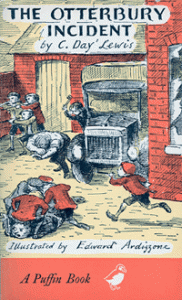 (the original Ardizzone illustrations are all inside though and here are some more). My dad read it to me when I was 8 (it was published when he was 8) and I loved it so much that I reread it several times, the last well into my teens. But, who knows, perhaps the magical world of bomb sites, spivs, boys brutalized by their guardians, and one kindly teacher, would no longer have any hold on me, let alone her.
Some years ago a considerably younger friend tried to explain the (to me, and, I’m glad to say, to CB, elusive) appeal of Friends: “Look, its seeing people having the kind of life you’d like yourself — a group of nice, attractive friends, witty, never really stressed, who care for each other and seem to enjoy their relationships. Its like you and The News Quiz: you wish that you were surrounded by a bunch of unattractive middle-aged people who still belong in the world as it was before the Miners’ Strike was lost, and make old-people jokes. You’d like that life, with an old Tory who doesn’t fit in (AC was still alive), the odd young person to make you glad you’re not young, and a occasional cricket-loving Trotskyist ex-punk to make you feel like you belong” (actually, I made up the bit in italics). The analysis was plausible enough that I refrained from pointing out the disanalogies — like that the News Quiz team is composed of real people, who are genuinely witty, genuinely friends, and do it all for a transport allowance and the price of the cup of tea and the slice of genoa cake I’ve no doubt they have on the train. I also refrained from pointing out that its a good job we’ve known each other since she was 8, or I’d be unnerved by her insight into my character.
Anyway I was reminded of this by hearing The News Quiz, which was bloody brilliant this week. I was thrilled that Shappi Khorsandi was on because, contrary to my friend’s comment, I like young people (though I am glad I’m not one) and Khorsandi seems like a rising star; but right at the beginning the cricket-loving Trotskyist ex-punk stole the show. Listen here.
Joe (a prospective teacher in an certification program) teasingly asks what is on my list of books about education that everyone should read. More useful, perhaps, would be my list of books that every teacher/prospective teacher should read. So, here’s the first in an occasional series of Brighouse recommendations. This is not strictly one that every teacher should read, but certainly every American non-rural public school teacher, and I’d guess most private school teachers too. I had long heard of The Shopping Mall High School: Winners and Losers in the Educational Marketplace
Various forces seem to have converged from different directions to force me to learn something about school improvement, and I, conveniently, have very easy access both to one of the experts and to a practitioner involved in improvement at a particular school. Here are some initial thoughts which may be too obvious for you to bother with. Comments on what I need to learn and how are more than welcome.